Oh, I see! moments
Travel Cultures Language

Creativity’s Corner: Where Art Meets Wordplay

by Sheron Long on April 17, 2014

Creative painting and word play by John Langdon showing the word "ME" set against the sky and the word "YOU" formed by the spaces inside the letters M and E. (Image © John Langdon)

“US”
© John Langdon

Look . . . and Look Again at John Langdon’s Illusions and Ambigrams

In life (and at OIC), you often get the invitation to consider new perspectives, to see things from different points of view. Today’s invitation is to a place where the visual and the verbal play together in the work of John Langdon. And the souvenir you take home is a hidden, often deeper meaning.

Let the games begin: How does the painting above fit its title, “US”?

Wordplay: The Power of One Little Letter

by Sheron Long on April 3, 2014

Reinvented book cover for Dan Brown's The Da Vinci Code with new cover art showing a codfish and the title shortened to The Da Vinci Code, illustrating an example of wordplay for word lovers. (Image with thanks to @darth)

Dropping a letter changes a best-seller with a sophisticated “code”
into a new plot starring a slimy “cod.”
(image thanks to @darth)

Clever Words for Clever Word Lovers

What’s so attractive about words such that some people become logophiles (yep, that’s the official term for “word lovers”)?

  • Perhaps it’s the puzzle of wordplay games like Scrabble where an aha moment lights up the brain when you figure out how to use all seven letters.
  • Maybe it’s the social aspect of games like Words with Friends, when folks who choose a random opponent meet through the chat feature. Some even marry, putting two important words together: I do.
  • But for many word lovers, it’s simply the thrill of the challenge.  There’s power there, too, for people like @darth, whose creative reinvention of book covers (above) just might change the course of literary history.

Oh I see. One little letter makes a mighty big difference. It could be for the better; it could be for the worse.

Newlyweds kissing and wordplay below showing the change from "Yours" to "Ours" by deleting one letter in a game that fascinates word lovers. (image © Malsveta/iStock)

A marriage promise is for better or worse.
Which is it when just one letter moves things from “yours” to “ours”?
© Malsveta/iStock

The Oxford English Dictionary defines 750,000 words in the English language. Because languages are always changing and words have many different forms, Merriam-Webster reports that the number might go as high as one million. Either way, the English language is a big playground.

Warming Up

Myself a logophile and ready to play, I first improved some book titles in my kitchen:

—A favorite cookbook went from The Joy of Cooking to The Joy of Cooing. After all, isn’t that what romantic dinner conversation is all about?

—Losing an r from Elizabeth Gilbert’s best-seller, Eat, Pay, Love was next. Adding a T to Julia Child’s opus, Mastering the Tart of French Cooking led me to a good dessert.

Feeling my oats now, I turned my place into my palace and a sure-fire way to get a “yes” whenever I send invites to a bite of dinner.

A dilapidated house, labeled "My Place" next to an opulent house labeled "My Palace," illustrating a wordplay game for word lovers. (image ©AbleStock.com and ©pabkov/iStock)

Tiny change, big difference if you’re having a banquet
©AbleStock.com (L) and ©pabkov/iStock (R)

Imagination Kicks In

Just as books in the Harry Potter series suspend reality, so it is with wordplay and the title for the new underwater series: Harry Otter. Stealing an F leads to more fun and fantasizing about the plots in Animal Arm and Lie of Pi.

So it goes—whenever I play with words, my imagination runs wild. I start to picture scenes like these:

—An eerie atmosphere changes to an eerie catmosphere with eyes aglow and fur that turns to fury.

Cat eyes glowing in the dark, illustrating wordplay of changing an "atmospheric condition" to "catmospheric condition," a game enjoyed by word lovers. (Image © Eric Gevaert / Hemera)

The catmospheric condition of the universe
© Eric Gevaert / Hemera

—On stage at the Lincoln Center, a ballerina in a spotted leotard becomes a leopard stalking prey.

—In a low-lit Nairobi night club, a mean ole mamba does the mambo.

—At a soiree aboard the haunted Queen Mary, an almost ghost turns out to be the host.

—In a close encounter of another kind, a Purple Martin house transforms into a purple Martian house.

More for the History Books

Wordplay has a long, illustrious history.

  • Anagrams, in which the letters of a word like listen are rearranged into a new word like silent, became popular in Europe in the Middle Ages and may even date to the ancient Greeks.
  • By the 17th Century, Louis XIII appointed a royal anagrammatist whose job it was to entertain the court by creating anagrams of people’s names.
  • The venerable crossword puzzle, birthed by Arthur Wynne for the New York World, celebrated its 100th birthday on December 21, 2013. It has given millions of logophiles a century worth of fun.

It’s no wonder then that word lovers and wordplay are still going strong today, sometimes in a mash-up of modern days and history. To wit: When a dog friend of mine snatched an entire bag of chips, it brought to mind the Greek beauty Helen of Troy. Why?

Hers was the face that launched a thousand ships sparking the battle of Troy. His was the face that lunched a thousand chips barking at the dare of his ploy.

Face of a springer spaniel against a background of potato chips, illustrating wordplay when "the face that launched a thousand ships" turns into "the face that lunched a thousand chips" enjoyed by word lovers. (Image © Son GalleryTM / iStock)

Helen of Troy and this good boy have a lot in common!
© Son GalleryTM / iStock

What fun! And you, too, can play. Enjoy good times and many “Oh, I see” moments inventing new titles for 20 famous books. Download the list and start playing, but—remember—you can change only one little letter.


Book titles VIA Pleated Jeans with input from reader comments and tweets to #bookswithalettermissing.

Find all kinds of creative word games at Merriam-Webster

Scrabble, invented during the Great Depression, is now owned by Hasbro. Words with Friends, developed in 2008 by Paul and David Bettner, is now owned by Zynga.

Comment on this post below, or inspire insight with your own OIC Moment here.

Same Animal + Different Cultures = Surprise!

by Bruce Goldstone on March 13, 2014

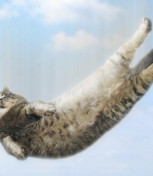
Falling cat, illustrating animal sayings that vary in different cultures and languages. (Image © deshy / iStock)

“If this is Life #7, I sure hope I’m an English-speaking cat!”
© deshy / iStock

Animal Symbols and Sayings

All over the world, cats are known for their seemingly magical ability to escape dangers that would be fatal to other, less feline species.  But different cultures and languages vary in how they talk about kitty’s special talents.

English speakers describe their death-defying trickiness by saying cats have nine lives. Consider 9Lives cat food, and its spokescat Morris, who vouch for the statistic.

Cats have the same reputation in Spanish, but in that language, they get only 7 lives. Are cats in Spanish-speaking cultures really less resilient than those where English is spoken? No, cats are cats, but the animal symbols and sayings across cultures may be quite different.

When you cross cultures, it’s a good idea to understand the differences so you don’t make a monkey out of yourself. Here’s some help with other critters in the animal kingdom.

Who’s Wise?

In ancient Greece, the wise goddess Athena was often depicted with or represented by an owl. That literary tradition plus the stately stare of the owl made this bird a symbol for wisdom in most Western cultures.

Wise-looking owl, representing wisdom, an animal symbol that varies in different cultures and languages. (Image © lingkuo / iStock)

Owl = Wisdom, right?
© lingkuo / iStock

But not everyone thinks owls are all that clever. In India, the owl’s stare is considered dopey rather than penetrating, leading to its reputation as a dim-wit. In fact, the Hindi word for owl— oolu—can also mean dolt, idiot, or fool.

Dopey-looking owl, reflecting an animal symbol that varies in different cultures and languages. (© Catherine Philip/iStock)

Maybe owls aren’t super smart after all.
© Catherine Philip/iStock

And in the Netherlands, owls are a symbol of being stubborn, uncooperative, and inflexible. There’s a Dutch saying that goes Wat baten kaars en bril, als den uil niet zienen wil? (What difference do light and glasses make, if the owl doesn’t want to see?)

Interpreting the Turtle

For many English speakers, turtles are symbols of slowness, persistence, and determination.

Turtle moving slowly, reflecting an animal symbol that varies in different cultures and languages. (© nwhaa / iStock)

Turtles always mean slow and steady, don’t they?
© nwhaa / iStock

But in, Thailand, turtles are associated with something very different. Watch this ad and see if you can figure out why it makes sense.

If the video does not display, watch it here.

Yep—that’s an ad for deodorant because turtle in Thai is slang for body odor.

Monkey Business

In some Western countries, monkeys are playful tricksters. English speakers talk about monkeying around, monkey business, and more fun than a barrel of monkeys.

What do you talk about when you talk about monkeys? © Hung_Chung_Chih/iStock

What do you talk about when
you talk about monkeys?
© Hung_Chung_Chih/iStock

But other cultures perceive the monkey in a far different way. In Portuguese, monkeys carry an element of sudden surprise. To express astonishment, a Brazilian might say Macacos me mordam! (Monkeys bite me!) It’s like saying “Well, I’ll be damned!” Or, if you ever watched the old Batman TV series, think of Robin’s ever-changing catchphrase of surprise, “Holy [fill-in-the-blank], Batman!”

Regal monkeys, reflecting an animal symbol that varies in different cultures and languages. (© fatchoi / iStock)

Monkeys with a regal air
© fatchoi / iStock

In China, however, monkeys aren’t silly or surprising. They’re clever and noble. At one time, the Chinese title marquis and the word for monkey had the same pronunciation: “hou.” So, in China, the monkey is associated with dignity, social position, and intelligence.

Silken Sayings

Some cultures express the same advice or wisdom in an animal saying, but the animals are different. For example, in English, there’s this saying: You can’t make a silk purse out of a sow’s ear.

A pig's ear, reflecting animal sayings that vary in different cultures and languages. (Image © Morgan David de Lossy / iStock)

Once a pig’s ear, always a pig’s ear.
© Morgan David de Lossy / iStock

In Spanish, a saying about monkeys is pretty much the same: Aunque la mona se vista de seda, mona se queda.  (A monkey that dresses in silk is still a monkey).

A baboon in a scarf, reflecting animal sayings that vary in different cultures and languages. (© fuse / Thinkstock)

Don’t you think a silk purse
would make this outfit complete?
© fuse / Thinkstock

Animal Anticipation

In English, to caution against making plans for something good until it really happens, people say: Don’t count your chickens before they hatch.

Chick and eggs, reflecting animal sayings that vary in different cultures and languages. (© gpointstudio / iStock)

Don’t count on your friends just yet, little fellow.
© gpointstudio / iStock

In Russia, people express pretty much the same sentiment: не дели шкуру неубитого медведя. (Don’t sell the pelt before the bear’s been shot.) Similar sayings show up in French-Canadian, Danish, Swedish, and Polish.

Brown bear, illustrating animal sayings that vary in different cultures and languages. (© dgwildlife / iStock)

Hey, I’m using this bearskin!
© dgwildlife / iStock

You Don’t Have to Be Real to Play

Different cultures even have different views of imaginary animals. In Western countries, dragons are usually fierce fire-breathing monsters that ravage villages and torment princesses. Something worthy of slaying. But in China and many Asian countries, they’re considered very good luck. Something worthy of celebrating in joyful dances.

Boy hugging Chinese dragon, reflecting an animal symbol that varies in different cultures and languages. (© Digital Vision / Photodisc)

Does this dragon look scary to you?
© Digital Vision / Photodisc

Oh, I seeManners, taboos, and animals, too, are all part of understanding different cultures and languages.  The symbols and sayings that may seem universal are often not. You might think about that the next time the cat’s got your tongue—because in Spanish, they’d blame your silence on mice: ¿El ratón te comió la lengua? (The mouse ate your tongue?)

♦♦♦

For more cross-cultural insights that will make you culture-smart, see “How Much Power’s in a Flower?” and “The Musical Scale Across Cultures.” To get a language fact a day, connect with @languagebandit

Video of the Thai deodorant commercial VIA The Zealous Water Buffalo.

Comment on this post below.


Copyright © 2011-2025 OIC Books   |   All Rights Reserved   |   Privacy Policy