Oh, I see! moments
Travel Cultures Language

Rendezvous à la Turk

by Joyce McGreevy on August 27, 2018

A young Turkish American girl celebrates her heritage at the Turkish Arts and Culture Festival in Monterey, California. (Image © Joyce McGreevy)

Derya Bolgün, age 10, welcomes you to the Turkish Arts and Culture Festival
in Monterey, California. 
© Joyce McGreevy

A Cultural Festival Calls Forth Memories

You won’t need sugar in your fincan kahve (cup of coffee) this morning. Şekerpare, a delicate cookie made with semolina, almonds, and love, delivers the sweetness. So, inhale the rich aroma and galvanize your senses with robust brew.  If you closed your eyes, you could be in Istanbul.

But you’re at a Turkish cultural festival in Monterey, California.

Pastries like Sekerpare and irmik helvasa connect Turkish Arts and Culture Festival in Monterey, California to the author’s memories of Istanbul. (Images © Joyce McGreevy/ Ceren Abi)

Is baklava Turkish or Greek? Depends on whom you ask. Şekerpare (center) and irmik helvasa (right)
reflect culinary traditions of Turkey’s Ottoman Empire.
© Joyce McGreevy (L)/ Ceren Abi (R)

Re(sound)

Oh, I see: At cultural festivals, details evoke worlds.  At Monterey’s Custom House Plaza, the percussive rhythm of the davul and the string-song of a bağalama become a soundtrack for Turkish memories.

Young women at the Turkish Arts and Culture Festival in Monterey, California reflect the exuberance of Turkish line dancing and inspire memories of Istanbul. (Image © Joyce McGreevy)

Young women in Monterey, California reflect the exuberance of Turkish line dancing. 
© Joyce McGreevy

Every note I hear is layered with sounds remembered:

The singsong pitch of street vendors and the sonorous calls-to-prayer of the muezzin; the miyav (meow) of sociable kediler (cats); the sparkling humor and plaintive beseeching of TV soap operas; the clatter of plates and clink of glasses at a meyhane; the buzz and bump of motorbikes on cobbled alleys; the banter of fishermen at the Galata Bridge amid the commentary of seagulls.

As if on cue, a colony of seagulls above Monterey Bay choruses raucously, bringing my senses back to California.

Re(scene)

At a cultural festival a single image can reassemble memory’s mosaic. I spot a display of nazar boncuğu, blue glass eye beads. Traditionally, these talismans warded off misfortune’s “evil eye” by staring boldly back, commanding misery to come no closer. In reality, Turks collect them mostly for their beauty and to give as gifts.

A display case of nazar boncuğu, blue glass eye beads, connect a Turkish Arts and Culture Festival in Monterey, California with the author’s memories of Istanbul. (Image © Joyce McGreevy)

The eyes have it: Shown here in Monterey, nazar boncuğu are everywhere in Turkey. 
© Joyce McGreevy

Seen in Monterey, the blue beads trigger a montage of memories: The blue-tiled Rüstem Paşa Mosque, bluer even than Istanbul’s more famous Blue Mosque. The azure blue of summer sky as you ferry across the steel blue Bosporus from Istanbul’s European side to its Asian side. The intense dark blue of lapis lazuli in a jeweler’s window. The shimmering blue of peacocks in a palace garden. Blue-black figs at an open-air market.

Re(word)

One 15th-century word encapsulates the entire spectrum of blues that first dazzled travelers in Turkey. The French pronounced it tur-KWAZ.

Yes, turquoise, or literally, “Turkish.” Today, we reserve that word for the bluish-green stone mined in arid regions of Turkey, America’s Southwest, and elsewhere. “Phosphate of copper and aluminum” lacks a certain poetry.

A collage of scenes in Istanbul and Bodrum reflects the prevalence of the color blue in Turkish arts and culture. (Image © Joyce McGreevy)

The color blue is prevalent throughout Turkey.
© Joyce McGreevy

A Thirst for Memories

Turkish wines are superb, but it’s too early to sample them. And other beverages offer their own complexities. A glass of gold is made using two stacked kettles, the lower kettle to boil the water, the top to warm the loose-leaf çay, or tea. Tulip-shaped glasses are essential.

A glass of Turkish tea at a cultural festival in Monterey, California inspires memories of Istanbul, Turkey. (Image © Joyce McGreevy)

Serve Turkish tea in glasses to assess its strength and admire its color.
© Joyce McGreevy

Now let’s order lunch and ayran (EYE-rahn), a salty, ice-cold yogurt drink. It’s an acquired taste, but a refreshing one, too. The savory, restorative counterpart to the American milkshake.

Two men cook Turkish food, one at a cultural festival in Monterey, California and one in Istanbul. (Image © Joyce McGreevy)

In tiny pop-up kitchens, two chefs—one in Monterey, one in Istanbul—satisfy hungry crowds.
© Joyce McGreevy

Ne yemek istersin? “What would you like to eat?” Turkish cuisine goes way beyond doner kebap. It reflects two continents, a host of regional, seasonal variations, and the experiences of 2,000 centuries. From palatial restoranları to rickety stands  on street corners, Turkish kitchens produce some of the world’s most splendid fare.

uyers, sellers, and Turkish ceramics at at a cultural festival in Monterey, California form a colorful collage of Istanbul street scenes. (Image © Joyce McGreevy)

Colorful Turkish ceramics in Monterey (upper left) recall a feast of colors in Istanbul.
© Joyce McGreevy

The Taste of Memories

Turkish breakfast is a lavish affair, a beautifully constructed spread of the finest regional cheeses, cured olives, egg dishes, rose jam, and more. But nothing inspires morning rapture quite like simit. It is to Turkey what the croissant is to Paris—deceptively simple and simply superb.

To find simit in Turkey, just look for the man wheeling a red trolley or balancing a tray stacked ten tiers high. In the U.S., simit is increasingly available at Mediterranean delis and bakeries, including Monterey’s International Market.

Served fresh and warm, simit are downright inspiring. They have even inspired the noun can simidi (jahn SIH-mihd-ee)—the name for the ring-shaped life preservers on Turkish ferries.

Simit at a cultural festival in Monterey, California inspires memories of Istanbul, Turkey. (Image © Ceren Abi)

The perfect Turkish breakfast begins with simit, a circular bread encrusted with sesame seeds.
© Ceren Abi

Turkish Memory Lane

By now even a passing California car inspires Turkish reverie: While driving from Istanbul to Bodrum, my Turkish relatives and I stop at the town of Ortaklar. Ortaklar’s main street is lined with carwashes, but each represents only half of a family-owned business. I discover the other half when we pull into Necati’nin Yeri.

While the car is seen to, we join festive diners at long tables under shade trees and canopies. Dish after exquisite dish arrives, and a young man slides flat rounds of dough into an outdoor oven, where they puff up like balloons. This is lavas (lah-VAHSH), so irresistible it’s a wonder the customers don’t puff up like balloons, too.

Recalling this feast,  I momentarily conflate thoroughly Turkish fare and American thoroughfares. Oh right, I’m in Monterey, California, not Ortaklar. But everything is redolent with the sweet confusion of memories.

Two street scenes, one during a cultural festival in Monterey, one in Istanbul, celebrate Turkish culture. (Image © Joyce McGreevy)

On a day in August, families stroll in Monterey and Istanbul. Can you tell which is which?
© Joyce McGreevy

The Taste of Turkish Words

I savor, too, the taste of Turkish words. A cultural festival offers the chance to practice. The Turkish language is considered fiendishly difficult to learn, but I disagree. Difficult to master, sure, but that’s true of any language. The spelling of modern Turkish is largely phonetic, so once you recognize differences in the alphabet and get the hang of certain sounds, you might be surprised at how quickly you catch on.

It begins with Merhaba (MEHR-hah-bah). Hello!

Fisherman’s Wharf Monterey inspires a visitor to a nearby Turkish cultural festival ito recall a similar scene at the Bosporus in Istanbul. (Image © Joyce McGreevy)

Left to right: On Monterey Bay and Istanbul’s Bosporus, friendly people go with the flow. 
© Joyce McGreevy

Learning to say hello, surely that’s the takeaway of cultural festivals.  Hello to the connections between here and there, past and present, you and me.  Merhaba to families strolling along the Bosporus and families strolling along Monterey Bay. Hello, Merhaba, and Welcome to whatever connects us all.

Thank you to Ceren Abi for contributing to this article. Seni seviyorum, Ceren!

See more of the Monterey Turkish Arts and Culture Festival here.

Comment on this post below, or inspire insight with your own OIC Moment here.

Walking New Zealand

by Joyce McGreevy on May 29, 2018

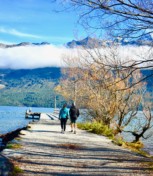
Glenorchy Pier, the gateway to many spectacular hiking trails, is a treat for visitors who are walking New Zealand. (Image © Joyce McGreevy)

Glenorchy in New Zealand’s South Island is a gateway to many spectacular hiking trails. 
© Joyce McGreevy

The Wordplay of Pathways

Everyday English reflects the wordplay of pathways. We speak of “getting off track,” or taking “the path of least resistance.” We express disappointment as being “led up the primrose path.” We tell new friends, “I’m glad our paths crossed.” For me, however, while walking New Zealand, I learned an entire new vocabulary.

Glenorchy’s wooden pathway leads into the wetlands and is a treat for visitors who are walking New Zealand. (Image © Joyce McGreevy)

Glenorchy’s boardwalk takes birdwatchers into the wetlands. 
© Joyce McGreevy

In New Zealand, a walker’s paradise, pathways crisscross language and the land like skeins of light.  Ancestors of the Maori walked the entirety of the country naming landforms and waterways. Today, walking is the Kiwi way, from short local bush walks to the 1,900-mile Te Araroa (“Long Pathway”).

Kiwis Walk the Talk

Here, walking is no mere footnote. Surveys show that for New Zealanders of every age and ethnicity, walking is the most popular recreation—by a mile kilometers.

Walking pathways around Waiheke Island’s beach and bush are a treat for visitors who are walking New Zealand. (Image © Joyce McGreevy)

Waiheke Island offers serene walks through bush and beach. 
© Joyce McGreevy

The origin of the word path is itself a kind of path. It begins, as many pathways do, with clear signposting: “Take Old English back to Old Frisian, then hang a right at Middle Dutch and keep going until you reach Old High German.”

These early words for path evoke footsteps:  paþpæþ pat, pad, pfad. But the ultimate origin for path has disappeared into the forests of time.

A walking pathway in Mangawhero Forest Walk in Tongariro National Park is a treat for visitors who are walking New Zealand. (Image © Joyce McGreevy)

Mangawhero Forest Walk in Tongariro National Park meanders through
Rimu, Matai, and Kahikatea trees. 
© Joyce McGreevy

Step Right Up

Let’s go wandering through the present. From the mainlands of North Island and South Island to smaller islands like Waiheke, pathways beckon.

A short path says, “Come on in! Plenty of views, no waiting.”

Walking pathways in Devonport’s Victoria Hill are a treat for visitors who are walking New Zealand. (Image © Joyce McGreevy)

Devonport’s bucolic walks are just a 10-minute ferry ride from the city of Auckland. 
© Joyce McGreevy

A steep path says, “Not so fast. Good things happen in steps.”

Steep wooden steps along a walking pathway in Queenstown challenge visitors who are walking New Zealand. (Image © Joyce McGreevy)

Queenstown’s topography is truly on the up and up. 
© Joyce McGreevy

Urban pathways are keen to get you where you’re going. “Hurry along! Hurry along!”

Island pathways are more laidback. Sun warms them, breezes ruffle their grasses and your hair. They whisper, “Wherever you’re headed, here’s nice, too.”

Grassy path toward Waiheke's Te Motu Vineyard is a treat for visitors who are walking New Zealand. (Image © Joyce McGreevy)

Waiheke’s Te Motu Vineyard is a gentle 20-minute stroll from Onetangi Road. 
© Joyce McGreevy

Sometimes you meet the perfect companion, and if you’re lucky, you’ll walk the same path for a while. As people in New Zealand like to say, “Sweet as!” (Sweet as what, you ask? Just “sweet as.”)

A friendly Paradise duck takes a step along a path in Te Anau inspiring visitors who are walking New Zealand. (Image © Joyce McGreevy)

At Lake Te Anau in NZ’s Fiordland,  Paradise ducks and other birds tag along with hikers. 
© Joyce McGreevy

The “Ara” Variations

The word for path in Maori is ara, and New Zealand’s first people have many other names for pathways. There’s ararātā, the path of native Rata trees, and ararimu, if the trees are Rimu. Or you may come to two paths, ararua; a blocked path, arapuni; or the pathway’s end, arapito.

In New Zealand’s mountains or along its coasts, one may encounter the sacred path, or aratapu.

A stone plaque at Queenstown Hill inspires visitors who are walking New Zealand. (Image © Joyce McGreevy)

Queenstown Hill is known in Maori as Te Tapu-nui, “the mountain of intense sacredness.”
© Joyce McGreevy

Some paths possess deep patience. After a long solitude, they welcome a lone hiker with birdsong.

A walking pathway in the New Zealand bush invites visitors who are walking New Zealand to listen to the bird songs. (Image © Joyce McGreevy)

Put away the earphones. Even when you cannot see native birds, you’ll hear their songs
© Joyce McGreevy

Some paths begin gently and rapidly become challenging.  A Maori proverb says, “If you bow your head, let it be to a lofty mountain.”

Walking pathway in Queenstown Hill’s rugged terrain challenges visitors who are walking New Zealand. (Image © Joyce McGreevy)

Queenstown Hill is a steep, demanding, and ultimately rewarding hike of several hours.  
© Joyce McGreevy

“Basket of Dreams,” a public sculpture by Caroline Robinson’s graces a walking pathway and delights visitors who are walking New Zealand. (Image © Joyce McGreevy)

Persevere until you reach the “Basket of Dreams,” a sculpture by Caroline Robinson.
© Joyce McGreevy

Mindful Walking

A path can be metaphorical, even when it’s literal. What’s better than a long walk for sorting things out in one’s mind?

Wild mushrooms growing along a forest pathway on Queenstown Hill symbolizes mushrooming troubles that visitors who are walking New Zealand can consider and even resolve on mindful walks. (Image © Joyce McGreevy)

If troubles seem to mushroom . . .
© Joyce McGreevy

A tree stump by a walking pathway on Queenstown Hill symbolizes problems that may have visitors who are walking New Zealand stumped. (Image © Joyce McGreevy)

Or you’re totally stumped . . .
© Joyce McGreevy

Tree roots on Queenstown Hill symbolize how visitors who are mindfully walking New Zealand think through issues and get to the root of a problem. (Image © Joyce McGreevy)

. . .  a mindful walk in the woods can help reveal the roots of an issue.
© Joyce McGreevy

A tree branch on Queenstown Hill serves as a symbol to visitors who are walking New Zealand that they may be grasping for the wrong things. (Image © Joyce McGreevy)

A path may drop hints: “You’re grasping for the wrong things.”
© Joyce McGreevy

Other Pathways

The path along a mountain ridge is called arapae, a path for the brave. But not all pathways are on the land. The horizon is a path for the eye, the sky a path for imagination.

A view down Lake Wakatipu to The Remarkables mountain range in Queenstown Hill is a treat for visitors who are walking New Zealand. (Image © Joyce McGreevy)

Hikes in The Remarkables mountain range offer tranquil views of NZ’s longest lake, Wakatipu. 
© Joyce McGreevy

Shadows and the rays of rainbows form pathways, too. And then there is aramoana, the sea path.

A view of a vintage sailing ship seen from a walking pathway on Devonport’s Victoria Hill is a treat for visitors who are walking New Zealand. (Image © Joyce McGreevy)

The views from Victoria Hill above Devonport in NZ’s North Island are pure storybook. 
© Joyce McGreevy

What Pathways Do You Walk?

We’re all on some kind of path. We may choose it, stumble upon it, change it, or create a whole new path.

And oh, I see now, after the beauty of walking New Zealand, if we keep our eyes open, whatever path we’re on can become aratoro—the path of discovery.

In the wordplay of pathways, it happens one step at a time.

A view from a walking pathway toward Glenorchy Lagoon is a treat for visitors who are walking New Zealand. (Image © Joyce McGreevy)

A walk to Glenorchy Lagoon is the surest way to inspiration. 
© Joyce McGreevy

Special thanks to Cleone Blomfield and Annette Caswell for their insights and hospitality in Queenstown and Glenorchy. 

To explore New Zealand on foot, start here.

Comment on this post below.

The Lucky Language of Fortune Cookies

by Meredith Mullins on May 14, 2018

Man's hands opening fortune cookies, revealing proverbs and sayings that can change your life. (Image © Comstock/Stockbyte.)

What wisdom can a cookie bring?
© Comstock Images/Stockbyte

Can Cookie Proverbs and Sayings Change Your Life?

We are often drawn to a peek at the future, whether fueled by fact or fantasy, proverbs or sayings, instinct or reason.

We shake the Magic 8 Ball to answer our important YES/NO questions and get answers such as “Signs point to yes,” “Outlook not so good,” or the annoyingly evasive “Reply hazy. Try again later.” (Was this a forerunner to sassy Siri?)

We sit in silence between worlds with our Ouija board and call on the spirits to guide us. We have our palms read or consult our horoscopes.

Tarot cards, ouija board, and magic 8 ball, all ways to tell the future in addition to the proverbs and sayings of fortune cookies. (Image © DrawbyDar/iStock, Pablofdezr/iStock, Montego666/iStock.)

Many ways to glimpse the future
© iStock

We study the colorful tarot cards for a glimpse of meaning about the past, present, and future, with messages from The High Priestess, The Hermit, The Magician, or The Wheel of Fortune.

Perhaps the most common oracle in the U.S. comes in the form of a cookie—the fortune cookie that arrives at the end of a meal at American Chinese restaurants or with every order of Chinese takeout.

We crack open the folded cookie and pause for a moment, wondering how the words on that tiny piece of paper might have meaning in our life. Or are they just a nice way to end a Chinese meal?

fortune cookies filled with proverbs and sayings that could be life changing. (Image © jerkaejc/iStock.)

Is our personal fortune likely to find us?
© jerkaejc/iStock

The Words of Fortune

The tweet-like messages range from poetic to practical, from vague enough to be true for anyone to specifics that can seem eerily prophetic.

The language of the fortune cookie is intended to be universal—inspirational proverbs and sayings, thought-provoking riddles, humorous comments on contemporary culture, and translations of traditional Chinese philosophy.

Paper strip with one of the proverbs and sayings of fortune cookies, You Will Become Great If You Believe in Yourself. (Image © EKaterina79/iStock.)

Universal inspiration
© EKaterina79/iStock

The writing strategy at Wonton Food, the largest producer of fortune cookies in the U.S., sheds some light and provides some “Oh, I see” moments about the fine art of fortune writing.

The company ships nearly 5 million cookies a day to Chinese restaurants all over the U.S. They have a simple goal. They want people to finish their meal with a positive message.

Proverbs and Sayings about love appear in fortune cookies. (Image © Angela King-Jones/iStock.)

A philosophy for any culture
© Angela King-Jones/iStock

Donald Lau, the sole Wonton Food fortune writer for decades has passed the pen to a new writer. But his philosophy is still at the heart of the messages.

“When they eat their fortune cookie, I want the customers to open the fortune, read it, maybe laugh, and leave the restaurant happy,” Mr. Lau says, “So that they come back again next week.”

The company has experimented with more “cautious” messages—reflecting the ups and downs of real life— but feedback from customers sent them back to more positive messages.

Fortune cookies with "Your taxes are due" is not one of the proverbs and sayings one wants to get. (Image © Robeo/iStock.)

Who wants this real-life fortune?
© Robeo/iStock

Messages like “There may be a crisis looming—be ready for it,” “Your luck is just not there— attend to practical matters today,” and “It’s over your head now. Time to get some professional help” were a bit of a downer.

The company also retired the iconic “You will meet a tall, dark stranger” as it sounded a bit too ominous.

Now, the fortunes are more philosophical than predictive. Some messages include a Chinese language lesson (an easy way to expand your Chinese vocabulary), as well as a string of lucky numbers.

Fortune cookies with proverbs and sayings like "Don't just think, act." (Image © Nicolesy/iStock.)

Motivational guidance
© Nicolesy/iStock

The lucky number sequence can be used in many ways—most often for lotteries or gambling investments.

Wonton Food still remembers providing winning Powerball numbers in one random fortune number sequence in 2005. The 110 winners who shared $19 million in prize money had all heeded the lucky numbers of their Wonton Food fortunes. They will long remember that happy ending to a Chinese meal.

Fortune cookie with money inside, a new version of proverbs and sayings for fortune cookies. (Image © Photodisc.)

Sometimes we wish for this kind of good fortune.
© Photodisc

Fortune Cookie History

The origins of the fortune cookie are murky. Some say the original idea came from China during the Ming Dynasty, when warriors delivered secret strategies inside tea cakes. Others trace the roots to Japan where rice cakes with fortunes inside (called tsujiura senbei) were sold near shrines.

Most everyone agrees that Chinese and Japanese immigrants to the U.S. in the early 1900s brought the idea to America and popularized the concept at Chinese restaurants.

One theory is that Makoto Hagiwara, with the San Francisco Japanese Tea Garden, created the cookies in 1907. Another theory gives credit to David Jung, who distributed the cookies from his noodle company in Los Angeles in 1916.

Fortune cookie with "I don't have the answer." as one of the proverbs and sayings. (Image © Robert Kacpura/iStock.)

Sometimes there is just no answer.
© Robert Kacpura/iStock

Whichever the origin, fortune cookies gained popularity in the U.S. after WW II and became a staple at Chinese restaurants throughout the country.

And, while you will occasionally spot fortune cookies in the U.K. and Europe, they are a decidedly American phenomenon . . . and, ironically, still rare in China.

Cute boy with row of fortune cookies, looking for the right fortune from all the proverbs and sayings. (Image © Yeko Photo Studio/iTunes.)

If at first you don’t succeed, keep searching for that perfect fortune.
© Yeko Photo Studio/iStock

Lasting Memories from One Smart Cookie

Most of us have had a fortune cookie saying that stays with us. Either we carry it in our wallet because it was so inspirational or we remember the cookie moment and the people with whom we shared the special fortune.

Here are some of my favorites:

  • The fortune you seek is in another cookie.
  • If you look back, you’ll soon be going that way.
  • Do not mistake temptation for opportunity.
  • If a turtle doesn’t have a shell, is it naked or homeless?
  • Don’t let statistics do a number on you.
  • You will be hungry again in one hour.
  • That wasn’t chicken.
  • Actions speak louder than fortune cookies.
  • Patience will find you this week. Wait for it.
  • Why not treat yourself to a good time instead of waiting for someone else to do it?
  • Ask not what your fortune cookie can do for you but what you can do for your fortune cookie.
  • Confucius say: If you think we’re going to sum up your whole life on this little bit of paper, you’re crazy.

Perhaps the best of all the proverbs and sayings is found in Iris Smyles’ New Yorker list of creative fortune cookie messages:

One day you will think to yourself, If only I could meet someone who understands me as well as this fortune cookie does.

Don’t worry. All signs point to YES.

Cracked fortune cookie with a message "Good luck" from all the proverbs and sayings in fortune cookies. (Image © Brand X Pictures/Stockbyte.)

Good luck!
© Brand X Pictures/Stockbyte

Thank you to the New York Times article by Jennifer 8. Lee, to the Time Magazine article by Olivia B. Waxman, and to the New Yorker article by Iris Smyles. For more information on the making of fortune cookies, visit the Wonton Food website.

Comment on this post below. 

Copyright © 2011-2025 OIC Books   |   All Rights Reserved   |   Privacy Policy