Oh, I see! moments
Travel Cultures Language

Cultural Heritage Below the Water Line

by Sheron Long on September 12, 2013

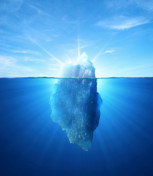
An iceberg above and below the water line, serving as a metaphor for the cultural iceberg in which the visible tip of surface culture belies the "deep culture" vastness hidden below the surface.

Culture is like an iceberg where the visible tip belies the vastness hidden below the surface.

What’s a Cultural Iceberg?

The culture or cultures you grow up in affect your deepest attitudes and beliefs, giving you your sense of what’s good or right, what feels comfortable, what behavior is acceptable, and conversely what’s not. What other people see may be only those things “on the surface”—for example, the way you talk or act, what you eat and how you dress.

That’s why culture is often represented as an iceberg. Ten percent is the “surface culture” that shows above the water line and 90%, known as “deep culture, ” is hidden below.

The Cultural Iceberg, showing aspects of surface culture and deep culture that stem from your cultural heritage. (Image © OIC Books)

The attitudes and beliefs in deep culture affect what shows on the surface.
© OIC Books

The hidden part of the iceberg influences everything you do and yet you may not even realize it. Ask yourself, for example, “Does it feel right when things come in threes or fours?

The Rule of 3

If you are from western cultures, the threes probably have it:

  • You get three wishes.
  • The third time’s the charm.
  • Speeches are written to make three points.
  • Favorite characters in fairy tales and songs come in threes—the three little pigs, the three blind mice.
  • Races start with “Get ready. Get set. Go!” Slogans are more memorable to westerners when they’re in threes: “Snap! Crackle! Pop!”

The Significance of 4

To native peoples of the Americas, however, the natural world matters most. There is sacred significance in the Four Directions—North, South, East, and West, and the number four is culturally ingrained:

  • The medicine wheel used for health and healing is divided into the Four Directions.
  • Things come in fours, such as the elements of nature (fire, air, water, earth) or aspects of life (spiritual, emotional, intellectual, physical).
  • Many native legends and creation myths, passed from generation to generation, tell of four brothers or four winds or four ancestors.
  • In ceremonies, the number four and its multiples figure prominently. For example, historical records and accounts show that, in the initiation ceremony of the Chipeway magicians, candidates entered a lodge of four poles where four stones lay before the fire. They stayed there for four days and participated in four feasts.

Comfort based on certain numbers is just one of countless ways that cultural heritage influences your approach to daily life.

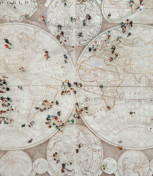
Globes showing different cultures with diverse cultural heritage

Look into the “deep culture” part of the cultural iceberg above and find some attitudes and beliefs you hold. How do these aspects of your cultural heritage affect what you do “on the surface”? For example:

  • Consider your concept of time and how it affects when you arrive at appointments and events.
  • How prompt do you feel you have to be to be considered on time?
  • Would people from other cultures agree?

Try a few more examples. Did anything make you say, “Oh, I see”?

Comment on this post below.

Image © iStockphoto

A Cultural Encounter with Mexico’s Calacas

by Janine Boylan on November 26, 2012

Oaxacan artist Carlomagno Pedro Martinez, whose calacas (skeleton sculptures) provide a cultural encounter

Sculptor Carlomagno Pedro Martinez adding texture to a skeleton’s shawl
© Janine Boylan

Symbols Abound in Skeleton Sculptures of Oaxacan Artist

Sculptor Carlomagno Pedro Martinez leans over the wooden table and meticulously adds texture to the wailing skeleton’s shawl. Loose bones, skulls, and other skeletons are scattered on the table around him.

At a cultural exhibit of Oaxacan artists in the Bowers Museum (Santa Ana, California),  Martinez,  the featured sculptor,  is working with the unique black clay he brought from his hometown near Coyotepec in Mexico.

Once Martinez’s figures dry, he polishes details with a quartz stone and then, using a centuries-old technique, kiln-fires his creations to obsidian black with gleaming metallic-like designs.

Martinez began working with clay when he was just four years old. His artistic parents taught his siblings and him the craft. Over time he developed his own style, inspired by traditional Mexican symbols and legends.

This was not my first cultural encounter with calacas, Mexican symbols of the dead. I knew that in Mexico, death is not negative or frightening. Figures like these typically are meant to be a joyous way to honor ancestors.

Observing the Sculptures

Martinez’s sculptures appear to be simple representations of everyday life.

One of Martinez’s pieces shows five animated skeletons on a bench. They are enamored with a frolicking dog and his bones.  Martinez had carefully textured each shawl, curved each hand into a meaningful pose, and added precise expressions to each face.

Five abuelas, dog, and bone sculpture, providing a cultural encounter with Mexico's calacas (skeleton sculptures) by Oaxacan artist

Five figures, dog, and bone sculpture by Carlomagno Pedro Martinez
© Janine Boylan

In another sculpture, a skeleton lies on its stomach (or, more precisely, rib cage), joyfully studying a book. A wise owl perches at the skeleton’s eye level. They appear to be engaged in an intent discussion about what they’re reading.

Skeleton and owl sculpture, providing a cultural encounter with Mexico's calacas (skeleton sculptures) by Oaxacan artist

Skeleton and owl sculpture by Carlomagno Pedro Martinez
© Janine Boylan

Nearby is a parade: a bone, a skull, a dog, and a cross-legged skeleton. A large mask necklace hangs around the skeleton’s neck. The dog is joyfully wagging its tail.

Skeleton and dog sculpture, providing a cultural encounter with Mexico's calacas (skeleton sculptures) by Oaxacan artist

Bone, skull, dog, and skeleton sculpture by Carlomagno Pedro Martinez
© Janine Boylan

An ornate turkey hovers on a shelf over the skeletons. It seems a bit out of place, but this time of year, turkeys are still in season, right?

Turkey sculpture, providing a cultural encounter with Mexico's calacas (skeleton sculptures) by Oaxacan artist

Turkey sculpture by Carlomagno Pedro Martinez
© Janine Boylan

Digging Deeper into Mexican Symbols

Being curious, I asked Martinez about the turkey.

When a turkey fluffs its feathers, he explained, it is a symbol of day turning to night.

Oh! It had nothing to do with Thanksgiving. This Oh, I see moment prompted me to ask more questions: What about the owl?

There is a traditional Mexican saying, Cuando el tecolote canta, el indio muere (When the owl cries, the Indian dies.). The owl is a symbol of death, not wisdom.

And the five figures? The dog?

Martinez explained that each figure is an abuela (grandmother) and represents 100 years of Mexican history. The dog represents the political party, and the bone represents the policies and politics. It wasn’t a park scene, but a symbol of history and politics.

The mask necklace around the neck of the cross-legged skeleton?

That is life, hanging around the neck of an ancestor.

More Than Meets the Eye

Oh, I see! What I had brought to each of his sculptures was an appreciation of his talent in crafting them and a message based only on the surface of the cultural encounter. But when he explained the deeper symbolism of each one, I had a completely different response. Each piece was a novel of symbols that deserved a more careful read.

It was a clear reminder to me of how important it is to dig deeper and gain a wider understanding. Something that appears clear and simple may have a complex message. That’s a lesson I can apply daily!

As I was leaving, I passed by the table from a different direction.

Turns out there was even more to that turkey than I first saw. Another reminder to look at something from many angles!

Back of turkey sculpture, providing a cultural encounter with Mexico's calacas (skeleton sculptures) by Oaxacan artist

Back of turkey sculpture by Carlomagno Pedro Martinez
© Janine Boylan

Comment on this post below, or inspire insight with your own OIC Moment here.

Copyright © 2011-2025 OIC Books   |   All Rights Reserved   |   Privacy Policy