Oh, I see! moments
Travel Cultures Language

Idyllic, Yet Never Idle

by Joyce McGreevy on April 3, 2017

The Chora, the original capital of Serifos inspires wanderlust to visit this tiny Greek island in the Cyclades. (Image © Joyce McGreevy)

Parts of the original Chora, the hilltop capital of Serifos, date back to 3 BCE.
© Joyce McGreevy

When Wanderlust Leads to Serifos

I’m on Serifos—and the side effects are wonderful. What sounds like a lyrical Big-Pharma trade name is actually a tiny Greek island, part of the Cyclades southeast of mainland Greece. Wanderlust has led me here. Around 225 of Greece’s 6,000 islands are inhabited. Their populations quadruple with tourists every summer.

But I’m traveling in January to the bafflement of friends. Why Serifos? Why now? One high-powered chum tells me, “Wait till summer, go to Hydra, Mykonos, or Santorini. There’s a fantastic party scene and I’ll introduce you to a TON of contacts.”

And there’s your answer, folks. Because I don’t want to do “the scene,” exchange business cards over cocktails, sign up for “kick-ass Pilates classes,” have my aura read, my spine realigned, or my roots touched up.

I want to just be.

A boat in the harbor at Serifos symbolizes the author's wanderlust to visit this tiny Greek island in the Cyclades. (Image © Joyce McGreevy)

Serifos in winter: I saw more traffic in the water than on the road.
© Joyce McGreevy

“The Journey Is the Thing”—Homer’s Odyssey

A crewman on the ferry at Serifos makes work into art on a tiny Greek island in the Cyclades. (Image © Joyce McGreevy)

Ferryside Theatre?
© Joyce McGreevy

I make the five-hour journey by ferry from Piraeus, Athens’ main port, to the Cyclades with laptop in tow. The plan is to divide my time between meeting deadlines and exploring the 30-mile square island.

As the ferry nudges the shore, crewmen stride the descending ramp, nimbly riding its metal edge to the pier and tossing the ropes. Inky night and the Aegean Sea surround us. The darkness is deep, the stars spectacular.

Christos, my host, is there to greet me. His family has traveled from Thessaloniki to make ready what will be my home for the next month.

The house is newly built but traditionally designed, gleaming white with blue trim. Inside, stone walls have been sculpted into counters, shelves, and bedside tables.

On a rain-swept winter’s night, this is heaven. As I unpack, there’s a knock at the door: Athina, Christos’ mother, brings supper on a tray. It’s a good omen when the namesake of the Goddess of Wisdom visits.

A house on the tiny Greek island of Serifos in the Cyclades evokes both wanderlust and a sense of home. (Image © Joyce McGreevy)

In tiny Serifos, Christos’ Seaview Modern needs no address, its road no name.
Mail sent to “American lady who talks to cats” would have reached me.
© Joyce McGreevy

Mythology and the Everyday Epic

I settle into pleasant routine, dividing my day between work, walks, and classes. The classes are online: Greek history, language, mythology. According to myth, wing-footed Perseus washed up on Serifos as a baby locked in a wooden chest. Years later, the island’s king sent him on a suicide mission to slay the Medusa. But Perseus returned, using Medusa’s head to turn the king—and Serifos—into stone.

As I gaze up at the commanding heights of stone peaks, the presence of Perseus and other immortals seems completely plausible. In this setting, it’s thrilling to read Homer’s Odyssey, as the hero’s longing for home plays tug-of-war with wanderlust. I read, then head off on rambles of my own.

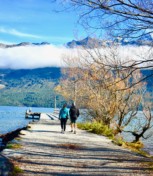
Hikers on a stone path in Serifos understand the wanderlust to visit this tiny Greek island in the Cyclades. (Image © Joyce McGreevy)

Springtime in Serifos: a walk with Athina and Aleka.
© Joyce McGreevy

Oh, I see: On an island, everyday moments become epic:

  • Skirting seasonal ponds by navigating through neighbors’ gardens, a delightful workaround
  • Savoring the only sound at night, the whispering of the sea
  • Witnessing the gradual approach of spring, like a ship on the horizon, as tender grasses and wildflowers re-emerge and trees become “birdful” again.
A garden on the tiny Greek island of Serifos in the Cyclades invites those with wanderlust to wander through. (Image © Joyce McGreevy)

On Serifos, a rain-blocked road is an opportunity, not an obstacle. 
© Joyce McGreevy

Low-tech in Paradise

When Homer’s Odyssey takes our hero to Scheria, he finds a magical land with self-steering ships and self-harvesting crops, yet women still do laundry by hand. On Serifos in the off-season, I have superfast wifi, but my washing machine is a bucket. When I ask a local what time the town’s laundromat opens, she replies Aprílios—“April.”

Christos offers to have someone do my laundry, but neither I nor my minimalist wardrobe warrant the fuss. Better to take a leaf from the Scherian women. Hanging laundry outside becomes my favorite ritual, a meditation on the elements—sea, sky, sun, and the mineral richness that speckles this green and rocky earth.

Laundry on a patio in Serifos, a tiny Greek island in the Cyclades, evokes the simple pleasures that come from wanderlust. (Image © Joyce McGreevy)

You won’t find this at a laundromat.
© Joyce McGreevy

No Stereotypes on Serifos

The winter population of Serifos hovers around 1,200, excluding small herds of friendly cats. The people are friendly, too, infinitely patient with my child’s-level Greek. I study every evening before bed, letting the words percolate into my dreams. As Homer’s Odyssey says, “There is a time for many words, there is also a time for sleep.”

A leaping cat in Serifos, a tiny Greek island in the Cyclades, shows that wanderlust isn't limited to humans. (Image © Joyce McGreevy)

The colors of sea & sky, sand & stone are everywhere on Serifos.
© Joyce McGreevy

Sigá-sigá (“step by step”), says Christina, a local shopkeeper. She, Athina, and others help me gather a living glossary from this small, rich universe—words for sky and clouds, wildflowers and windmills, honey and olive oil. At one taverna, the staff is fluent in English yet take the time to coach me in Greek. The syllables taste as satisfying in the mouth as the exquisite roast chickpea soup with garlic and oregano.

A bowl of revithia, or chickpeas soup, in the tiny Greek island of Serifos in the Cyclades, is one of the rewards of wanderlust. (Image © Joyce McGreevy)

Revithia sto fourno, a traditional Greek soup made with roasted
chickpeas, oregano, lemon, olive oil—and magic.
© Joyce McGreevy

If this were a movie, Hollywood would reinvent the locals as a Colorful Cast of Loveable Eccentrics. But quaint stereotypes don’t match the reality. People of Serifos travel the world, access 24-hour news, work at a range of professions. Among these thoughtful and serious-minded people, the only oddball I know of is myself.

A well-stocked shop in Serifos shows that even a tiny Greek island in the Cyclades, can satisfy any appetite, including wanderlust. (Image © Joyce McGreevy)

Think you can’t find gluten-free or other speciality foods in
the hilltop village of a tiny island? Guess again.
© Joyce McGreevy

McGreevy’s Odyssey

One night there’s true misadventure. Whatever gods I’ve inadvertently offended exact revenge on my laptop. Suddenly, I’m not so complacent. Up against deadline, I have two choices:

  • travel all the way back to Athens, hastily book a room, sort out the laptop, invest in a second one for backup (the cost of doing business while traveling full time), and meet that deadline with minutes to spare; or
  • curse my fate. As Homer’s Odyssey says, “These mortals are so quick to blame the gods.”

I opt for the journey.

“To Long for the Sight of Home”—Homer’s Odyssey

A ferry pulling into Serifos, a tiny Greek island in the Cyclades, symbolizes the tug-of-war between wanderlust and love of home. (Image © Joyce McGreevy)

Back in port.
© Joyce McGreevy

When I return to  the Cyclades, my sea legs are steady but my land legs not so much. Disembarking, I walk a few paces, then stumble. Immediately, arms reach out to lift me up. There are no strangers on Serifos, only neighbors.

Next morning, as I hang the laundry, the scent of wild rosemary and the thrum of hedgerow bees deliver a message to my senses—spring has landed! Soon it will be Kathari Deftera (“Clean Monday”), a day when children fly kites, bakeries offer unleavened lagana bread, and festivities mark the eve of Lent.

Lagana, a traditional bread found on many a tiny Greek island in the Cyclades, is tasty enough to inspire wanderlust. (Image © Joyce McGreevy)

Lagana bread: The name, which is also the origin of the
word lasagna, comes from a Greco-Roman pastry dough.
© Joyce McGreevy

Settling into work, I switch on the new laptop. The QWERTY keyboard includes a few Cyrillic letters. Since my software is set for American English, it makes no difference on a practical level, but on a heart level it means something that fills me with joy.

Then it hits me: wanderlust has led full circle. I feel at home on a tiny Greek island in the Cyclades. As Homer said, “Even a fool learns something once it hits him.” Dear Christos, I type, I’d like to stay on Serifos for another month.

A cat, Chora steps, and a weathered urn on Serifos, a tiny Greek island in the Cyclades, create the kind of tableau that inspires wanderlust. (Image © Joyce McGreevy)

Whether you’ve got nine lives or just one,
Serifos is a good place to be.
© Joyce McGreevy

Access superb online courses in Greek Mythology (University of Pennsylvania) here and
Ancient Greek History (Wesleyan University) here.

Comment on this post below, or inspire insight with your own OIC Moment here.

Different Cultures Share a Supermarket Dream

by Meredith Mullins on March 6, 2017

Man with shopping cart at La Louve, the new Paris food co-op that unites different cultures. (Image © Meredith Mullins.)

La Louve: A new Paris food co-op is born from a cross-cultural dream.
© Meredith Mullins

La Louve: A Paris Food Co-op Innovation

You wouldn’t expect a supermarket to grab newspaper headlines. But La Louve, a new food co-op in Paris, has been doing just that.

What makes it newsworthy? It’s the first cooperative supermarket in Paris—a social experiment where members are responsible for the direction and daily functioning of the enterprise.

It has the added unique quality of being modeled after an American food co-op and creatively sculpted to work in France. An intriguing blend of different cultures.

Child shopping at the Paris food co-op La Louve, showing a successful blend of different cultures. (Image © Meredith Mullins.)

A supermarket for all ages
© Meredith Mullins

Realizing a Dream

France is not new to the concept of cooperatives and is certainly not new to the advantages of blending the best of distinctive cultures.

There were some challenges, however, as Americans Tom Boothe and Brian Horihan dove into this adventure.

Both Tom and Brian were residents of France interested in quality food, the protection of the planet, and an alternative to a profit-oriented commercial approach to food shopping.

And both had experience with the successful Park Slope Co-op in Brooklyn, New York—an exemplary prototype for their dream.

Shelf of olive oils at the Paris food co-op La Louve, an experiment in blending different cultures. (Image © Meredith Mullins.)

Offering the best quality products at reduced prices
© Meredith Mullins

The mission was simple: to offer quality products at a reduced price and to be able to pay the producers a fair price for their products.

The question was how to fit this model into France—to work within existing laws, gain government support, and respect cultural preferences.

La Louve sign in the window, identifying the Paris food co-op and recognizing a merging of different cultures. (Image © Meredith Mullins.)

La Louve Supermarket in Test Phase
© Meredith Mullins

The She-Wolf Approach

 La Louve in French translates to she wolf. A strong alpha-female animal that protects and defends and does not stop until the work is done or the goal is reached. Family is paramount (as is survival of the pack).

The name seemed fitting as the seed of a dream for this experimental food co-op designed to build community around a common goal.

Tom and Brian met each challenge with cross-cultural intelligence. Six years of hard work and perseverance later, La Louve opened its doors.

Cashier line at the Paris food co-op La Louve, an experiment in the blending of different cultures. (Image © Meredith Mullins.)

Even in the Test Phase, La Louve is a busy place.
© Meredith Mullins

Values and Principles

 La Louve functions via two primary concepts. It is a not-for-profit association whose members, as in all co-ops, participate in the governing and functioning of the supermarket. Members vote, as co-owners, on decisions that need to be made.

In addition, as in the Park Slope Co-op model, each member dedicates time each month to work at the co-op.

Woman marks prices at the refrigerator in the Paris food co-op La Louve, an experiment in the blending of different cultures. (Image © Meredith Mullins.)

A La Louve co-op member marks product prices.
© Meredith Mullins

For La Louve, members work three hours every four weeks. This requirement proved more difficult to implement in France, since it is unusual for someone to be required to work for no pay, even a modest three hours every month.

The work tasks for the co-op members range from cashiering to receiving deliveries, stocking shelves, cleaning, and managing administrative duties.

Three people discuss wine at the Paris food co-op La Louve, an experiment in the blending of different cultures. (Image © Meredith Mullins.)

Co-founder Tom Boothe (also a wine expert) provides wine information to a co-op member.
© Meredith Mullins

As more members join the co-op, more jobs will be created. Since the Park Slope co-op was founded in 1973 and now has more than 16,000 working members, many different jobs exist there.

In addition to standard supermarket-type jobs, Park Slope members can accompany shoppers home or to the subway to help them with their packages; write for the LineWaiters gazette, a co-op newspaper to read while waiting in the cashier line; or wash the toys in the children’s center, since childcare is a service provided to shoppers or workers.

The member workforce provides a customer-oriented shopping experience, a spirit of community, and the low overhead needed to keep product prices at their lowest.

A man selects from the produce shelves at the Paris food co-op La Louve, an experiment in blending different cultures. (Image © Meredith Mullins.)

Organic produce from local producers
© Meredith Mullins

What’s on La Louve’s Shelves?

With brands such as Naturattiva, BioNaturae, Artisinale, and Naturata on the shelves, the underlying focus of the co-op is evident. Although there is not a requirement that products be organic (bio, in French), each offering is carefully selected to be the best and most healthful choice available.

The purchasing group (le groupment d’achats) invests time in researching each product. They conduct taste tests when needed to maintain their goal of quality—for example, sampling a variety of olive oils or chocolates or teas before deciding which to carry. (Put me on the wine team, please.)

Wine shelf at the Paris food co-op La Louve, an experiment in blending different cultures. (Image © Meredith Mullins.)

It’s France! An incredible selection of wines
© Meredith Mullins

They also strive to source products from local, planet-friendly producers who share the same values and ethical and environmentally sound work practices as the co-op.

The products are selected based on group decisions and will evolve according to the wishes of the co-op members.

Shelf of potato chips at the Paris food co-op La Louve, an experiment in blending different cultures. (Image © Meredith Mullins.)

Organic potato chips—pourquoi pas?
© Meredith Mullins

Do you want a snack while you’re watching that soccer match? Reach for organic chili- or sour-cream-flavored chips. Do you have a chocolate craving? Try a Chocolate and Love bar.

Shelf of chocolate bars at the Paris food co-op La Louve, an experiment in blending different cultures. (Image © Meredith Mullins.)

Chocolate and Love
© Meredith Mullins

Are you looking for warmth during a cold winter? How about the popular lambswool socks. Do you depend on fresh organic fruit and vegetables? Local producers will deliver what’s in season.

All of these choices can be found at 15–40% less than at the major supermarket chains.

The mayor of Paris, Anne Hidalgo, talks with the diverse members of La Louve, the Paris food co-op that recognizes different cultures. (Image © Meredith Mullins.)

The Mayor of Paris, Anne Hidalgo (orange scarf), and the Mayor of the 18th arrondissement, Eric Lejoindre (behind her to the left), visit with members of La Louve.
© Meredith Mullins

What’s in La Louve’s Heart?

The diversity of the co-op members creates a vibrant dynamic. Although the store has been open only four months and is still in its test phase, there are more than 4500 members (with 42% living in the 18th arrondissement where the store is located).

This neighborhood was chosen, with the support of the City of Paris and the Mayor of the 18th arrondissement, because of the heterogeneity of the population and the need for a place where quality food could be purchased for a reduced price.

Two people chat at the food co-op La Louve in Paris, showing a successful blend of different cultures. (Image © Meredith Mullins.)

A friendly environment for shopping (co-founder Brian Horihan center photo)
© Meredith Mullins

The project inspires a spirit of community. As one of the co-op members said, it’s great to see people really talking with one another in a supermarket. Another member mentions that she enjoys shopping with a smile. The camaraderie is a large part of the experience.

The project has also led to other new co-ops in France. Cities such as Lille, Bordeaux, Grenoble, Toulouse, Montpellier, and Marseille are following the same processes that La Louve implemented to reach a successful outcome.

Paris Mayor Anne Hidalgo talks with members of the Paris food co-op La Louve, an experiment in the blending of different cultures. (Image © Meredith Mullins.)

Mayor Hidalgo receives an honorary membership to La Louve.
© Meredith Mullins

The “Oh, I See” Moments

There are many “Oh, I see” moments in La Louve’s six-year road to reality. For me, as co-op member #6 (an early adopter), there was much to learn from the dedication of the original visionaries.

They were committed to their core values. Their hard work offered them little immediate reward other than the hope that the dream would someday become reality.

They rose to the challenges that molding an American food co-op concept into a French reality presented—different cultures uniting in a productive way.

And now, members reap the rewards of being able to shop with a smile.

Shopping cart at the Paris food co-op La Louve, an experiment in blending different cultures. (Image © Meredith Mullins.)

Vive La Louve
© Meredith Mullins

For more information, visit La Louve Food Co-op, Park Slope Food Co-op, Food Co-op, the film by Tom Boothe, and City of Paris.

Comment on this post below, or inspire insight with your own OIC Moment here.


Not Just Another Day at the Beach

by Meredith Mullins on February 13, 2017

An ocean view of the fishing village of M'Bour Senegal, offering travel adventures and a photographer's dream of images. (Image © Meredith Mullins.)

Life and livelihood from the sea in M’Bour, Senegal
© Meredith Mullins

A Photographer’s Dream: Cultural Encounter in Senegal

Travel adventures are triggered in many different ways. Journeys to exotic lands. Serendipitous celebrations. Unexpected challenges. New friendships with strangers. Losing yourself to the rhythms of wherever you are.

Boy and boat in M'Bour offering travel adventures and a photographer's dream with vivid Senegal life. (Image © Meredith Mullins.)

Falling in step with the local rhythms
© Meredith Mullins

This travel adventure is a cultural encounter centered on a memorable day at a Senegal beach. It all started with the washing of a horse. And, as I always say, “When you begin your day with a ceremonial horse washing, the promise of greatness is in the air.”

Senegal boys washing a horse, offering travel adventures and a photographer's dream in M'Bour, Senegal. (Image © Meredith Mullins.)

The washing of the horse: a perfect way to start a day of travel adventures
© Meredith Mullins

An M’Bour Adventure

I was relaxing on a café terrace in M’Bour, looking out toward the edge of the earth and shielding my eyes from the relentless tropical sun, when I spied said horse, knee deep in the Atlantic Ocean.

Like a celebrity equine, he stood proud and poised, with just the right touch of obedience and humility. A team of young Senegalese beach lovers surrounded him and splashed him with sea water. Apparently it was horse washing day.

I waded out and offered my help, with a traveler’s curiosity and a not-so-hidden motive of capturing the jubilant event in photographs.

Four boys washing a horse in M'Bour, Senegal, offering travel adventures and a photographer's dream in images. (Image © Meredith Mullins.)

Adding the finishing touches to the horse washing process
© Meredith Mullins

A Photography Philosophy Pause

I should pause here to say the Senegalese are a very proud and confident people. They show you exactly who they are—each with a direct and unselfconscious gaze that seems to come from deep within.

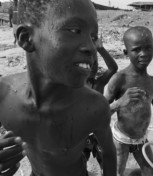
Three Senegalese boys (B&W) on the beach in M'Bour, Senegal, offering travel adventures and a photographer's dream in photos. (Image © Meredith Mullins.)

Showing themselves as they wish to be seen
© Meredith Mullins

They are also quite reticent to be photographed, for a number of very good reasons. They have suffered and have been taken advantage of—in history (slavery) and in contemporary life (tourists who click away with their cameras without respect for privacy or permission and without regard for the human heartbeat inside).

As a photographer of people, I have learned that an enduring and meaningful photograph comes from building a solid relationship with those you are photographing and by conveying a strong sense of place. In Senegal, this connection takes a sincere investment of time.

Meanwhile . . . Back to the Horse

I stayed with the horse washing crowd for a long time, as we played in the water and got to know one another. I learned the intricacies of sea water washing, as we made our horse as white and as bright as possible.

Senegal boy resting in the ocean in M'Bour, offering travel adventures and a photographer's dream in images. (Image © Meredith Mullins.)

Cooling off in the Atlantic
© Meredith Mullins

The kids became my muses and my friends, as well as an integral part of my photographs. They were simply themselves, and they allowed me to capture that essence.

Small boy on the beach in M'Bour, Senegal, offering travel adventures and a photographer's dream of Senegal portraits. (Image © Meredith Mullins.)

Meeting the essence of M’Bour on the beach
© Meredith Mullins

A Walk on the Beach

Several of the horse washing team then became my tour guides and accompanied me along the beach to every small community and encampment. I became a focus of attention. Everyone was interested in me . . . just as I was in them.

Crowds gathered. Children came running. Villagers waved in welcome.

And when I treated one village to candy from their shop, suddenly everyone was there. (A huge thank you to my guides for excellent crowd control.)

Villagers in M'Bour, Senegal reach for candy in the local shop. (Image © Meredith Mullins.)

A candy frenzy
© Meredith Mullins

As a result of this intense and real connection, I made more memorable photographs in a few hours than I have ever made in any other place.

Boy runs to the ocean in M'Bour, Senegal, offering travel adventures and a photographer's dream of images. (Image © Meredith Mullins.)

A run to the sea
© Meredith Mullins

That success was, in part, because of the vivid colors, the symphony of varied faces, and the bustling fishing life and love of the sea. But my “Oh, I see” moment was that it was also, in part, because I was fully present in their life, even for a brief moment in time.

Woman with baby on her back in M'Bour, Senegal, offering travel adventures and a photographer's dream of images. (Image © Meredith Mullins.)

Welcoming smiles from M’Bour villagers
© Meredith Mullins

They say in photography that if you make one strong photograph during a shooting day, you have been successful. A photographer’s dream.

I made many images that day that I treasure. It was a day rich in sensory experience. But more important than the photos, I still remember feeling a very real part of the Senegal rhythms, as the community of M’Bour washed, swam, fished, played, and turned toward the water for life and livelihood.

These are the kind of cultural encounters that stay with you forever.

Three boys on the beach in M'Bour, Senegal (B&W and close up), offering travel adventures and a photographer's dream in images. (Image © Meredith Mullins.)

New friends on the M’Bour beach walk
© Meredith Mullins

Comment on this post below. 

Copyright © 2011-2025 OIC Books   |   All Rights Reserved   |   Privacy Policy