Oh, I see! moments
Travel Cultures Language

OIC the Road Ahead and…

by Sheron Long on July 27, 2021

A little sailboat sets sail for an unusual and imaginary island seen in the distance, symbolizing travels to different cultures. (Image © Urvashi9/iStock)

It’s time to set sail for new horizons.

Looking Back, a World Well-Travelled

In the last 9 years, we’ve enjoyed our travels with you to fascinating and often little-known parts of the world—moving across cultures, delighting in different languages, exercising the bilingual brain, and enjoying the insights that came from the ride.

In this—OICs last post—it’s time to say a fond farewell and to wish you well. May you continue to travel the world and discover how stepping into different cultures enriches your life.

In the (School) Zone of Different Cultures

by Sheron Long on March 9, 2021

This round cardboard school zone sign from The Gambia with arrow pointing in one direction and 3 kids going in the opposite direction is part of a series of school zone signs from different cultures. Image © Kirszen/iStock

The beeline—Did this school sign from The Gambia presage 2020 education
or where kids wanted to go?
© Kirszen

School Zone Signs of the Times

All over the world in 2020 school traffic stopped and not just in the crosswalks. Now buses are creeping back to school, kids are in the crosswalks again, and our minds at OIC have moved from online education to the lines on school zone signs in different cultures.

Sign designers have the challenge of a small canvas driven by the need for clarity and by endless government guidelines on color, shape, and messaging. Road sign specs in the US government manual alone amount to 862 pages, and most other countries also make the effort to standardize. Still, while school zone signs and other road signs are a labor of uniformity and full of constraints, they show more about different cultures than you might think.

Fashion Statements?

In the USA, the yellow-green fluorescent background of the school zone sign sets off the beauty of basic black outfits. And the accessory—is it a stylish clutch? A book? Or the homework that the dog didn’t eat? No matter, with something in hand as a visual cue, we know the kids are surely on their way to school.

This yellow-green fluorescent school zone sign and arrow from the USA with a female and male student holding a book is part of a series of school zone signs from different cultures. Image © Garrett Aitken/iStock.

Wait! Without shoes, this fashion statement isn’t in step with the times!
© Garrett Aitken

In such a small space, it’s the visual cue that distinguishes the school zone crossing from other pedestrian signage. In Japan, for example, one cue on school zone signs is the monochromatic equivalent of the brightly-colored caps school children wear to avoid traffic accidents.

While times have changed in Japan and more casual dress is allowed in elementary schools, the traditional uniform of short pants for young boys and pleated skirts for young girls still make the school statement— if not for fashion, at least for clarity.

This school zone sign in Japan features two students wearing caps, one a boy in short pants and the other a girl in a pleated skirt, both part of the traditional uniforms for elementary students, and is part of a series of school zone signs from different cultures. <br>Image courtesy of Nesnad, CC BY 3.0 via Wikimedia Commons

Most primary students in Japan wear
a hat or cap selected by the school with two styles shown on this sign.
Courtesy of Nesnad, CC BY 3.0 via Wikimedia Commons

School sign fashion is slow to change. Who would want to rewrite all those regulations to keep up with the trends? Or replace and recycle the millions of school signs around the world? But why must all the girls on school signs wear skirts? Clearly NOT a sign of the times, and neither are the bows.

This school zone crosswalk features a girl with a bow in her pigtail guiding a boy with book in hand and is part of a series of school zone signs from different cultures. <br>Image © vikif/iStock.

The school crosswalk–always a path of increased assistance
© vikif

At least in Valencia, Spain, there’s a nod to a more modern accoutrement (and the weight of textbooks) via the much more practical backpack.

This sidewalk sign shows a female and male student in profile and with backpacks as it points its way to a nearby school and is part of a series of school zone signs from different cultures. Image © jansmartino/iStock .

Seen in Spain—The classic yellow and black of well-dressed street signs
signals the way to school.
© jansmartino

Look, Ma! No Hands!

Yes, school zone signs have style from the realistic to the graphically simplistic. On the realistic side—In New Zealand, the school children have discernible hands and feet. Also in Zimbabwe and in Ecuador, where even the heels on the shoes show.

This school zone sign adopts a more realistic style, showing a girl and boy with hands and feet on their way to school, and is part of a series of school zone signs from different cultures. Image © Powerofforever/iStock .

New Zealanders must know it’s easier to read and write with hands.
© Powerofforeveer

Two school zone signs from Zimbabwe (L) and Ecuador (R) show a more realistic style, each with a girl and a boy who have hands and feet and with even the suggestion of heels on the shoes on the Ecuador sign, and are part of a series of school zone signs from different cultures. Image © Ben185 (Zimbabwe) and ANPerryman (Ecuador)/iStock .

These school signs in Zimbabwe (L) and Ecuador (R) illustrate how the degree of detail extends
beyond hands and feet to hairstyles, clothing, colors, shapes, borders, and even attribution.
© Ben185 (Zimbabwe) and © ANPerryman (Ecuador)

Denmark, however, believes in no frills: no hands, no feet, no discernible clothes, no coifs. Just get attention with a bright red border and get the point across. Still, with the no-hands approach, don’t you wonder why those ever-present books aren’t falling to the ground?

From Denmark, this triangular school zone sign with a thick red border and stylistically simple figures with no hands, feet, or clothing, shows a girl and a boy on their way to school and is part of a series of school zone signs from different cultures. Image © Carsten Medom Madsen/iStock .

Well labeled and simple, this triangular school zone sign in Denmark
gets right to the point, all three of them.
© Carsten Medom Madsen

Like Denmark, Italy and Spain rely on the same red-and-white attention grabbers. The figures, though, exude enthusiasm—kids running to class with no feet and swinging books with no hands. So eager to learn! But—yikes!—what about the two who lost their heads?

Similar signs from Italy and Spain, each with a thick red border and stylistically simple figures of a boy and a girl with no hands, feet, or clothing, who are running enthusiastically to school and are part of a series of school zone signs from different cultures. Image © Matthew71(Italian sign) and peeterv (Spanish sign)/iStock.

Dents, scratches, chips, a little graffiti. It’s all part of being a schoolyard sign.
© Matthew71 (Italian sign) and © peeterv (Spanish sign)

Who Leads?

Take a look back at the signs so far. Almost all show two figures. A designer in each country had to decide which one would lead. And, despite the female stereotypes of dress that seem to grace school signs around the world, it’s often the girl who leads. Sometimes out front, sometimes from behind, and sometimes with real intention and confidence. Is this sign a sign of the times before the times had come or a sign that the times took time to notice that girls are leaders, too?

This triangular school zone sign from Germany shows a girl confidently leading a boy to school and is part of a series of school zone signs from different cultures. Image © prill/iStock.

Take my hand and follow me!
© prill

On some school zone signs, a parent shows up, taking the lead. This sign from Greece offers a bit of a father-and-daughter dance, maybe even a tug to get a reluctant kid going.

This blue circular school zone sign from Greece shows a father pulling his daughter along on her way to school and is part of a series of school zone signs from different cultures. Image © NeilLang/iStock.

Greece is the sunniest country in Europe! With about 250 days of sunshine in Greece,
it’s hard to want to go to school.
© Neil Lang

And sometimes, the signs show just kids all on their own and in a rush to get to school. No reluctance for this guy in India!

This square blue-bordered school zone sign from India shows a boy running to school and is part of a series of school zone signs from different cultures. Image © yogesh_more/iStock.

Late for school or can’t wait to get there? Either way, this guy’s on a mission.
© yogesh_more

Right now, there’s little reluctance in family homes around the world after many COVID months at home. The enthusiastic “running to school” signs, may not be part of the culture where you live, but they capture our current feelings completely.

And when it comes to who leads, it doesn’t matter if it’s the girl or the boy on the school zone sign. But it does matter that leaders around the world and in every community get “in the zone,” that they show up to sense the strength of our feelings and pave the way for a safe return to school.

Just like the school zone signs in different cultures, the details and the student portrayals will vary, but every culture will find its way back to school, leaving its unique mark. And that’s a good sign.

With appreciation to iStock for all school zone photos, except the sign in Japan.  

Please comment on the post below. 

Oh, Deer! Road Signs in Different Cultures

by Sheron Long on March 31, 2015

Deer crossing sign in Hertfordshire, England, shows a running deer with a huge set of antlers, illustrating how different cultures interpret the same animal on road signs. (Image © Simon Gurney)

In Hertfordshire, England, the deer on road signs have a certain regal look
with antlers fit for a bejeweled crown.
© Simon Gurney

Crossing the Road and Cultures, Too

Why does a chicken cross the road? Ponder that all you wish, but know for sure that a chicken and a host of other beasts are gonna cross the road.

Humans devised the idea of warning signs to help you avoid a bump in the road. Governments and international commissions created copious specs (862 pages in the US Manual alone) to make sure the humans got it right.

With all the international constraints and the small size of the “canvas,” you might think road signs would be boring, routine, standard. But—surprise!—they show more about different cultures and geographies than you might think!

Deer Designs

Deer are native to every continent except Australia and Antarctica. That results in many different deer species across geographies and climates, providing a challenge to anyone who might want to standardize the deer sign.

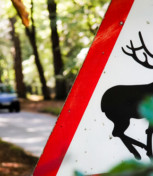
The iconic deer on the US sign is a silhouette with a nice leap and a cute turned-up tail. But why are the antlers backward?

Deer crossing sign on an Idaho roadway, illustrating how the design of road signs varies in different cultures. (Image © jimkruger)

If a deer on this Idaho roadway jumps at your car, don’t take time to compare
its horns to the sign. Just get outta the way!
© jimkruger

The style, the balance, the angle of the leap of this American deer may seem like pure perfection, but it lacks the “moves” of the deer on the English country road.

And it’s also missing some personalized charm. The beguiling smile of the British deer wasn’t there when the sign went up, but the 3/4 perspective used by the designer invited some playfulness. Well done, mate!

For designers, the horns are always the dilemma, especially when more than one species of deer cross the same road. Maybe they see the horns like hair styles—this year, bigger and bouffant; next year, curly and compact. Perhaps the horns balance the angle of the leap. Or, do the antlers just reflect the deer in the ‘hood?

Three deer crossing signs: white, triangular sign with red border and deer from France; yellow diamond-shaped sign with black border and deer from Canada; yellow triangular sign with red border and deer from Sweden, illustrating how road signs can vary in different cultures. [Image © alblec (Canada) / © 221A (Sweden)]

Deer crossing signs (l to r) from France—an elegant deer, of course, on its way to Paris—
and from Canada (© alblec), and Sweden (© 221A)

Despite many attempts, the shapes of warning signs defy international standardization—diamond-shaped in the US and Canada, triangular in most of the EU. Background colors and border styles vary, too. Like beauty, the efficacy of warnings is clearly in the eye of the beholder.

The Happiness Index

The UN looks at happiness across countries by polling citizens and collecting information on several happiness indexes. It has set every March 20 as the International Day of Happiness.

Published each year since 2012, the World Happiness Report ranks countries based on the Gallup World Poll. In 2020, Finland came in first and several other Scandinavian countries—Norway, Sweden, and Denmark—ranked in the top ten. A half-world away, tiny Costa Rica, the land of pura vidaranked #15; the US, #18; and Spain, #28.

Though there’s no way to know if the happiness indexes pertain to the bovine population, it is curious that the wag of the tail on cattle crossing signs in Spain and Costa Rica are oh-so-different!

Two road signs warning of cattle crossings, the top by a road in Spain and the bottom by a road in Costa Rica, illustrating how different cultures depict the same animal on road signs. [Image © percds (top) and © Sheron Long (bottom)]

Wag more. Moo less!
Cattle crossing signs in Spain (top) and in Costa Rica (bottom).
© percds / © Sheron Long

Fact and Feeling

Happiness is not the only emotion that springs from the metal of a road sign. The mellow California sign below would have you thinking, “C’mon, wild boars are mothers, too.” But it’s the Japanese sign that gets it right.

Two road signs warning of a wild boar crossing, the one on the left from Japan and the one on the right from Carmel, CA, illustrating the same animal depicted on road signs in different cultures. (Image © Spontaneous Pictures (L) and © Sheron Long (R)

The personality of a wild boar does not change because it migrates to California!
© Spontaneous Pictures (l) / © Sheron Long (r)

In some parts of the world, the road signs are factually correct, delivering on their promise.

Llama and Vicuña crossing sign in the highlands of Bolivia with the corresponding animals crossing behind it, illustrating how road signs vary in different cultures. (Image © javarman3)

Llama and vicuña crossing in the Bolivian highlands–a wooly meet-up!
© javarman3

In others, not so much. This road sign throws you a curve—it promises straight-line black-and-white stripes and delivers two rounds of fluffy brown feathers.

Zebra crossing sign with "No Fences" warning in Namibia with ostriches behind it, illustrating that road signs vary in different cultures. (Image © Bryta)

“No fences” in Namibia means ostriches and other beasts can crash the party.
© Bryta

Confusion and Contradiction 

Svalbard, a cluster of islands about midway between Norway and the North Pole, has a small permanent population and polar bears. It needs warning signs, of course, and this one says, “Applies throughout Svalbard.” But still you have to wonder why it’s there—if you’re walking in an Arctic snowstorm and encounter a polar bear, will you see it?

Polar bear crossing sign on a snow-covered road in Norway, illustrating how animals vary on road signs in different countries. (Image © Avatar_023)

White on white polar bear crossing in Norway
© Avatar_023

If you’re driving through the warmer climate of Namibia, it’s good to be on the lookout for ground squirrels. They live in bands, sometimes in groups of 20, all of which might be milling around the same crossing.

But what’s the message on the crossing sign? Are the ground squirrels already road kill, or are they slow? Or, are they road kill because they’re slow? Or, do YOU go slow so you don’t end up as road kill?

Ground squirrel crossing sign with a "Dead Slow" notice in Namibia, illustrating the variety of animals on road signs in different cultures. (Image © namibelephant)

Ground squirrel crossing in Namibia
© namibelephant

Confusion can turn to contradiction. The red sign says STOP in Arabic, but apparently camels are exempt.

Stop sign and camel crossing directional sign toward the Sahara desert in Morocco, illustrating the variety of animals on road signs in different cultures. (Image © Jann Huizenga)

In Morocco, red stop sign and camel directional sign toward the Sahara desert. Stop or go?
© Jann Huizenga

Clarity is the gold standard for warning signs, and some rise to the challenge. Take this one in South Africa—it’s clear, it’s realer than real, and if you do what it says, you’ll never feel as silly as a baboon.

Baboon warning sign in Cape Town, South Africa, illustrating the variety of animals on road signs in different cultures. (Image © Micky Wiswedel)

Special precautions prevail at this baboon crossing in Cape Town, South Africa.
© Micky Wiswedel

Where in the World Are You?

Get ready to say, “Oh, I see!” It’s your turn to cross the road into different cultures and match the road signs to these map points: 

1. Germany  2. Nicaragua  3. New Zealand  4. Thailand  5. South Africa  6. France

Warning signs for animal crossings---penguins, turtles and snakes, moose, elephants, daisies, and crabs, all illustrating how different cultures represent animals on road signs. (Images---A: © Oralleff / B: © Sheron Long / C: © Andreas Weber / D: © Tim Arbaev / E: © David Callan / F: © Steve B Photography

Oh, I see! Do U?
Credits (A-F): © Oralleff / © Sheron Long / © Andreas Weber
© Tim Arbaev / © David Callan / © Steve B Photography

Different wildlife, different cultures, different languages. They all hold the clues. Good luck, and STOP to check your road sign answers below.

Comment on this post below.

For more on how cultures show their differences on school signs, see “In the (School) Zone of Different Cultures.”

With appreciation to Thinkstock and iStock for images except those copyrighted by Sheron Long.
Answers: 1. Germany is C, a moose crossing at the Christmas market in the Königsplatz in Kassel, Germany. 2. Nicaragua is F, a crab crossing by Long Bay on Corn Island. 3. New Zealand is A, a penguin crossing on the South Island. 4. Thailand is D, an elephant crossing in Phuket. 5. South Africa is E, a dassie crossing at KwaZulu-Natal. 6. France is B, a snake and turtle crossing in the swampy lands of the Camargue.

Copyright © 2011-2025 OIC Books   |   All Rights Reserved   |   Privacy Policy