Oh, I see! moments
Travel Cultures Language

Quick! Trap a Travel Memory

by Joyce McGreevy on August 6, 2019

Travel journals are also travel keespakes that evoke your precious travel memories—the joys of the journey. (Image © Joyce McGreevy)

Travel memories speak volumes. But you needn’t compile volumes to keep them.
© Joyce McGreevy

How to Keep on Keeping Travel Keepsakes—and Still Enjoy the Trip

Keeping a travel journal is something that some people enjoy doing and some people wish they enjoyed doing. If you’re in the latter group, you probably own one or more beautifully bound journals, the sight of which filled you with travel inspiration—initially.

Then came the journey, and despite your best intentions to create a travel keepsake, your journal sputtered to a stop.  Why? It’s often about how we view the travel journal—that most non-stationary of stationery objects—before and during a journey.

In the anticipatory period before departure, the blank pages of a journal are an invitation to adventure and a promise of keen observations. There will be aha moments! There will be rich descriptions!  

A toy dog, a travel mascot, “writes” in his travel journals to create travel keepsakes that evoke the joys of the journey. (Image © Joyce McGreevy)

Even the most dogged travel journalist needs time to savor the joys of the journey.
© Joyce McGreevy

But during the journey, something shifts, and you can’t keep up with keeping a journal:

  • The little book that seemed so charming has become a chore master. It silently berates you from the hotel nightstand for “failing” to provide a daily, in-depth account of your travels.
  • Or you really, truly want to record a specific travel experience—only to discover that you’re contending with clichés, grappling with grammar, or hating your handwriting. In short, you had more fun filing your taxes.

Are there easier options?

Yes, thanks to quick ‘n easy travel keepsakes that “journal” the journey as you go. Yes, you can capture a sense of place without mastering plein air painting,  and you can bring home meaningful souvenirs without impacting your FICO score.

Oh, I see:  The ideal travel keepsake is one that happens on the go and adds to the joy of the journey. Here are some ideas:

1. Scale back.

Did sketching the view from the Eiffel Tower prove a tad challenging? Consider making “postage stamp” art instead. In that journal you’re carrying around, divide a page for the day into small squares about an inch wide. Draw a quick sketch or trap a word that reminds you of the place or person or the feeling you had in the travel moment.  These one-inch square sketches focus on a single set of the details of the day as you live them. Add the date and your location, and you have a travel keepsake that didn’t keep you from your travels.

Tiny quick-sketches in a travel journal reflect a quick and easy way to capture travel memories. (Image © Joyce McGreevy)

Don’t love every quick-sketch? Make a “patchwork” page of your favorites.
© Joyce McGreevy

2. Make audio postcards.

In one of the most poetic scenes of the Academy Award-winning film “Il Postino,” a postman records sounds of his village that inspire him. A quick tap of your cellphone’s voice recorder is all it takes to collect audio “postcards” of your own: a muezzin’s call to prayer in Istanbul, street music in Berlin, a lion’s roar in Botswana. Voice-recorder apps automatically tag the date and location, so just add a personal note, and send or save your audio postcard.

A bell tower in Bruges and a river in the Tongariro Forest, New Zealand suggest how audio recordings can capture travel memories. (Image © Joyce McGreevy)

From bells in Bruges to a river in Tongariro, sounds enhance travel memories.
© Joyce McGreevy

3. Save what you savor.

When you’re enjoying a travel moment, squirrel away a reminder. Maybe it’s a menu from a restaurant with a few tasting notes in the margins. It could also be a map section, a business card, a shopping bag,  or a food label. Back at home, remember the tastes of your trip as you make a culinary collage for your kitchen. Or, along the way, spill out your treasures onto a flat surface, arrange them in an interesting way, and create a digital collage (no glue stick required!). Then:

  • Snap a photo of your collage.
  • Re-use or recycle the paper.
  • Voila!—a portable keepsake minus the baggage.
A digital travel collage is a clever way to trap memories and create travel keepsakes that evoke the joys of the journey. (Image © Joyce McGreevy)

The digital-only collage lets you “keep” items that won’t fit in your suitcase.
© Joyce McGreevy

4. Love it? List it.

Those moments at the end of a travel day are the perfect time to sum up the day in less than 3 minutes. Keep it light and breezy. Invite your travel companions to join in, if you’d like, and collect:

  • an “Oh, I see” moment: Sunflowers turn their faces away from the sun!
  • people you’re glad you met and why: Annamieke translated the Flemish menu.
  • a phrase that sums up the day’s adventures or mishaps: Good thing we took the “wrong” train!
  • new foods you ate: brunost (Norwegian brown cheese); simit (Turkish bagel)
  • new words you learned: Blagodarya! (“Thank you!” Bulgaria); Comme c’est beau! (“How beautiful!” France)
Norwegian waffles with cheese, noted in a list of travel memories, become a travel keepsake that evokes the joys of the journey. (Image © Joyce McGreevy)

At home, use your list to recall details:  Norwegian vafler med  brunost were
surprisingly
nydelig (delicious). The cheese reminded me of caramel!
© Joyce McGreevy

Keep Keepsakes Simple, for Keep’s Sake!

You don’t have to be crafty or write volumes to create travel keepsakes. Just let your observations and experiences be your guide. Each time you write, draw, list, or photograph to collect a travel keepsake, you’re preserving a precious travel memory that evokes the joys of the journey.

Find out more! Consult our curated and creative list of easy-to-use apps that help you gather audio, photographic, and print keepsakes in one place and build on them from there. Also find our round-up of the best online sites, books, and classes for creating, organizing, and displaying your travel keepsakes after you’re home. Download the free PDF:


Comment on the post below, or inspire insight with your own OIC Moment here

Carry Where You Came From With You

by Joyce McGreevy on July 23, 2019

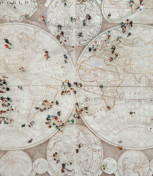
People walking on global map evoke the idea of crossing cultures as we travel through life together. (Image © iStock/ Orbon Alija

We come from everywhere, crossing cultures to build new communities
and enrich each other’s lives.
© Orbon Alija / iStock

Crossing Cultures: A Perspective on Traveling Through Life

Ever since I opened my first “big kid” textbook in third grade, I’ve been fascinated by one of history’s earliest, ongoing events—the ways we the people of Earth are perpetually crossing cultures and coming together again in shared places.

In airports and train stations, the faces of those arriving and departing reflect every emotion—excitement and curiosity, exhaustion and confusion. Meanwhile, we’re all traveling through life.

Alongside the joys and challenges of this journey, we each carry the need for home, a place to come to and people who want us to be there.

People at an airport evoke the metaphor of carrying where you came from with you as you travel through life. (Image © Joyce McGreevy)

Coming or going, rooted or uprooted, we are all traveling through a world we share.
© Joyce McGreevy

Sometimes the place is a country, a state, or a city.  There’s a dance to these shared places that I love, a movement around and with each other that we can witness on any given day.

It’s in the way we share busy crosswalks without colliding, or make room for each other on a crowded subway.  It’s in the way we hold doors for one another, help someone carry a heavy suitcase, or ease a stroller safely over an obstacle.

I see it at times when we’ve absentmindedly left something behind, and someone rushes after us, waving our nearly-lost possession like a flag, relieved to restore it to us. And then? With or without a shared language, we share a smile.

In the back-and-forth of deeper conversations, we share more of where we came from. We reveal our attitudes and values.  We try out new ideas. We solve problems and work through conflicts. We discover, grow, and celebrate.

In such moments, we’re not just traveling through life, we’re traveling together. Without questioning where others come from, we create something important together—a sense of community that carries us all forward.

We All Come from Somewhere

For all of us in this world, life starts on a particular day in a particular place in a particular culture. Then we start that travel through life. Whether we move to Oregon from Texas or come to one country from another, the people and places we encounter add to our lives, expanding and enriching the culture that we came from.

These encounters are a little like a potluck where everybody brings something from their home  and there’s something new for everyone. New tastes, all kinds of food. And the way we share it with each other? That’s called community.

People gathered for a parade reminds the writer that each of us carries where we came from with us and all of us are traveling through life together. (Image © Joyce McGreevy)

We all come from somewhere to gather together in community.
© Joyce McGreevy

What We Carry Together

My extended family is daily created by people who carry where they came from. You wouldn’t guess it to look at just me, but collectively, we carry many languages, including Chinese, Spanish, Turkish, Irish, Hebrew, English, and Italian.

We cover all different faiths and none. We’re straight, gay, we live in big cities, small towns, and rural areas. We agree and disagree on everything from food to music to our perspectives and philosophies.

In short, we’re like many families today.

Factor in our friends, neighbors, and co-workers. Every time we get together, the circle widens. “We’re going to need more chairs!” someone says and somehow we always find enough.

We carry chairs, we carry food. We carry where we came from, the better to share it.

People at a community supper reflect how each of us can make a difference when we share with others. (Image © Joyce McGreevy)

We are better when we share what we carry, when we welcome each other to the table.
© Joyce McGreevy

The Journeys We Share

As humans, where we come from covers a vast array of differences: from our birth years to our personal appearances, from our histories to our hopes, our spoken languages and the unvoiced languages of our dreams—in our cultures and circumstances, our certainties and changes, our traumas and triumphs, our gifts and goals.

As humans, wherever we are, wherever we come from, we have the power to do something truly extraordinary. We can connect across cultures and strengthen each other’s sense of belonging.

Of course, that takes patience.

It takes getting to know one another. Uncrossing our arms and pulling our chairs closer together. Sharing our “travels” and discovering where these journeys of experience connect.  Using our words to welcome, our listening to understand.

A community mural labeled with personal values that cross cultures reflects the idea that "carrying where you came from with you" can make a difference to others. (Image © Joyce McGreevy)

In sharing our differences, we create solidarity through respect.
© Joyce McGreevy

The Essential Difference that Our Differences Make

Something remarkable happens when we say, “Thank goodness you’re here.” It’s an Oh, I see moment: We discover that the combination of our differences is exactly what’s needed for our worthiest endeavors to flourish.

So much is enriched when we carry where we came from and share the wisdom: a community garden, a classroom, a local business, a theater production, a life-saving surgery, an environmental effort, a country that comes closer to its ideals.

In those times, we find ourselves capable of crossing cultures and comfort zones. In those times, our differences make a positive difference together.

“Welcome,” our actions say. “Pull up a chair, there’s room for everyone at the table.”

In those times, wherever we come from, whatever we carry, we’re traveling through life together. In those times, we’re creating a shared place called home.

Comment on the post below. 

Summer Like a Local

by Joyce McGreevy on July 8, 2019

Public street art on Rue St-Famille, Montréal reflects the everyday pleasure of exploring the urban culture. (Image © Joyce McGreevy)

Wandering leads to discovery in Montréal. Murals enliven every neighborhood.
© Joyce McGreevy

The Widespread Pleasures of Montréal’s Urban Culture

No wonder jazz is a top attraction for visitors to Montréal. The largest city in eastern Canada doesn’t just reflect urban culture, it riffs on it, reinterpreting it in endless variations.

Since visiting Montréal as a child, I’ve returned numerous times, always encountering new layers to its creative nature.

Most first-time visitors stay within a compact area around the Vieux-Port (Old Port), where  cobblestone streets and picturesque buildings date to the 17th century.  Charming though it is, visiting in peak season can give  the impression that all 10 million annual visitors have shown up at once.

That’s why I encourage you to explore beyond the core. Oh, I see: Montréal’s summertime pleasures are generously sprinkled all over the city.

A zip line and Ferris wheel in Montréal suggest that slowing down and broadening your focus are additional ways to explore the urban culture. (Image © Joyce McGreevy)

Sure, zip around the Old Port, but broaden your circle, too.
© Joyce McGreevy

Here are five ways to celebrate Montréal’s urban culture. Eco-friendly, art-loving, and community-minded, they’ll make you feel right at home.

1. Do your reading in the park.

In many cities, cooling off on a summer’s day means cranking up the A/C. Montréalers keep cool by heading to the nearest green space. With 19 major parks and over 1,300 green squares, you won’t need a map to find one.

A park in Montréal reflects the everyday pleasure of exploring the urban culture. (Image © Joyce McGreevy)

Montréal is on track to increase its canopy cover to 25% by 2025.
© Joyce McGreevy

Montréalers’ love of green spaces was formalized in 1874 when Mount Royal became the first protected area in Québec. The design gig for Parc Mont-Royal went to Frederick Law Olmsted, who also designed the grounds of New York’s Central Park.

Now Montréal’s green space is on the verge of another growth spurt. Over the next three years, the city will build its largest park yet—four times the size of Parc Mont-Royal—on the urban island’s western tip.

A woman walking and a corner grocery reflect the everyday pleasures of exploring Montréal’s urban culture. (Image © Joyce McGreevy)

To shop like a local, buy only what you can carry, cook, and picnic on over 1-2 days.
© Joyce McGreevy

2. Hop to the shop, car-free.

With a dépanneur on virtually every block, shopping for food on foot is easy.  Come spring, Montréal’s oldest public markets take off their “winter coats.” Down come the walls that shelter shoppers from 82 inches of annual snowfall.

The Marché Jean-Talon suggests the everyday pleasure of shopping for Québécois products and exploring Montréal’s urban culture. (Image © Joyce McGreevy)

Marché Jean-Talon has fed Montréal families since 1933.
© Joyce McGreevy

Which market should you choose, Marché Jean-Talon or Atwater Market? Both—and don’t overlook Marché Maisonneuve:

  • Atwater Market: The tall clock tower makes it a cinch for newcomers to find, and you can work off that maple sugar pie with a run along the Lachine Canal.
  • Marché Maisonneuve: Test your French fluency, marvel at the 1910 Beaux-Arts building that started it all, and test-ride a self-driving shuttle to Montréal’s Olympic Stadium.
  • Marché Jean-Talon: Explore the neighborhood known locally as Petite-Italie.
 An Italian café in Petite-Italie reflects the everyday pleasure of exploring Montréal’s urban culture. (Image © Joyce McGreevy)

After all that grocery-shopping, you’ll surely need a treat in Little Italy.
© Joyce McGreevy

Don’t make a list. Just wander among artful displays of Québécois produce, charcuterie, wheels of cheese, fresh oysters from the Bay of Gaspé, handmade ices, fresh flowers, herbs, and more.

 3. Meet the neighbors.

Whatever your language, it’s easy to meet the neighbors in Montréal. I’ve enjoyed conversations in cafés, bookstores, the Segal Center Theatre, a local swimming pool, and while sitting on the curb of Rue St-Denis waiting for a parade to begin.

Even a short stroll can lead to memorable meet-and-greets. Last Saturday I went out for a newspaper. Two blocks later, I was dancing at a neighborhood barbecue. As for Sunday, I’m unlikely to forget meeting Antoine:

Circus artist Antoine Carabinier shows his sense of humor, another reminder of the fun of exploring Montréal’s urban culture. (Image © Joyce McGreevy)

Better known for balancing on the Russian bar in his family’s Cirque Alfonse,
Antoine Carabinier makes a genial barmaid at a Montréal street festival.
© Joyce McGreevy

4. Join the circus.

Every year, visitors flock to Montréal’s Jazz Festival, Cirque du Soleil, the “Just for Laughs” Comedy Festival, and other hot-ticket events.

No ticket? No worries.

Montréal’s creativity spills onto neighborhood streets, spreads across parks, and splashes across walls.  Every summer, the roving Repercussion Theatre makes Shakespeare-in-the-Park accessible to all. Murals have a festival of their own. Meanwhile, Montréal Complètement Cirque scatters magic all around the city.

A circus artist performs for an audience on the Rue Maisonneuve, embodying the festive side of Montréal’s urban culture. (Image © Joyce McGreevy)

A graduate from Montreal’s École Nationale de Cirque runs rings around his audience.
© Joyce McGreevy

5. Debate a local hot topic.

Montréalers have strong opinions about which is better, Fairmount Bagel or St-Viateur Bagel. Thus, it behooves you to “research” both.

But don’t just grab and gobble. Savor the “hole” truth with a lesson from local baker Will Paquet. As my Toronto classmates agree, his bagel-baking class is enriched by culinary science, seeded with local tips, and leavened with humor.

Bagel baker Will Paquet describes an everyday culinary pleasure of Montréal’s urban culture. (Image © Joyce McGreevy)

Paquet’s not out to “schmear” NY bagels, just passionate about Montréal methods.
© Joyce McGreevy

As Paquet guides us through the steps, we learn what makes Montréal bagels distinctive. Smaller and thinner than NY bagels, and with a faster transition between proofing and kneading, they are hand-rolled and poached in honey-water. Unlike NY bagels, they’re also flipped halfway through the baking.

Traditionally, Montréal bagels were baked in a wood-fired oven, but the city is phasing this out for environmental reasons. Even so, under Paquet’s tutelage the results are thrilling—a toothsome crunch followed by soul-transporting, soft-as-a-cloud sweetness.

Bagels in various stage of preparation evoke an everyday culinary pleasure of Montréal’s urban culture. (Image © Joyce McGreevy)

Making bagels delivers a taste of Montréal’s urban culture.
© Joyce McGreevy

To buy bagels like a local, says Paquet, order “Sesame, still warm,” consume your bagel within 30 minutes, and don’t bury it under a mound of sandwich fillers. In Montréal, the bagel itself is the star, not the stage.

Extend your urban boundaries

This 377-year old city embraces over two dozen neighborhoods, each with its own personality, flavors, and festivities. Factor in Canadian friendliness, convenient public transport, and a summer sun that stays up late, and you’ve got the perfect excuse to get neighborly with Montréal’s urban culture.

Learn more about Will Paquet’s bagel-making classes here.

Comment on the post below, or inspire insight with your own OIC Moment here.

Copyright © 2011-2025 OIC Books   |   All Rights Reserved   |   Privacy Policy