Oh, I see! moments
Travel Cultures Language

Savoring Summer

by Joyce McGreevy on July 30, 2018

A woman sitting by the Oregon shore suggests why savoring summer can be a life-changing experience. (Image @ Joyce McGreevy)

When’s the last time you took a breather?
© Joyce McGreevy (Featured: Margie McGreevy)

The Life-Changing Experience
of Celebrating the Season

Having a good summer? Or did it register merely as high temperatures while you went about your daily business? Considering the seriousness of world issues and the stress of busy lives, does it even make sense to celebrate this season?

Yes! Savoring summer can be a life-changing experience.

A sun-themed collage evokes the beauty of savoring summer. (Image @ Joyce McGreevy)

Summer sun appears in countless ways.
© Joyce McGreevy

Our brains respond to summer, even if the rest of us ignores it.

Studies have identified two neural responses to summer that seem contradictory. When summer’s heat is on, our brain responses really do slow down. Yet the brain’s ability to respond to tasks that require sustained attention actually peaks in summer.

Does that mean we should turn up the office A/C and focus our high-functioning attention on GTD—Getting Things Done? Or could it mean that summer offers a two-fold opportunity? One, to let our brains slow down. Two, to apply summer-peak focus to more than just mundane tasks.

Sunset on the Oregon shore suggests why savoring summer can be a life-changing experience. (Image @ Joyce McGreevy)

When’s the last time you took a walk by the water?
© Joyce McGreevy

“Smell the sea and feel the sky.”

Maybe you’ve seen that recent study on the benefits of extended “forest-bathing.” Or the one about standing barefoot on grass for a moment. “Big Duh” Spoiler Alert: Being outdoors is good for you.

Poets have known this all along. “Smell the sea and feel the sky. Let your soul and spirit fly,” sang Van Morrison. Even Ralph Waldo Emerson, a philosopher one pictures barnacled to a desk, declared, “Live in the sunshine. Swim in the sea. Drink in the wild air.”

In summer, sensory experience is amplified. It’s the warmth on your skin, reminding you that, “Oh right, I have a body!” That there’s more to you more than a suit of clothes with a head poking out at the top.

Bare feet on grass suggest the pleasure of savoring summer. (Image @ Joyce McGreevy)

Hello, silly toes! It’s nice to see you again.
© Joyce McGreevy

It’s the rumbling roar and briny scent of ocean waves. The chorus of birds broadcasting nature’s morning news. A sunset so vibrant it practically cries out, “Aren’t you glad you didn’t miss this?”

Craft your own summer.

Summer also meshes with the sensory appeal of what we humans carry. The smell of cocoa butter. The thwack of a baseball bat hitting a home run. The itch of sand in . . . interesting places. The overheard music that transports us to other summers. There’s even a song about that, Eric Church’s “Springsteen”:

“To this day when I hear that song
I see you standin’ there all night long
Discount shades, store bought tan
Flip flops and cut-off jeans”

What were your artifacts of summers past? What human-made objects are part of your summer today?

A street scene on Waikehe Island suggests the pleasure of savoring summer. (Image @ Joyce McGreevy)

When’s the last time you sipped lemonade?
© Joyce McGreevy

Savor summer foods.

“I always like summer
best
you can eat fresh corn
from daddy’s garden”

So says Nikki Giovanni in the poem “Knoxville, Tennessee.” What tastes like summer to you? A luscious peach warm from the tree? The salty, syrupy crunch of fairground snacks? The heirloom-tomato and lime-kissed gazpacho your mom used to make? The sour-cherry pie that always held enough slices for everyone?

Summer like a child.

When we were kids, summer marked the beginning of adventure. Boredom was our ally then, because it spurred us into devising games, stories, lemonade stands, and neighborhood track meets—anything to avoid the dreaded alternative, Chores.

We climbed trees, sat under them for hours with books, and turned the stories into plays, casting them with any available siblings, dolls, and pets.

A tree house evokes the pleasure of savoring summer. (Image @ Joyce McGreevy)

When’s the last time you saw the world from a treehouse?
© Joyce McGreevy

We did not “set goals” or work on “self-improvement.” We gave into obsessions. Like reading every Nancy Drew mystery or book about ancient Egypt.  Learning to skateboard, draw a horse, do magic tricks, blow chewing-gum bubbles, craft a lanyard, or make up dance routines to radio songs.

Now that we’re all grown up, why settle for staring at phones and online episodes?

Imagine taking out the teeny-tiny key to that little pink diary you kept in fifth grade. Picture the “Bestest, Funnest Day Ever!!!!!” What simple pleasure or Big Adventure is written there?

Sandcastles on the beach suggest the pleasure of savoring summer. (Image @ Joyce McGreevy)

Give yourself a hall pass and rediscover recess. You’ll be the better for it.
© Joyce McGreevy

Cast summer magic.

When I was a kid, summer nights were for suppers on the patio, outdoor concerts, and coming home from the beach so drowsy that our parents carried us in from the station wagon and put us to bed. Okay, maybe some of us pretended to be asleep, cherishing the safety of a parent’s TLC.

One summer my sister Carolyn and I investigated The Mystery of The Fast-Growing Zucchini. For several nights, we went on stake-out, setting up sleeping bags in the garden and staring intently, determined not to . . . (yawn) . . . fall . . . asleep . .  . . .

Although we never did crack the case, we had delightful conversations, made up the silliest songs, and even experienced the thrill of star-diving: We’d lie on the grass and convince our brains that the sky was below us. Then we’d “dive” in.

What magic are you making time for? When did you last look up at the sky? Or carry supper outside? Or swap family anecdotes as sunset deepened into inkiest night? Until you could no longer see each other but sensed and appreciated each other’s presence?

The full moon over a desert suburb in Palm Springs evokes the beauty of savoring summer. (Image @ Joyce McGreevy)

When’s the last time you stopped for the summer moon?
© Joyce McGreevy

Share summer abundance.

But what does it matter? In a world that can feel as cold and uncertain as an iced-over alley at midnight, isn’t it frivolous to celebrate summer?

Here’s the thing:

  • Those outdoor summers remind you that the environment is not a concept, but where we all live.
  • The summer garden you savor feeds your persistence through the winter.
  • Summer cooks know that the secret to sweetening sour-cherry pie is to share it.
  • Summer nights, when you gather in a circle of belonging, reveal real-life magic: Your circle has the potential to expand. Your circle can grow as big as the Earth is round. Your circle can welcome as many people as there are stars in the sky.
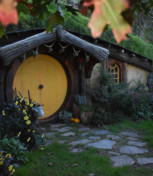
A vintage house in Illinois evokes the beauty of savoring summer. (Image @ Joyce McGreevy)

When’s the last time you sat on the porch and watched the world go by?
© Joyce McGreevy

So why give your summer brain a change of focus? Why invite your body for a visit?

Oh, I see: To refill the well.

Only then can you draw strength to do what needs to be done. Only then can you refresh yourself with the clarity to know what that is.

Can savoring summer be a life-changing experience? Goodness, yes. And not just for you.

Need a reminder of summer-night magic? Listen to Allen Toussaint’s “Southern Nights” here.

Comment on this post below, or inspire insight with your own OIC Moment here.

Everything is Pawssible at the Arles Photo Festival

by Meredith Mullins on July 23, 2018

[nopinit]

Casual, a photo by William Wegman in 2002, shown at the Rencontres d'Arles (Arles Photo Festival). (Image © William Wegman.)

Candy stars in Casual (2002)
© William Wegman (Courtesy of the artist)

William Wegman Makes Us Smile

What’s the best way to experience William Wegman’s “Being Human” exhibit at the 2018 Rencontres d’Arles (Arles Photo Festival)?

Spend time with Wegman’s original 20 x 24 Polaroid prints—but also take note of the faces of the visitors.

Everyone is smiling.

We’re smiling at dogs sporting festive wigs, or arching majestically on shapes of color, or agilely balancing things on their nose or head, or morphing into other animals like a giraffelant, or going about the daily tasks of living (with a surreptitious set of human hands).

We’re smiling at each of the 100 photographs displayed in this show, but we’re really smiling at ourselves as we make a connection to the fascinating world of being human.

We’re also amazed at just how creative Wegman has been in the nearly 50 years he has been photographing his beloved weimaraners.

Cut to Reveal, a photo by William Wegman at the Rencontres d'Arles (Arles Photo Festival). (Image © William Wegman.)

Batty stars in Cut to Reveal (1997)
© William Wegman (Courtesy of the artist)

With a retrospective such as “Being Human,” it becomes clear that Wegman continues to evolve and challenge himself (and his dogs)—with a unique blend of conceptual art and surrealism; a range of elements from cubism, color fields, masquerades, high fashion, theatrical costumes, eclectic furniture, and figure studies; and above all . . . humor.

In a world where the harsh realities of the planet are often a subtle (or not so subtle) presence in photographic images, these images give our spirit a chance to laugh.

Upside Downward, a photo by William Wegman at the Rencontres d'Arles (Arles Photo Festival). (Image © William Wegman.)

Penny stars in Upside Downward (2006)
© William Wegman (Courtesy of the artist)

No Underdogs Here

As the exhibit curator William Ewing notes in the book Being Human, Wegman explores many genres—photojournalism, astronomy, gastronomy, landscapes, seascapes, haute couture, theatre, opera, art trends, and metaphysical and difficult existential questions—all through the noble character and soulsearching pale eyes of his dogs.

“I’ve always thought of working with the dogs as parallel play. The dogs play their game and I play mine,” says Wegman in conversation with Ewing.

The canine cast of characters all like to play . . . and to work. The dogs want to be chosen to be photographed. In fact, they feel left out if they are not the center of attention on the set.

Sometimes Wegman has to pretend that everyone has a part, even when one dog is the focus. There’s no underdog here.

In the Wegman studio, every dog is a star. And every dog has his or her own talent and personality. Wegman is an expert at casting the right dog with the right creative vision. We get to know the character of Man Ray, Fay Ray, Chundo, Bettina (Batty), Crooky, Mazzy, Chip, Bobbin, Candy, Penny, Flo, and Topper.

Constructivism, a photo by William Wegman at the Rencontres d'Arles (Arles Photo Festival). (Image © William Wegman.)

Topper stars in Constructivism (2014)
© William Wegman (Courtesy of the artist)

In The Beginning There Was Man Ray

How did it all begin? The puppy Man Ray came into the picture (pun intended) while Wegman was teaching in California in 1970. Wegman’s artistic media up until that time had been drawing, painting, and video.

Man Ray made it clear that he wanted to be a part of the action, so Wegman began featuring him in photographs. He marveled at how Man Ray was transformed by the act of photographing him. “He became,” in Wegman’s words.

Man Ray was regal, confident, a leader of the pack. He emerged as the star of Wegman’s photographs, as well as videos. He even learned to spell.

If video does not display, watch it here.

The Dog Photographer

Although Wegman is sometimes called “the dog photographer” or is accused of being too anthropomorphic, his art moves well beyond any such categorization (although it’s hard to argue the anthropomorphism point when Man Ray was named “Man of the Year” by the Village Voice after he died).

The basic truth is that Wegman’s art is a tender collaboration between a human and humans’ best friends. The subject is not dogs. The subject is life.

George, a photo by William Wegman at the Rencontres d'Arles (Arles Photo Festival). (Image © William Wegman.)

Chundo stars in George (1997)
© William Wegman (Courtesy of the artist)

The portraiture is not unlike other humanists’ approach. The photographer works to show the deeper layers of the subject so that the viewer will be engaged in the story . . . in the discovery . . . in the exploration.

Wegman has the advantage that wiemaraners are hunting dogs and are inclined to stay still, as if pointing. However, he still must elicit the right emotions (although he admits that the wiemaraner expression is somewhat detached . . . similar to an elegant fashion model who is a bit above it all).

The Wegman techniques are slightly different from the average portrait photographer. How does he get his subjects to do what he wants?

Cat was a big word with many of my dogs,” Wegman says. “Ball has been an important word until recently, and Bone continues to be promising. But if you keep saying Bone and don’t deliver, the word crashes and you have to find another word.”

Cursive Display, a photo by William Wegman at the Rencontres d'Arles (Arles Photo Festival). (Image © William Wegman.)

Flo stars in Cursive Display (2013)
© William Wegman (Courtesy of the artist)

The Polaroid Era

Wegman’s style and vision changed in 1978 when Polaroid invited him to try out one of their few new 20 x 24 cameras.

The camera was the size of a refrigerator and weighed more than 400 pounds. Wegman had to go to the Polaroid studio (dogs, costumes, and props in hand) to create the photographs.

The camera dictated that he work in color, in a vertical format. He saw the images almost immediately after shooting, which enabled timely adjustments. And the images had all the quality advantages of a large-format camera.

Because of the size and immobility of the camera, he had to bring his subjects up to the level of the lens. There also was no post-shoot manipulation. The image was exactly as it was shot.

Later, he did go on location from time to time, hauling the camera in a truck (along with the Polaroid assistant).

Wegman worked with the Polaroid camera from 1979 to 2007, creating more than 15,000 images.

Knowing the challenges of this camera format makes seeing these Polaroid originals in the exhibit all the more thrilling. It becomes obvious how much work went into creating these complex stories and capturing the “decisive moment.”

As Wegman said in an interview, ““The lucky accident happens over and over again if you just spend time at it.”

After the end of the Polaroid era, Wegman moved to digital. Thus, he still has the benefit of seeing the image immediately so he can make adjustments.

However, because post-production is now a possibility, he must test the faith of his viewers to know he does not manipulate the images with Photoshop. He is still working in the Polaroid philosophy.

Feathered Footwear, a photo by William Wegman at the Rencontres d'Arles (Arles Photo Festival). (Image © William Wegman.)

Feathered Footwear (1999)
© William Wegman (Courtesy of the artist)

An “Oh I See” Pawsterity Moment

The axiom that photographing something you love brings you closer to that subject is certainly true for William Wegman.

An aboriginal saying is also true: Dogs make us human.

We come out of the “Being Human” exhibit feeling better about ourselves and our fellow beings. And we come out smiling.


Les Rencontres de la photographie d’Arles, exhibitions run from July 2 until September 23 2018, 34 Rue du Dr Fanton, 13200 Arles

The exhibit “Being Human,” curated by William Ewing is produced by the Foundation for the Exhibition of Photography, Minneapolis, in collaboration with the Rencontres d’Arles.

William Wegman’s work can be found at the Sperone Westwater Gallery in New York. His numerous books can be found on Amazon.

The new book “Being Human” in collaboration with William Ewing includes more than 300 photos, many of which have never been shown, and can be found here.

Comment on this post below, or inspire insight with your own OIC Moment here.

A bonus encore: Wegman’s famous Dog Duet.

If video does not display, watch it here.

Memorable Moments: A Wave of Ocean Wonders

by Your friends at OIC on July 17, 2018

Oh, I sea!
© iStock

One constant in our travels is the ocean, whose mysteries make it a prime location for “Oh, I see!” moments.  As our bloggers navigate their way to their next set of inspiring adventures, take a dip back into some posts that highlight the majesty and artistry of what lies beneath the sea. Whether you’re diving in for the first time, or revisiting these posts as we are, fascinating discoveries await. Enjoy!


Sculpture in the underwater museum by Jason deCaires Taylor, showing innovations by artist and ocean. (Image © Jason deCaire's Taylor)

The ocean is an extraordinary exhibition space, altering art with life.
© Jason deClaires Taylor

The Underwater Museums of Jason deCaires Taylor

Jason deCaires Taylor creates the world’s first underwater museums where sculptures grow into artificial reefs, showing innovations by both artist and ocean. Go to the post.


colorful plastic pieces in rows in Jerry Takigawa's artistic expression of world ocean tragedy

© Jerry Takigawa

Artistic Expression Speaks Out for World Oceans

Jerry Takigawa’s artistic expression inspires us artistically while delivering a powerful call to action to save the world’s oceans. As a special bonus, this post includes a free download for protecting our oceans, with useful tips for reducing your plastics footprint. Go to the post.


Sea nettle Jellies swimming at the Monterey Bay Aquarium, showing travel stories that connect travelers to different worlds (image © Sam Anaya A.).

Watch these jellies long enough and you will be transported to another world.
© Sam Anaya A.

The Awe-Inspiring Monterey Bay Aquarium

The Monterey Bay Aquarium lets us travel underwater while still breathing our own air. Come on a journey that connects us to awe-inspiring worlds. Go to the post.


To explore more treasures from the past, check out the Blog Topics & Archive section. And to find a new “Oh, I see!” moment every week in your inbox, take this opportunity to subscribe.

Copyright © 2011-2025 OIC Books   |   All Rights Reserved   |   Privacy Policy