Oh, I see! moments
Travel Cultures Language

Nobody in Bulgaria Is Calling You a Hobo

by Joyce McGreevy on February 27, 2017

A Bulgarian street prompts the thought that learning a second language will mean learning a second alphabet, Cyrillic. (Image © Joyce McGreevy)

Not all who wander Bulgarian streets are lost, just the non-Bulgarians.
© Joyce McGreevy

When Learning a Second Language
Means Learning a Second Alphabet

Your mission? Walk to the store. The one with signs that say “HOBO!” Funny, many stores in Bulgaria display that word. Why? You’re learning a second language, but hobo is nowhere in your phrasebook.

Even more mystifying to an English speaker? Bulgarian maps.

A Bulgarian map helps the author understand that learning a second language will mean learning a second alphabet, Cyrillic. (Image in the public domain.)

Should I turn наляво or надясно? And which is which?

Someone tells you, “Bilingual signs are everywhere.” So off you go, innocent as the day you were born. Sure enough, you find a sign with two versions of a street name.

Breakthrough? Nope. Because the sign isn’t actually bilingual. You’re looking at two distinct alphabets showcasing one common language.

Oh sure, the Roman script looks familiar because, it’s used for English. You can even sound it out: Ulitsa Sveti Kiril I Metodiy. But the language is Bulgarian.

And that other script?  Кирил И Методий ул. That’s Cyrillic. If it were in English it would say Saints Cyril and Methodius Street.

You don’t just have a language barrier—you have an alphabet barrier.

Bulgarian lettering on a beer glass helps the author understand that learning a second language will mean learning a second alphabet, Cyrillic. (Image © Joyce McGreevy)

Do I “ask for it by name” or keep pointing
at the cute horsey on the menu?
© Joyce McGreevy

Surprising Cyrillic

Oh, I see: Sometimes learning a second language means learning a second alphabet.

What to do? Stick to GPS? Staring at your phone while crossing city streets seems unwise.

Brazen it out? Seek directions by speaking only English?  Also problematic.

It promotes a double standard:  “When people come to our English-speaking country they should learn the language, and when we go to their non-English speaking countries we should . . . uh, be able to count on others speaking English.”

Decorative graffiti on a Bulgarian street shows that learning a second language and a second alphabet, Cyrillic, can be fun. (Image © Joyce McGreevy)

The plays of Шекспир are popular worldwide, including in Bulgaria.
© Joyce McGreevy

When in Bulgaria . . .

You could copy street names in Roman script and show them to locals while looking pathetic and finger-miming the act of walking. Thing is, Roman script in Bulgaria, like many other Balkan countries, is a relatively recent phenomenon. It’s a linguistic standardization linked to membership of the European Union.

So, unless you’re showing your note to Sofia’s millennials—many of whom speak three or more languages—you’ll find that Roman script is as unfamiliar to many locals as Cyrillic is to you.

In a pinch, there are translation apps. But good luck forging authentic human connections as you stand jabbing the keypad of a device while holding up the line at a café.

My friend, it’s time to learn a little Cyrillic.

Language Geeks and Greeks

Zahari Zograf's 1848 mural of Bulgarian saints Cyril and Methodius show how the Cyrillic alphabet relates to learning a second language. (Image in the public domain)

Men of letters: Cyril and Methodius with alphabet.
Mural by Zahari Zograf (1848)

First, meet Cyril. St. Cyril, to be precise.

Cyril must be the Russian fellow who invented the Cyrillic alphabet, right?

Sorry, no. According to Bulgarian scholars, Bulgaria introduced Cyrillic, not Russia.

So, Cyril the Bulgarian invented Cyrillic?

If only it were that simple.

He was from Thessaloniki, which today is part of Greece, but was then part of the Bulgarian Empire. Cyril  and his kid brother Methodius were monks who liked monkeying around with language.

And so these two Greek Bulgarians (or Bulgarian Greeks) invented the Glagolitic alphabet.

So Many Alphabets, So Little Time

Now I know what you’re thinking:  Aha! Glagolitic must have been the first Slavic alphabet! And you’d be right.

The whole thing was modeled on Ancient Greek. In 850 A.D., there was plenty of Ancient Greek left over just waiting for hotshots like Cyril and Methodius to put it to good use.

The Acropolis reminds the author that learning a second language, Bulgarian, owes much to Ancient Greece, birthplace of Cyrillic. (Image © Joyce McGreevy)

Ancient Greek, a pillar of the (language) community.
© Joyce McGreevy

Having set up future generations of Greek and Bulgarian scholars with topics for debate, Cyril and Methodius passed mischievously away. Oh, those wacky monks.

In the 10th century, the C&M Brothers’ linguistic start-up was replaced by another evolution of the Bulgarian alphabet. This is the alphabet that scholars named after both brothers—oops sorry, fella—just Cyril.

Alas, there was no Methodius to their fad-ness.

Today, Cyrillic features in more than 50 languages spoken by over 250 million people in Eurasia. Also in Chicago, home to the largest Balkan community outside of the Balkans.

A traditionally dressed Bulgarian woman using a smartphone remind the author that learning a second language means learning a second alphabet, Cyrillic. (Image © Joyce McGreevy)

Communication has changed with the times
in Bulgaria, but Cyrillic is still going strong.
© Joyce McGreevy

Getting from A to Ж

Let’s begin. There are 30 pairs of letters in the Cyrillic alphabet. Some look and sound a lot like letters in the Roman alphabet: A as in palm, E as in best, O as in order.

Then you have trickster letters, like:

CYRILLIC SOUNDS LIKE AS IN
H N No way!
B V Very confusing!
P R Reeeally?
C S Seriously?

And I haven’t even mentioned Д (not to be confused with Л). Or Щ (not to be confused with Ш).

Decorative graffiti in Bulgaria suggests the feeling of learning a second language by learning a second alphabet, Cyrillic. (Image © Joyce McGreevy)

One way to decipher two alphabets?
© Joyce McGreevy

Magical Cyrillic

Okay, just dip your toe in. You’d be surprised what a difference even a handful of letters can make. Consider it your magic decoder ring.

Remember: Many letters, including K, A, and E, made it from Cyrillic into Roman unchanged.

Now, look at this letter:  Ф. It sounds like PH in Phone. Knowing that, you can decipher this:

A Bulgarian Cyrillic sign for coffee suggests the benefits of learning a second language by learning a second alphabet. (Image © Joyce McGreevy)

Okay, so the visual cues help, too.
© Joyce McGreevy

Next, check out these two signs.

Bulgarian street signs in Cyrillic show that learning a second language can mean learning a second alphabet, Cyrillic. (Image © Joyce McGreevy)

“These little town обувки are longing to отклоняват…”
© Joyce McGreevy

You’ve learned Ф, so you can read the sign on the green post.

Now check out the sign on the right. Remember:  P (Cyrillic) = R (Roman).

Hooked on Cyrillic

But those are cognates, you say.  What about words that are All-Bulgarian-All-the-Time?

A Bulgarian sign for antiques shows that learning a second language sometimes means learning a second alphabet, Cyrillic. (Image © Joyce McGreevy)

Shop till ya припадне!
© Joyce McGreevy

Does Aптека mean “antique”? Look again, knowing that п (Cyrillic) = P (Roman).

Roman lettering makes it APTEKA, which means “Pharmacy.” Handy to know when you have a headache and a 17th century vase just won’t help.

As for HOBO, many a tourist out shopping for souvenirs has misinterpreted it—because they mistook the letters for Roman. But—say it with me —they’re Cyrillic.

Seriously, Nobody in Bulgaria Is Calling You a Hobo

Remember:

  • H (Cyrillic) = N (Roman)
  • O is O in both alphabets
  • B (Cyrillic) = V (Roman)

In short, the Bulgarian word HOBO (Cyrillic) is NOVO (Roman), which literally means NEW. As in, “Sale! Buy now!”

Sold on learning a second language? Then consider learning a second alphabet. From Bulgaria to Greece, Eurasia to Chicago, Cyrillic is as easy as АБЦ.

Comment on this post below, or inspire insight with your own OIC Moment here.

Not Just Another Day at the Beach

by Meredith Mullins on February 13, 2017

An ocean view of the fishing village of M'Bour Senegal, offering travel adventures and a photographer's dream of images. (Image © Meredith Mullins.)

Life and livelihood from the sea in M’Bour, Senegal
© Meredith Mullins

A Photographer’s Dream: Cultural Encounter in Senegal

Travel adventures are triggered in many different ways. Journeys to exotic lands. Serendipitous celebrations. Unexpected challenges. New friendships with strangers. Losing yourself to the rhythms of wherever you are.

Boy and boat in M'Bour offering travel adventures and a photographer's dream with vivid Senegal life. (Image © Meredith Mullins.)

Falling in step with the local rhythms
© Meredith Mullins

This travel adventure is a cultural encounter centered on a memorable day at a Senegal beach. It all started with the washing of a horse. And, as I always say, “When you begin your day with a ceremonial horse washing, the promise of greatness is in the air.”

Senegal boys washing a horse, offering travel adventures and a photographer's dream in M'Bour, Senegal. (Image © Meredith Mullins.)

The washing of the horse: a perfect way to start a day of travel adventures
© Meredith Mullins

An M’Bour Adventure

I was relaxing on a café terrace in M’Bour, looking out toward the edge of the earth and shielding my eyes from the relentless tropical sun, when I spied said horse, knee deep in the Atlantic Ocean.

Like a celebrity equine, he stood proud and poised, with just the right touch of obedience and humility. A team of young Senegalese beach lovers surrounded him and splashed him with sea water. Apparently it was horse washing day.

I waded out and offered my help, with a traveler’s curiosity and a not-so-hidden motive of capturing the jubilant event in photographs.

Four boys washing a horse in M'Bour, Senegal, offering travel adventures and a photographer's dream in images. (Image © Meredith Mullins.)

Adding the finishing touches to the horse washing process
© Meredith Mullins

A Photography Philosophy Pause

I should pause here to say the Senegalese are a very proud and confident people. They show you exactly who they are—each with a direct and unselfconscious gaze that seems to come from deep within.

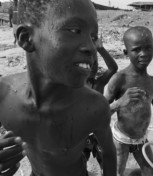
Three Senegalese boys (B&W) on the beach in M'Bour, Senegal, offering travel adventures and a photographer's dream in photos. (Image © Meredith Mullins.)

Showing themselves as they wish to be seen
© Meredith Mullins

They are also quite reticent to be photographed, for a number of very good reasons. They have suffered and have been taken advantage of—in history (slavery) and in contemporary life (tourists who click away with their cameras without respect for privacy or permission and without regard for the human heartbeat inside).

As a photographer of people, I have learned that an enduring and meaningful photograph comes from building a solid relationship with those you are photographing and by conveying a strong sense of place. In Senegal, this connection takes a sincere investment of time.

Meanwhile . . . Back to the Horse

I stayed with the horse washing crowd for a long time, as we played in the water and got to know one another. I learned the intricacies of sea water washing, as we made our horse as white and as bright as possible.

Senegal boy resting in the ocean in M'Bour, offering travel adventures and a photographer's dream in images. (Image © Meredith Mullins.)

Cooling off in the Atlantic
© Meredith Mullins

The kids became my muses and my friends, as well as an integral part of my photographs. They were simply themselves, and they allowed me to capture that essence.

Small boy on the beach in M'Bour, Senegal, offering travel adventures and a photographer's dream of Senegal portraits. (Image © Meredith Mullins.)

Meeting the essence of M’Bour on the beach
© Meredith Mullins

A Walk on the Beach

Several of the horse washing team then became my tour guides and accompanied me along the beach to every small community and encampment. I became a focus of attention. Everyone was interested in me . . . just as I was in them.

Crowds gathered. Children came running. Villagers waved in welcome.

And when I treated one village to candy from their shop, suddenly everyone was there. (A huge thank you to my guides for excellent crowd control.)

Villagers in M'Bour, Senegal reach for candy in the local shop. (Image © Meredith Mullins.)

A candy frenzy
© Meredith Mullins

As a result of this intense and real connection, I made more memorable photographs in a few hours than I have ever made in any other place.

Boy runs to the ocean in M'Bour, Senegal, offering travel adventures and a photographer's dream of images. (Image © Meredith Mullins.)

A run to the sea
© Meredith Mullins

That success was, in part, because of the vivid colors, the symphony of varied faces, and the bustling fishing life and love of the sea. But my “Oh, I see” moment was that it was also, in part, because I was fully present in their life, even for a brief moment in time.

Woman with baby on her back in M'Bour, Senegal, offering travel adventures and a photographer's dream of images. (Image © Meredith Mullins.)

Welcoming smiles from M’Bour villagers
© Meredith Mullins

They say in photography that if you make one strong photograph during a shooting day, you have been successful. A photographer’s dream.

I made many images that day that I treasure. It was a day rich in sensory experience. But more important than the photos, I still remember feeling a very real part of the Senegal rhythms, as the community of M’Bour washed, swam, fished, played, and turned toward the water for life and livelihood.

These are the kind of cultural encounters that stay with you forever.

Three boys on the beach in M'Bour, Senegal (B&W and close up), offering travel adventures and a photographer's dream in images. (Image © Meredith Mullins.)

New friends on the M’Bour beach walk
© Meredith Mullins

Comment on this post below. 

Aha Moments in Aarhus

by Joyce McGreevy on February 6, 2017

A kayaker savors an aha moment at sunset in Aarhus, where the 2017 European Capital of Culture will celebrate community connection to nature. (Image © Anders Hede/VisitAarhus)

A quiet sunset before the start of Aarhus 2017, a yearlong series of events
to celebrate community by rethinking it. 
© Anders Hede/VisitAarhus

Can we celebrate community by rethinking it?

The aha moments began at dawn with a mass bicycling event. As cyclists of all ages glided by, the winter mist rose like a curtain, revealing the newest European Capital of Culture. Aarhus 2017 had launched.  All year, this small Danish city will celebrate community by rethinking it.

Celebrations continued into the night, with songs lifted by the wind to soar above the crowds. As six Viking ships set sail, hundreds of choral singers and thousands of locals, each carrying illuminated paper ships, transformed the port into a sea of lights.

Water Music, a harbor-side event in Aarhus, 2017 European Capital of Culture, was staged to celebrate community by rethinking performance art and creating aha moments. (Image © Sõren Pagter/Aarhus 2017)

Rethinking theatre: Even a port can be a stage in Water Music, part of Aarhus 2017.
© Sõren Pagter/Aarhus 2017

Rethinking Creative Cities

Located a few hours west of Copenhagen, Aarhus (OR-hoose) has attracted growing numbers of international visitors. This is a city in love with nature. Harbor and forest surround it and a tranquil river flows through its bustling center.

The Aarhus River’s renewed visibility shows how rethinking leads to aha moments, one more reason to celebrate community. (Image © Joyce McGreevy)

Once paved over for cars, Aarhus River was reopened in 2005.
© Joyce McGreevy

It’s also home to some of the world’s most sophisticated architecture: landmarks like the Isbjerget (“Icebergs”)  and DOKK1, a tech-spectacular community hub and library.

Being a European Capital of Culture goes beyond tourism says Aarhus 2017 Program Director Juliana Engberg. “It raises the ambitions of a city and its region. It encourages us to stand up and be noticed, and to become a creative city.”

The Isbjerget (“Icebergs”) of Aarhus, 2017 European Capital of Culture, reflect how rethinking architecture leads to aha moments. (Image © Kim Wyon/VisitDenmark)

Rethinking structure: Uniquely angled to resemble icebergs,
these Aarhus apartments maximize views of the sea.
© Kim Wyon/VisitDenmark

Rethinking Time Travel

Taking notice of Aarhus is a good idea.  With a population of 315, 000, Aarhus is a heady mix of charmed village and edgy urban hive.

Møllestien, the most photographed street for aha moments in Aarhus, was saved by rethinking how housing can celebrate community. (Image © Joyce McGreevy)

Rethinking housing: 18th century Møllestien, the most photographed street
in Aarhus, once faced demolition. Then artists and students moved in.
© Joyce McGreevy

To explore it is to wander through time. One moment you’re strolling the cobblestones of Møllestien (“Mill Lane”), where hollyhocks and roses frame half-timbered cottages. Next moment, you’re gazing up at the rainbow-tinted circular skywalk of the ARoS Museum of Modern Art.

The rainbow skywalk of ARoS Museum of Modern Art inspires aha moments that celebrate community in Aarhus, the 2017 European Capital of Culture. (Image © Joyce McGreevy)

Rethinking vision: A skywalk by Olafur Eliasson atop ARoS offers
rainbow-tinted panoramas of the city.
© Joyce McGreevy

Historically, Aarhus is one of Scandinavia’s oldest cities, founded around 770. But its concentration of university students makes it one of the youngest cities.

And wow, does Aarhus welcome new arrivals. Whenever a child is born here, parents press a button at the local hospital, sounding a three-ton bronze bell in that high-tech library.

Rethinking Past and Future

The theme of Aarhus 2017 is Let’s Rethink.  “We will examine our Danish DNA,” say organizers, “and take delight and pride in its unique history.” Folkelige (popular traditions) are part of the program, including Viking pageants to rival the most binge-worthy Nordic dramas.

A woman re-enacts 17th century life in Aarhus, where such aha moments celebrate community history by rethinking it. (Image © Joyce McGreevy)

Rethinking history: An immersive living museum in Old Town Aarhus
leads you from the 1700s to the 1970s.
© Joyce McGreevy

Rethinking the Future

But diversity and the future play an even larger role. In forums, performances, and feasts, people in Aarhus will explore social media and social isolation, individual rights and collaborative endeavors, stereotypes about ages and cultures, and the potential of all generations.

At the People’s Feast later this spring, long, connected tables will be set up along city streets, and 500 locals and visitors will have supper and talk things over.

These days, there’s certainly plenty to talk about. Aarhus 2017 suggests that people the world over dare to rethink together, too.

Oh, I see: As people in one culture ask the big questions, people in cultures everywhere can move closer to meaningful answers.

Diners celebrate community at one long outdoor table in Aarhus, designed to inspire aha moments by rethinking food and fellowship. (Image © Stefan Ravn/Aarhus 2017)

Rethinking social media: “The biggest dinner party in the history of Denmark,”
The People’s Feast encourages public discussion and debate over a good meal.
© Stefan Ravn/Aarhus 2017

Rethinking Cultures

This year will be transformative for Aarhus, and not just as 2017 Capital of European Culture. As one organizer said, “We’re asking big questions of ourselves, such as: What will it mean to be human in the future?” An urgent question indeed.

What aha moments will occur? What new ideas will travel from Aarhus to your house?

Where else in the world might people sit down at one table? How can we connect what makes us unique from one another and recognize in it our shared humanity? How can we all rethink together?

Imagine a place where, as each new arrival joins us, we ring a bell of welcome. Could that be what it means to celebrate community?

Experience ARoS from the inside. Tour Olafur Eliasson’s skywalk here.

Comment on this post below, or inspire insight with your own OIC Moment here.

Copyright © 2011-2025 OIC Books   |   All Rights Reserved   |   Privacy Policy