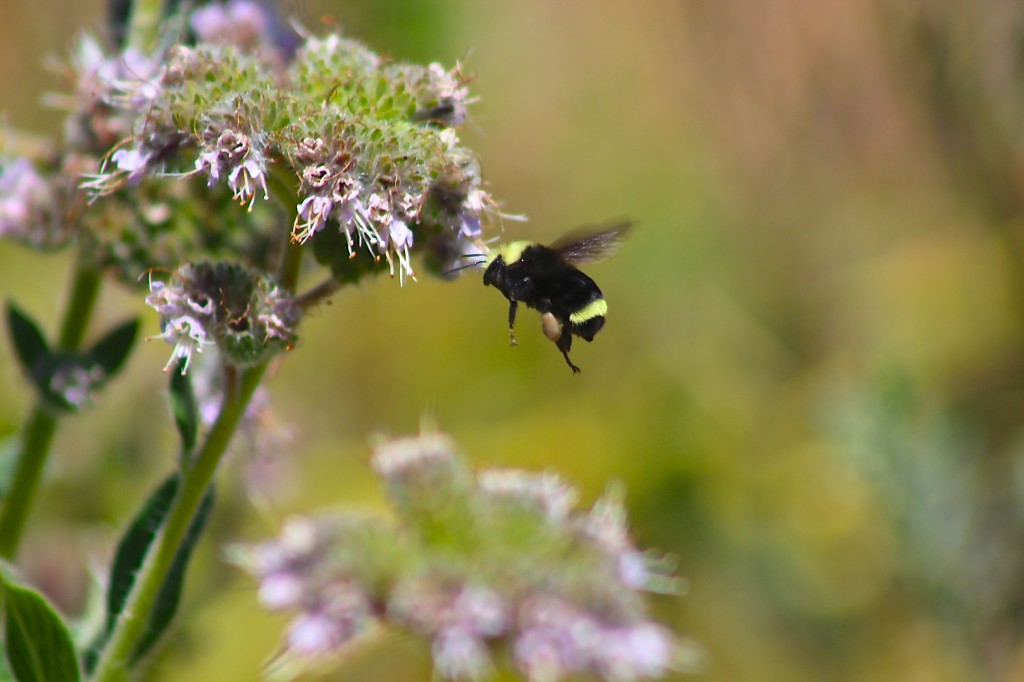
<div id="attachment_8829" style="width: 570px" class="wp-caption aligncenter"><img loading="lazy" decoding="async" aria-describedby="caption-attachment-8829" class="size-large wp-image-8829 " src="https://www.oh-i-see.com/blog/wp-content/uploads/2013/05/IMG_4890-1024x682.jpg" alt="A bumblebee whose behavior shows life lessons in a bee garden" width="560" height="372" srcset="https://www.oh-i-see.com/blog/wp-content/uploads/2013/05/IMG_4890-1024x682.jpg 1024w, https://www.oh-i-see.com/blog/wp-content/uploads/2013/05/IMG_4890-300x200.jpg 300w, https://www.oh-i-see.com/blog/wp-content/uploads/2013/05/IMG_4890-207x138.jpg 207w" sizes="auto, (max-width: 560px) 100vw, 560px" /><p id="caption-attachment-8829" class="wp-caption-text">A bumblebee approaches a phacelia.<br />© Janine Boylan</p></div>
<p>The other day I met some neighbors I didn&#8217;t know too well: bees. Walking through a bee garden planted especially for bees, I learned a lot about these little creatures. They had some <strong>Oh, I see</strong> important life lessons for me, too.<strong><br />
</strong></p>
<h4>1. Diversity is the spice of life.</h4>
<p>When you think of bees, it&#8217;s likely that you picture a honeybee. But the honeybee is only one of many, many different kinds of bees.</p>
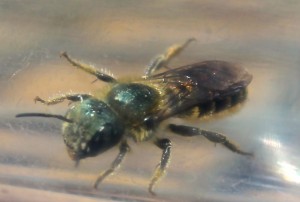
<div id="attachment_8832" style="width: 310px" class="wp-caption aligncenter"><img loading="lazy" decoding="async" aria-describedby="caption-attachment-8832" class="size-medium wp-image-8832 " src="https://www.oh-i-see.com/blog/wp-content/uploads/2013/05/IMG_4842-300x202.jpg" alt="A green leafcutter bee, whose behavior shows life lessons in a bee garden" width="300" height="202" srcset="https://www.oh-i-see.com/blog/wp-content/uploads/2013/05/IMG_4842-300x202.jpg 300w, https://www.oh-i-see.com/blog/wp-content/uploads/2013/05/IMG_4842-207x139.jpg 207w, https://www.oh-i-see.com/blog/wp-content/uploads/2013/05/IMG_4842.jpg 635w" sizes="auto, (max-width: 300px) 100vw, 300px" /><p id="caption-attachment-8832" class="wp-caption-text">A green leaf-cutter bee<br />© Janine Boylan</p></div>
<p>There are about <a href="http://www.fs.usda.gov/Internet/FSE_DOCUMENTS/stelprdb5306468.pdf" target="_blank" rel="noopener">4,000 species of bees</a> in North America: round fuzzy striped bumblebees, small bright green sweat bees, thin yellow and black leaf-cutter bees, big black carpenter bees, and more. </p>{"id":8827,"date":"2013-05-27T03:00:57","date_gmt":"2013-05-27T10:00:57","guid":{"rendered":"http:\/\/ohisee.genweb.site\/blog\/?p=8827"},"modified":"2021-07-21T10:05:01","modified_gmt":"2021-07-21T17:05:01","slug":"seven-important-life-lessons-in-a-bee-garden","status":"publish","type":"post","link":"https:\/\/www.oh-i-see.com\/blog\/seven-important-life-lessons-in-a-bee-garden\/","title":{"rendered":"Seven Important Life Lessons in a Bee Garden"},"content":{"rendered":"<div id=\"attachment_8829\" style=\"width: 570px\" class=\"wp-caption aligncenter\"><img loading=\"lazy\" decoding=\"async\" aria-describedby=\"caption-attachment-8829\" class=\"size-large wp-image-8829 \" src=\"https:\/\/www.oh-i-see.com\/blog\/wp-content\/uploads\/2013\/05\/IMG_4890-1024x682.jpg\" alt=\"A bumblebee whose behavior shows life lessons in a bee garden\" width=\"560\" height=\"372\" srcset=\"https:\/\/www.oh-i-see.com\/blog\/wp-content\/uploads\/2013\/05\/IMG_4890-1024x682.jpg 1024w, https:\/\/www.oh-i-see.com\/blog\/wp-content\/uploads\/2013\/05\/IMG_4890-300x200.jpg 300w, https:\/\/www.oh-i-see.com\/blog\/wp-content\/uploads\/2013\/05\/IMG_4890-207x138.jpg 207w\" sizes=\"auto, (max-width: 560px) 100vw, 560px\" \/><p id=\"caption-attachment-8829\" class=\"wp-caption-text\">A bumblebee approaches a phacelia.<br \/>\u00a9 Janine Boylan<\/p><\/div>\n<p>The other day I met some neighbors I didn&#8217;t know too well: bees. Walking through a bee garden planted especially for bees, I learned a lot about these little creatures. They had some <strong>Oh, I see<\/strong>\u00a0important life lessons for me, too.<strong><br \/>\n<\/strong><\/p>\n<h4>1. Diversity is the spice of life.<\/h4>\n<p>When you think of bees, it&#8217;s likely that you picture a honeybee. But the honeybee is only one of many, many different kinds of bees.<\/p>\n<div id=\"attachment_8832\" style=\"width: 310px\" class=\"wp-caption aligncenter\"><img loading=\"lazy\" decoding=\"async\" aria-describedby=\"caption-attachment-8832\" class=\"size-medium wp-image-8832 \" src=\"https:\/\/www.oh-i-see.com\/blog\/wp-content\/uploads\/2013\/05\/IMG_4842-300x202.jpg\" alt=\"A green leafcutter bee, whose behavior shows life lessons in a bee garden\" width=\"300\" height=\"202\" srcset=\"https:\/\/www.oh-i-see.com\/blog\/wp-content\/uploads\/2013\/05\/IMG_4842-300x202.jpg 300w, https:\/\/www.oh-i-see.com\/blog\/wp-content\/uploads\/2013\/05\/IMG_4842-207x139.jpg 207w, https:\/\/www.oh-i-see.com\/blog\/wp-content\/uploads\/2013\/05\/IMG_4842.jpg 635w\" sizes=\"auto, (max-width: 300px) 100vw, 300px\" \/><p id=\"caption-attachment-8832\" class=\"wp-caption-text\">A green leaf-cutter bee<br \/>\u00a9 Janine Boylan<\/p><\/div>\n<p>There are about <a href=\"http:\/\/www.fs.usda.gov\/Internet\/FSE_DOCUMENTS\/stelprdb5306468.pdf\" target=\"_blank\" rel=\"noopener\">4,000 species of bees<\/a> in North America: round fuzzy striped bumblebees, small bright green sweat bees, thin yellow and black leaf-cutter bees, big black carpenter bees, and more.<!--more--><\/p>\n<h4>2. It&#8217;s the little things that count.<\/h4>\n<p>Bees may be tiny, but they are critical.<\/p>\n<ul>\n<li>Many plants depend on bees and other pollinators to carry pollen from one plant to another. The transfer of pollen fertilizes the plants and allows them to produce fruit.<\/li>\n<li>About 1\/3 of the food we eat needs to be pollinated. Without bees, flowering food crops like almonds, apricots, olives, and strawberries would not mature.<\/li>\n<li>Because pesticides and disease have greatly reduced the bee population, farmers now rent hives so that honeybees will pollinate the crops. For example, California&#8217;s almond growers hire about one million hives, or about half of the managed U.S. honeybees, to pollinate their crops.<\/li>\n<li>A recent <a href=\"http:\/\/www.guardian.co.uk\/environment\/2013\/feb\/28\/wild-bees-pollinators-crop-yields\" target=\"_blank\" rel=\"noopener\">study\u00a0led by Lucas Garibaldi<\/a>\u00a0concluded that native bees are about twice as effective as honeybees in pollinating crops. Native bees use various pollinating techniques and tend to visit a larger variety of plants than honeybees.\u00a0But they do not live in hives like honeybees so their native\u00a0habitats\u00a0need to be preserved near fields that they can pollinate.<\/li>\n<\/ul>\n<p>We need to make sure we keep these little guys going!<\/p>\n<h4>3. There is more than one way to get a job done.<\/h4>\n<p>Bees spend their days gathering pollen for their young, but different bees collect pollen differently. Some gather it in pollen sacks on special flattened parts of their legs. Others collect it on their undersides with a pollen brush. Both methods are equally effective!<\/p>\n<div id=\"attachment_8831\" style=\"width: 672px\" class=\"wp-caption aligncenter\"><img loading=\"lazy\" decoding=\"async\" aria-describedby=\"caption-attachment-8831\" class=\" wp-image-8831 \" src=\"https:\/\/www.oh-i-see.com\/blog\/wp-content\/uploads\/2013\/05\/IMG_4870.jpg\" alt=\"A leafcutter bee collecting pollen and showing life lessons in a bee garden\" width=\"662\" height=\"439\" srcset=\"https:\/\/www.oh-i-see.com\/blog\/wp-content\/uploads\/2013\/05\/IMG_4870.jpg 1378w, https:\/\/www.oh-i-see.com\/blog\/wp-content\/uploads\/2013\/05\/IMG_4870-300x199.jpg 300w, https:\/\/www.oh-i-see.com\/blog\/wp-content\/uploads\/2013\/05\/IMG_4870-1024x679.jpg 1024w, https:\/\/www.oh-i-see.com\/blog\/wp-content\/uploads\/2013\/05\/IMG_4870-207x137.jpg 207w\" sizes=\"auto, (max-width: 662px) 100vw, 662px\" \/><p id=\"caption-attachment-8831\" class=\"wp-caption-text\">A leaf-cutter bee collects pollen with a pollen brush.<br \/>\u00a9 Janine Boylan<\/p><\/div>\n<h4>4. Learn to adapt.<\/h4>\n<p>Each type of bee favors different types of plants. Bumblebees may wallow in floppy\u00a0orange poppies, but leaf-cutter bees prefer to flit from tiny thyme flower to tiny thyme flower.<\/p>\n<p>The bee and its preferred flowers often have adapted so that they have synchronous life cycles. When the bee needs the flower in order to gather food, the flower is blooming. When the flower needs the bee in order to be pollinated, the bee is fully grown and ready to work.<\/p>\n<h4>5. Surround yourself with what you love.<\/h4>\n<p><a href=\"http:\/\/nature.berkeley.edu\/urbanbeegardens\/general_guidelines.html\" target=\"_blank\" rel=\"noopener\">Bee\u00a0gardens<\/a> that have a variety of flowering bee-friendly plants such as cosmos, catmint, and tidytips are most attractive to these creatures. They particularly appreciate large patches (1.5 meters square) of each type of flower.<\/p>\n<p>Bees also will frequent gardens that have flowers in spring, summer, and fall so that they have a constant food source year-round.<\/p>\n<div id=\"attachment_8830\" style=\"width: 494px\" class=\"wp-caption aligncenter\"><img loading=\"lazy\" decoding=\"async\" aria-describedby=\"caption-attachment-8830\" class=\" wp-image-8830 \" src=\"https:\/\/www.oh-i-see.com\/blog\/wp-content\/uploads\/2013\/05\/IMG_4975.jpg\" alt=\"A honeybee, whose behavior shows life lessons in a bee garden\" width=\"484\" height=\"431\" srcset=\"https:\/\/www.oh-i-see.com\/blog\/wp-content\/uploads\/2013\/05\/IMG_4975.jpg 1154w, https:\/\/www.oh-i-see.com\/blog\/wp-content\/uploads\/2013\/05\/IMG_4975-300x266.jpg 300w, https:\/\/www.oh-i-see.com\/blog\/wp-content\/uploads\/2013\/05\/IMG_4975-1024x910.jpg 1024w, https:\/\/www.oh-i-see.com\/blog\/wp-content\/uploads\/2013\/05\/IMG_4975-207x184.jpg 207w\" sizes=\"auto, (max-width: 484px) 100vw, 484px\" \/><p id=\"caption-attachment-8830\" class=\"wp-caption-text\">A honeybee on lavender<br \/>\u00a9 Janine Boylan<\/p><\/div>\n<h4>6. Live in the way that is most comfortable to you.<\/h4>\n<p>Honeybees and bumblebees live in colonies with a queen, but most other bees are solitary. For example, a\u00a0mining bee or a sweat bee lives in the ground. A leaf-cutter bee lives in a stem or in a hole in a log.<\/p>\n<p>When a solitary female has mated and is ready to lay eggs, she proceeds alone:<\/p>\n<ul>\n<li>First, she gathers pollen and nectar which she mixes together to form a &#8220;pollen loaf.&#8221;<\/li>\n<li>Next she\u00a0digs a hole in the ground and alternates pollen loaves and eggs.<\/li>\n<li>Then she seals the hole and leaves.<\/li>\n<\/ul>\n<p>The eggs hatch, and even the babies are left to care for themselves&#8212;with no\u00a0doting\u00a0worker bees to watch over them.<\/p>\n<h4>7. The truth doesn&#8217;t have to sting.<\/h4>\n<p>Bees have a bad\u00a0reputation\u00a0for painful stings, but the truth is that most bees are harmless and gentle.<\/p>\n<p>A bee will defend its home if it is disturbed, but bees prefer to gather pollen than sting people. And a sting is a last resort. Bees will flee the scene or buzz angrily before stinging.<\/p>\n<p>Also, while honeybees give their lives for a sting, native bees can sting multiple times. It&#8217;s only the female that stings because the stinger is a modified egg-laying device.<\/p>\n<h4>OIC-d-Bs!<\/h4>\n<p>What important life lessons from the bees!<\/p>\n<p>Maybe next weekend I&#8217;ll plant a bee garden of my own to inspire even more wisdom!<\/p>\n<div id=\"attachment_8943\" style=\"width: 310px\" class=\"wp-caption aligncenter\"><img loading=\"lazy\" decoding=\"async\" aria-describedby=\"caption-attachment-8943\" class=\"size-medium wp-image-8943 \" src=\"https:\/\/www.oh-i-see.com\/blog\/wp-content\/uploads\/2013\/05\/IMG_4888-300x200.jpg\" alt=\"A bee garden where important life lessons are on display\" width=\"300\" height=\"200\" srcset=\"https:\/\/www.oh-i-see.com\/blog\/wp-content\/uploads\/2013\/05\/IMG_4888-300x200.jpg 300w, https:\/\/www.oh-i-see.com\/blog\/wp-content\/uploads\/2013\/05\/IMG_4888-1024x682.jpg 1024w, https:\/\/www.oh-i-see.com\/blog\/wp-content\/uploads\/2013\/05\/IMG_4888-207x138.jpg 207w\" sizes=\"auto, (max-width: 300px) 100vw, 300px\" \/><p id=\"caption-attachment-8943\" class=\"wp-caption-text\">All bees are welcome in this bee garden!<br \/>\u00a9 Janine Boylan<\/p><\/div>\n<p><em>Special thanks to Patrick Stadille for inspiring this post and for making sure my bee facts are right.<\/em><\/p>\n<p><em>To learn more about bees and creating bee gardens, click to download our free guide:<\/em><span id=\"hs-cta-wrapper-1fa9f866-92d3-471b-b3ae-41298bef6271\" class=\"hs-cta-wrapper\"><span id=\"hs-cta-1fa9f866-92d3-471b-b3ae-41298bef6271\" class=\"hs-cta-node hs-cta-1fa9f866-92d3-471b-b3ae-41298bef6271\"><br \/>\n<\/span><\/span> <!-- end HubSpot Call-to-Action Code --><\/p>\n<p><a href=\"https:\/\/www.oh-i-see.com\/blog\/wp-content\/uploads\/2014\/07\/BeeSources2.pdf\"><img loading=\"lazy\" decoding=\"async\" class=\"aligncenter wp-image-19561 size-full\" src=\"https:\/\/www.oh-i-see.com\/blog\/wp-content\/uploads\/2014\/07\/Bee-sources-CTA400.jpg\" alt=\"\" width=\"400\" height=\"101\" srcset=\"https:\/\/www.oh-i-see.com\/blog\/wp-content\/uploads\/2014\/07\/Bee-sources-CTA400.jpg 400w, https:\/\/www.oh-i-see.com\/blog\/wp-content\/uploads\/2014\/07\/Bee-sources-CTA400-300x75.jpg 300w, https:\/\/www.oh-i-see.com\/blog\/wp-content\/uploads\/2014\/07\/Bee-sources-CTA400-207x52.jpg 207w\" sizes=\"auto, (max-width: 400px) 100vw, 400px\" \/><\/a><\/p>\n<p>&nbsp;<\/p>\n<p><em><em><a title=\"Creative Inspiration Flows In Underwater Photographs\" href=\"#comments\">Comment<\/a>\u00a0<\/em>on this post below, or inspire insight with your own\u00a0OIC Moment\u00a0<\/em><a href=\"https:\/\/www.oh-i-see.com\/blog\/your-oic-moments\/\"><em>here<\/em><\/a><em>.<\/em><\/p>","protected":false},"excerpt":{"rendered":null,"protected":false},"author":6,"featured_media":8829,"comment_status":"closed","ping_status":"open","sticky":false,"template":"","format":"standard","meta":{"footnotes":""},"categories":[202],"tags":[],"class_list":["post-8827","post","type-post","status-publish","format-standard","has-post-thumbnail","hentry","category-lessons-life"],"aioseo_notices":[],"_links":{"self":[{"href":"https:\/\/www.oh-i-see.com\/blog\/wp-json\/wp\/v2\/posts\/8827","targetHints":{"allow":["GET"]}}],"collection":[{"href":"https:\/\/www.oh-i-see.com\/blog\/wp-json\/wp\/v2\/posts"}],"about":[{"href":"https:\/\/www.oh-i-see.com\/blog\/wp-json\/wp\/v2\/types\/post"}],"author":[{"embeddable":true,"href":"https:\/\/www.oh-i-see.com\/blog\/wp-json\/wp\/v2\/users\/6"}],"replies":[{"embeddable":true,"href":"https:\/\/www.oh-i-see.com\/blog\/wp-json\/wp\/v2\/comments?post=8827"}],"version-history":[{"count":3,"href":"https:\/\/www.oh-i-see.com\/blog\/wp-json\/wp\/v2\/posts\/8827\/revisions"}],"predecessor-version":[{"id":40846,"href":"https:\/\/www.oh-i-see.com\/blog\/wp-json\/wp\/v2\/posts\/8827\/revisions\/40846"}],"wp:featuredmedia":[{"embeddable":true,"href":"https:\/\/www.oh-i-see.com\/blog\/wp-json\/wp\/v2\/media\/8829"}],"wp:attachment":[{"href":"https:\/\/www.oh-i-see.com\/blog\/wp-json\/wp\/v2\/media?parent=8827"}],"wp:term":[{"taxonomy":"category","embeddable":true,"href":"https:\/\/www.oh-i-see.com\/blog\/wp-json\/wp\/v2\/categories?post=8827"},{"taxonomy":"post_tag","embeddable":true,"href":"https:\/\/www.oh-i-see.com\/blog\/wp-json\/wp\/v2\/tags?post=8827"}],"curies":[{"name":"wp","href":"https:\/\/api.w.org\/{rel}","templated":true}]}}