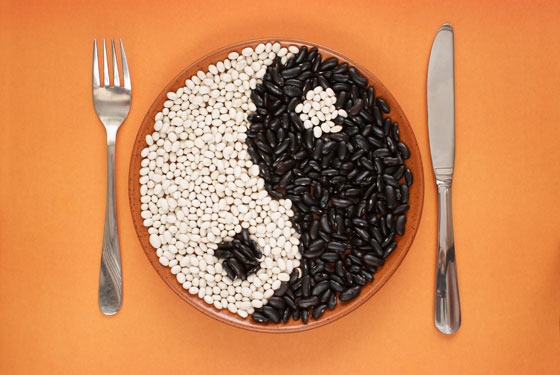
<div id="attachment_7099" style="width: 570px" class="wp-caption aligncenter"><img loading="lazy" decoding="async" aria-describedby="caption-attachment-7099" class="size-full wp-image-7099 " src="https://www.oh-i-see.com/blog/wp-content/uploads/2013/03/123089381sized.jpg" alt="Yin-yang symbol representing a concept learned by crossing cultures" width="560" height="375" srcset="https://www.oh-i-see.com/blog/wp-content/uploads/2013/03/123089381sized.jpg 560w, https://www.oh-i-see.com/blog/wp-content/uploads/2013/03/123089381sized-300x200.jpg 300w, https://www.oh-i-see.com/blog/wp-content/uploads/2013/03/123089381sized-207x138.jpg 207w" sizes="auto, (max-width: 560px) 100vw, 560px" /><p id="caption-attachment-7099" class="wp-caption-text">Yin and yang are always on the plate of life.</p>
<p></p></div>
<h4>Embracing Different Cultures</h4>
<p>Often the first taste of another culture is through its food or music or fashion, something like &#8220;hello.&#8221; But people who find a way of crossing cultures&#8212;stepping inside the culture&#8217;s traditions, language, history, attitudes, and beliefs&#8212;are forever changed by the experience. </p>{"id":7086,"date":"2013-03-28T03:00:30","date_gmt":"2013-03-28T10:00:30","guid":{"rendered":"http:\/\/ohisee.genweb.site\/blog\/?p=7086"},"modified":"2021-07-20T09:32:36","modified_gmt":"2021-07-20T16:32:36","slug":"the-yin-and-yang-of-crossing-cultures","status":"publish","type":"post","link":"https:\/\/www.oh-i-see.com\/blog\/the-yin-and-yang-of-crossing-cultures\/","title":{"rendered":"The Yin and Yang of Crossing Cultures"},"content":{"rendered":"<div id=\"attachment_7099\" style=\"width: 570px\" class=\"wp-caption aligncenter\"><img loading=\"lazy\" decoding=\"async\" aria-describedby=\"caption-attachment-7099\" class=\"size-full wp-image-7099 \" src=\"https:\/\/www.oh-i-see.com\/blog\/wp-content\/uploads\/2013\/03\/123089381sized.jpg\" alt=\"Yin-yang symbol representing a concept learned by crossing cultures\" width=\"560\" height=\"375\" srcset=\"https:\/\/www.oh-i-see.com\/blog\/wp-content\/uploads\/2013\/03\/123089381sized.jpg 560w, https:\/\/www.oh-i-see.com\/blog\/wp-content\/uploads\/2013\/03\/123089381sized-300x200.jpg 300w, https:\/\/www.oh-i-see.com\/blog\/wp-content\/uploads\/2013\/03\/123089381sized-207x138.jpg 207w\" sizes=\"auto, (max-width: 560px) 100vw, 560px\" \/><p id=\"caption-attachment-7099\" class=\"wp-caption-text\">Yin and yang are always on the plate of life.<\/p>\n<p><\/p><\/div>\n<h4>Embracing Different Cultures<\/h4>\n<p>Often the first taste of another culture is through its food or music or fashion, something like &#8220;hello.&#8221; But people who find a way of crossing cultures&#8212;stepping inside the culture&#8217;s traditions, language, history, attitudes, and beliefs&#8212;are forever changed by the experience.<!--more--><\/p>\n<p>In the Taoist <em>yin<\/em>&#8211;<em>yang<\/em> symbol:<\/p>\n<ul>\n<li>The\u00a0outer circle represents the &#8220;everything,&#8221; an indivisible whole.<\/li>\n<li>The black-and-white shapes inside show two opposite but interdependent energies that are constantly transforming each other, much like a kaleidoscope.<\/li>\n<li>Night and day or birth and death are examples. They are opposite but interconnected; one cannot exist without the other.<\/li>\n<\/ul>\n<p>In much the same way, two cultures can seem to be opposites and yet make up the indivisible whole of a person who has embraced both.<\/p>\n<h4><strong>One Artist&#8217;s Quest<\/strong><\/h4>\n<p>Born in France and a doctor by profession, <a href=\"http:\/\/goldpapers.weebly.com\/index.html\" target=\"_blank\" rel=\"noopener\">Fran\u00e7oise Ben Arous<\/a> understands the influence and creative inspiration of different cultures.<\/p>\n<p>Though she has traveled worldwide, it was a\u00a0trip to Hanoi, Vietnam, a few years ago, that became her turning point, a compelling <strong>OIC moment<\/strong>. According to Romanian artists Eduard Andrei:<\/p>\n<p style=\"padding-left: 30px; text-align: left;\"><em>&#8220;She then began an initiatory journey to find her true self, as a person and as an artist, by exploring profound Asia, whose culture she felt as an integral part of her spiritual identity.&#8221;<\/em><\/p>\n<p>Arous&#8217; work, a mix of her Western heritage and Eastern Zen philosophy, is represented by the <a href=\"http:\/\/emmanuelfremingallery.com\/\" target=\"_blank\" rel=\"noopener\">Emmanuel Fremin Gallery<\/a>\u00a0and offers a view into the beauty of cross-cultural art.<\/p>\n<div id=\"attachment_7089\" style=\"width: 570px\" class=\"wp-caption aligncenter\"><img loading=\"lazy\" decoding=\"async\" aria-describedby=\"caption-attachment-7089\" class=\"wp-image-7089 size-large\" src=\"https:\/\/www.oh-i-see.com\/blog\/wp-content\/uploads\/2013\/03\/Grand-Tressage-High-1024x660.jpg\" alt=\"Collage made of joss paper, showing creative expression that comes from crossing cultures \" width=\"560\" height=\"361\" srcset=\"https:\/\/www.oh-i-see.com\/blog\/wp-content\/uploads\/2013\/03\/Grand-Tressage-High-1024x660.jpg 1024w, https:\/\/www.oh-i-see.com\/blog\/wp-content\/uploads\/2013\/03\/Grand-Tressage-High-300x193.jpg 300w, https:\/\/www.oh-i-see.com\/blog\/wp-content\/uploads\/2013\/03\/Grand-Tressage-High-207x133.jpg 207w, https:\/\/www.oh-i-see.com\/blog\/wp-content\/uploads\/2013\/03\/Grand-Tressage-High.jpg 1577w\" sizes=\"auto, (max-width: 560px) 100vw, 560px\" \/><p id=\"caption-attachment-7089\" class=\"wp-caption-text\">&#8220;Grand Tressage High,&#8221; collage \u00a9 Fran\u00e7oise Ben Arous. <br \/>Arous&#8217; signature, a seal like those on traditional Japanese and Chinese paintings, shows her attachment to Asian culture.<\/p><\/div>\n<h4>Cultural Discovery<\/h4>\n<p>The works are collages with a sculptural feel. They are created from <a href=\"http:\/\/www.nationsonline.org\/oneworld\/Chinese_Customs\/joss_paper.htm\" target=\"_blank\" rel=\"noopener\">joss paper<\/a>, which itself is a coarse paper handmade from bamboo and containing a thin layer of metal in gold or silver.<\/p>\n<div id=\"attachment_7269\" style=\"width: 410px\" class=\"wp-caption aligncenter\"><img loading=\"lazy\" decoding=\"async\" aria-describedby=\"caption-attachment-7269\" class=\"size-full wp-image-7269\" src=\"https:\/\/www.oh-i-see.com\/blog\/wp-content\/uploads\/2013\/03\/JossPaper.jpg\" alt=\"Joss paper samples like those used by Fran\u00e7oise Ben Arous in artwork inspired by crossing cultures\" width=\"400\" height=\"224\" srcset=\"https:\/\/www.oh-i-see.com\/blog\/wp-content\/uploads\/2013\/03\/JossPaper.jpg 400w, https:\/\/www.oh-i-see.com\/blog\/wp-content\/uploads\/2013\/03\/JossPaper-300x168.jpg 300w, https:\/\/www.oh-i-see.com\/blog\/wp-content\/uploads\/2013\/03\/JossPaper-207x115.jpg 207w\" sizes=\"auto, (max-width: 400px) 100vw, 400px\" \/><p id=\"caption-attachment-7269\" class=\"wp-caption-text\">Joss papers with gold foil (left) and with silver foil (right)<br \/>photographs CC courtesy, <span style=\"color: #0000ff;\"><a href=\"http:\/\/commons.wikimedia.org\/wiki\/User:Kanashimi\" target=\"_blank\" rel=\"noopener\"><span style=\"color: #0000ff;\">Kanashimi<\/span><\/a><\/span><\/p><\/div>\n<p>In some Asian cultures, joss paper is burned during\u00a0<a href=\"http:\/\/www.nationsonline.org\/oneworld\/Chinese_Customs\/taoism_ancestor_worship.htm\" target=\"_blank\" rel=\"noopener\">ancestor worship<\/a>, a ritual reflecting the concept of the family as a close unit of living and dead relatives. Joss paper is known as\u00a0<em>jin\u00a0<\/em>or\u00a0<em>yin.<\/em><\/p>\n<ul>\n<li><i>Jin\u00a0<\/i>has\u00a0a gold metal square and\u00a0is given to both the deceased and higher gods, such as the Jade Emperor.<\/li>\n<li><em>Yin\u00a0<\/em>has a silver metal square and<em>\u00a0<\/em>is for offerings to the spirits of ancestors and local deities.<\/li>\n<\/ul>\n<p>Joss paper is burned as an offering at funerals, on special holidays, and\u00a0throughout the year at shrines in family homes.<\/p>\n<h4>From Cultural Discovery to Creative Expression<\/h4>\n<p>After discovering the origin of joss paper on her first trip to Hanoi, Arous returned often to find the best quality paper for her artistic creations, and it became the favored medium for her collages.<\/p>\n<p>She was attracted by the pictorial quality of the paper. She cuts it into geometric shapes and attaches it to board or canvas, creating abstract 3-D compositions, described by Eduard Andrei, as &#8220;sometimes evoking urban or geometric structures.&#8221;<\/p>\n<div id=\"attachment_7090\" style=\"width: 460px\" class=\"wp-caption aligncenter\"><a href=\"https:\/\/www.oh-i-see.com\/blog\/wp-content\/uploads\/2013\/03\/Indigo-1-High.jpg\"><img loading=\"lazy\" decoding=\"async\" aria-describedby=\"caption-attachment-7090\" class=\" wp-image-7090 \" src=\"https:\/\/www.oh-i-see.com\/blog\/wp-content\/uploads\/2013\/03\/Indigo-1-High.jpg\" alt=\"Collage made of joss paper, showing creative expression that comes from crossing cultures \" width=\"450\" height=\"558\" srcset=\"https:\/\/www.oh-i-see.com\/blog\/wp-content\/uploads\/2013\/03\/Indigo-1-High.jpg 580w, https:\/\/www.oh-i-see.com\/blog\/wp-content\/uploads\/2013\/03\/Indigo-1-High-241x300.jpg 241w, https:\/\/www.oh-i-see.com\/blog\/wp-content\/uploads\/2013\/03\/Indigo-1-High-166x207.jpg 166w\" sizes=\"auto, (max-width: 450px) 100vw, 450px\" \/><\/a><p id=\"caption-attachment-7090\" class=\"wp-caption-text\">&#8220;Indigo 1 High,&#8221; joss paper collage with colored accents <br \/>\u00a9 Fran\u00e7oise Ben Arous<\/p><\/div>\n<p>In some compositions, Arous keeps to a monochromatic harmony in gold or silver. In others, she may enhance the papers by adding color accents of acrylic or watercolor and textures achieved through thin incisions.<\/p>\n<div id=\"attachment_7088\" style=\"width: 485px\" class=\"wp-caption aligncenter\"><img loading=\"lazy\" decoding=\"async\" aria-describedby=\"caption-attachment-7088\" class=\" wp-image-7088\" src=\"https:\/\/www.oh-i-see.com\/blog\/wp-content\/uploads\/2013\/03\/CHANDIGARH-e1364348030544.jpg\" alt=\"Collage made of joss paper, showing creative expression that comes from crossing cultures\" width=\"475\" height=\"648\" srcset=\"https:\/\/www.oh-i-see.com\/blog\/wp-content\/uploads\/2013\/03\/CHANDIGARH-e1364348030544.jpg 432w, https:\/\/www.oh-i-see.com\/blog\/wp-content\/uploads\/2013\/03\/CHANDIGARH-e1364348030544-219x300.jpg 219w\" sizes=\"auto, (max-width: 475px) 100vw, 475px\" \/><p id=\"caption-attachment-7088\" class=\"wp-caption-text\">&#8220;Chandigarh,&#8221; joss paper collage whose wavy high relief <br \/>connotes fluidity of movement<br \/>\u00a9 Fran\u00e7oise Ben Arous<\/p><\/div>\n<p>Despite the association of joss paper with the deceased, Arous&#8217; works convey a joy of living. The metal sheets capture and reflect light in ways that change with the time of the day or the vantage point of the viewer.<\/p>\n<p>Luminosity and movement characterize her works, which Andrei calls &#8220;jewel-like.&#8221; He continues:<\/p>\n<p style=\"padding-left: 60px;\"><em>&#8220;Fran\u00e7oise&#8217;s works thus call to mind the aesthetic of the Japanese prints\u00a0<\/em>Ukiyo-e<em> (literally images of the floating world) and of Impressionism.&#8221;<\/em><\/p>\n<p>From the West, Arous also cites Henri Matisse, Paul Klee, and the Art Deco period as influences on her work. Clearly, East and West&#8212;two energies, both powerful like y<em>in<\/em>\u00a0and\u00a0<em>yang&#8212;<\/em>meet\u00a0in her work,\u00a0and the result is a richness of creative expression attained by crossing cultures.<\/p>\n<p><strong>Oh, I see<\/strong>&#8212;as it is in art, it is in life that two cultures shared are a remarkable inspiration.<\/p>\n<div id=\"attachment_7271\" style=\"width: 160px\" class=\"wp-caption aligncenter\"><img loading=\"lazy\" decoding=\"async\" aria-describedby=\"caption-attachment-7271\" class=\"size-thumbnail wp-image-7271 \" src=\"https:\/\/www.oh-i-see.com\/blog\/wp-content\/uploads\/2013\/03\/162603533small-150x150.jpg\" alt=\"Yin-yang symbol, representing a concept learned by crossing cultures\" width=\"150\" height=\"150\" \/><p id=\"caption-attachment-7271\" class=\"wp-caption-text\">Yin and yang<\/p>\n<p><\/p><\/div>\n<p style=\"text-align: left;\"><em>For those interested in knowing more about the <a href=\"http:\/\/www.nationsonline.org\/\" target=\"_blank\" rel=\"noopener\">world&#8217;s cultures<\/a>, visit The Nations Online Project, where you can click a country on an image of the planet and begin your discovery on the &#8220;ten-thousand dimensional net covering heaven and earth,&#8221; the\u00a0Chinese\u00a0name for the internet.\u00a0<\/em><\/p>\n<p><em><em>The\u00a0<a href=\"http:\/\/www.china.org.cn\/english\/features\/Festivals\/78319.htm\" target=\"_blank\" rel=\"noopener\">Qingming Festival<\/a>\u00a0<\/em>, also known as Tomb-Sweeping Day, occurs annually on a day between April 4 and 6. On this day, some Chinese people around the world sweep the tombs of their ancestors, offer food and flowers, and burn joss paper. See pictures\u00a0<a href=\"http:\/\/www.washingtonpost.com\/world\/asia_pacific\/qingming-festival-honors-chinas-dead\/2012\/04\/04\/gIQADM9rvS_gallery.html#photo=1\" target=\"_blank\" rel=\"noopener\">here<\/a>.<\/em><\/p>\n<p><em>Yin and yang images courtesy of Thinkstock.<\/em><\/p>\n<p><em><em><a href=\"#comments\"><em><em>Comment<\/em><\/em><\/a>\u00a0<\/em>on this post below.\u00a0<\/em><\/p>","protected":false},"excerpt":{"rendered":null,"protected":false},"author":4,"featured_media":7099,"comment_status":"closed","ping_status":"open","sticky":false,"template":"","format":"standard","meta":{"footnotes":""},"categories":[98,99,126,246],"tags":[],"class_list":["post-7086","post","type-post","status-publish","format-standard","has-post-thumbnail","hentry","category-crossing-culture","category-heritage-culture","category-art-creative","category-vietnam-mappoints"],"aioseo_notices":[],"_links":{"self":[{"href":"https:\/\/www.oh-i-see.com\/blog\/wp-json\/wp\/v2\/posts\/7086","targetHints":{"allow":["GET"]}}],"collection":[{"href":"https:\/\/www.oh-i-see.com\/blog\/wp-json\/wp\/v2\/posts"}],"about":[{"href":"https:\/\/www.oh-i-see.com\/blog\/wp-json\/wp\/v2\/types\/post"}],"author":[{"embeddable":true,"href":"https:\/\/www.oh-i-see.com\/blog\/wp-json\/wp\/v2\/users\/4"}],"replies":[{"embeddable":true,"href":"https:\/\/www.oh-i-see.com\/blog\/wp-json\/wp\/v2\/comments?post=7086"}],"version-history":[{"count":6,"href":"https:\/\/www.oh-i-see.com\/blog\/wp-json\/wp\/v2\/posts\/7086\/revisions"}],"predecessor-version":[{"id":40787,"href":"https:\/\/www.oh-i-see.com\/blog\/wp-json\/wp\/v2\/posts\/7086\/revisions\/40787"}],"wp:featuredmedia":[{"embeddable":true,"href":"https:\/\/www.oh-i-see.com\/blog\/wp-json\/wp\/v2\/media\/7099"}],"wp:attachment":[{"href":"https:\/\/www.oh-i-see.com\/blog\/wp-json\/wp\/v2\/media?parent=7086"}],"wp:term":[{"taxonomy":"category","embeddable":true,"href":"https:\/\/www.oh-i-see.com\/blog\/wp-json\/wp\/v2\/categories?post=7086"},{"taxonomy":"post_tag","embeddable":true,"href":"https:\/\/www.oh-i-see.com\/blog\/wp-json\/wp\/v2\/tags?post=7086"}],"curies":[{"name":"wp","href":"https:\/\/api.w.org\/{rel}","templated":true}]}}