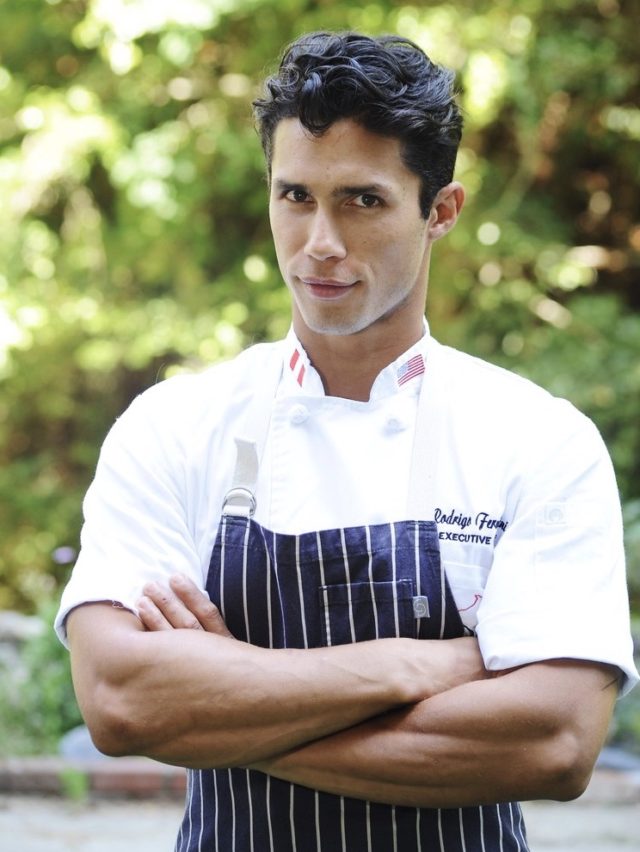
<div id="attachment_38692" style="width: 570px" class="wp-caption aligncenter"><img loading="lazy" decoding="async" aria-describedby="caption-attachment-38692" class="wp-image-38692 size-shareaholic-thumbnail" src="https://www.oh-i-see.com/blog/wp-content/uploads/2020/10/9D4D9713-7C73-4120-8952-D8282870BDA8_1_201_a-640x852.jpeg" alt="Chef Rodrigo Fernandini of Chiclayo, Peru, shares his passion for Peruvian cuisine and culture, as featured on “In the Kitchen with OIC.” Image © Rodrigo Fernandini)" width="560" height="746" srcset="https://www.oh-i-see.com/blog/wp-content/uploads/2020/10/9D4D9713-7C73-4120-8952-D8282870BDA8_1_201_a-640x852.jpeg 640w, https://www.oh-i-see.com/blog/wp-content/uploads/2020/10/9D4D9713-7C73-4120-8952-D8282870BDA8_1_201_a-225x300.jpeg 225w, https://www.oh-i-see.com/blog/wp-content/uploads/2020/10/9D4D9713-7C73-4120-8952-D8282870BDA8_1_201_a-155x207.jpeg 155w, https://www.oh-i-see.com/blog/wp-content/uploads/2020/10/9D4D9713-7C73-4120-8952-D8282870BDA8_1_201_a.jpeg 744w" sizes="auto, (max-width: 560px) 100vw, 560px" /><p id="caption-attachment-38692" class="wp-caption-text">Chef Rodrigo Fernandini grew up in Chiclayo, capital of Peruvian gastronomy.<br />© Rodrigo Fernandini</p></div>
<h2>What&#8217;s on Chef Fernandini&#8217;s Menu?  Peruvian Culture!</h2>
<p>In California, the cooking class was starting on Zoom. In Oregon, I hesitated. On the one hand, I was eager to explore Peruvian cuisine for &#8220;In the Kitchen with OIC,&#8221; our newest recurring feature. On the other hand, I missed travel, open-air markets, rolling up my sleeves in foreign kitchens. I missed food tours, following local experts along unfamiliar streets.</p>
<p>I wanted <em>real</em>.</p>
<p>Peru was on my 2020 itinerary. Instead, I was exploring the culture of my studio apartment. <em>OK, fine.</em> I’d try Chef Fernandini’s online cooking class. As I logged on, I sighed. Would it be just another Zoom meeting?</p>
<p>It . . . was . . . <em>exhilarating!</em> A kinesthetic thrill that had us up and moving, prepping, stirring, tasting, listening, and laughing with fellow classmates. All while the smoky, sweet heat and fragrance of <em>aji panca </em>and<em> rocoto </em>peppers, plantains, avocado oil, and cumin transformed our scattered kitchens into a shared experience of Peru. <em>That</em> was real.</p>
<p>Screen, what screen? It felt like we were in Fernandini&#8217;s kitchen.  <strong>Oh, I see:</strong> When you can’t travel to Peru, invite Peruvian food and culture home to you.</p>
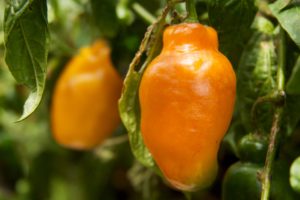
<div id="attachment_38679" style="width: 460px" class="wp-caption aligncenter"><img loading="lazy" decoding="async" aria-describedby="caption-attachment-38679" class="wp-image-38679" src="https://www.oh-i-see.com/blog/wp-content/uploads/2020/10/Peru_-_Cusco_098_-_Peruvian_rocoto_peppers_7360325120-300x200.jpg" alt="Rocoto chile peppers are a staple of Peruvian cuisine and culture, as featured on “In the Kitchen with OIC.” (Image © McKay Savage)" width="450" height="300" srcset="https://www.oh-i-see.com/blog/wp-content/uploads/2020/10/Peru_-_Cusco_098_-_Peruvian_rocoto_peppers_7360325120-300x200.jpg 300w, https://www.oh-i-see.com/blog/wp-content/uploads/2020/10/Peru_-_Cusco_098_-_Peruvian_rocoto_peppers_7360325120-1024x683.jpg 1024w, https://www.oh-i-see.com/blog/wp-content/uploads/2020/10/Peru_-_Cusco_098_-_Peruvian_rocoto_peppers_7360325120-768x512.jpg 768w, https://www.oh-i-see.com/blog/wp-content/uploads/2020/10/Peru_-_Cusco_098_-_Peruvian_rocoto_peppers_7360325120-1536x1024.jpg 1536w, https://www.oh-i-see.com/blog/wp-content/uploads/2020/10/Peru_-_Cusco_098_-_Peruvian_rocoto_peppers_7360325120-2048x1365.jpg 2048w, https://www.oh-i-see.com/blog/wp-content/uploads/2020/10/Peru_-_Cusco_098_-_Peruvian_rocoto_peppers_7360325120-207x138.jpg 207w, https://www.oh-i-see.com/blog/wp-content/uploads/2020/10/Peru_-_Cusco_098_-_Peruvian_rocoto_peppers_7360325120-640x427.jpg 640w" sizes="auto, (max-width: 450px) 100vw, 450px" /><p id="caption-attachment-38679" class="wp-caption-text">Tree-grown Andean <em>rocoto</em> is gaining popularity with U.S. chile pepper fans. <br />© <span style="color: #3366ff;"><a style="color: #3366ff;" href="https://www.flickr.com/people/56796376@N00" target="_blank" rel="noopener noreferrer">McKay Savage</a></span><a href="https://commons.wikimedia.org/wiki/File:Peru_-_Cusco_098_-_Peruvian_rocoto_peppers_(7360325120).jpg" target="_blank" rel="noopener noreferrer">,</a> CC BY <span style="color: #3366ff;"><a style="color: #3366ff;" href="https://creativecommons.org/licenses/by/2.0/" target="_blank" rel="noopener noreferrer">2.0 Commons</a></span></p></div>
<h4><strong>Home Cooking, Chiclayo Style</strong></h4>
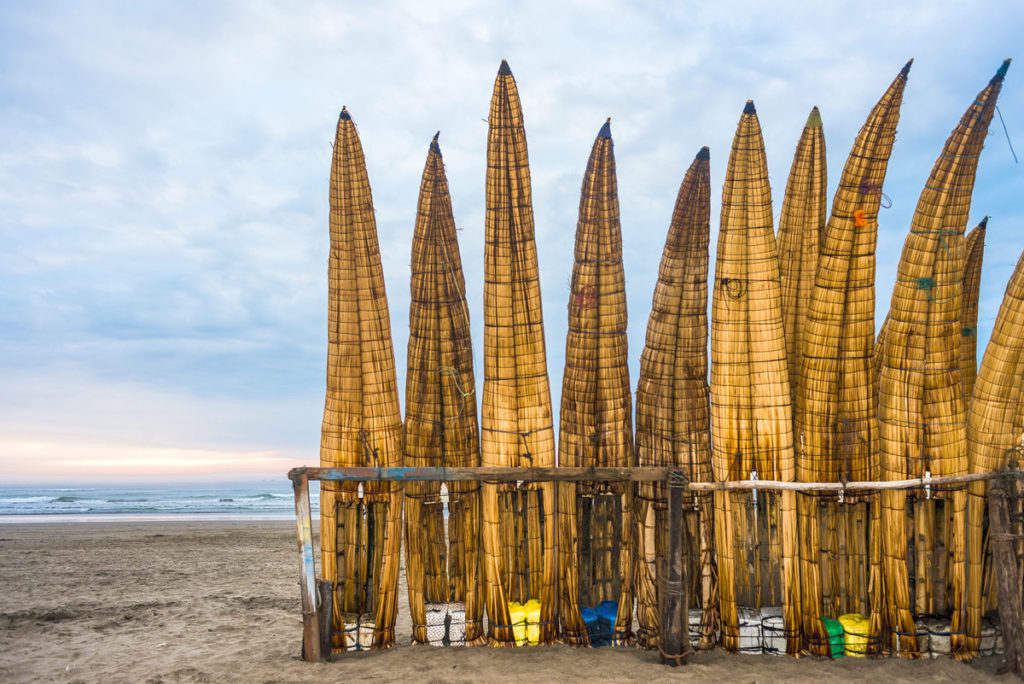
<p>His culinary journey began when Fernandini was four years old. This was in Pimentel, the beach district of Chiclayo, northern Peru. He recalls running into the kitchen, drawn by the aromas of garlic, peppers, and onions.</p>
<p>“I would put my whole face beside the pot, take a deep breath, and ask, ‘Oh, Mamá what is that smell? It’s so good!&#8217; &#8221; He also loved home-cooked seafood. Mamá got to the market as the morning’s catch came in.</p>
<div id="attachment_38672" style="width: 570px" class="wp-caption aligncenter"><img loading="lazy" decoding="async" aria-describedby="caption-attachment-38672" class="wp-image-38672 size-large" src="https://www.oh-i-see.com/blog/wp-content/uploads/2020/10/iStock-480296502-1024x684.jpg" alt="Reed boats, linked to Chiclayo’s fishing and culinary traditions, evoke Peruvian cuisine and culture. (image © xeni4ka/ iStock)" width="560" height="374" srcset="https://www.oh-i-see.com/blog/wp-content/uploads/2020/10/iStock-480296502-1024x684.jpg 1024w, https://www.oh-i-see.com/blog/wp-content/uploads/2020/10/iStock-480296502-300x200.jpg 300w, https://www.oh-i-see.com/blog/wp-content/uploads/2020/10/iStock-480296502-768x513.jpg 768w, https://www.oh-i-see.com/blog/wp-content/uploads/2020/10/iStock-480296502-207x138.jpg 207w, https://www.oh-i-see.com/blog/wp-content/uploads/2020/10/iStock-480296502-640x427.jpg 640w, https://www.oh-i-see.com/blog/wp-content/uploads/2020/10/iStock-480296502.jpg 1200w" sizes="auto, (max-width: 560px) 100vw, 560px" /><p id="caption-attachment-38672" class="wp-caption-text">Traditional fishing boats, <em>caballitos de totora,</em> &#8220;little horses made of tortora reed,&#8221; <br />are icons of coastal Peru.<br />©<span style="color: #3366ff;"> <a style="color: #3366ff;" href="https://www.istockphoto.com/portfolio/xeni4ka?assettype=image&amp;mediatype=photography&amp;sort=best" target="_blank" rel="noopener noreferrer">xeni4ka</a></span>/ iStock</p></div>
<p>Regional ingredients whetted Fernandini’s appetite for cooking and stirred pride in his culture.  So where is the starting point for an outsider? How to approach the rich context of Peruvian cuisine?</p>
<p>“Begin with <em>ceviche</em>.”  So central is this dish to Peru’s culinary culture that it has its own national holiday on June 28.</p>
<p>Some might ask,<em> What’s to explore?</em> <em>It’s marinated fish, you love it or hate it, end of story. </em>In fact, it’s an early chapter in a rich culinary narrative.</p>
<h4><strong>Peruvian Fish Tales</strong></h4>
<p>Over 2,000 years ago, the indigenous Moche cured fish in <em>tumbo</em>, banana passionfruit juice. Later, the Incas marinated fish in <em>chicha</em>, fermented corn beverage. In the 1500s, the Spanish brought lime—and conquest.</p>
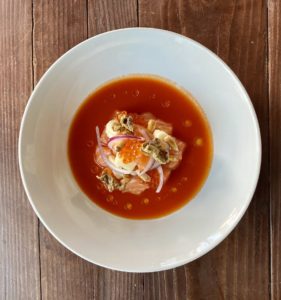
<p>Recipes for <em>ceviche</em> illuminate Peru’s <em>costa, sierra y selva—</em>its coast, mountains, and jungle—where 80 climates support biodiversity. For example, says Fernandini, in the mountains, <em>ceviche</em> is  made with trout and <em>rocoto</em>.</p>
<div id="attachment_38699" style="width: 570px" class="wp-caption aligncenter"><img loading="lazy" decoding="async" aria-describedby="caption-attachment-38699" class="wp-image-38699" src="https://www.oh-i-see.com/blog/wp-content/uploads/2020/10/6DA080E3-A566-47C1-91BB-C30407784BF2_1_105_c-281x300.jpeg" alt="Mountain ceviche by Chef Rodrigo Fernandini innovates on the regional culinary traditions and cuisine in Peruvian culture. (Image © Rodrigo Fernandini)" width="560" height="597" srcset="https://www.oh-i-see.com/blog/wp-content/uploads/2020/10/6DA080E3-A566-47C1-91BB-C30407784BF2_1_105_c-281x300.jpeg 281w, https://www.oh-i-see.com/blog/wp-content/uploads/2020/10/6DA080E3-A566-47C1-91BB-C30407784BF2_1_105_c-768x819.jpeg 768w, https://www.oh-i-see.com/blog/wp-content/uploads/2020/10/6DA080E3-A566-47C1-91BB-C30407784BF2_1_105_c-194x207.jpeg 194w, https://www.oh-i-see.com/blog/wp-content/uploads/2020/10/6DA080E3-A566-47C1-91BB-C30407784BF2_1_105_c-640x683.jpeg 640w, https://www.oh-i-see.com/blog/wp-content/uploads/2020/10/6DA080E3-A566-47C1-91BB-C30407784BF2_1_105_c.jpeg 858w" sizes="auto, (max-width: 560px) 100vw, 560px" /><p id="caption-attachment-38699" class="wp-caption-text">“Peruvian Andes trout and <em>rocoto</em> are inseparable,” says Fernandini. <br />His mountain <em>ceviche</em> also features <em>chicharrón </em>(fried pork belly) and ginger garlic oil.<br />© Rodrigo Fernandini</p></div>
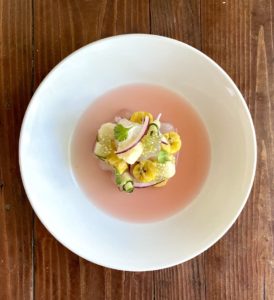
<p><span style="color: #000000;">In the jungle, <em>ceviche</em> is made with <em>paiche</em>, an Amazonian fish, prehistoric in origin and weighing up to <a style="color: #000000;" href="https://assets.bwbx.io/images/users/iqjWHBFdfxIU/i43ipvzBHQ0A/v1/1800x-1.jpg" target="_blank" rel="noopener noreferrer">400 pounds</a>.</span></p>
<div id="attachment_38700" style="width: 570px" class="wp-caption aligncenter"><img loading="lazy" decoding="async" aria-describedby="caption-attachment-38700" class="wp-image-38700" src="https://www.oh-i-see.com/blog/wp-content/uploads/2020/10/8CB6B188-1115-461F-A279-9C7764C2AA58_1_105_c-274x300.jpeg" alt="Jungle ceviche with cumu cumu berries, by Chef Rodrigo Fernandini, showcases Peruvian cuisine and culture. (Image © Rodrigo Fernandini)" width="560" height="613" srcset="https://www.oh-i-see.com/blog/wp-content/uploads/2020/10/8CB6B188-1115-461F-A279-9C7764C2AA58_1_105_c-274x300.jpeg 274w, https://www.oh-i-see.com/blog/wp-content/uploads/2020/10/8CB6B188-1115-461F-A279-9C7764C2AA58_1_105_c-768x841.jpeg 768w, https://www.oh-i-see.com/blog/wp-content/uploads/2020/10/8CB6B188-1115-461F-A279-9C7764C2AA58_1_105_c-189x207.jpeg 189w, https://www.oh-i-see.com/blog/wp-content/uploads/2020/10/8CB6B188-1115-461F-A279-9C7764C2AA58_1_105_c-640x700.jpeg 640w, https://www.oh-i-see.com/blog/wp-content/uploads/2020/10/8CB6B188-1115-461F-A279-9C7764C2AA58_1_105_c.jpeg 847w" sizes="auto, (max-width: 560px) 100vw, 560px" /><p id="caption-attachment-38700" class="wp-caption-text">The rosy pink of Fernandini’s jungle <em>ceviche</em> comes from <em>camu camu</em> berries. <br />© Rodrigo Fernandini</p></div>
<h4><strong>The Runway or the Rush?</strong></h4>
<p>After high school, a lucrative career in modeling beckoned. Fernandini soon garnered international acclaim, including as runner-up in the Mr. World competition. But what he wanted was to cook. Creating an all-new resume that was long on passion and short on skills, he went to restaurant after restaurant offering to work for free.</p>
<p>Eventually, someone said yes.</p>
<p>“Wow! The rush! The adrenaline! I was supposed to be there four hours, but I stayed for eleven.”</p>
<p>Staff dismissed Fernandini’s enthusiasm as first-day excitement, but three months later and on the verge of going broke, he was still saying “I love this. I want to keep going!”</p>
<h4><strong>The Sound of One Herb Snapping</strong></h4>
<p>Fernandini attained a coveted spot at <em>Le Cordon Bleu</em> in Lima, then the renowned cooking academy’s only location in South America. For three years, he rode a whirlwind of studying, cooking, and staging—working for free—in Lima’s top restaurants.</p>
<p>Then came tests, like identifying ingredients while blindfolded. Could you tell cinnamon by the sound it makes when snapped? Could you distinguish black and green pepper by texture?  Chef Fernandini can.</p>
<p>Students were also expected to write monographs—by hand. Never one to resist a challenge, Fernandini researched the influence of Japan on Peruvian cuisine.</p>
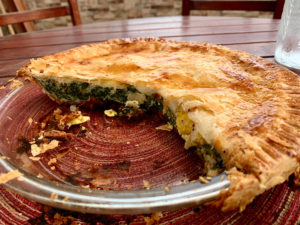
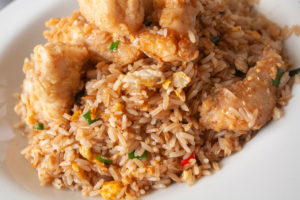
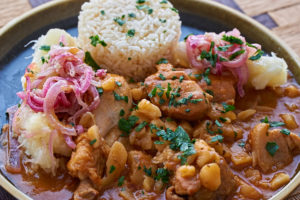
<p>This was no mere <em>fusion</em>, a modern term for the intentional layering of unexpected flavors. For 500 years, people had migrated to Peru, from Spain, Africa, China, Japan, Italy and the Middle East, bringing long-standing traditions and slowly learning each other’s culinary language.</p>
<div id="attachment_38674" style="width: 410px" class="wp-caption aligncenter"><img loading="lazy" decoding="async" aria-describedby="caption-attachment-38674" class="wp-image-38674" src="https://www.oh-i-see.com/blog/wp-content/uploads/2020/10/iStock-1209532312-300x225.jpg" alt="Pastel de acelga, chard tart, exemplifies the Italian influence on Peruvian cuisine and culture. (Image © Luis Felipe Rios/ iStock)" width="400" height="300" srcset="https://www.oh-i-see.com/blog/wp-content/uploads/2020/10/iStock-1209532312-300x225.jpg 300w, https://www.oh-i-see.com/blog/wp-content/uploads/2020/10/iStock-1209532312-1024x768.jpg 1024w, https://www.oh-i-see.com/blog/wp-content/uploads/2020/10/iStock-1209532312-768x576.jpg 768w, https://www.oh-i-see.com/blog/wp-content/uploads/2020/10/iStock-1209532312-207x155.jpg 207w, https://www.oh-i-see.com/blog/wp-content/uploads/2020/10/iStock-1209532312-640x480.jpg 640w, https://www.oh-i-see.com/blog/wp-content/uploads/2020/10/iStock-1209532312.jpg 1200w" sizes="auto, (max-width: 400px) 100vw, 400px" /><p id="caption-attachment-38674" class="wp-caption-text"><em>Pastel de acelga</em> (chard tart), a staple of bakeries in Lima, Peru, <br />originated as <em>erbazzone</em> in Italy. <br /><span style="color: #3366ff;"><a style="color: #3366ff;" href="https://www.istockphoto.com/portfolio/luisfeliperios?assettype=image&amp;mediatype=photography&amp;sort=best" target="_blank" rel="noopener noreferrer">Luis Felipe Rios</a></span><span style="color: #0000ff;">/</span> iStock</p></div>
<div id="attachment_38675" style="width: 410px" class="wp-caption aligncenter"><img loading="lazy" decoding="async" aria-describedby="caption-attachment-38675" class="wp-image-38675" src="https://www.oh-i-see.com/blog/wp-content/uploads/2020/10/iStock-1218071347-300x200.jpg" alt="Chaufa de mariscos, rice with seafood, is emblematic of widespread Cantonese influence on Peruvian cuisine and culture. (Image © Edgar D. Pons/ iStock)" width="400" height="267" srcset="https://www.oh-i-see.com/blog/wp-content/uploads/2020/10/iStock-1218071347-300x200.jpg 300w, https://www.oh-i-see.com/blog/wp-content/uploads/2020/10/iStock-1218071347-1024x683.jpg 1024w, https://www.oh-i-see.com/blog/wp-content/uploads/2020/10/iStock-1218071347-768x512.jpg 768w, https://www.oh-i-see.com/blog/wp-content/uploads/2020/10/iStock-1218071347-207x138.jpg 207w, https://www.oh-i-see.com/blog/wp-content/uploads/2020/10/iStock-1218071347-640x427.jpg 640w, https://www.oh-i-see.com/blog/wp-content/uploads/2020/10/iStock-1218071347.jpg 1200w" sizes="auto, (max-width: 400px) 100vw, 400px" /><p id="caption-attachment-38675" class="wp-caption-text"><em>Chaufa de mariscos, </em>seafood with rice, reflects<br />Cantonese China&#8217;s widespread influence on Peru. <br /><span style="color: #3366ff;"><a style="color: #3366ff;" href="https://www.istockphoto.com/portfolio/christianvinces?assettype=image&amp;mediatype=photography&amp;sort=best" target="_blank" rel="noopener noreferrer">Christian Vinces</a></span>/iStock</p></div>
<div id="attachment_38673" style="width: 410px" class="wp-caption aligncenter"><img loading="lazy" decoding="async" aria-describedby="caption-attachment-38673" class="wp-image-38673" src="https://www.oh-i-see.com/blog/wp-content/uploads/2020/10/iStock-1014232780-300x200.jpg" alt="Carapulcra, a hearty stew, combines Spanish, African, and Peruvian cuisine and innovates on Peruvian culture. (Image © Edgar D. Pons/ iStock)" width="400" height="266" srcset="https://www.oh-i-see.com/blog/wp-content/uploads/2020/10/iStock-1014232780-300x200.jpg 300w, https://www.oh-i-see.com/blog/wp-content/uploads/2020/10/iStock-1014232780-1024x681.jpg 1024w, https://www.oh-i-see.com/blog/wp-content/uploads/2020/10/iStock-1014232780-768x511.jpg 768w, https://www.oh-i-see.com/blog/wp-content/uploads/2020/10/iStock-1014232780-207x138.jpg 207w, https://www.oh-i-see.com/blog/wp-content/uploads/2020/10/iStock-1014232780-640x426.jpg 640w, https://www.oh-i-see.com/blog/wp-content/uploads/2020/10/iStock-1014232780.jpg 1200w" sizes="auto, (max-width: 400px) 100vw, 400px" /><p id="caption-attachment-38673" class="wp-caption-text"><em>Carapulcra</em>, a hearty stew with dried potatoes and peanuts, <br />combines indigenous, Spanish, and African traditions.  <br /><span style="color: #3366ff;"><a style="color: #3366ff;" href="https://www.istockphoto.com/portfolio/dedvyned?assettype=image&amp;mediatype=photography&amp;sort=best" target="_blank" rel="noopener noreferrer">Edgar D. Pons</a></span>/iStock</p></div>
<h4><strong>“Land of the Rising Sun” Meets “Land of Abundance”</strong></h4>
<p>After Peru won independence from Spain in 1821, Japanese immigrants arrived to work in agriculture, trade, and restaurants. Japanese chefs shared their love of seafood, subtle flavors, and care in handling ingredients.</p>
<p>This changed the way Peruvians ate, including national dishes like <em>ceviche</em>. Marination times shortened, ingredient options expanded. <em>Nikkei</em>, the melding of Japanese and Peruvian ingredients, traditions, and techniques, was born.</p>
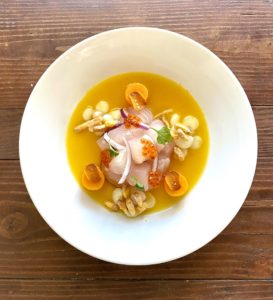
<p>“We started to respect and understand the freshness and texture of just-caught fish.” Fernandini’s inspired take on coastal <em>ceviche </em>features halibut, yellow chili, caviar, sweet potato, and “tiger’s milk,” Peru’s classic citrus marinade.</p>
<div id="attachment_38701" style="width: 510px" class="wp-caption aligncenter"><img loading="lazy" decoding="async" aria-describedby="caption-attachment-38701" class="wp-image-38701" src="https://www.oh-i-see.com/blog/wp-content/uploads/2020/10/EA2CFA89-DEEA-4BDD-AA9D-0E689B171AD1_1_105_c-273x300.jpeg" alt="Coastal ceviche by Chef Rodrigo Fernandini, combines traditional and contemporary aspects of Peruvian cuisine and culture. (Image © Rodrigo Fernandini)" width="500" height="550" srcset="https://www.oh-i-see.com/blog/wp-content/uploads/2020/10/EA2CFA89-DEEA-4BDD-AA9D-0E689B171AD1_1_105_c-273x300.jpeg 273w, https://www.oh-i-see.com/blog/wp-content/uploads/2020/10/EA2CFA89-DEEA-4BDD-AA9D-0E689B171AD1_1_105_c-768x844.jpeg 768w, https://www.oh-i-see.com/blog/wp-content/uploads/2020/10/EA2CFA89-DEEA-4BDD-AA9D-0E689B171AD1_1_105_c-188x207.jpeg 188w, https://www.oh-i-see.com/blog/wp-content/uploads/2020/10/EA2CFA89-DEEA-4BDD-AA9D-0E689B171AD1_1_105_c-640x704.jpeg 640w, https://www.oh-i-see.com/blog/wp-content/uploads/2020/10/EA2CFA89-DEEA-4BDD-AA9D-0E689B171AD1_1_105_c.jpeg 845w" sizes="auto, (max-width: 500px) 100vw, 500px" /><p id="caption-attachment-38701" class="wp-caption-text"><em>Chulpi </em>(toasted corn) and yellow chili create culinary gold <br />in Fernandini&#8217;s coastal <em>ceviche</em>. <br />© Rodrigo Fernandini</p></div>
<p>Fernandini gives the impression that visiting Peru without eating at a Japanese-influenced restaurant would be tantamount to bypassing Machu Picchu. He cites <a href="https://www.theworlds50best.com/the-list/1-10/Maido.html" target="_blank" rel="noopener noreferrer"><em>Maido</em></a><span style="color: #333333;"> </span>in Lima, ranked #10 among world’s best restaurants—“utterly splendid!”—and speaks of opening a Peruvian sushi restaurant someday.</p>
<p>Suddenly, my list of future favorite foods is much longer.</p>
<h4><strong>A Cultural Mission</strong></h4>
<p>Fernandini has been on a mission to delight American palates ever since moving to the USA. Initially, he faced stereotypes about Peruvian food: “It’s so greasy, so heavy!”</p>
<p>This was all the more surprising since <em>Novoandina</em>, New Andean cuisine, had gone global by the 1980s, making grains like <em>quinoa</em>, herbs like <em>huacatay</em>, and a wealth of recipes available to home cooks everywhere.</p>
<p>“I said, we have to do something about this!”</p>
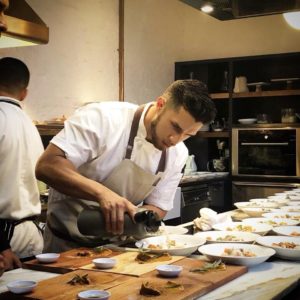
<div id="attachment_38681" style="width: 570px" class="wp-caption aligncenter"><img loading="lazy" decoding="async" aria-describedby="caption-attachment-38681" class="wp-image-38681" src="https://www.oh-i-see.com/blog/wp-content/uploads/2020/10/rodrigo2-300x300.jpg" alt="Chef Rodrigo Fernandini, shown in his pop-up restaurant Ayllu, is on a mission to share the wide range of Peruvian cuisine and culture. (Image © Rodrigo Fernandini)" width="560" height="560" srcset="https://www.oh-i-see.com/blog/wp-content/uploads/2020/10/rodrigo2-300x300.jpg 300w, https://www.oh-i-see.com/blog/wp-content/uploads/2020/10/rodrigo2-150x150.jpg 150w, https://www.oh-i-see.com/blog/wp-content/uploads/2020/10/rodrigo2-768x768.jpg 768w, https://www.oh-i-see.com/blog/wp-content/uploads/2020/10/rodrigo2-207x207.jpg 207w, https://www.oh-i-see.com/blog/wp-content/uploads/2020/10/rodrigo2-640x640.jpg 640w, https://www.oh-i-see.com/blog/wp-content/uploads/2020/10/rodrigo2-144x144.jpg 144w, https://www.oh-i-see.com/blog/wp-content/uploads/2020/10/rodrigo2.jpg 960w" sizes="auto, (max-width: 560px) 100vw, 560px" /><p id="caption-attachment-38681" class="wp-caption-text">Rodrigo&#8217;s pop-up restaurant, <em><span style="color: #0000ff;"><a style="color: #0000ff;" href="http://www.ayllurestaurant.com" target="_blank" rel="noopener noreferrer">Ayllu</a></span>.</em> Demand turned the monthly event <br />into sold-out double seatings, week after week, for years. <br />© Rodrigo Fernandini</p></div>
<p>By then, he was working at Michelin-starred restaurants and being mentored by chefs like the Four Seasons’ Jayson Poe. During time off, Rodrigo cooked even more, spending months planning a five-course menu for the launch of a pop-up restaurant.</p>
<p>Two people attended.</p>
<p>When a partner suggested canceling, Rodrigo said, “No way. We have to respect those two people and make it happen.”</p>
<p>The two diners hired Rodrigo to cater dinner for 30. Soon he was juggling full-time work with booming demand for the pop-up. After years of slogging and saving, he opened his own restaurant, <a href="http://www.joraperuvianfood.com" target="_blank" rel="noopener noreferrer"><em>Jora</em></a>.</p>
<div id="attachment_38702" style="width: 410px" class="wp-caption aligncenter"><img loading="lazy" decoding="async" aria-describedby="caption-attachment-38702" class="wp-image-38702" src="https://www.oh-i-see.com/blog/wp-content/uploads/2020/10/Jora-300x300.jpg" alt="The logo of Jora, Chef Rodrigo Fernandini’s casual dining spot in San Jose, California, evokes his mission to share Peruvian cuisine and culture. (Image © Rodrigo Fernandini)" width="400" height="400" srcset="https://www.oh-i-see.com/blog/wp-content/uploads/2020/10/Jora-300x300.jpg 300w, https://www.oh-i-see.com/blog/wp-content/uploads/2020/10/Jora-1024x1024.jpg 1024w, https://www.oh-i-see.com/blog/wp-content/uploads/2020/10/Jora-150x150.jpg 150w, https://www.oh-i-see.com/blog/wp-content/uploads/2020/10/Jora-768x768.jpg 768w, https://www.oh-i-see.com/blog/wp-content/uploads/2020/10/Jora-1536x1536.jpg 1536w, https://www.oh-i-see.com/blog/wp-content/uploads/2020/10/Jora-207x207.jpg 207w, https://www.oh-i-see.com/blog/wp-content/uploads/2020/10/Jora-640x640.jpg 640w, https://www.oh-i-see.com/blog/wp-content/uploads/2020/10/Jora-144x144.jpg 144w, https://www.oh-i-see.com/blog/wp-content/uploads/2020/10/Jora.jpg 1616w" sizes="auto, (max-width: 400px) 100vw, 400px" /><p id="caption-attachment-38702" class="wp-caption-text">In San Jose, California, <em>Jora</em> applies classical technique<br />to a casual Peruvian menu. <br />© Rodrigo Fernandini</p></div>
<p>It was a dream come true. It was also December 2019. As <em>Jora</em> was hitting its stride, Covid was shutting down restaurants.</p>
<p>“Hard times, but I&#8217;m a warrior,” says Fernandini. “Recently we reopened for outdoor dining, take-out, delivery. I’m also doing the cooking class with <a href="https://www.chefsfeed.com" target="_blank" rel="noopener noreferrer">ChefsFeed.com</a>. I really like teaching.”</p>
<div id="attachment_38691" style="width: 570px" class="wp-caption aligncenter"><img loading="lazy" decoding="async" aria-describedby="caption-attachment-38691" class="wp-image-38691" src="https://www.oh-i-see.com/blog/wp-content/uploads/2020/10/79556CC2-90DD-4EDF-AAB0-2EB33A58C7E1_1_105_c-300x225.jpeg" alt="Chef Rodrigo Fernandini shown on a computer screen as he speaks on Zoom about Peruvian cuisine and culture in his online cooking class. (Image © Joyce McGreevy)" width="560" height="420" srcset="https://www.oh-i-see.com/blog/wp-content/uploads/2020/10/79556CC2-90DD-4EDF-AAB0-2EB33A58C7E1_1_105_c-300x225.jpeg 300w, https://www.oh-i-see.com/blog/wp-content/uploads/2020/10/79556CC2-90DD-4EDF-AAB0-2EB33A58C7E1_1_105_c-768x576.jpeg 768w, https://www.oh-i-see.com/blog/wp-content/uploads/2020/10/79556CC2-90DD-4EDF-AAB0-2EB33A58C7E1_1_105_c-207x155.jpeg 207w, https://www.oh-i-see.com/blog/wp-content/uploads/2020/10/79556CC2-90DD-4EDF-AAB0-2EB33A58C7E1_1_105_c-640x480.jpeg 640w, https://www.oh-i-see.com/blog/wp-content/uploads/2020/10/79556CC2-90DD-4EDF-AAB0-2EB33A58C7E1_1_105_c.jpeg 1024w" sizes="auto, (max-width: 560px) 100vw, 560px" /><p id="caption-attachment-38691" class="wp-caption-text">&#8220;Live feed&#8221; gains new meaning when your kitchen becomes Chef Fernandini&#8217;s classroom.<br />© Joyce McGreevy</p></div>
<p>“Food brings people to the table to enjoy, and as you&#8217;re eating, you’re sharing your culture. Whatever I cook, I want to deliver on the promise of authenticity, originality, and respect for the product, the process, the person, and the moment. Everything I do is based on this. And yeah, I&#8217;m having fun in the kitchen. I love it—this is my happy place.”</p>
<p>Thanks to Chef Fernandini&#8217;s online class, my apartment kitchen is a happier place, too, a place were Peruvian cuisine and culture will always be welcome.</p>
<p>Until next month, this is &#8220;In the Kitchen with OIC&#8221; wishing you <em>Buen provecho!</em></p>
<p><span style="color: #333333;"><em>Request news of Chef Fernandini&#8217;s  classes <a style="color: #333333;" href="https://experiences.chefsfeed.com/browse/?search=Rodrigo%20Fernandini&amp;order_type=upcoming" target="_blank" rel="noopener noreferrer">here</a></em><em>.  </em><em>Can&#8217;t wait? Start <a style="color: #333333;" href="https://www.youtube.com/watch?v=UcaHYVRWoaQ" target="_blank" rel="noopener noreferrer">here</a>, then f</em><em>ollow Chef Fernandini <a style="color: #333333;" href="https://www.instagram.com/rodrigofernandini/?hl=en" target="_blank" rel="noopener noreferrer">here</a>.</em></span></p>
<p><em><a href="#comments" target="_blank" rel="noopener">Comment</a> on the post below, or inspire insight with your own OIC Moment <a href="https://www.oh-i-see.com/blog/your-oic-moments/" target="_blank" rel="noopener">here.</a></em></p>
{"id":38677,"date":"2020-10-20T03:00:58","date_gmt":"2020-10-20T10:00:58","guid":{"rendered":"https:\/\/www.oh-i-see.com\/blog\/?p=38677"},"modified":"2021-08-02T10:38:20","modified_gmt":"2021-08-02T17:38:20","slug":"in-the-kitchen-with-oic-peruvian-cuisine","status":"publish","type":"post","link":"https:\/\/www.oh-i-see.com\/blog\/in-the-kitchen-with-oic-peruvian-cuisine\/","title":{"rendered":"In the Kitchen with OIC: Peruvian Cuisine"},"content":{"rendered":"<div id=\"attachment_38692\" style=\"width: 570px\" class=\"wp-caption aligncenter\"><img loading=\"lazy\" decoding=\"async\" aria-describedby=\"caption-attachment-38692\" class=\"wp-image-38692 size-shareaholic-thumbnail\" src=\"https:\/\/www.oh-i-see.com\/blog\/wp-content\/uploads\/2020\/10\/9D4D9713-7C73-4120-8952-D8282870BDA8_1_201_a-640x852.jpeg\" alt=\"Chef Rodrigo Fernandini of Chiclayo, Peru, shares his passion for Peruvian cuisine and culture, as featured on \u201cIn the Kitchen with OIC.\u201d Image \u00a9 Rodrigo Fernandini)\" width=\"560\" height=\"746\" srcset=\"https:\/\/www.oh-i-see.com\/blog\/wp-content\/uploads\/2020\/10\/9D4D9713-7C73-4120-8952-D8282870BDA8_1_201_a-640x852.jpeg 640w, https:\/\/www.oh-i-see.com\/blog\/wp-content\/uploads\/2020\/10\/9D4D9713-7C73-4120-8952-D8282870BDA8_1_201_a-225x300.jpeg 225w, https:\/\/www.oh-i-see.com\/blog\/wp-content\/uploads\/2020\/10\/9D4D9713-7C73-4120-8952-D8282870BDA8_1_201_a-155x207.jpeg 155w, https:\/\/www.oh-i-see.com\/blog\/wp-content\/uploads\/2020\/10\/9D4D9713-7C73-4120-8952-D8282870BDA8_1_201_a.jpeg 744w\" sizes=\"auto, (max-width: 560px) 100vw, 560px\" \/><p id=\"caption-attachment-38692\" class=\"wp-caption-text\">Chef Rodrigo Fernandini grew up in Chiclayo, capital of Peruvian gastronomy.<br \/>\u00a9 Rodrigo Fernandini<\/p><\/div>\n<h2>What&#8217;s on Chef Fernandini&#8217;s Menu?\u00a0 Peruvian Culture!<\/h2>\n<p>In California, the cooking class was starting on Zoom. In Oregon, I hesitated. On the one hand, I was eager to explore Peruvian cuisine for &#8220;In the Kitchen with OIC,&#8221; our newest recurring feature. On the other hand, I missed travel, open-air markets, rolling up my sleeves in foreign kitchens. I missed food tours, following local experts along unfamiliar streets.<\/p>\n<p>I wanted <em>real<\/em>.<\/p>\n<p>Peru was on my 2020 itinerary. Instead, I was exploring the culture of my studio apartment. <em>OK, fine.<\/em> I\u2019d try Chef Fernandini\u2019s online cooking class. As I logged on, I sighed. Would it be just another Zoom meeting?<\/p>\n<p>It . . . was . . . <em>exhilarating!<\/em> A kinesthetic thrill that had us up and moving, prepping, stirring, tasting, listening, and laughing with fellow classmates. All while the smoky, sweet heat and fragrance of <em>aji panca <\/em>and<em> rocoto <\/em>peppers, plantains, avocado oil, and cumin transformed our scattered kitchens into a shared experience of Peru. <em>That<\/em> was real.<\/p>\n<p>Screen, what screen? It felt like we were in Fernandini&#8217;s kitchen. \u00a0<strong>Oh, I see:<\/strong> When you can\u2019t travel to Peru, invite Peruvian food and culture home to you.<\/p>\n<div id=\"attachment_38679\" style=\"width: 460px\" class=\"wp-caption aligncenter\"><img loading=\"lazy\" decoding=\"async\" aria-describedby=\"caption-attachment-38679\" class=\"wp-image-38679\" src=\"https:\/\/www.oh-i-see.com\/blog\/wp-content\/uploads\/2020\/10\/Peru_-_Cusco_098_-_Peruvian_rocoto_peppers_7360325120-300x200.jpg\" alt=\"Rocoto chile peppers are a staple of Peruvian cuisine and culture, as featured on \u201cIn the Kitchen with OIC.\u201d (Image \u00a9 McKay Savage)\" width=\"450\" height=\"300\" srcset=\"https:\/\/www.oh-i-see.com\/blog\/wp-content\/uploads\/2020\/10\/Peru_-_Cusco_098_-_Peruvian_rocoto_peppers_7360325120-300x200.jpg 300w, https:\/\/www.oh-i-see.com\/blog\/wp-content\/uploads\/2020\/10\/Peru_-_Cusco_098_-_Peruvian_rocoto_peppers_7360325120-1024x683.jpg 1024w, https:\/\/www.oh-i-see.com\/blog\/wp-content\/uploads\/2020\/10\/Peru_-_Cusco_098_-_Peruvian_rocoto_peppers_7360325120-768x512.jpg 768w, https:\/\/www.oh-i-see.com\/blog\/wp-content\/uploads\/2020\/10\/Peru_-_Cusco_098_-_Peruvian_rocoto_peppers_7360325120-1536x1024.jpg 1536w, https:\/\/www.oh-i-see.com\/blog\/wp-content\/uploads\/2020\/10\/Peru_-_Cusco_098_-_Peruvian_rocoto_peppers_7360325120-2048x1365.jpg 2048w, https:\/\/www.oh-i-see.com\/blog\/wp-content\/uploads\/2020\/10\/Peru_-_Cusco_098_-_Peruvian_rocoto_peppers_7360325120-207x138.jpg 207w, https:\/\/www.oh-i-see.com\/blog\/wp-content\/uploads\/2020\/10\/Peru_-_Cusco_098_-_Peruvian_rocoto_peppers_7360325120-640x427.jpg 640w\" sizes=\"auto, (max-width: 450px) 100vw, 450px\" \/><p id=\"caption-attachment-38679\" class=\"wp-caption-text\">Tree-grown Andean <em>rocoto<\/em> is gaining popularity with U.S. chile pepper fans. <br \/>\u00a9 <span style=\"color: #3366ff;\"><a style=\"color: #3366ff;\" href=\"https:\/\/www.flickr.com\/people\/56796376@N00\" target=\"_blank\" rel=\"noopener noreferrer\">McKay Savage<\/a><\/span><a href=\"https:\/\/commons.wikimedia.org\/wiki\/File:Peru_-_Cusco_098_-_Peruvian_rocoto_peppers_(7360325120).jpg\" target=\"_blank\" rel=\"noopener noreferrer\">,<\/a> CC BY <span style=\"color: #3366ff;\"><a style=\"color: #3366ff;\" href=\"https:\/\/creativecommons.org\/licenses\/by\/2.0\/\" target=\"_blank\" rel=\"noopener noreferrer\">2.0 Commons<\/a><\/span><\/p><\/div>\n<h4><strong>Home Cooking, Chiclayo Style<\/strong><\/h4>\n<p>His culinary journey began when Fernandini was four years old. This was in Pimentel, the beach district of Chiclayo, northern Peru. He recalls running into the kitchen, drawn by the aromas of garlic, peppers, and onions.<\/p>\n<p>\u201cI would put my whole face beside the pot, take a deep breath, and ask, \u2018Oh, Mam\u00e1 what is that smell? It\u2019s so good!&#8217; &#8221; He also loved home-cooked seafood. Mam\u00e1 got to the market as the morning\u2019s catch came in.<\/p>\n<div id=\"attachment_38672\" style=\"width: 570px\" class=\"wp-caption aligncenter\"><img loading=\"lazy\" decoding=\"async\" aria-describedby=\"caption-attachment-38672\" class=\"wp-image-38672 size-large\" src=\"https:\/\/www.oh-i-see.com\/blog\/wp-content\/uploads\/2020\/10\/iStock-480296502-1024x684.jpg\" alt=\"Reed boats, linked to Chiclayo\u2019s fishing and culinary traditions, evoke Peruvian cuisine and culture. (image \u00a9 xeni4ka\/ iStock)\" width=\"560\" height=\"374\" srcset=\"https:\/\/www.oh-i-see.com\/blog\/wp-content\/uploads\/2020\/10\/iStock-480296502-1024x684.jpg 1024w, https:\/\/www.oh-i-see.com\/blog\/wp-content\/uploads\/2020\/10\/iStock-480296502-300x200.jpg 300w, https:\/\/www.oh-i-see.com\/blog\/wp-content\/uploads\/2020\/10\/iStock-480296502-768x513.jpg 768w, https:\/\/www.oh-i-see.com\/blog\/wp-content\/uploads\/2020\/10\/iStock-480296502-207x138.jpg 207w, https:\/\/www.oh-i-see.com\/blog\/wp-content\/uploads\/2020\/10\/iStock-480296502-640x427.jpg 640w, https:\/\/www.oh-i-see.com\/blog\/wp-content\/uploads\/2020\/10\/iStock-480296502.jpg 1200w\" sizes=\"auto, (max-width: 560px) 100vw, 560px\" \/><p id=\"caption-attachment-38672\" class=\"wp-caption-text\">Traditional fishing boats, <em>caballitos de totora,<\/em> &#8220;little horses made of tortora reed,&#8221; <br \/>are icons of coastal Peru.<br \/>\u00a9<span style=\"color: #3366ff;\"> <a style=\"color: #3366ff;\" href=\"https:\/\/www.istockphoto.com\/portfolio\/xeni4ka?assettype=image&amp;mediatype=photography&amp;sort=best\" target=\"_blank\" rel=\"noopener noreferrer\">xeni4ka<\/a><\/span>\/ iStock<\/p><\/div>\n<p>Regional ingredients whetted Fernandini\u2019s appetite for cooking and stirred pride in his culture. \u00a0So where is the starting point for an outsider? How to approach the rich context of Peruvian cuisine?<\/p>\n<p>\u201cBegin with <em>ceviche<\/em>.\u201d\u00a0 So central is this dish to Peru\u2019s culinary culture that it has its own national holiday on June 28.<\/p>\n<p>Some might ask,<em> What\u2019s to explore?<\/em> <em>It\u2019s marinated fish, you love it or hate it, end of story. <\/em>In fact, it\u2019s an early chapter in a rich culinary narrative.<\/p>\n<h4><strong>Peruvian Fish Tales<\/strong><\/h4>\n<p>Over 2,000 years ago, the indigenous Moche cured fish in <em>tumbo<\/em>, banana passionfruit juice. Later, the Incas marinated fish in <em>chicha<\/em>, fermented corn beverage. In the 1500s, the Spanish brought lime\u2014and conquest.<\/p>\n<p>Recipes for <em>ceviche<\/em> illuminate Peru\u2019s <em>costa, sierra y selva\u2014<\/em>its coast, mountains, and jungle\u2014where 80 climates support biodiversity. For example, says Fernandini, in the mountains, <em>ceviche<\/em> is\u00a0 made with trout and <em>rocoto<\/em>.<\/p>\n<div id=\"attachment_38699\" style=\"width: 570px\" class=\"wp-caption aligncenter\"><img loading=\"lazy\" decoding=\"async\" aria-describedby=\"caption-attachment-38699\" class=\"wp-image-38699\" src=\"https:\/\/www.oh-i-see.com\/blog\/wp-content\/uploads\/2020\/10\/6DA080E3-A566-47C1-91BB-C30407784BF2_1_105_c-281x300.jpeg\" alt=\"Mountain ceviche by Chef Rodrigo Fernandini innovates on the regional culinary traditions and cuisine in Peruvian culture. (Image \u00a9 Rodrigo Fernandini)\" width=\"560\" height=\"597\" srcset=\"https:\/\/www.oh-i-see.com\/blog\/wp-content\/uploads\/2020\/10\/6DA080E3-A566-47C1-91BB-C30407784BF2_1_105_c-281x300.jpeg 281w, https:\/\/www.oh-i-see.com\/blog\/wp-content\/uploads\/2020\/10\/6DA080E3-A566-47C1-91BB-C30407784BF2_1_105_c-768x819.jpeg 768w, https:\/\/www.oh-i-see.com\/blog\/wp-content\/uploads\/2020\/10\/6DA080E3-A566-47C1-91BB-C30407784BF2_1_105_c-194x207.jpeg 194w, https:\/\/www.oh-i-see.com\/blog\/wp-content\/uploads\/2020\/10\/6DA080E3-A566-47C1-91BB-C30407784BF2_1_105_c-640x683.jpeg 640w, https:\/\/www.oh-i-see.com\/blog\/wp-content\/uploads\/2020\/10\/6DA080E3-A566-47C1-91BB-C30407784BF2_1_105_c.jpeg 858w\" sizes=\"auto, (max-width: 560px) 100vw, 560px\" \/><p id=\"caption-attachment-38699\" class=\"wp-caption-text\">\u201cPeruvian Andes trout and <em>rocoto<\/em> are inseparable,\u201d says Fernandini. <br \/>His mountain <em>ceviche<\/em> also features <em>chicharr\u00f3n <\/em>(fried pork belly) and ginger garlic oil.<br \/>\u00a9 Rodrigo Fernandini<\/p><\/div>\n<p><span style=\"color: #000000;\">In the jungle, <em>ceviche<\/em> is made with <em>paiche<\/em>, an Amazonian fish, prehistoric in origin and weighing up to <a style=\"color: #000000;\" href=\"https:\/\/assets.bwbx.io\/images\/users\/iqjWHBFdfxIU\/i43ipvzBHQ0A\/v1\/1800x-1.jpg\" target=\"_blank\" rel=\"noopener noreferrer\">400 pounds<\/a>.<\/span><\/p>\n<div id=\"attachment_38700\" style=\"width: 570px\" class=\"wp-caption aligncenter\"><img loading=\"lazy\" decoding=\"async\" aria-describedby=\"caption-attachment-38700\" class=\"wp-image-38700\" src=\"https:\/\/www.oh-i-see.com\/blog\/wp-content\/uploads\/2020\/10\/8CB6B188-1115-461F-A279-9C7764C2AA58_1_105_c-274x300.jpeg\" alt=\"Jungle ceviche with cumu cumu berries, by Chef Rodrigo Fernandini, showcases Peruvian cuisine and culture. (Image \u00a9 Rodrigo Fernandini)\" width=\"560\" height=\"613\" srcset=\"https:\/\/www.oh-i-see.com\/blog\/wp-content\/uploads\/2020\/10\/8CB6B188-1115-461F-A279-9C7764C2AA58_1_105_c-274x300.jpeg 274w, https:\/\/www.oh-i-see.com\/blog\/wp-content\/uploads\/2020\/10\/8CB6B188-1115-461F-A279-9C7764C2AA58_1_105_c-768x841.jpeg 768w, https:\/\/www.oh-i-see.com\/blog\/wp-content\/uploads\/2020\/10\/8CB6B188-1115-461F-A279-9C7764C2AA58_1_105_c-189x207.jpeg 189w, https:\/\/www.oh-i-see.com\/blog\/wp-content\/uploads\/2020\/10\/8CB6B188-1115-461F-A279-9C7764C2AA58_1_105_c-640x700.jpeg 640w, https:\/\/www.oh-i-see.com\/blog\/wp-content\/uploads\/2020\/10\/8CB6B188-1115-461F-A279-9C7764C2AA58_1_105_c.jpeg 847w\" sizes=\"auto, (max-width: 560px) 100vw, 560px\" \/><p id=\"caption-attachment-38700\" class=\"wp-caption-text\">The rosy pink of Fernandini\u2019s jungle <em>ceviche<\/em> comes from <em>camu camu<\/em> berries. <br \/>\u00a9 Rodrigo Fernandini<\/p><\/div>\n<h4><strong>The Runway or the Rush?<\/strong><\/h4>\n<p>After high school, a lucrative career in modeling beckoned. Fernandini soon garnered international acclaim, including as runner-up in the Mr. World competition. But what he wanted was to cook. Creating an all-new resume that was long on passion and short on skills, he went to restaurant after restaurant offering to work for free.<\/p>\n<p>Eventually, someone said yes.<\/p>\n<p>\u201cWow! The rush! The adrenaline! I was supposed to be there four hours, but I stayed for eleven.\u201d<\/p>\n<p>Staff dismissed Fernandini\u2019s enthusiasm as first-day excitement, but three months later and on the verge of going broke, he was still saying \u201cI love this. I want to keep going!\u201d<\/p>\n<h4><strong>The Sound of One Herb Snapping<\/strong><\/h4>\n<p>Fernandini attained a coveted spot at <em>Le Cordon Bleu<\/em> in Lima, then the renowned cooking academy\u2019s only location in South America. For three years, he rode a whirlwind of studying, cooking, and staging\u2014working for free\u2014in Lima\u2019s top restaurants.<\/p>\n<p>Then came tests, like identifying ingredients while blindfolded. Could you tell cinnamon by the sound it makes when snapped? Could you distinguish black and green pepper by texture? \u00a0Chef Fernandini can.<\/p>\n<p>Students were also expected to write monographs\u2014by hand. Never one to resist a challenge, Fernandini researched the influence of Japan on Peruvian cuisine.<\/p>\n<p>This was no mere <em>fusion<\/em>, a modern term for the intentional layering of unexpected flavors. For 500 years, people had migrated to Peru, from Spain, Africa, China, Japan, Italy and the Middle East, bringing long-standing traditions and slowly learning each other\u2019s culinary language.<\/p>\n<div id=\"attachment_38674\" style=\"width: 410px\" class=\"wp-caption aligncenter\"><img loading=\"lazy\" decoding=\"async\" aria-describedby=\"caption-attachment-38674\" class=\"wp-image-38674\" src=\"https:\/\/www.oh-i-see.com\/blog\/wp-content\/uploads\/2020\/10\/iStock-1209532312-300x225.jpg\" alt=\"Pastel de acelga, chard tart, exemplifies the Italian influence on Peruvian cuisine and culture. (Image \u00a9 Luis Felipe Rios\/ iStock)\" width=\"400\" height=\"300\" srcset=\"https:\/\/www.oh-i-see.com\/blog\/wp-content\/uploads\/2020\/10\/iStock-1209532312-300x225.jpg 300w, https:\/\/www.oh-i-see.com\/blog\/wp-content\/uploads\/2020\/10\/iStock-1209532312-1024x768.jpg 1024w, https:\/\/www.oh-i-see.com\/blog\/wp-content\/uploads\/2020\/10\/iStock-1209532312-768x576.jpg 768w, https:\/\/www.oh-i-see.com\/blog\/wp-content\/uploads\/2020\/10\/iStock-1209532312-207x155.jpg 207w, https:\/\/www.oh-i-see.com\/blog\/wp-content\/uploads\/2020\/10\/iStock-1209532312-640x480.jpg 640w, https:\/\/www.oh-i-see.com\/blog\/wp-content\/uploads\/2020\/10\/iStock-1209532312.jpg 1200w\" sizes=\"auto, (max-width: 400px) 100vw, 400px\" \/><p id=\"caption-attachment-38674\" class=\"wp-caption-text\"><em>Pastel de acelga<\/em> (chard tart), a staple of bakeries in Lima, Peru, <br \/>originated as <em>erbazzone<\/em> in Italy.\u00a0<br \/><span style=\"color: #3366ff;\"><a style=\"color: #3366ff;\" href=\"https:\/\/www.istockphoto.com\/portfolio\/luisfeliperios?assettype=image&amp;mediatype=photography&amp;sort=best\" target=\"_blank\" rel=\"noopener noreferrer\">Luis Felipe Rios<\/a><\/span><span style=\"color: #0000ff;\">\/<\/span> iStock<\/p><\/div>\n<div id=\"attachment_38675\" style=\"width: 410px\" class=\"wp-caption aligncenter\"><img loading=\"lazy\" decoding=\"async\" aria-describedby=\"caption-attachment-38675\" class=\"wp-image-38675\" src=\"https:\/\/www.oh-i-see.com\/blog\/wp-content\/uploads\/2020\/10\/iStock-1218071347-300x200.jpg\" alt=\"Chaufa de mariscos, rice with seafood, is emblematic of widespread Cantonese influence on Peruvian cuisine and culture. (Image \u00a9 Edgar D. Pons\/ iStock)\" width=\"400\" height=\"267\" srcset=\"https:\/\/www.oh-i-see.com\/blog\/wp-content\/uploads\/2020\/10\/iStock-1218071347-300x200.jpg 300w, https:\/\/www.oh-i-see.com\/blog\/wp-content\/uploads\/2020\/10\/iStock-1218071347-1024x683.jpg 1024w, https:\/\/www.oh-i-see.com\/blog\/wp-content\/uploads\/2020\/10\/iStock-1218071347-768x512.jpg 768w, https:\/\/www.oh-i-see.com\/blog\/wp-content\/uploads\/2020\/10\/iStock-1218071347-207x138.jpg 207w, https:\/\/www.oh-i-see.com\/blog\/wp-content\/uploads\/2020\/10\/iStock-1218071347-640x427.jpg 640w, https:\/\/www.oh-i-see.com\/blog\/wp-content\/uploads\/2020\/10\/iStock-1218071347.jpg 1200w\" sizes=\"auto, (max-width: 400px) 100vw, 400px\" \/><p id=\"caption-attachment-38675\" class=\"wp-caption-text\"><em>Chaufa de mariscos, <\/em>seafood with rice, reflects<br \/>Cantonese China&#8217;s widespread influence on Peru. <br \/><span style=\"color: #3366ff;\"><a style=\"color: #3366ff;\" href=\"https:\/\/www.istockphoto.com\/portfolio\/christianvinces?assettype=image&amp;mediatype=photography&amp;sort=best\" target=\"_blank\" rel=\"noopener noreferrer\">Christian Vinces<\/a><\/span>\/iStock<\/p><\/div>\n<div id=\"attachment_38673\" style=\"width: 410px\" class=\"wp-caption aligncenter\"><img loading=\"lazy\" decoding=\"async\" aria-describedby=\"caption-attachment-38673\" class=\"wp-image-38673\" src=\"https:\/\/www.oh-i-see.com\/blog\/wp-content\/uploads\/2020\/10\/iStock-1014232780-300x200.jpg\" alt=\"Carapulcra, a hearty stew, combines Spanish, African, and Peruvian cuisine and innovates on Peruvian culture. (Image \u00a9 Edgar D. Pons\/ iStock)\" width=\"400\" height=\"266\" srcset=\"https:\/\/www.oh-i-see.com\/blog\/wp-content\/uploads\/2020\/10\/iStock-1014232780-300x200.jpg 300w, https:\/\/www.oh-i-see.com\/blog\/wp-content\/uploads\/2020\/10\/iStock-1014232780-1024x681.jpg 1024w, https:\/\/www.oh-i-see.com\/blog\/wp-content\/uploads\/2020\/10\/iStock-1014232780-768x511.jpg 768w, https:\/\/www.oh-i-see.com\/blog\/wp-content\/uploads\/2020\/10\/iStock-1014232780-207x138.jpg 207w, https:\/\/www.oh-i-see.com\/blog\/wp-content\/uploads\/2020\/10\/iStock-1014232780-640x426.jpg 640w, https:\/\/www.oh-i-see.com\/blog\/wp-content\/uploads\/2020\/10\/iStock-1014232780.jpg 1200w\" sizes=\"auto, (max-width: 400px) 100vw, 400px\" \/><p id=\"caption-attachment-38673\" class=\"wp-caption-text\"><em>Carapulcra<\/em>, a hearty stew with dried potatoes and peanuts, <br \/>combines indigenous, Spanish, and African traditions.\u00a0 <br \/><span style=\"color: #3366ff;\"><a style=\"color: #3366ff;\" href=\"https:\/\/www.istockphoto.com\/portfolio\/dedvyned?assettype=image&amp;mediatype=photography&amp;sort=best\" target=\"_blank\" rel=\"noopener noreferrer\">Edgar D. Pons<\/a><\/span>\/iStock<\/p><\/div>\n<h4><strong>\u201cLand of the Rising Sun\u201d Meets \u201cLand of Abundance\u201d<\/strong><\/h4>\n<p>After Peru won independence from Spain in 1821, Japanese immigrants arrived to work in agriculture, trade, and restaurants. Japanese chefs shared their love of seafood, subtle flavors, and care in handling ingredients.<\/p>\n<p>This changed the way Peruvians ate, including national dishes like <em>ceviche<\/em>. Marination times shortened, ingredient options expanded. <em>Nikkei<\/em>, the melding of Japanese and Peruvian ingredients, traditions, and techniques, was born.<\/p>\n<p>\u201cWe started to respect and understand the freshness and texture of just-caught fish.\u201d Fernandini\u2019s inspired take on coastal <em>ceviche <\/em>features halibut, yellow chili, caviar, sweet potato, and \u201ctiger\u2019s milk,\u201d Peru\u2019s classic citrus marinade.<\/p>\n<div id=\"attachment_38701\" style=\"width: 510px\" class=\"wp-caption aligncenter\"><img loading=\"lazy\" decoding=\"async\" aria-describedby=\"caption-attachment-38701\" class=\"wp-image-38701\" src=\"https:\/\/www.oh-i-see.com\/blog\/wp-content\/uploads\/2020\/10\/EA2CFA89-DEEA-4BDD-AA9D-0E689B171AD1_1_105_c-273x300.jpeg\" alt=\"Coastal ceviche by Chef Rodrigo Fernandini, combines traditional and contemporary aspects of Peruvian cuisine and culture. (Image \u00a9 Rodrigo Fernandini)\" width=\"500\" height=\"550\" srcset=\"https:\/\/www.oh-i-see.com\/blog\/wp-content\/uploads\/2020\/10\/EA2CFA89-DEEA-4BDD-AA9D-0E689B171AD1_1_105_c-273x300.jpeg 273w, https:\/\/www.oh-i-see.com\/blog\/wp-content\/uploads\/2020\/10\/EA2CFA89-DEEA-4BDD-AA9D-0E689B171AD1_1_105_c-768x844.jpeg 768w, https:\/\/www.oh-i-see.com\/blog\/wp-content\/uploads\/2020\/10\/EA2CFA89-DEEA-4BDD-AA9D-0E689B171AD1_1_105_c-188x207.jpeg 188w, https:\/\/www.oh-i-see.com\/blog\/wp-content\/uploads\/2020\/10\/EA2CFA89-DEEA-4BDD-AA9D-0E689B171AD1_1_105_c-640x704.jpeg 640w, https:\/\/www.oh-i-see.com\/blog\/wp-content\/uploads\/2020\/10\/EA2CFA89-DEEA-4BDD-AA9D-0E689B171AD1_1_105_c.jpeg 845w\" sizes=\"auto, (max-width: 500px) 100vw, 500px\" \/><p id=\"caption-attachment-38701\" class=\"wp-caption-text\"><em>Chulpi <\/em>(toasted corn) and yellow chili create culinary gold <br \/>in Fernandini&#8217;s coastal <em>ceviche<\/em>. <br \/>\u00a9 Rodrigo Fernandini<\/p><\/div>\n<p>Fernandini gives the impression that visiting Peru without eating at a Japanese-influenced restaurant would be tantamount to bypassing Machu Picchu. He cites <a href=\"https:\/\/www.theworlds50best.com\/the-list\/1-10\/Maido.html\" target=\"_blank\" rel=\"noopener noreferrer\"><em>Maido<\/em><\/a><span style=\"color: #333333;\">\u00a0<\/span>in Lima, ranked #10 among world\u2019s best restaurants\u2014\u201cutterly splendid!\u201d\u2014and speaks of opening a Peruvian sushi restaurant someday.<\/p>\n<p>Suddenly, my list of future favorite foods is much longer.<\/p>\n<h4><strong>A Cultural Mission<\/strong><\/h4>\n<p>Fernandini has been on a mission to delight American palates ever since moving to the USA. Initially, he faced stereotypes about Peruvian food: \u201cIt\u2019s so greasy, so heavy!\u201d<\/p>\n<p>This was all the more surprising since <em>Novoandina<\/em>, New Andean cuisine, had gone global by the 1980s, making grains like <em>quinoa<\/em>, herbs like <em>huacatay<\/em>, and a wealth of recipes available to home cooks everywhere.<\/p>\n<p>\u201cI said, we have to do something about this!\u201d<\/p>\n<div id=\"attachment_38681\" style=\"width: 570px\" class=\"wp-caption aligncenter\"><img loading=\"lazy\" decoding=\"async\" aria-describedby=\"caption-attachment-38681\" class=\"wp-image-38681\" src=\"https:\/\/www.oh-i-see.com\/blog\/wp-content\/uploads\/2020\/10\/rodrigo2-300x300.jpg\" alt=\"Chef Rodrigo Fernandini, shown in his pop-up restaurant Ayllu, is on a mission to share the wide range of Peruvian cuisine and culture. (Image \u00a9 Rodrigo Fernandini)\" width=\"560\" height=\"560\" srcset=\"https:\/\/www.oh-i-see.com\/blog\/wp-content\/uploads\/2020\/10\/rodrigo2-300x300.jpg 300w, https:\/\/www.oh-i-see.com\/blog\/wp-content\/uploads\/2020\/10\/rodrigo2-150x150.jpg 150w, https:\/\/www.oh-i-see.com\/blog\/wp-content\/uploads\/2020\/10\/rodrigo2-768x768.jpg 768w, https:\/\/www.oh-i-see.com\/blog\/wp-content\/uploads\/2020\/10\/rodrigo2-207x207.jpg 207w, https:\/\/www.oh-i-see.com\/blog\/wp-content\/uploads\/2020\/10\/rodrigo2-640x640.jpg 640w, https:\/\/www.oh-i-see.com\/blog\/wp-content\/uploads\/2020\/10\/rodrigo2-144x144.jpg 144w, https:\/\/www.oh-i-see.com\/blog\/wp-content\/uploads\/2020\/10\/rodrigo2.jpg 960w\" sizes=\"auto, (max-width: 560px) 100vw, 560px\" \/><p id=\"caption-attachment-38681\" class=\"wp-caption-text\">Rodrigo&#8217;s pop-up restaurant, <em><span style=\"color: #0000ff;\"><a style=\"color: #0000ff;\" href=\"http:\/\/www.ayllurestaurant.com\" target=\"_blank\" rel=\"noopener noreferrer\">Ayllu<\/a><\/span>.<\/em> Demand turned the monthly event <br \/>into sold-out double seatings, week after week, for years. <br \/>\u00a9 Rodrigo Fernandini<\/p><\/div>\n<p>By then, he was working at Michelin-starred restaurants and being mentored by chefs like the Four Seasons\u2019 Jayson Poe. During time off, Rodrigo cooked even more, spending months planning a five-course menu for the launch of a pop-up restaurant.<\/p>\n<p>Two people attended.<\/p>\n<p>When a partner suggested canceling, Rodrigo said, \u201cNo way. We have to respect those two people and make it happen.\u201d<\/p>\n<p>The two diners hired Rodrigo to cater dinner for 30. Soon he was juggling full-time work with booming demand for the pop-up. After years of slogging and saving, he opened his own restaurant, <a href=\"http:\/\/www.joraperuvianfood.com\" target=\"_blank\" rel=\"noopener noreferrer\"><em>Jora<\/em><\/a>.<\/p>\n<div id=\"attachment_38702\" style=\"width: 410px\" class=\"wp-caption aligncenter\"><img loading=\"lazy\" decoding=\"async\" aria-describedby=\"caption-attachment-38702\" class=\"wp-image-38702\" src=\"https:\/\/www.oh-i-see.com\/blog\/wp-content\/uploads\/2020\/10\/Jora-300x300.jpg\" alt=\"The logo of Jora, Chef Rodrigo Fernandini\u2019s casual dining spot in San Jose, California, evokes his mission to share Peruvian cuisine and culture. (Image \u00a9 Rodrigo Fernandini)\" width=\"400\" height=\"400\" srcset=\"https:\/\/www.oh-i-see.com\/blog\/wp-content\/uploads\/2020\/10\/Jora-300x300.jpg 300w, https:\/\/www.oh-i-see.com\/blog\/wp-content\/uploads\/2020\/10\/Jora-1024x1024.jpg 1024w, https:\/\/www.oh-i-see.com\/blog\/wp-content\/uploads\/2020\/10\/Jora-150x150.jpg 150w, https:\/\/www.oh-i-see.com\/blog\/wp-content\/uploads\/2020\/10\/Jora-768x768.jpg 768w, https:\/\/www.oh-i-see.com\/blog\/wp-content\/uploads\/2020\/10\/Jora-1536x1536.jpg 1536w, https:\/\/www.oh-i-see.com\/blog\/wp-content\/uploads\/2020\/10\/Jora-207x207.jpg 207w, https:\/\/www.oh-i-see.com\/blog\/wp-content\/uploads\/2020\/10\/Jora-640x640.jpg 640w, https:\/\/www.oh-i-see.com\/blog\/wp-content\/uploads\/2020\/10\/Jora-144x144.jpg 144w, https:\/\/www.oh-i-see.com\/blog\/wp-content\/uploads\/2020\/10\/Jora.jpg 1616w\" sizes=\"auto, (max-width: 400px) 100vw, 400px\" \/><p id=\"caption-attachment-38702\" class=\"wp-caption-text\">In San Jose, California, <em>Jora<\/em> applies classical technique<br \/>to a casual Peruvian menu.\u00a0<br \/>\u00a9 Rodrigo Fernandini<\/p><\/div>\n<p>It was a dream come true. It was also December 2019. As <em>Jora<\/em> was hitting its stride, Covid was shutting down restaurants.<\/p>\n<p>\u201cHard times, but I&#8217;m a warrior,\u201d says Fernandini. \u201cRecently we reopened for outdoor dining, take-out, delivery. I\u2019m also doing the cooking class with <a href=\"https:\/\/www.chefsfeed.com\" target=\"_blank\" rel=\"noopener noreferrer\">ChefsFeed.com<\/a>. I\u00a0really like teaching.\u201d<\/p>\n<div id=\"attachment_38691\" style=\"width: 570px\" class=\"wp-caption aligncenter\"><img loading=\"lazy\" decoding=\"async\" aria-describedby=\"caption-attachment-38691\" class=\"wp-image-38691\" src=\"https:\/\/www.oh-i-see.com\/blog\/wp-content\/uploads\/2020\/10\/79556CC2-90DD-4EDF-AAB0-2EB33A58C7E1_1_105_c-300x225.jpeg\" alt=\"Chef Rodrigo Fernandini shown on a computer screen as he speaks on Zoom about Peruvian cuisine and culture in his online cooking class. (Image \u00a9 Joyce McGreevy)\" width=\"560\" height=\"420\" srcset=\"https:\/\/www.oh-i-see.com\/blog\/wp-content\/uploads\/2020\/10\/79556CC2-90DD-4EDF-AAB0-2EB33A58C7E1_1_105_c-300x225.jpeg 300w, https:\/\/www.oh-i-see.com\/blog\/wp-content\/uploads\/2020\/10\/79556CC2-90DD-4EDF-AAB0-2EB33A58C7E1_1_105_c-768x576.jpeg 768w, https:\/\/www.oh-i-see.com\/blog\/wp-content\/uploads\/2020\/10\/79556CC2-90DD-4EDF-AAB0-2EB33A58C7E1_1_105_c-207x155.jpeg 207w, https:\/\/www.oh-i-see.com\/blog\/wp-content\/uploads\/2020\/10\/79556CC2-90DD-4EDF-AAB0-2EB33A58C7E1_1_105_c-640x480.jpeg 640w, https:\/\/www.oh-i-see.com\/blog\/wp-content\/uploads\/2020\/10\/79556CC2-90DD-4EDF-AAB0-2EB33A58C7E1_1_105_c.jpeg 1024w\" sizes=\"auto, (max-width: 560px) 100vw, 560px\" \/><p id=\"caption-attachment-38691\" class=\"wp-caption-text\">&#8220;Live feed&#8221; gains new meaning when your kitchen becomes Chef Fernandini&#8217;s classroom.<br \/>\u00a9 Joyce McGreevy<\/p><\/div>\n<p>\u201cFood brings people to the table to enjoy, and as you&#8217;re eating, you\u2019re sharing your culture. Whatever I cook, I want to deliver on the promise of authenticity, originality, and respect for the product, the process, the person, and the moment. Everything I do is based on this. And yeah, I&#8217;m having fun in the kitchen. I love it\u2014this is my happy place.\u201d<\/p>\n<p>Thanks to Chef Fernandini&#8217;s online class, my apartment kitchen is a happier place, too, a place were Peruvian cuisine and culture will always be welcome.<\/p>\n<p>Until next month, this is &#8220;In the Kitchen with OIC&#8221; wishing you <em>Buen provecho!<\/em><\/p>\n<p><span style=\"color: #333333;\"><em>Request news of Chef Fernandini&#8217;s\u00a0 classes <a style=\"color: #333333;\" href=\"https:\/\/experiences.chefsfeed.com\/browse\/?search=Rodrigo%20Fernandini&amp;order_type=upcoming\" target=\"_blank\" rel=\"noopener noreferrer\">here<\/a><\/em><em>.\u00a0 <\/em><em>Can&#8217;t wait? Start <a style=\"color: #333333;\" href=\"https:\/\/www.youtube.com\/watch?v=UcaHYVRWoaQ\" target=\"_blank\" rel=\"noopener noreferrer\">here<\/a>, then f<\/em><em>ollow Chef Fernandini <a style=\"color: #333333;\" href=\"https:\/\/www.instagram.com\/rodrigofernandini\/?hl=en\" target=\"_blank\" rel=\"noopener noreferrer\">here<\/a>.<\/em><\/span><\/p>\n<p><em><a href=\"#comments\" target=\"_blank\" rel=\"noopener\">Comment<\/a> on the post below, or inspire insight with your own OIC Moment <a href=\"https:\/\/www.oh-i-see.com\/blog\/your-oic-moments\/\" target=\"_blank\" rel=\"noopener\">here.<\/a><\/em><\/p>\n","protected":false},"excerpt":{"rendered":null,"protected":false},"author":15,"featured_media":38692,"comment_status":"closed","ping_status":"open","sticky":false,"template":"","format":"standard","meta":{"footnotes":""},"categories":[99,502,250],"tags":[],"class_list":["post-38677","post","type-post","status-publish","format-standard","has-post-thumbnail","hentry","category-heritage-culture","category-peru-mappoints","category-chefs-creative"],"aioseo_notices":[],"_links":{"self":[{"href":"https:\/\/www.oh-i-see.com\/blog\/wp-json\/wp\/v2\/posts\/38677","targetHints":{"allow":["GET"]}}],"collection":[{"href":"https:\/\/www.oh-i-see.com\/blog\/wp-json\/wp\/v2\/posts"}],"about":[{"href":"https:\/\/www.oh-i-see.com\/blog\/wp-json\/wp\/v2\/types\/post"}],"author":[{"embeddable":true,"href":"https:\/\/www.oh-i-see.com\/blog\/wp-json\/wp\/v2\/users\/15"}],"replies":[{"embeddable":true,"href":"https:\/\/www.oh-i-see.com\/blog\/wp-json\/wp\/v2\/comments?post=38677"}],"version-history":[{"count":79,"href":"https:\/\/www.oh-i-see.com\/blog\/wp-json\/wp\/v2\/posts\/38677\/revisions"}],"predecessor-version":[{"id":41023,"href":"https:\/\/www.oh-i-see.com\/blog\/wp-json\/wp\/v2\/posts\/38677\/revisions\/41023"}],"wp:featuredmedia":[{"embeddable":true,"href":"https:\/\/www.oh-i-see.com\/blog\/wp-json\/wp\/v2\/media\/38692"}],"wp:attachment":[{"href":"https:\/\/www.oh-i-see.com\/blog\/wp-json\/wp\/v2\/media?parent=38677"}],"wp:term":[{"taxonomy":"category","embeddable":true,"href":"https:\/\/www.oh-i-see.com\/blog\/wp-json\/wp\/v2\/categories?post=38677"},{"taxonomy":"post_tag","embeddable":true,"href":"https:\/\/www.oh-i-see.com\/blog\/wp-json\/wp\/v2\/tags?post=38677"}],"curies":[{"name":"wp","href":"https:\/\/api.w.org\/{rel}","templated":true}]}}