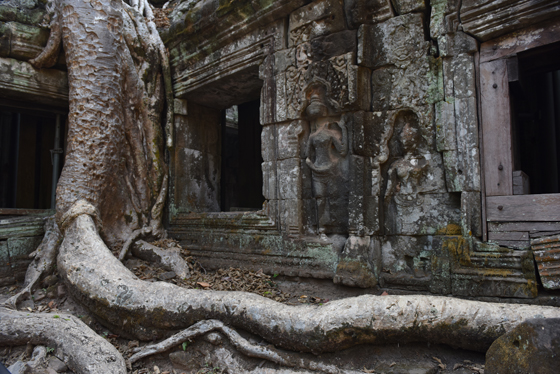
<div id="attachment_36295" style="width: 570px" class="wp-caption aligncenter"><img loading="lazy" decoding="async" aria-describedby="caption-attachment-36295" class="size-full wp-image-36295" src="https://www.oh-i-see.com/blog/wp-content/uploads/2020/02/MMM_3371-Version-2s.jpg" alt="" width="560" height="374" srcset="https://www.oh-i-see.com/blog/wp-content/uploads/2020/02/MMM_3371-Version-2s.jpg 560w, https://www.oh-i-see.com/blog/wp-content/uploads/2020/02/MMM_3371-Version-2s-300x200.jpg 300w, https://www.oh-i-see.com/blog/wp-content/uploads/2020/02/MMM_3371-Version-2s-207x138.jpg 207w" sizes="auto, (max-width: 560px) 100vw, 560px" /><p id="caption-attachment-36295" class="wp-caption-text">The Ta Prohm Temple, intentionally left in its natural state to show what explorers<br />found in the 19th century.<br />© Meredith Mullins</p></div>
<h2>Lost Among the Ruins in One of the Most Amazing Places on Earth</h2>
<p>Many years ago, I saw a photograph of a multi-rooted tree swallowing an ancient temple in one overgrown gulp.</p>
<p>For me, the siren’s call came through with haunting clarity. It was then and there—through a National Geographic image—that I knew I had to see these ruins, lost in the jungles of Cambodia. Even the name—Angkor Wat—exuded mystery. </p>{"id":36286,"date":"2020-03-03T03:00:48","date_gmt":"2020-03-03T11:00:48","guid":{"rendered":"https:\/\/www.oh-i-see.com\/blog\/?p=36286"},"modified":"2021-07-20T08:08:40","modified_gmt":"2021-07-20T15:08:40","slug":"travels-to-the-past-angkor-cambodia","status":"publish","type":"post","link":"https:\/\/www.oh-i-see.com\/blog\/travels-to-the-past-angkor-cambodia\/","title":{"rendered":"Travels to the Past\u2014Angkor, Cambodia"},"content":{"rendered":"<div id=\"attachment_36295\" style=\"width: 570px\" class=\"wp-caption aligncenter\"><img loading=\"lazy\" decoding=\"async\" aria-describedby=\"caption-attachment-36295\" class=\"size-full wp-image-36295\" src=\"https:\/\/www.oh-i-see.com\/blog\/wp-content\/uploads\/2020\/02\/MMM_3371-Version-2s.jpg\" alt=\"\" width=\"560\" height=\"374\" srcset=\"https:\/\/www.oh-i-see.com\/blog\/wp-content\/uploads\/2020\/02\/MMM_3371-Version-2s.jpg 560w, https:\/\/www.oh-i-see.com\/blog\/wp-content\/uploads\/2020\/02\/MMM_3371-Version-2s-300x200.jpg 300w, https:\/\/www.oh-i-see.com\/blog\/wp-content\/uploads\/2020\/02\/MMM_3371-Version-2s-207x138.jpg 207w\" sizes=\"auto, (max-width: 560px) 100vw, 560px\" \/><p id=\"caption-attachment-36295\" class=\"wp-caption-text\">The Ta Prohm Temple, intentionally left in its natural state to show what explorers<br \/>found in the 19th century.<br \/>\u00a9 Meredith Mullins<\/p><\/div>\n<h2>Lost Among the Ruins in One of the Most Amazing Places on Earth<\/h2>\n<p>Many years ago, I saw a photograph of a multi-rooted tree swallowing an ancient temple in one overgrown gulp.<\/p>\n<p>For me, the siren\u2019s call came through with haunting clarity. It was then and there\u2014through a National Geographic image\u2014that I knew I had to see these ruins, lost in the jungles of Cambodia. Even the name\u2014Angkor Wat\u2014exuded mystery.<!--more--><\/p>\n<div id=\"attachment_36298\" style=\"width: 490px\" class=\"wp-caption aligncenter\"><img loading=\"lazy\" decoding=\"async\" aria-describedby=\"caption-attachment-36298\" class=\"size-full wp-image-36298\" src=\"https:\/\/www.oh-i-see.com\/blog\/wp-content\/uploads\/2020\/02\/MMM_3373-Version-2s.jpg\" alt=\"\" width=\"480\" height=\"623\" srcset=\"https:\/\/www.oh-i-see.com\/blog\/wp-content\/uploads\/2020\/02\/MMM_3373-Version-2s.jpg 480w, https:\/\/www.oh-i-see.com\/blog\/wp-content\/uploads\/2020\/02\/MMM_3373-Version-2s-231x300.jpg 231w, https:\/\/www.oh-i-see.com\/blog\/wp-content\/uploads\/2020\/02\/MMM_3373-Version-2s-159x207.jpg 159w, https:\/\/www.oh-i-see.com\/blog\/wp-content\/uploads\/2020\/02\/MMM_3373-Version-2s-300x389.jpg 300w\" sizes=\"auto, (max-width: 480px) 100vw, 480px\" \/><p id=\"caption-attachment-36298\" class=\"wp-caption-text\">Replicating my National Geographic memory.<br \/>Who will win this battle\u2014the silk-cotton tree or the remnants of the Khmer Empire?<br \/>\u00a9 Meredith Mullins<\/p><\/div>\n<p>For some, the call might come through Lara Croft Tomb Raider (Angelina Jolie) racing through the crumbling Khmer temples.<\/p>\n<p>For some, the call may be just from imagining the life of Indiana Jones or James Bond, moving through time and discovering ancient cities and lost civilizations.<\/p>\n<div id=\"attachment_36292\" style=\"width: 570px\" class=\"wp-caption aligncenter\"><img loading=\"lazy\" decoding=\"async\" aria-describedby=\"caption-attachment-36292\" class=\"size-full wp-image-36292\" src=\"https:\/\/www.oh-i-see.com\/blog\/wp-content\/uploads\/2020\/02\/MMM_2877-Version-2s.jpg\" alt=\"Beng Melea Temple in Angkor, Siem Reap, Cambodia, one of the Angkor temples in one of the amazing places on earth. (Image \u00a9 Meredith Mullins.)\" width=\"560\" height=\"601\" srcset=\"https:\/\/www.oh-i-see.com\/blog\/wp-content\/uploads\/2020\/02\/MMM_2877-Version-2s.jpg 560w, https:\/\/www.oh-i-see.com\/blog\/wp-content\/uploads\/2020\/02\/MMM_2877-Version-2s-280x300.jpg 280w, https:\/\/www.oh-i-see.com\/blog\/wp-content\/uploads\/2020\/02\/MMM_2877-Version-2s-193x207.jpg 193w, https:\/\/www.oh-i-see.com\/blog\/wp-content\/uploads\/2020\/02\/MMM_2877-Version-2s-300x322.jpg 300w\" sizes=\"auto, (max-width: 560px) 100vw, 560px\" \/><p id=\"caption-attachment-36292\" class=\"wp-caption-text\">Beng Melea Temple, devoured by nature . . . and time.<br \/>\u00a9 Meredith Mullins<\/p><\/div>\n<p>No matter how we become entangled, these past civilizations are worthy of discovery. They continue to amaze us with the intelligence and artistry of the creators.<\/p>\n<div id=\"attachment_36333\" style=\"width: 570px\" class=\"wp-caption aligncenter\"><img loading=\"lazy\" decoding=\"async\" aria-describedby=\"caption-attachment-36333\" class=\"size-full wp-image-36333\" src=\"https:\/\/www.oh-i-see.com\/blog\/wp-content\/uploads\/2020\/02\/MMM_2932-Version-2s.jpg\" alt=\"\" width=\"560\" height=\"318\" srcset=\"https:\/\/www.oh-i-see.com\/blog\/wp-content\/uploads\/2020\/02\/MMM_2932-Version-2s.jpg 560w, https:\/\/www.oh-i-see.com\/blog\/wp-content\/uploads\/2020\/02\/MMM_2932-Version-2s-300x170.jpg 300w, https:\/\/www.oh-i-see.com\/blog\/wp-content\/uploads\/2020\/02\/MMM_2932-Version-2s-207x118.jpg 207w\" sizes=\"auto, (max-width: 560px) 100vw, 560px\" \/><p id=\"caption-attachment-36333\" class=\"wp-caption-text\">Every wall tells a story (Banteay Srei Temple carving).<br \/>\u00a9 Meredith Mullins<\/p><\/div>\n<p>These cultures had no worldly knowledge. They had only random clues to the complex rhythms of the universe. And yet, these empires were so far advanced that they should not be \u201clost\u201d at all. They should still be living strong.<\/p>\n<div id=\"attachment_36324\" style=\"width: 490px\" class=\"wp-caption aligncenter\"><img loading=\"lazy\" decoding=\"async\" aria-describedby=\"caption-attachment-36324\" class=\"size-full wp-image-36324\" src=\"https:\/\/www.oh-i-see.com\/blog\/wp-content\/uploads\/2020\/02\/MMM_3629-Version-2s.jpg\" alt=\"\" width=\"480\" height=\"719\" srcset=\"https:\/\/www.oh-i-see.com\/blog\/wp-content\/uploads\/2020\/02\/MMM_3629-Version-2s.jpg 480w, https:\/\/www.oh-i-see.com\/blog\/wp-content\/uploads\/2020\/02\/MMM_3629-Version-2s-200x300.jpg 200w, https:\/\/www.oh-i-see.com\/blog\/wp-content\/uploads\/2020\/02\/MMM_3629-Version-2s-138x207.jpg 138w, https:\/\/www.oh-i-see.com\/blog\/wp-content\/uploads\/2020\/02\/MMM_3629-Version-2s-300x449.jpg 300w\" sizes=\"auto, (max-width: 480px) 100vw, 480px\" \/><p id=\"caption-attachment-36324\" class=\"wp-caption-text\">Moving closer to heaven: Ascension to the gods (Angkor Wat)<br \/>\u00a9 Meredith Mullins<\/p><\/div>\n<h4>Angkor . . . What?<\/h4>\n<p>Full disclosure\u2014I always thought Angkor Wat was the whole city of temples. In fact, Angkor is the extensive metropolis, with roads, buildings, canals, and reservoirs\u2014an area of more than 1000 square kilometers. Angkor is the Khmer word for \u201ccity.\u201d<\/p>\n<div id=\"attachment_36318\" style=\"width: 570px\" class=\"wp-caption aligncenter\"><img loading=\"lazy\" decoding=\"async\" aria-describedby=\"caption-attachment-36318\" class=\"size-full wp-image-36318\" src=\"https:\/\/www.oh-i-see.com\/blog\/wp-content\/uploads\/2020\/02\/angkors.jpg\" alt=\"\" width=\"560\" height=\"348\" srcset=\"https:\/\/www.oh-i-see.com\/blog\/wp-content\/uploads\/2020\/02\/angkors.jpg 560w, https:\/\/www.oh-i-see.com\/blog\/wp-content\/uploads\/2020\/02\/angkors-300x186.jpg 300w, https:\/\/www.oh-i-see.com\/blog\/wp-content\/uploads\/2020\/02\/angkors-207x129.jpg 207w\" sizes=\"auto, (max-width: 560px) 100vw, 560px\" \/><p id=\"caption-attachment-36318\" class=\"wp-caption-text\">Angkor Wat, the largest of the Angkor temples<br \/>\u00a9 Meredith Mullins<\/p><\/div>\n<p>Angkor Wat is its crown jewel\u2014the massive architectural and engineering triumph, built in the early 12<sup>th\u00a0<\/sup>Century during the reign of King Suryavarman II.<\/p>\n<p>This temple was the center of the vast Khmer megacity, and was dedicated to the Hindu god Vishnu, since trade with India was a significant influence on the Khmer culture.<\/p>\n<div id=\"attachment_36349\" style=\"width: 570px\" class=\"wp-caption aligncenter\"><img loading=\"lazy\" decoding=\"async\" aria-describedby=\"caption-attachment-36349\" class=\"size-full wp-image-36349\" src=\"https:\/\/www.oh-i-see.com\/blog\/wp-content\/uploads\/2020\/02\/MMM_3670-Version-2s.jpg\" alt=\"\" width=\"560\" height=\"374\" srcset=\"https:\/\/www.oh-i-see.com\/blog\/wp-content\/uploads\/2020\/02\/MMM_3670-Version-2s.jpg 560w, https:\/\/www.oh-i-see.com\/blog\/wp-content\/uploads\/2020\/02\/MMM_3670-Version-2s-300x200.jpg 300w, https:\/\/www.oh-i-see.com\/blog\/wp-content\/uploads\/2020\/02\/MMM_3670-Version-2s-207x138.jpg 207w\" sizes=\"auto, (max-width: 560px) 100vw, 560px\" \/><p id=\"caption-attachment-36349\" class=\"wp-caption-text\">The bas-relief carvings of Angkor Wat show stories of battle, as well as daily life.<br \/>\u00a9 Meredith Mullins<\/p><\/div>\n<p>After King Suryavarman II and a period of instability, King Jayavarman VII came to power and proceeded on an ambitious 40-year building spree.<\/p>\n<div id=\"attachment_36305\" style=\"width: 570px\" class=\"wp-caption aligncenter\"><img loading=\"lazy\" decoding=\"async\" aria-describedby=\"caption-attachment-36305\" class=\"size-full wp-image-36305\" src=\"https:\/\/www.oh-i-see.com\/blog\/wp-content\/uploads\/2020\/02\/MMM_3195s.jpg\" alt=\"\" width=\"560\" height=\"374\" srcset=\"https:\/\/www.oh-i-see.com\/blog\/wp-content\/uploads\/2020\/02\/MMM_3195s.jpg 560w, https:\/\/www.oh-i-see.com\/blog\/wp-content\/uploads\/2020\/02\/MMM_3195s-300x200.jpg 300w, https:\/\/www.oh-i-see.com\/blog\/wp-content\/uploads\/2020\/02\/MMM_3195s-207x138.jpg 207w\" sizes=\"auto, (max-width: 560px) 100vw, 560px\" \/><p id=\"caption-attachment-36305\" class=\"wp-caption-text\">Gate (and moat) leading to King Jayavarman&#8217;s Angkor Thom<br \/>\u00a9 Meredith Mullins<\/p><\/div>\n<p>The Angkor Thom area of Jayavarman VII offers some of the most beautiful temples, such as Bayon and Ta Prohm. Jayavarman\u2019s expansion project included more than 100 temples, as well as hospitals and housing across the empire. Jayavarman VII was also responsible for shifting the religious focus to Buddhism.<\/p>\n<div id=\"attachment_36304\" style=\"width: 570px\" class=\"wp-caption aligncenter\"><img loading=\"lazy\" decoding=\"async\" aria-describedby=\"caption-attachment-36304\" class=\"size-full wp-image-36304\" src=\"https:\/\/www.oh-i-see.com\/blog\/wp-content\/uploads\/2020\/02\/MMM_3245-Version-2s.jpg\" alt=\"\" width=\"560\" height=\"274\" srcset=\"https:\/\/www.oh-i-see.com\/blog\/wp-content\/uploads\/2020\/02\/MMM_3245-Version-2s.jpg 560w, https:\/\/www.oh-i-see.com\/blog\/wp-content\/uploads\/2020\/02\/MMM_3245-Version-2s-300x147.jpg 300w, https:\/\/www.oh-i-see.com\/blog\/wp-content\/uploads\/2020\/02\/MMM_3245-Version-2s-207x101.jpg 207w\" sizes=\"auto, (max-width: 560px) 100vw, 560px\" \/><p id=\"caption-attachment-36304\" class=\"wp-caption-text\">The Bayon Temple<br \/>Can you find the face(s) of King Jayavarman VII?<br \/>\u00a9 Meredith Mullins<\/p><\/div>\n<p>There are more than 1000 temples in the region. At the height of Angkor\u2019s success (from the 11<sup>th\u00a0<\/sup>to 14<sup>th\u00a0<\/sup>centuries), it was the largest city in the world\u2014home to nearly a million people and the capital of the mighty Khmer Empire.<\/p>\n<div id=\"attachment_36309\" style=\"width: 570px\" class=\"wp-caption aligncenter\"><img loading=\"lazy\" decoding=\"async\" aria-describedby=\"caption-attachment-36309\" class=\"size-full wp-image-36309\" src=\"https:\/\/www.oh-i-see.com\/blog\/wp-content\/uploads\/2020\/02\/MMM_3530-Version-2s.jpg\" alt=\"Faces at Ta Prohm Temple in Angkor, Siem Reap, Cambodia, one of the Angkor temples in one of the most amazing places on earth. (Image \u00a9 Meredith Mullins.)\" width=\"560\" height=\"537\" srcset=\"https:\/\/www.oh-i-see.com\/blog\/wp-content\/uploads\/2020\/02\/MMM_3530-Version-2s.jpg 560w, https:\/\/www.oh-i-see.com\/blog\/wp-content\/uploads\/2020\/02\/MMM_3530-Version-2s-300x288.jpg 300w, https:\/\/www.oh-i-see.com\/blog\/wp-content\/uploads\/2020\/02\/MMM_3530-Version-2s-207x198.jpg 207w\" sizes=\"auto, (max-width: 560px) 100vw, 560px\" \/><p id=\"caption-attachment-36309\" class=\"wp-caption-text\">What is believed to be King Jayavarman&#8217;s face looks out in four directions<br \/>over the vast Khmer Empire (Ta Prohm Temple).<br \/>\u00a9 Meredith Mullins<\/p><\/div>\n<p>It is still the largest religious monument on earth, although most of the temples have been abandoned to the jungle.<\/p>\n<div id=\"attachment_36321\" style=\"width: 570px\" class=\"wp-caption aligncenter\"><img loading=\"lazy\" decoding=\"async\" aria-describedby=\"caption-attachment-36321\" class=\"size-full wp-image-36321\" src=\"https:\/\/www.oh-i-see.com\/blog\/wp-content\/uploads\/2020\/02\/MMM_3645s.jpg\" alt=\"Buddhist monks at Angkor Wat in Angkor, Siem Reap, Cambodia, one of the Angkor temples in one of the most amazing places on earth. (Image \u00a9 Meredith Mullins.)\" width=\"560\" height=\"349\" srcset=\"https:\/\/www.oh-i-see.com\/blog\/wp-content\/uploads\/2020\/02\/MMM_3645s.jpg 560w, https:\/\/www.oh-i-see.com\/blog\/wp-content\/uploads\/2020\/02\/MMM_3645s-300x187.jpg 300w, https:\/\/www.oh-i-see.com\/blog\/wp-content\/uploads\/2020\/02\/MMM_3645s-207x129.jpg 207w\" sizes=\"auto, (max-width: 560px) 100vw, 560px\" \/><p id=\"caption-attachment-36321\" class=\"wp-caption-text\">Angkor Wat today is a Buddhist temple and has been in continuous use as<br \/>a religious site since its origin, nearly 900 years ago.<br \/>\u00a9 Meredith Mullins<\/p><\/div>\n<p>It is believed that after the death of Jayavarman VII, climate conditions (first a long drought and then a period of flooding) destroyed the intricate water network, which made living conditions challenging. The golden age was over. The region was all but abandoned.<\/p>\n<div id=\"attachment_36294\" style=\"width: 570px\" class=\"wp-caption aligncenter\"><img loading=\"lazy\" decoding=\"async\" aria-describedby=\"caption-attachment-36294\" class=\"size-full wp-image-36294\" src=\"https:\/\/www.oh-i-see.com\/blog\/wp-content\/uploads\/2020\/02\/MMM_3433-Version-2s.jpg\" alt=\"Ta Prohm Temple in Angkor, Siem Reap, Cambodia, one of the Angkor temples in one of the most amazing places on earth. (Image \u00a9 Meredith Mullins.)\" width=\"560\" height=\"379\" srcset=\"https:\/\/www.oh-i-see.com\/blog\/wp-content\/uploads\/2020\/02\/MMM_3433-Version-2s.jpg 560w, https:\/\/www.oh-i-see.com\/blog\/wp-content\/uploads\/2020\/02\/MMM_3433-Version-2s-300x203.jpg 300w, https:\/\/www.oh-i-see.com\/blog\/wp-content\/uploads\/2020\/02\/MMM_3433-Version-2s-207x140.jpg 207w\" sizes=\"auto, (max-width: 560px) 100vw, 560px\" \/><p id=\"caption-attachment-36294\" class=\"wp-caption-text\">King Jayavarman&#8217;s Ta Prohm Temple, gobbled up by a Strangler Fig tree.<br \/>\u00a9 Meredith Mullins<\/p><\/div>\n<h4>The Art of Rediscovery<\/h4>\n<p>European explorers and scientists rediscovered the temples in the mid 1800s. The history of the Khmer Empire was unearthed, along with information about the intricate building processes, the network of services provided, and the graphic depictions of everyday life and historic highlights.<\/p>\n<div id=\"attachment_36352\" style=\"width: 570px\" class=\"wp-caption aligncenter\"><img loading=\"lazy\" decoding=\"async\" aria-describedby=\"caption-attachment-36352\" class=\"size-full wp-image-36352\" src=\"https:\/\/www.oh-i-see.com\/blog\/wp-content\/uploads\/2020\/02\/MMM_3672-Version-2s.jpg\" alt=\"\" width=\"560\" height=\"374\" srcset=\"https:\/\/www.oh-i-see.com\/blog\/wp-content\/uploads\/2020\/02\/MMM_3672-Version-2s.jpg 560w, https:\/\/www.oh-i-see.com\/blog\/wp-content\/uploads\/2020\/02\/MMM_3672-Version-2s-300x200.jpg 300w, https:\/\/www.oh-i-see.com\/blog\/wp-content\/uploads\/2020\/02\/MMM_3672-Version-2s-207x138.jpg 207w\" sizes=\"auto, (max-width: 560px) 100vw, 560px\" \/><p id=\"caption-attachment-36352\" class=\"wp-caption-text\">Miles of carvings tell the stories of the past.<br \/>\u00a9 Meredith Mullins<\/p><\/div>\n<p>Restoration work began, but many of the historic relics were stolen or moved.<\/p>\n<div id=\"attachment_36323\" style=\"width: 570px\" class=\"wp-caption aligncenter\"><img loading=\"lazy\" decoding=\"async\" aria-describedby=\"caption-attachment-36323\" class=\"size-full wp-image-36323\" src=\"https:\/\/www.oh-i-see.com\/blog\/wp-content\/uploads\/2020\/02\/MMM_3620-Version-2s.jpg\" alt=\"Headless statues at Angkor Wat in Siem Reap, Cambodia, one of the Angkor temples in one of the most amazing places on earth. (Image \u00a9 Meredith Mullins.)\" width=\"560\" height=\"553\" srcset=\"https:\/\/www.oh-i-see.com\/blog\/wp-content\/uploads\/2020\/02\/MMM_3620-Version-2s.jpg 560w, https:\/\/www.oh-i-see.com\/blog\/wp-content\/uploads\/2020\/02\/MMM_3620-Version-2s-300x296.jpg 300w, https:\/\/www.oh-i-see.com\/blog\/wp-content\/uploads\/2020\/02\/MMM_3620-Version-2s-207x204.jpg 207w\" sizes=\"auto, (max-width: 560px) 100vw, 560px\" \/><p id=\"caption-attachment-36323\" class=\"wp-caption-text\">Headless statues\u2014a result of human destruction (thieves who have stolen history)<br \/>\u00a9 Meredith Mullins<\/p><\/div>\n<p>More challenges remained. The war period from the 1960s prevented maintenance of the temples. The planting of land mines in the region also made the area dangerous.<\/p>\n<div id=\"attachment_36339\" style=\"width: 570px\" class=\"wp-caption aligncenter\"><img loading=\"lazy\" decoding=\"async\" aria-describedby=\"caption-attachment-36339\" class=\"size-full wp-image-36339\" src=\"https:\/\/www.oh-i-see.com\/blog\/wp-content\/uploads\/2020\/02\/MMM_2806s.jpg\" alt=\"\" width=\"560\" height=\"372\" srcset=\"https:\/\/www.oh-i-see.com\/blog\/wp-content\/uploads\/2020\/02\/MMM_2806s.jpg 560w, https:\/\/www.oh-i-see.com\/blog\/wp-content\/uploads\/2020\/02\/MMM_2806s-300x199.jpg 300w, https:\/\/www.oh-i-see.com\/blog\/wp-content\/uploads\/2020\/02\/MMM_2806s-207x138.jpg 207w\" sizes=\"auto, (max-width: 560px) 100vw, 560px\" \/><p id=\"caption-attachment-36339\" class=\"wp-caption-text\">The challenge of clearing the land mines<br \/>\u00a9 Meredith Mullins<\/p><\/div>\n<p>Only since the mid 1990s have the land mines been cleared and tourism encouraged. Now, a new challenge presents itself.<\/p>\n<p>With millions of visitors each year, the limited water supply in the region and the fragility of the stone temples require a renewed vigilance. How can these treasures be protected?<\/p>\n<div id=\"attachment_36293\" style=\"width: 570px\" class=\"wp-caption aligncenter\"><img loading=\"lazy\" decoding=\"async\" aria-describedby=\"caption-attachment-36293\" class=\"size-full wp-image-36293\" src=\"https:\/\/www.oh-i-see.com\/blog\/wp-content\/uploads\/2020\/02\/MMM_2945-Version-2s.jpg\" alt=\"Banteay Srei Temple in Angkor, Siem Reap, Cambodia, one of the Angkor Temples in one of the most amazing places on earth. (Image \u00a9 Meredith Mullins.)\" width=\"560\" height=\"397\" srcset=\"https:\/\/www.oh-i-see.com\/blog\/wp-content\/uploads\/2020\/02\/MMM_2945-Version-2s.jpg 560w, https:\/\/www.oh-i-see.com\/blog\/wp-content\/uploads\/2020\/02\/MMM_2945-Version-2s-300x213.jpg 300w, https:\/\/www.oh-i-see.com\/blog\/wp-content\/uploads\/2020\/02\/MMM_2945-Version-2s-207x147.jpg 207w\" sizes=\"auto, (max-width: 560px) 100vw, 560px\" \/><p id=\"caption-attachment-36293\" class=\"wp-caption-text\">The red sandstone of Banteay Srei Temple lends itself to intricate carvings.<br \/>\u00a9 Meredith Mullins<\/p><\/div>\n<h4>A Link with the Past . . . and with the Future<\/h4>\n<p>The experts who are studying the Khmer culture and the history of these ancient empires feel the continual excitement of discovery.<\/p>\n<p>As a restoration manager watches a sandstone block lifted into place through 21<sup>st\u00a0<\/sup>century technology, he marvels at how workers more than 800 years ago accomplished the same thing, but with much simpler tools. In fact, the Bayon Temple was built with 600,000 stone blocks\u2014 quarried by hand at a distance and transported to the Bayon site. Yet, they got it done.<\/p>\n<div id=\"attachment_36345\" style=\"width: 570px\" class=\"wp-caption aligncenter\"><img loading=\"lazy\" decoding=\"async\" aria-describedby=\"caption-attachment-36345\" class=\"size-full wp-image-36345\" src=\"https:\/\/www.oh-i-see.com\/blog\/wp-content\/uploads\/2020\/02\/MMM_3321-Version-2s.jpg\" alt=\"\" width=\"560\" height=\"374\" srcset=\"https:\/\/www.oh-i-see.com\/blog\/wp-content\/uploads\/2020\/02\/MMM_3321-Version-2s.jpg 560w, https:\/\/www.oh-i-see.com\/blog\/wp-content\/uploads\/2020\/02\/MMM_3321-Version-2s-300x200.jpg 300w, https:\/\/www.oh-i-see.com\/blog\/wp-content\/uploads\/2020\/02\/MMM_3321-Version-2s-207x138.jpg 207w\" sizes=\"auto, (max-width: 560px) 100vw, 560px\" \/><p id=\"caption-attachment-36345\" class=\"wp-caption-text\">The Bayon Temple, was made of 600,000 stone blocks, transported miles<br \/>from the quarry through water canals. An amazing 12th century feat.<br \/>\u00a9 Meredith Mullins<\/p><\/div>\n<p>As I climbed over ancient stones and followed the stories engraved for, literally, miles on the walls of the temples, I felt a part of the past.<\/p>\n<p>Yes, I had been inspired to come to Cambodia by a photograph. But now, I could feel the warmth of the sandstone and the power of an empire.<\/p>\n<div id=\"attachment_36342\" style=\"width: 570px\" class=\"wp-caption aligncenter\"><img loading=\"lazy\" decoding=\"async\" aria-describedby=\"caption-attachment-36342\" class=\"size-full wp-image-36342\" src=\"https:\/\/www.oh-i-see.com\/blog\/wp-content\/uploads\/2020\/02\/MMM_2838s.jpg\" alt=\"Ruined Beng Mealea Temple in Angkor, Siem Reap, Cambodia, one of the Angkor temples in one of the most amazing places on earth. (Image \u00a9 Meredith Mullins.)\" width=\"560\" height=\"374\" srcset=\"https:\/\/www.oh-i-see.com\/blog\/wp-content\/uploads\/2020\/02\/MMM_2838s.jpg 560w, https:\/\/www.oh-i-see.com\/blog\/wp-content\/uploads\/2020\/02\/MMM_2838s-300x200.jpg 300w, https:\/\/www.oh-i-see.com\/blog\/wp-content\/uploads\/2020\/02\/MMM_2838s-207x138.jpg 207w\" sizes=\"auto, (max-width: 560px) 100vw, 560px\" \/><p id=\"caption-attachment-36342\" class=\"wp-caption-text\">When you&#8217;re climbing through ruins, alone in the jungle,<br \/>you can&#8217;t help but feel a part of the past (Beng Mealea Temple).<br \/>\u00a9 Meredith Mullins<\/p><\/div>\n<p>Visiting the past can be a rich\u00a0<strong>\u201cOh, I see\u201d moment.<\/strong> \u00a0Also rewarding, can be thinking of the future . . . and how best to preserve the amazing places on earth.<\/p>\n<div id=\"attachment_36347\" style=\"width: 570px\" class=\"wp-caption aligncenter\"><img loading=\"lazy\" decoding=\"async\" aria-describedby=\"caption-attachment-36347\" class=\"size-full wp-image-36347\" src=\"https:\/\/www.oh-i-see.com\/blog\/wp-content\/uploads\/2020\/02\/MMM_3342-Version-2s.jpg\" alt=\"\" width=\"560\" height=\"374\" srcset=\"https:\/\/www.oh-i-see.com\/blog\/wp-content\/uploads\/2020\/02\/MMM_3342-Version-2s.jpg 560w, https:\/\/www.oh-i-see.com\/blog\/wp-content\/uploads\/2020\/02\/MMM_3342-Version-2s-300x200.jpg 300w, https:\/\/www.oh-i-see.com\/blog\/wp-content\/uploads\/2020\/02\/MMM_3342-Version-2s-207x138.jpg 207w\" sizes=\"auto, (max-width: 560px) 100vw, 560px\" \/><p id=\"caption-attachment-36347\" class=\"wp-caption-text\">Looking to the past and to the future<br \/>\u00a9 Meredith Mullins<\/p><\/div>\n<p><i>Thank you to <\/i><a style=\"font-style: italic;\" href=\"http:\/\/www.hanumantravel.com\" target=\"_blank\" rel=\"noopener noreferrer\">Hanuman Travel,<\/a><i> a Cambodian based travel company, and to our guide Meas Dara\u00a0Polrith (aka Paul) (who also taught Gordon Ramsey how to find tarantulas to fry). The trip was organized by Richard Murai and the nonprofit <a href=\"https:\/\/photography.org\" target=\"_blank\" rel=\"noopener noreferrer\">Center for Photographic Art.<\/a><\/i><\/p>\n<p><em><i><a title=\"Creative Inspiration Flows In Underwater Photographs\" href=\"#comments\">Comment<\/a><\/i>\u00a0on this post below, or inspire insight with your own\u00a0OIC Moment\u00a0<a href=\"https:\/\/www.oh-i-see.com\/blog\/your-oic-moments\/\">here<\/a>.<\/em><\/p>","protected":false},"excerpt":{"rendered":null,"protected":false},"author":5,"featured_media":36295,"comment_status":"closed","ping_status":"open","sticky":false,"template":"","format":"standard","meta":{"footnotes":""},"categories":[251,539,535],"tags":[],"class_list":["post-36286","post","type-post","status-publish","format-standard","has-post-thumbnail","hentry","category-asia","category-cambodia-mappoints","category-history-travel"],"aioseo_notices":[],"_links":{"self":[{"href":"https:\/\/www.oh-i-see.com\/blog\/wp-json\/wp\/v2\/posts\/36286","targetHints":{"allow":["GET"]}}],"collection":[{"href":"https:\/\/www.oh-i-see.com\/blog\/wp-json\/wp\/v2\/posts"}],"about":[{"href":"https:\/\/www.oh-i-see.com\/blog\/wp-json\/wp\/v2\/types\/post"}],"author":[{"embeddable":true,"href":"https:\/\/www.oh-i-see.com\/blog\/wp-json\/wp\/v2\/users\/5"}],"replies":[{"embeddable":true,"href":"https:\/\/www.oh-i-see.com\/blog\/wp-json\/wp\/v2\/comments?post=36286"}],"version-history":[{"count":47,"href":"https:\/\/www.oh-i-see.com\/blog\/wp-json\/wp\/v2\/posts\/36286\/revisions"}],"predecessor-version":[{"id":36388,"href":"https:\/\/www.oh-i-see.com\/blog\/wp-json\/wp\/v2\/posts\/36286\/revisions\/36388"}],"wp:featuredmedia":[{"embeddable":true,"href":"https:\/\/www.oh-i-see.com\/blog\/wp-json\/wp\/v2\/media\/36295"}],"wp:attachment":[{"href":"https:\/\/www.oh-i-see.com\/blog\/wp-json\/wp\/v2\/media?parent=36286"}],"wp:term":[{"taxonomy":"category","embeddable":true,"href":"https:\/\/www.oh-i-see.com\/blog\/wp-json\/wp\/v2\/categories?post=36286"},{"taxonomy":"post_tag","embeddable":true,"href":"https:\/\/www.oh-i-see.com\/blog\/wp-json\/wp\/v2\/tags?post=36286"}],"curies":[{"name":"wp","href":"https:\/\/api.w.org\/{rel}","templated":true}]}}