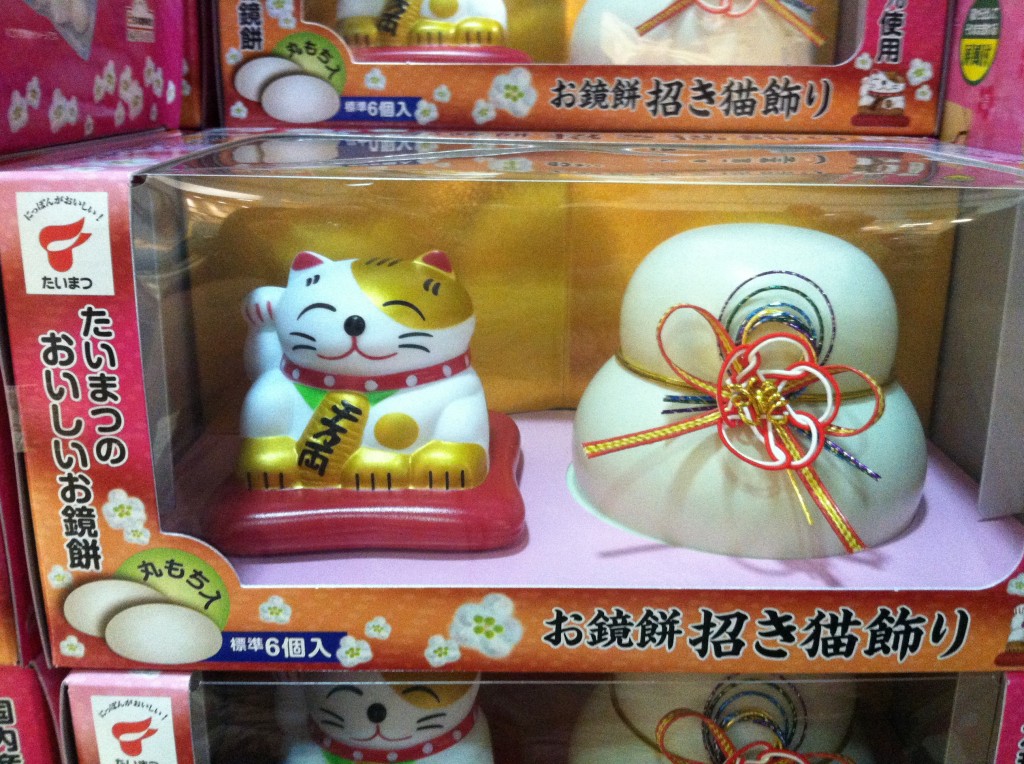
Japanese plastic mochi © Janine Boylan
Japanese plastic mochi © Janine Boylan
When I was living in Japan, I made every effort to have as many cultural encounters as possible. I picnicked with friends under the cherry blossoms in the spring. I participated in a formal tea ceremony. I attended events at the local museum. I even threw pots with a local potter.
So, around December, when these bright, shiny plastic packages started appearing in grocery stores, I knew it was time for another cultural encounter!
I was ready and eager. I stared at the package. A cat with raised paw! I had seen many of these already. The raised paw is meant to be beckoning wealth. These cats are considered good luck charms.
But what was that flattened, faceless snowman with the crazy bow tie? And what does one do with it? I searched the package for clues, but, since I couldn’t read the writing, I found nothing that helped.
A few days later, I was walking by the train station. Several men in traditional robes were chanting. One man had a giant wooden hammer and was pounding something white and sticky in a huge wooden bowl. Understandably, a small crowd had formed.
However, no one but me looked concerned. In fact, the entire crowd was quite amused when the man turned and placed the hammer in my hands. He gestured to me to hit the sticky glob in time with the chanting. I obeyed.
I had no idea what was going on. After a few half-hearted whacks, I returned the hammer, smiled, and gave a small bow. Then I shuffled away as quickly as I could. I did note just before I left, however, that the glob looked suspiciously like the mysterious faceless snowman (just with no bow tie).
After that, I saw more and more faceless snowmen appear around town. I noticed that, in addition to the shimmering bow ties, many snowmen boasted small oranges like perky caps. Thankfully, there were no more real men with big wooden hammers.
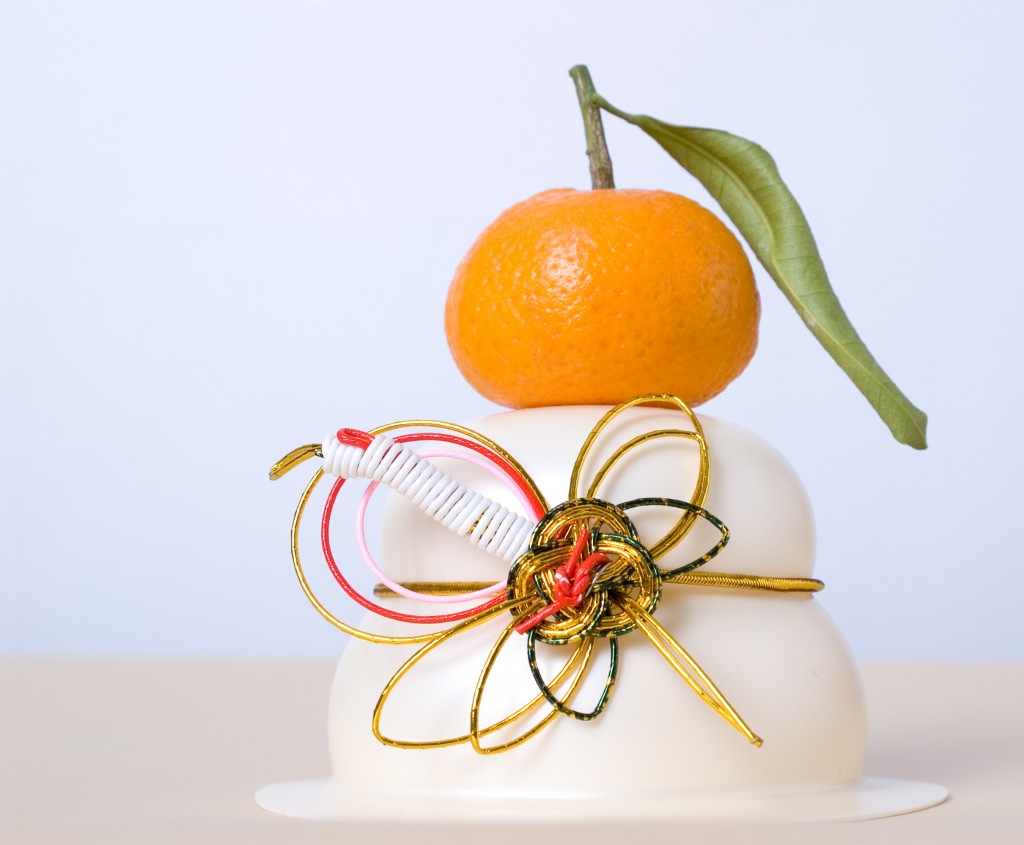
traditional Japanese mochi for the New Year © Thinkstock
Since, at the time, I didn’t have a computer to look up “faceless sticky snowman with orange on top,” I had to search and find someone who could explain the mystery to me.
I learned that it is a Japanese New Year tradition to make a sticky treat called mochi from rice. Often there are ceremonies, like in front of the train station, where the public can participate in the pounding. The rice gets walloped until it submits into a stretchy, thick, white blob. Then it is covered in rice flour and formed into two disks, a smaller one on top of a larger one.
The disks represent the old year and the new year. The orange on top, called daidai, represents the continuation of family from generation to generation. Oh, I see. I had had my cultural encounter without knowing it was happening!
People can either get fresh mochi, or they can purchase plastic-encased mochi like the ones I originally saw in the store. Then they place these New Year’s offerings in their home until around January 11. By then the mochi is dry and cracked. Families break it apart (never cutting–that would be bad luck!) and cook and eat it.
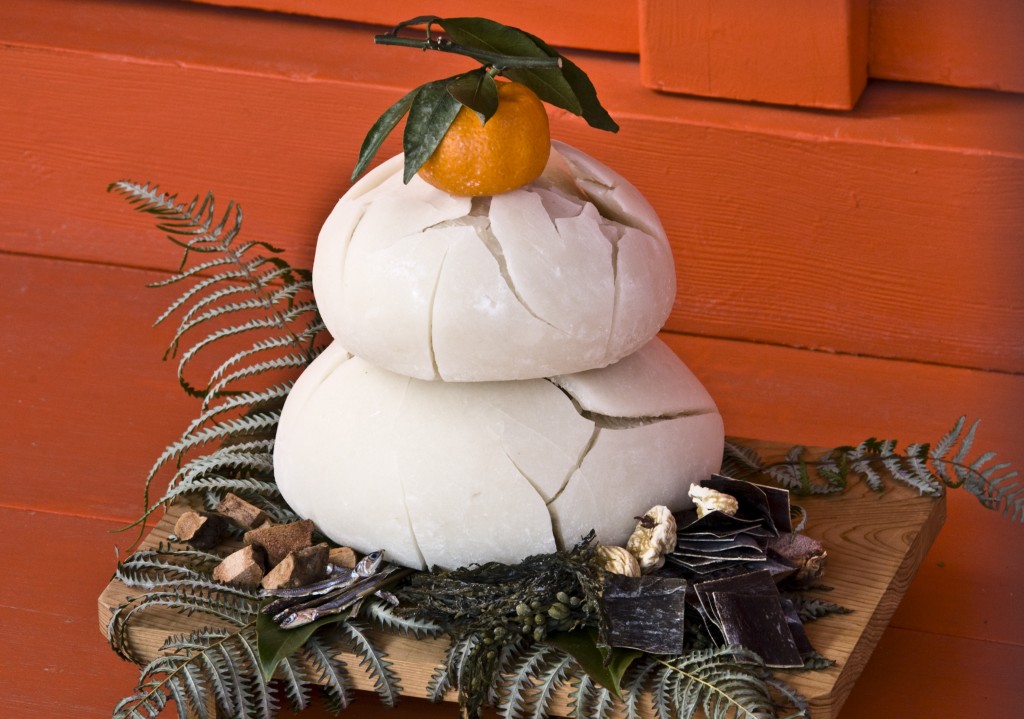
Japanese New Year mochi, ready to be broken and cooked © Thinkstock
Since my first cultural encounter with mochi, I have learned to love the sticky rice treat. And my mochi-making career still has hope.
Just last year, I found myself in San Francisco at Japantown Peace Plaza pounding mochi again. This time I was chanting and pounding with confidence.
But I’m not sure I’m ready to compete with the skilled mochi-pounding children featured in this video. It was filmed in San Francisco’s Japantown at Kristi Yamaguchi’s Children’s Day Festival when they gave a mid-year performance of this Japanese cultural tradition.
If the video does not display, watch it here.
As the New Year approaches, people around the world, like me, who love Japanese cultural traditions, are proudly displaying faceless snowmen with glittery bow ties and orange caps.
Happy New Year! 明けましておめでとうございます
Comment on this post below.
{"id":3585,"date":"2012-12-31T09:42:46","date_gmt":"2012-12-31T17:42:46","guid":{"rendered":"http:\/\/ohisee.genweb.site\/blog\/?p=3585"},"modified":"2021-07-26T11:20:34","modified_gmt":"2021-07-26T18:20:34","slug":"mochi-a-cultural-encounter","status":"publish","type":"post","link":"https:\/\/www.oh-i-see.com\/blog\/mochi-a-cultural-encounter\/","title":{"rendered":"Mochi: A Cultural Encounter"},"content":{"rendered":"
Japanese plastic mochi \u00a9 Janine Boylan<\/p><\/div>\n
When I was living in Japan,<\/strong> I made every effort to have as many cultural encounters as possible. I\u00a0picnicked with friends under the cherry blossoms in the spring. I participated in a formal tea ceremony. I attended events at the local museum. I even threw pots with a local potter.<\/p>\n So, around December, when these bright, shiny plastic packages started appearing in grocery stores, I knew it was time for another cultural encounter!<\/p>\n I was ready and eager. I stared at the package. A cat with raised paw! I had seen many of these already. The raised paw is meant to be beckoning wealth. These cats are considered good luck charms.<\/p>\n But what was that flattened, faceless snowman with the crazy bow tie? And what does one do with it? I searched the package for clues, but, since I couldn’t read the writing, I found nothing that helped.<\/p>\n A few days later, I was walking by the train station.<\/strong> Several men in traditional robes were chanting. One man had a giant wooden hammer and was pounding something white and sticky in a huge wooden bowl. Understandably, a small crowd had formed.<\/p>\n However, no one but me looked concerned. In fact, the entire crowd was quite\u00a0amused\u00a0when the man turned and placed the hammer in my hands. He gestured to me to hit the sticky glob in time with the chanting. I obeyed.<\/p>\n I had no idea what was going on.<\/strong>\u00a0After a few half-hearted whacks, I returned the hammer, smiled, and gave a small bow. Then I shuffled away as quickly as I could.\u00a0I did note just before I left, however, that the glob looked suspiciously like the mysterious faceless snowman (just with no bow tie).<\/p>\n After that, I saw more and more faceless snowmen\u00a0appear around town. I noticed that, in addition to the shimmering bow ties, many snowmen boasted small oranges like perky caps.\u00a0Thankfully, there were no more real men with big wooden hammers.<\/p>\n traditional Japanese mochi for the New Year \u00a9 Thinkstock<\/p><\/div>\n Since, at the time, I didn’t have a computer to look up “faceless sticky snowman with orange on top,” I had to search and find someone who could explain the mystery to me.<\/p>\n I learned that it is a Japanese New Year tradition<\/strong> to make a sticky treat called mochi\u00a0<\/em>from rice. Often there are ceremonies, like in front of the train station, where the public can participate in the pounding.\u00a0The rice gets walloped until it submits into a stretchy, thick, white blob. Then it is covered in rice flour and formed into two disks, a smaller one on top of a larger one.<\/p>\n The disks represent the old year and the new year. The orange on top, called daidai<\/em>, represents the\u00a0continuation\u00a0of family from generation to generation.\u00a0Oh, I see.<\/strong>\u00a0I had had my cultural encounter without knowing it was happening!<\/p>\n People can either get fresh mochi,<\/em> or they can purchase plastic-encased mochi<\/em> like the ones I originally saw in the store. Then they\u00a0place these New Year’s offerings\u00a0in their home until around January 11. By then the mochi<\/em> is dry and cracked. Families break it apart (never cutting–that would be bad luck!) and cook and eat it.<\/p>\n Japanese New Year mochi, ready to be broken and cooked \u00a9 Thinkstock<\/p><\/div>\n Since my first cultural encounter with mochi<\/em>, I have learned to love the sticky rice treat.\u00a0And my mochi-<\/em>making career still has hope.<\/p>\n Just last year, I found myself in San Francisco<\/strong>\u00a0at\u00a0<\/strong>Japantown Peace Plaza<\/a> pounding mochi<\/em> again. This time I was chanting and pounding with confidence.<\/p>\n But I’m not sure I’m ready to compete with the skilled mochi-pounding children featured in this video. It was filmed in San Francisco’s Japantown at Kristi Yamaguchi’s\u00a0Children’s Day Festival<\/a> when they gave a mid-year performance of this Japanese cultural tradition.<\/p>\n
