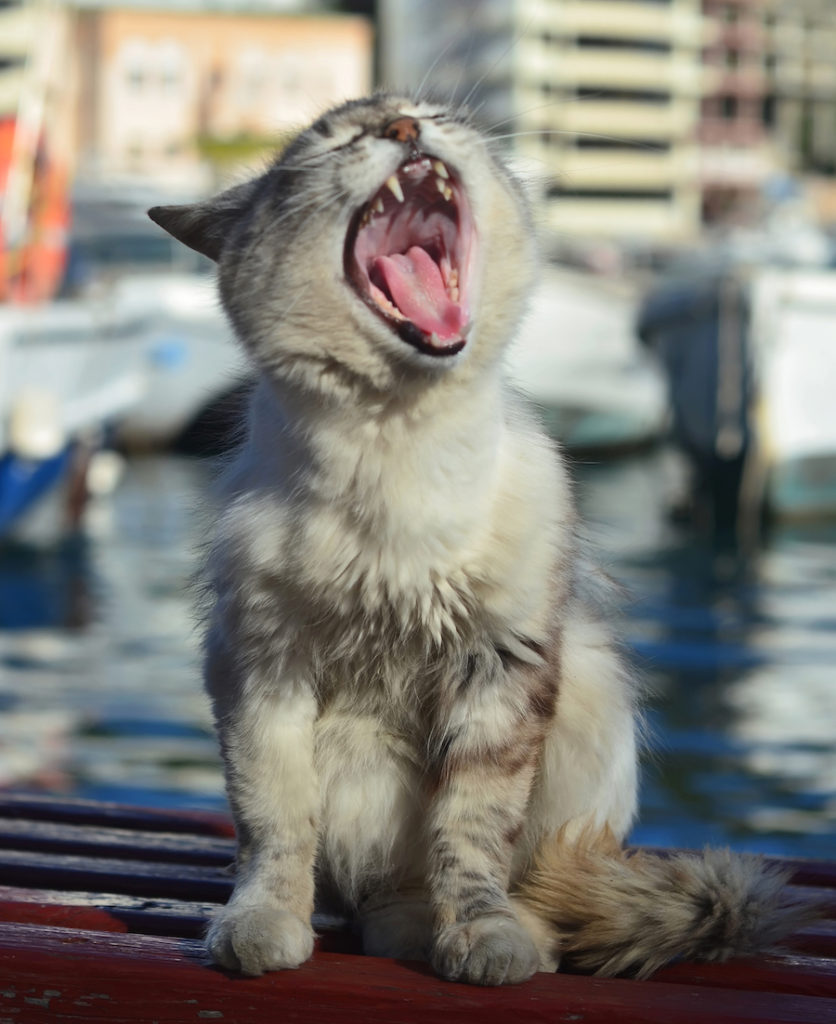
Don’t give your tongue to a cat. Why not?
© iStock/Maroznc
Don’t give your tongue to a cat. Why not?
© iStock/Maroznc
In the picturesque and poetic world of French idioms, the animal kingdom is well represented. Noah—and his ark—would be proud. Animals are key players in the proverbs and sayings of French culture.
Cats, lambs, sheep, ducks, dogs, elephants, wolves, chickens, cows, cockroaches, spiders, fish, rabbits, horses, rats, and giraffes all make an appearance.
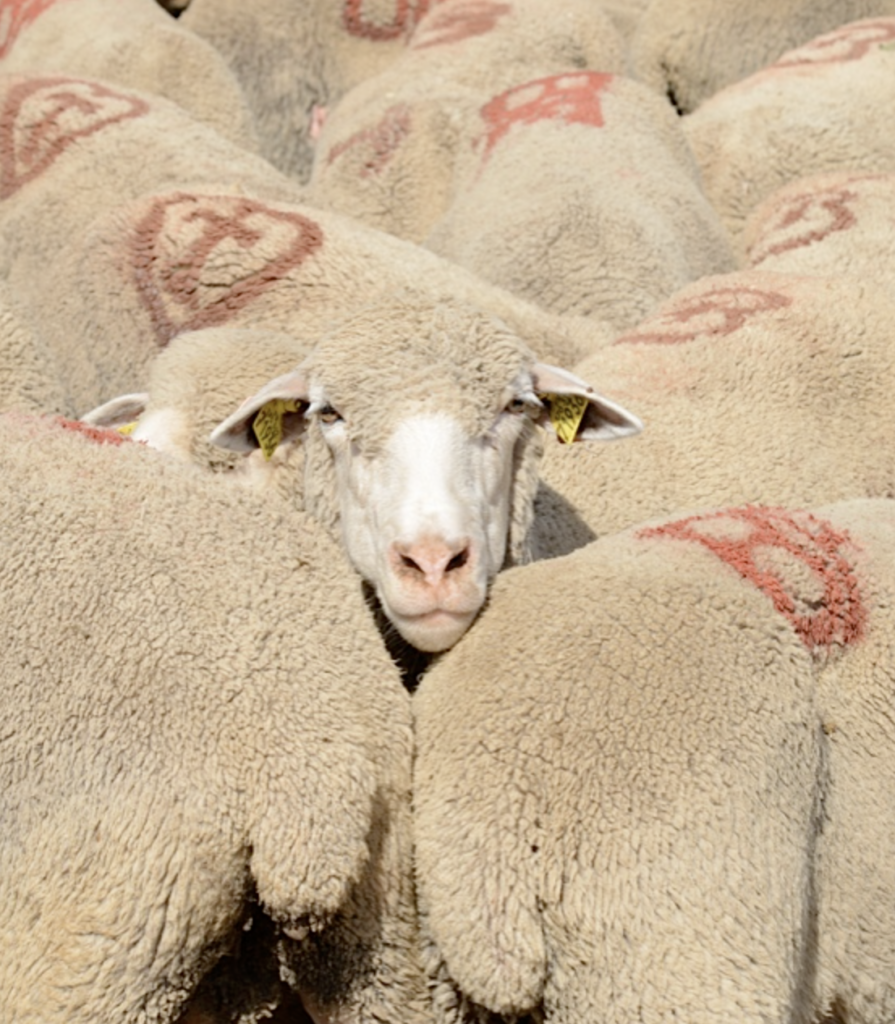
Where do sheep fit in to French idioms?
© Meredith Mullins
Idioms can come from various parts of a culture—food, history, social traditions, sports, values—but many languages use animals as a basis for their idioms.
Animals have universal appeal. We are familiar with basic animal characteristics no matter what our culture of origin. For centuries, we humans have observed how animals act.
We know that busy bees could do the lion’s share of the work and be so dog tired that they’d have to take a cat nap.
Learning a second language is never easy. But you know you are developing a bilingual brain when you can introduce idioms into casual conversation. And understanding this omnipresent figurative language will also give you insight into how a culture thinks.
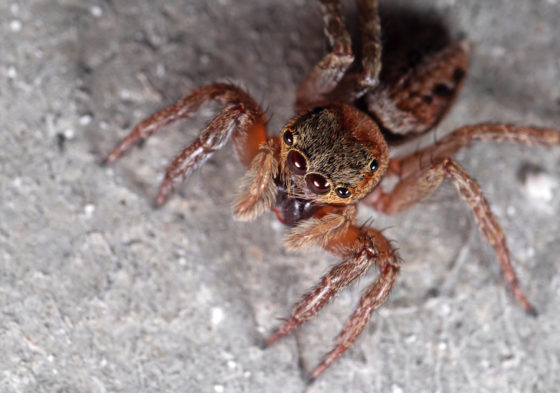
Do you have a spider on the ceiling . . . or bats in the belfry?
© iStock/Backiris
Idioms can, of course, drive you crazy—making you feel like you have bats in the belfry. Or, as the French would say, “to have a spider on the ceiling” (avoir une araignée au plafond).
The words—the metaphors— often don’t make sense at all, even to the native speakers.
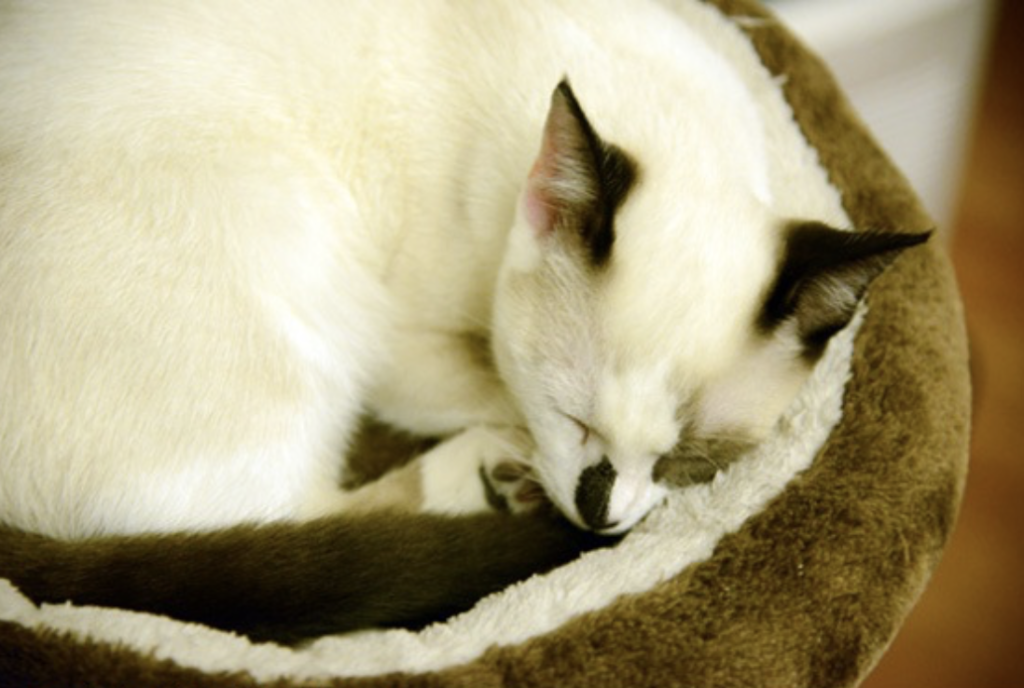
Leave well enough alone. Don’t wake the sleeping cat.
© Meredith Mullins
Our feline friends win the idiom popularity competition in French. Cat references are everywhere.
When things are going well, English speakers say, “Let sleeping dogs lie,” while French speakers advise, “Don’t wake the sleeping cat” (ne réveillez pas le chat qui dort).
When you arrive at a place where you’re supposed to meet someone and there’s no one around, you say “there is no cat” (il n’y a pas un chat).

Where is everyone? Il n’y a pas un chat.
© Meredith Mullins
You don’t have a “frog in your throat,” you have a “cat in your throat” (avoir un chat dans la gorge).
When you have better things to do, it’s not that you “have other fish to fry,” it’s that you have other cats to flog (avoir d’autres chats à fouetter).
And, if you want to “give up” and just quit (perhaps because there are too many cat idioms?), you “give your tongue to a cat” (donner sa langue au chat).
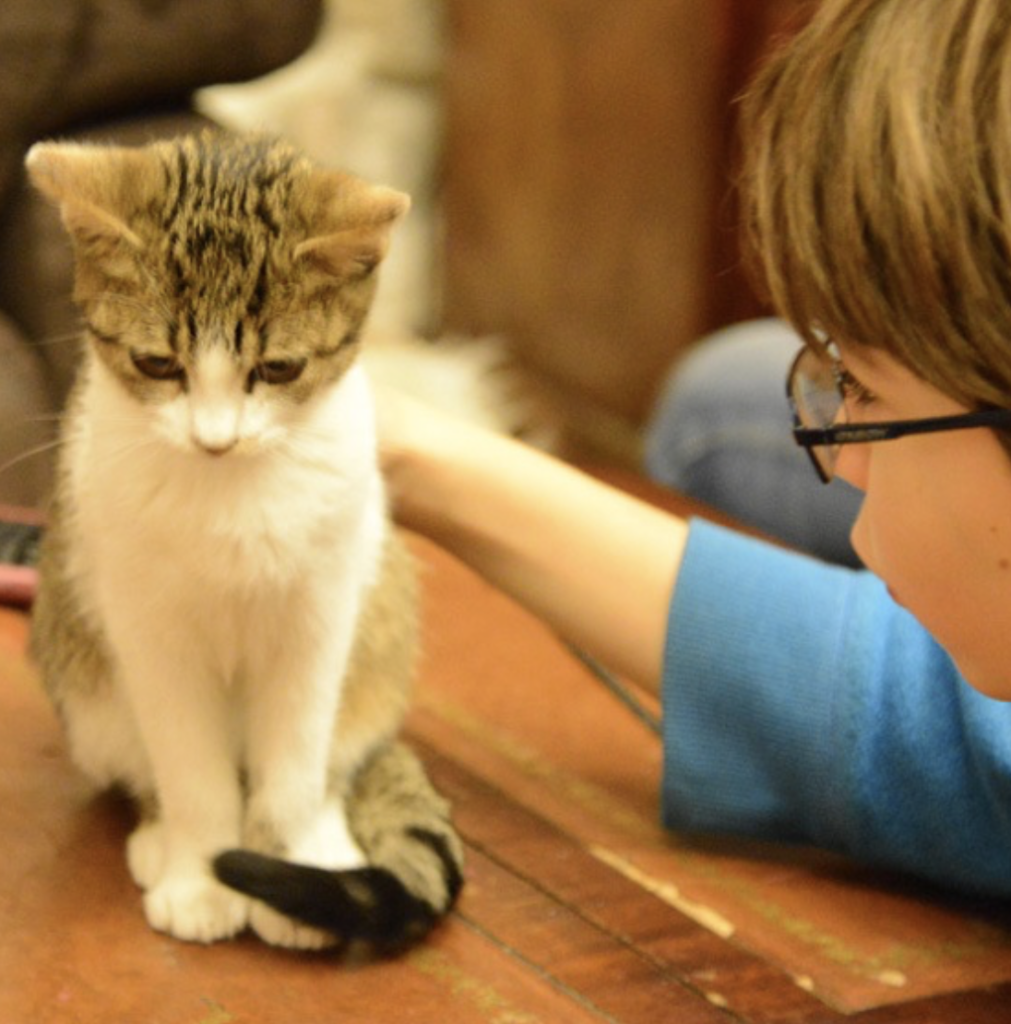
He won’t “give his tongue to a cat” because he doesn’t like to quit.
© Meredith Mullins
Many of the French idioms are similar to English idioms. Someone can be as sly as a fox (rusé comme un renard), stubborn as a mule (têtu comme une mule), or they can take the bull by the horns (prendre le taureau par les cornes).
Someone can be talkative as a magpie (bavard comme une pie), slow as a tortoise (lent comme une tortue), soft as a lamb (doux comme un agneau), or dumb as a donkey (bête comme un âne).
But several of the French idioms tell a poetic and mysterious story.

“Entre chien et loup” is the mystical time between light and darkness.
© iStock/twildlife
“Entre chien et loop” literally means “between the dog and the wolf.” However, the picture this paints is more enchanted than the literal translation.
The phrase refers to dusk, when the light is growing dim and the world is becoming more mystical. Your mind can play tricks about what you see. Are you looking at a dog or a wolf?
This time between the spectrum of light and darkness would be called “the witching hour” in English.
The French idiom “peigner la girafe” (to comb the giraffe) also presents a rich visual. It tells a story of a difficult task—a job that will be challenging and time consuming and will perhaps not yield any fruitful results.

How long does it take to comb TWO giraffes?
© Lauren Gezurian
And, if we find we are wasting time combing the giraffe—that is to say, our focus is wandering and we are straying from important work—the French would say “revenons à nos moutons.” Let’s get back to our sheep. In other words, let’s get back to business. Let’s stay on topic.
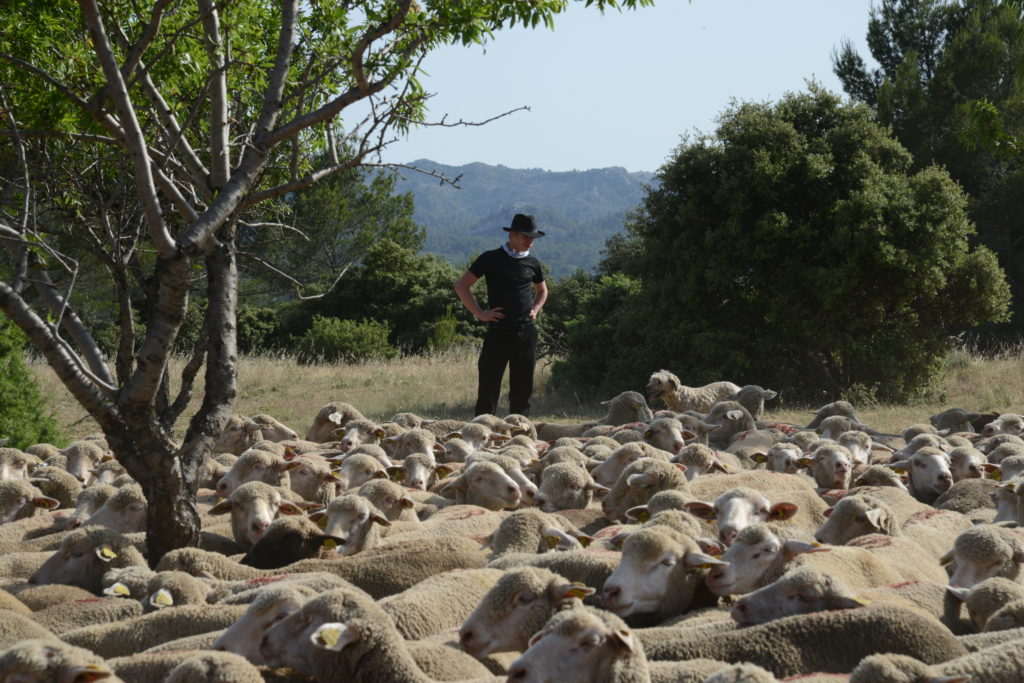
Minding the sheep is important. So . . . let’s get to the task at hand. “Revenons à nos moutons.”
© Meredith Mullins
In France, folks can sometimes be as bored as a dead rat (s’ennuyer comme un rat mort). And when people feel blue, they say “j’ai le cafard,” which literally means “I have the cockroach”— now that’s a depressing thought.
Idioms are a good way to describe emotions or to give advice in any language; but, as the French say—Une hirondelle ne fait pas le printemps (One swallow does not mean it’s spring.) That is to say, don’t make generalizations about a people or a culture without further research.

Don’t jump to conclusions: one swallow does not mean it’s spring.
© DMT
Now, let’s get back to our sheep. (Nous revenons à nos moutons). How to master idiomatic language and continue to build a bilingual brain.
I have never actually been told out loud that I speak French like a Spanish cow (parler français comme une vache espagnole), but I’m sure some of my French friends have thought it.
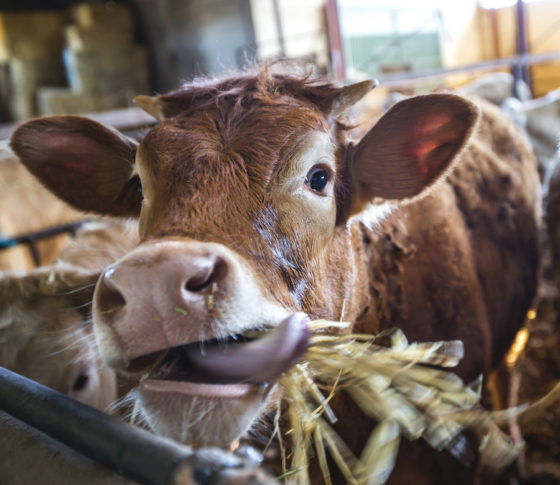
Please don’t tell me I speak French like a Spanish cow.
© iStock/Jorgefontestad
This insulting phrase is the French idiom for implying that a stumbling French language learner is still, well, stumbling, especially when it comes to idiomatic expressions, proverbs, and sayings.
Will I ever build a bilingual brain with a full range of French idioms? I would have to answer “When pigs fly,” which is the English idiom for “not a chance.” In French, I would say “when hens have teeth” (quand les poules auront des dents).
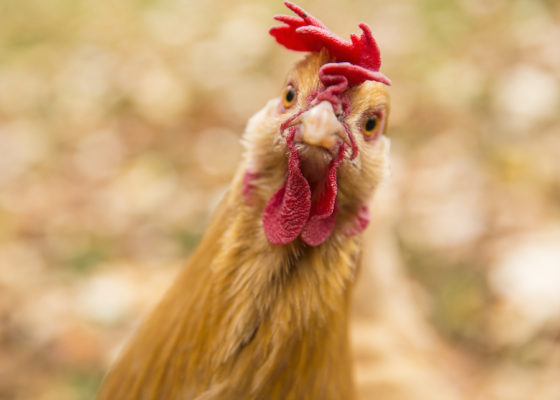
Quand les poules auront des dents. Does that really mean never?
© iStock/Shootingstar22
I am, however, secretly optimistic about my idiomatic progress. There are, in fact, rare species of hens that DO have teeth.
Comment on this post below, or inspire insight with your own OIC Moment here.
{"id":35024,"date":"2019-09-23T03:00:43","date_gmt":"2019-09-23T10:00:43","guid":{"rendered":"https:\/\/www.oh-i-see.com\/blog\/?p=35024"},"modified":"2021-07-20T08:06:34","modified_gmt":"2021-07-20T15:06:34","slug":"french-idioms-pay-tribute-to-the-animal-kingdom","status":"publish","type":"post","link":"https:\/\/www.oh-i-see.com\/blog\/french-idioms-pay-tribute-to-the-animal-kingdom\/","title":{"rendered":"French Idioms Pay Tribute to the Animal Kingdom"},"content":{"rendered":"
Don’t give your tongue to a cat. Why not?
\u00a9 iStock\/Maroznc<\/p><\/div>\n
In the picturesque and poetic world of French idioms, the animal kingdom is well represented. Noah\u2014and his ark\u2014would be proud. Animals are key players in the proverbs and sayings of French culture.<\/p>\n
Cats, lambs, sheep, ducks, dogs, elephants, wolves, chickens, cows, cockroaches, spiders, fish, rabbits, horses, rats, and giraffes all make an appearance.<\/p>\n

Where do sheep fit in to French idioms?
\u00a9 Meredith Mullins<\/p><\/div>\n
Idioms can come from various parts of a culture\u2014food, history, social traditions, sports, values\u2014but many languages use animals as a basis for their idioms.<\/p>\n
Animals have universal appeal. We are familiar with basic animal characteristics no matter what our culture of origin. For centuries, we humans have observed how animals act.<\/p>\n
We know that busy bees could do the lion\u2019s share of the work and be so dog tired that they\u2019d have to take a cat nap.<\/p>\n
Learning a second language is never easy. But you know you are developing a bilingual brain when you can introduce idioms into casual conversation. And understanding this omnipresent figurative language will also give you insight into how a culture thinks.<\/p>\n

Do you have a spider on the ceiling . . . or bats in the belfry?
\u00a9 iStock\/Backiris<\/p><\/div>\n
Idioms can, of course, drive you crazy\u2014making you feel like you have bats in the belfry. Or, as the French would say, \u201cto have a spider on the ceiling\u201d (avoir une araign\u00e9e au plafond).<\/em><\/p>\n The words\u2014the metaphors\u2014 often don\u2019t make sense at all, even to the native speakers.<\/p>\n Leave well enough alone. Don’t wake the sleeping cat. Our feline friends win the idiom popularity competition in French. Cat references are everywhere.<\/p>\n When things are going well, English speakers say, \u201cLet sleeping dogs lie,\u201d while French speakers advise, \u201cDon\u2019t wake the sleeping cat\u201d (ne r\u00e9veillez pas le chat qui dort). <\/em><\/p>\n When you arrive at a place where you\u2019re supposed to meet someone and there\u2019s no one around, you say \u201cthere is no cat\u201d (il n\u2019y a pas un chat).<\/em><\/p>\n Where is everyone? Il n’y a pas un chat.<\/em> You don\u2019t have a \u201cfrog in your throat,\u201d you have a \u201ccat in your throat\u201d (avoir un chat dans la gorge). <\/em><\/p>\n When you have better things to do, it\u2019s not that you \u201chave other fish to fry,\u201d it\u2019s that you have other cats to flog (avoir d\u2019autres chats \u00e0 fouetter).<\/em><\/p>\n And, if you want to \u201cgive up\u201d and just quit (perhaps because there are too many cat idioms?), you \u201cgive your tongue to a cat\u201d (donner sa langue au chat).<\/em><\/p>\n He won’t “give his tongue to a cat” because he doesn’t like to quit. Many of the French idioms are similar to English idioms. Someone can be as sly as a fox (rus\u00e9 comme un renard),\u00a0<\/em>stubborn as a mule (t\u00eatu comme une mule),\u00a0<\/em>or they can take the bull by the horns (prendre le taureau par les cornes).<\/em><\/p>\n Someone can be talkative as a magpie (bavard comme une pie),\u00a0<\/em>slow as a tortoise (lent comme une tortue),\u00a0<\/em>soft as a lamb (doux comme un agneau),\u00a0<\/em>or dumb as a donkey (b\u00eate comme un \u00e2ne).<\/em><\/p>\n But several of the French idioms tell a poetic and mysterious story.<\/p>\n “Entre chien et loup”<\/em> is the mystical time between light and darkness. \u201cEntre chien et\u00a0loop\u201d\u00a0<\/i>literally means \u201cbetween the dog and the wolf.\u201d However, the picture this paints is more enchanted than the literal translation.<\/p>\n The phrase refers to dusk, when the light is growing dim and the world is becoming more mystical. Your mind can play tricks about what you see. Are you looking at a dog or a wolf?<\/p>\n This time between the spectrum of light and darkness would be called \u201cthe witching hour\u201d in English.<\/p>\n The French idiom \u201cpeigner la\u00a0girafe\u201d\u00a0<\/i>(to comb the giraffe) also presents a rich visual. It tells a story of a difficult task\u2014a job that will be challenging and time consuming and will perhaps not yield any fruitful results.<\/p>\n How long does it take to comb TWO giraffes? And, if we find we are wasting time combing the giraffe\u2014that is to say, our focus is wandering and we are straying from important work\u2014the French would say \u201crevenons \u00e0 nos moutons.\u201d <\/em>Let\u2019s get back to our sheep.\u00a0<\/em>In other words, let\u2019s get back to business. Let\u2019s stay on topic.<\/p>\n Minding the sheep is important. So . . . let’s get to the task at hand. “Revenons \u00e0 nos moutons.”<\/em> In France, folks can sometimes be as bored as a dead rat (s\u2019ennuyer comme un rat mort). <\/em>And when people feel blue, they say “j’ai le\u00a0cafard,”\u00a0<\/i>which literally means “I have the cockroach”\u2014 now that’s a depressing thought.<\/p>\n Idioms are a good way to describe emotions or to give advice in any language; but, as the French say\u2014Une hirondelle ne fait pas le printemps <\/em>(One swallow does not mean it\u2019s spring.) That is to say, don\u2019t make generalizations about a people or a culture without further research.<\/p>\n Don’t jump to conclusions: one swallow does not mean it’s spring. Now, let\u2019s get back to our sheep. (Nous revenons \u00e0 nos moutons).\u00a0<\/em>How to master idiomatic language and continue to build a bilingual brain.<\/p>\n I have never actually been told out loud that I speak French like a Spanish cow (<\/em>parler fran\u00e7ais comme une vache espagnole),\u00a0<\/em>but I\u2019m sure some of my French friends have thought it.<\/p>\n Please don’t tell me I speak French like a Spanish cow. This insulting phrase is the French idiom for implying that a stumbling French language learner is still, well, stumbling, especially when it comes to idiomatic expressions, proverbs, and sayings.<\/p>\n Will I ever build a bilingual brain with a full range of French idioms? I would have to answer \u201cWhen pigs fly,\u201d which is the English idiom for \u201cnot a chance.\u201d In French, I would say \u201cwhen hens have teeth\u201d (quand les poules auront des dents). <\/em><\/p>\n Quand les poules auront des dents.<\/em> Does that really mean never? I am, however, secretly optimistic about my idiomatic progress. There are, in fact, rare species of hens that DO have teeth.<\/p>\n Comment<\/a><\/i>\u00a0on this post below, or inspire insight with your own\u00a0OIC Moment\u00a0here<\/a>.<\/em><\/p>\n","protected":false},"excerpt":{"rendered":null,"protected":false},"author":5,"featured_media":35029,"comment_status":"closed","ping_status":"open","sticky":false,"template":"","format":"standard","meta":{"footnotes":""},"categories":[189,200,102,235],"tags":[],"class_list":["post-35024","post","type-post","status-publish","format-standard","has-post-thumbnail","hentry","category-bilingual-language","category-france-mappoints","category-culture-language","category-proverbs-language"],"aioseo_notices":[],"_links":{"self":[{"href":"https:\/\/www.oh-i-see.com\/blog\/wp-json\/wp\/v2\/posts\/35024","targetHints":{"allow":["GET"]}}],"collection":[{"href":"https:\/\/www.oh-i-see.com\/blog\/wp-json\/wp\/v2\/posts"}],"about":[{"href":"https:\/\/www.oh-i-see.com\/blog\/wp-json\/wp\/v2\/types\/post"}],"author":[{"embeddable":true,"href":"https:\/\/www.oh-i-see.com\/blog\/wp-json\/wp\/v2\/users\/5"}],"replies":[{"embeddable":true,"href":"https:\/\/www.oh-i-see.com\/blog\/wp-json\/wp\/v2\/comments?post=35024"}],"version-history":[{"count":30,"href":"https:\/\/www.oh-i-see.com\/blog\/wp-json\/wp\/v2\/posts\/35024\/revisions"}],"predecessor-version":[{"id":35070,"href":"https:\/\/www.oh-i-see.com\/blog\/wp-json\/wp\/v2\/posts\/35024\/revisions\/35070"}],"wp:featuredmedia":[{"embeddable":true,"href":"https:\/\/www.oh-i-see.com\/blog\/wp-json\/wp\/v2\/media\/35029"}],"wp:attachment":[{"href":"https:\/\/www.oh-i-see.com\/blog\/wp-json\/wp\/v2\/media?parent=35024"}],"wp:term":[{"taxonomy":"category","embeddable":true,"href":"https:\/\/www.oh-i-see.com\/blog\/wp-json\/wp\/v2\/categories?post=35024"},{"taxonomy":"post_tag","embeddable":true,"href":"https:\/\/www.oh-i-see.com\/blog\/wp-json\/wp\/v2\/tags?post=35024"}],"curies":[{"name":"wp","href":"https:\/\/api.w.org\/{rel}","templated":true}]}}
\u00a9 Meredith Mullins<\/p><\/div>\nThe Cat\u2019s Meow<\/h4>\n

\u00a9 Meredith Mullins<\/p><\/div>\n
\u00a9 Meredith Mullins<\/p><\/div>\nA Medley of Animal Visuals<\/h4>\n

\u00a9 iStock\/twildlife<\/p><\/div>\n
\u00a9 Lauren Gezurian<\/p><\/div>\n
\u00a9 Meredith Mullins<\/p><\/div>\n
\u00a9 DMT<\/p><\/div>\nOh, I See. Mastering Idioms Is Challenging<\/h4>\n

\u00a9 iStock\/Jorgefontestad<\/p><\/div>\n
\u00a9 iStock\/Shootingstar22<\/p><\/div>\n