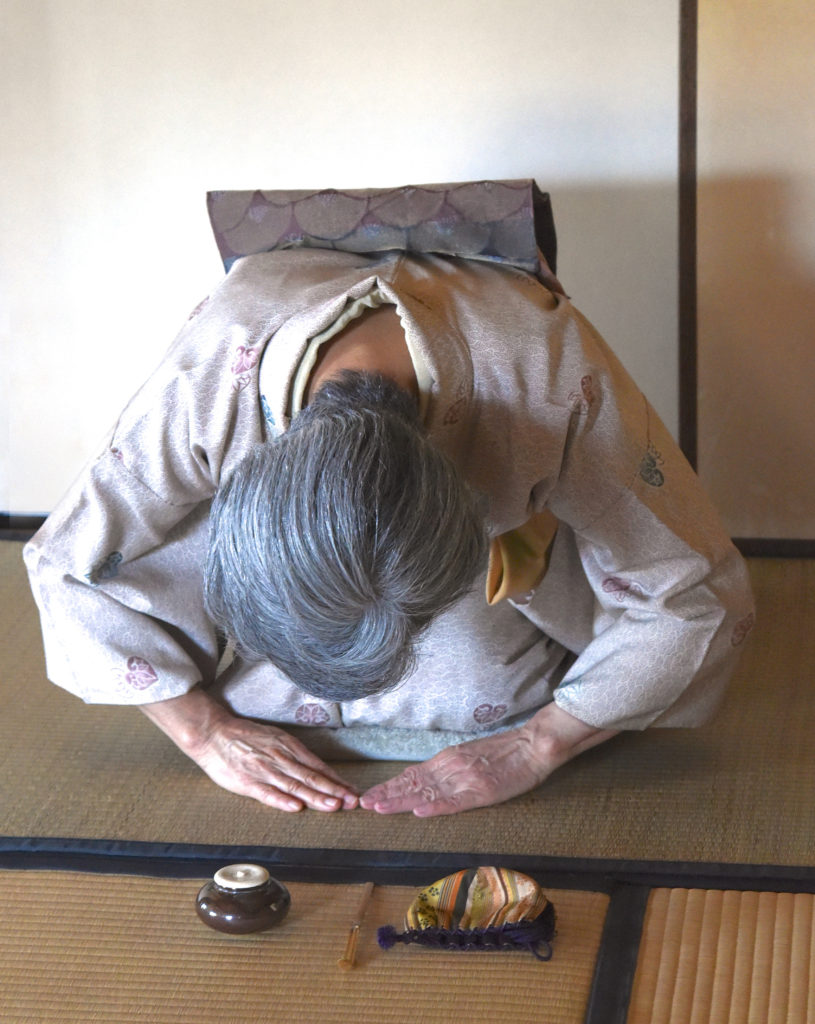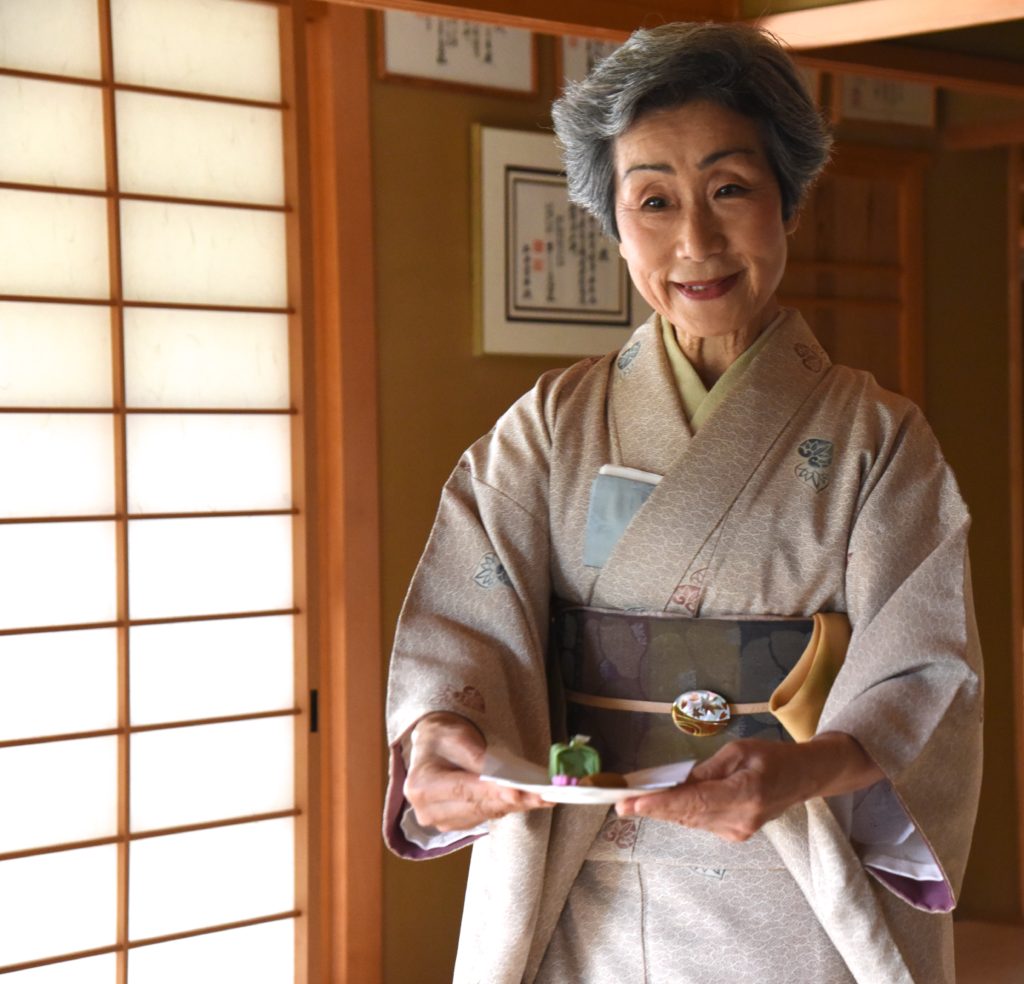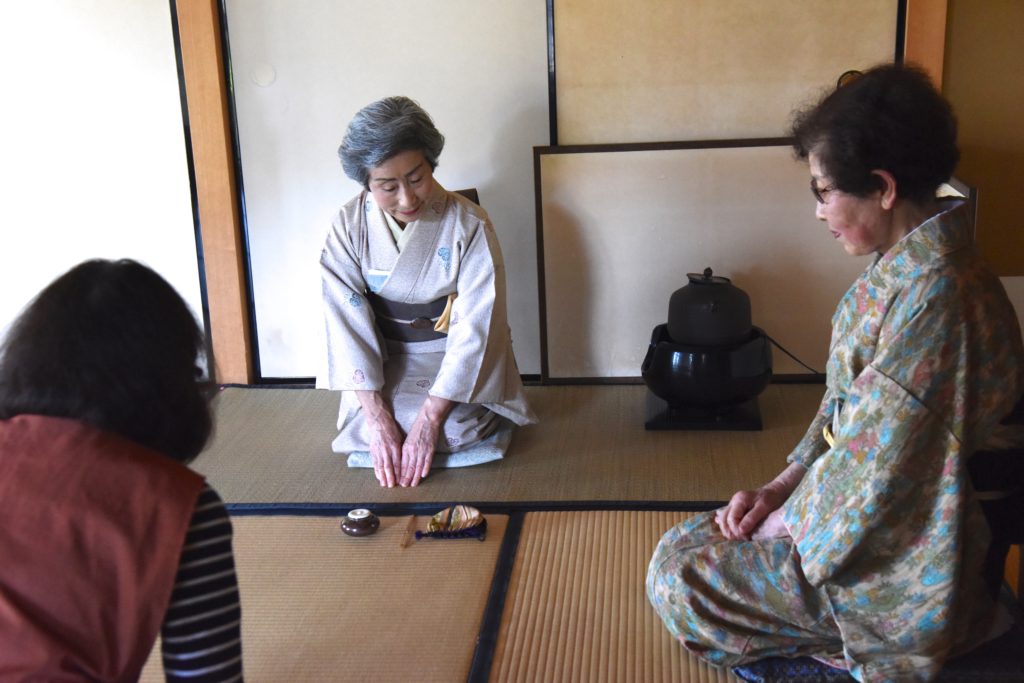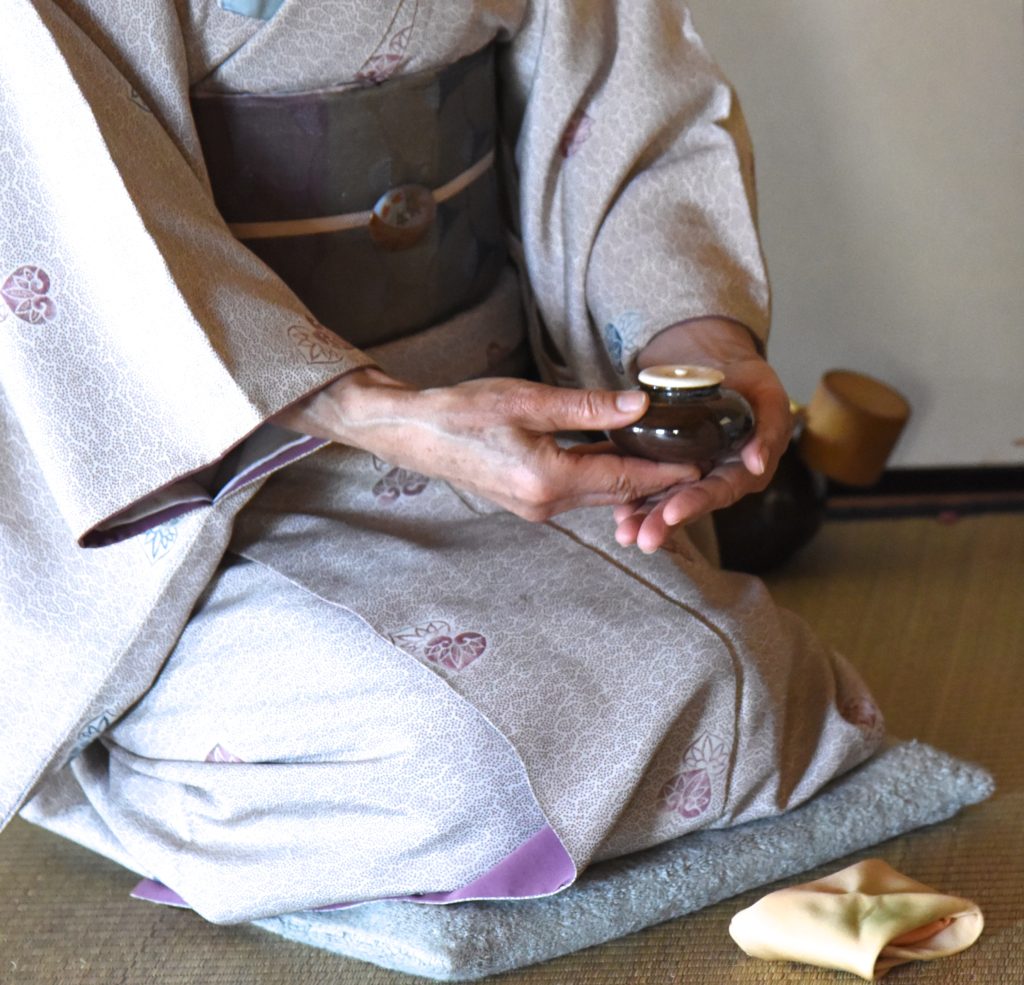
<div id="attachment_32334" style="width: 570px" class="wp-caption aligncenter"><img loading="lazy" decoding="async" aria-describedby="caption-attachment-32334" class="size-large wp-image-32334" src="https://www.oh-i-see.com/blog/wp-content/uploads/2018/10/MMM_7610-1024x985.jpg" alt="Japanese woman presents a tea caddy for the Japanese tea ceremony, showing the cultural traditions of Japan. (Image © Meredith Mullins.)" width="560" height="539" /><p id="caption-attachment-32334" class="wp-caption-text">The Way of Tea<br />© Meredith Mullins</p></div>
<h2>Ichi-go Ichi-e: Life Lessons</h2>
<p style="padding-left: 60px;"><em>Let the tea be simple and your hospitality heartfelt.—</em>Sen no Rikyu*</p>
<p>When I entered the tea house, I suddenly felt reverential—a guest of some greater spirit.</p>
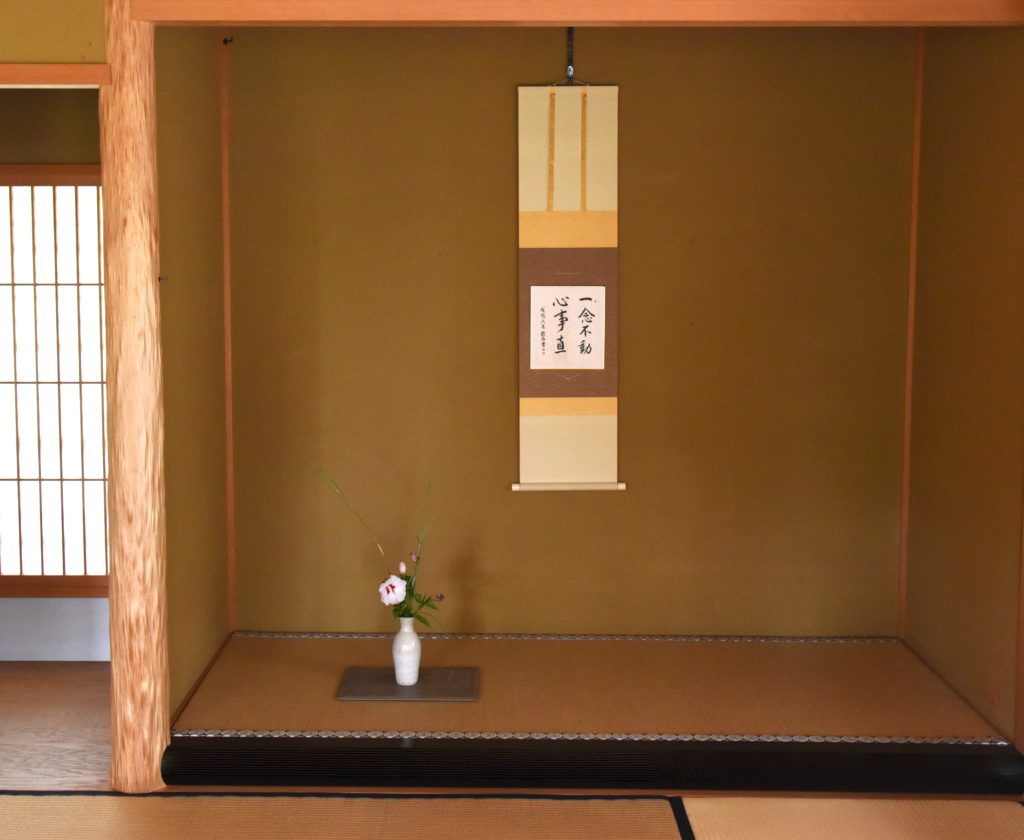
<p>The simple wooden walls, tatami floor, and perfect Ikebana arrangement created a sanctuary so serene that the only sounds were that of the birds in the garden and the simmering water for the tea.</p>
<p>I met Kozue, a student who was dressed in a silk kimono of muted tones of lilac and plum that had been passed through generations of her family. I asked her how long she has been studying the Japanese tea ceremony.</p>
<p>She bowed her head slightly and said, “Only 27 years.”</p>
<div id="attachment_32348" style="width: 570px" class="wp-caption aligncenter"><img loading="lazy" decoding="async" aria-describedby="caption-attachment-32348" class="size-large wp-image-32348" src="https://www.oh-i-see.com/blog/wp-content/uploads/2018/10/MMM_7617-Version-2adj-815x1024.jpg" alt="Japanese woman bows in front of utensils for the Japanese tea ceremony, showing the cultural traditions of Japan. (Image © Meredith Mullins.)" width="560" height="704" /><p id="caption-attachment-32348" class="wp-caption-text">A lifetime of study<br />© Meredith Mullins</p></div>
<p>I knew then that there was a more profound layer to the seeming simplicity of the tea ceremony.</p>
<p>Some art forms take a lifetime to master. The tea ceremony is one of those arts—part of a rich heritage of Japanese cultural traditions.</p>
<div id="attachment_32320" style="width: 570px" class="wp-caption aligncenter"><img loading="lazy" decoding="async" aria-describedby="caption-attachment-32320" class="size-large wp-image-32320" src="https://www.oh-i-see.com/blog/wp-content/uploads/2018/10/MMM_7563-1024x840.jpg" alt="An alcove in a Japanese tea house, the setting for the Japanese tea ceremony that shows the cultural traditions of Japan. (Image © Meredith Mullins.)" width="560" height="459" /><p id="caption-attachment-32320" class="wp-caption-text">The simple elegance of the Japanese tea house<br />© Meredith Mullins</p></div>
<h4>From Mozart to <em>Chadō</em></h4>
<p>In the interest of full disclosure, I must admit to my tea inspiration. I was reminded of the elegance of the Japanese tea ceremony recently in an episode of “Mozart in the Jungle” (Season 4/Episode 8) directed by Roman Coppola. (Yes, television <em>can </em>be enlightening.) After watching this mesmerizing segment, I went in search of more knowledge.</p>
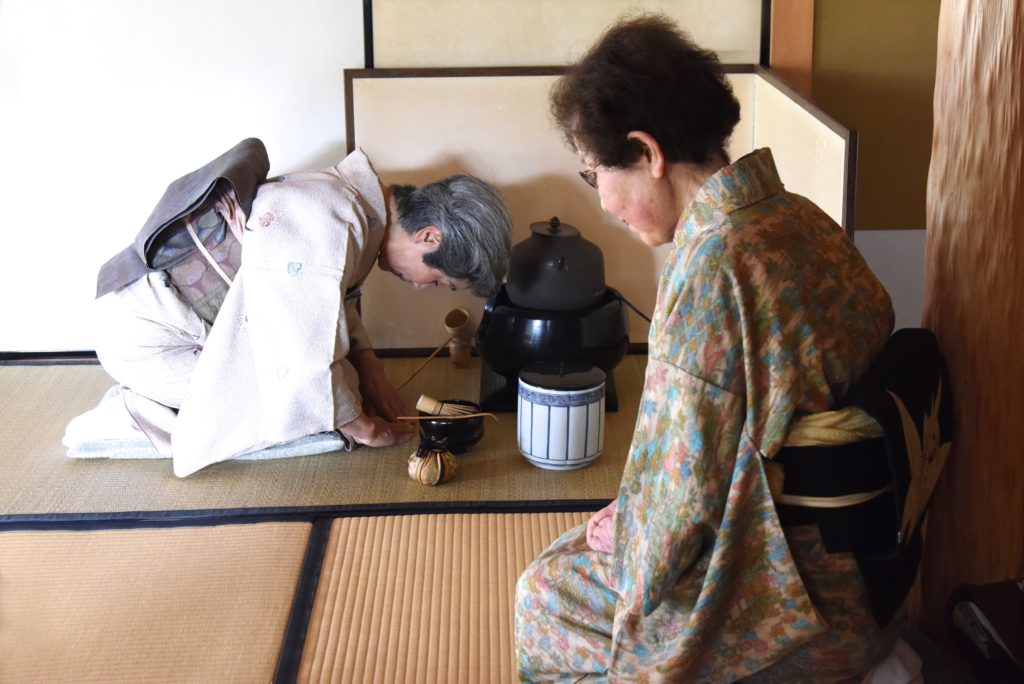
<p>I was fortunate to find a local class in the art of Japanese tea taught by Mrs. Matsui, who has been studying the tea ceremony for most of her life.</p>
<p>She has built a tea house in the Japanese garden behind her modern California home and teaches those who wish to learn more about the graceful and meticulously choreographed steps in <em>chadō</em>, or the “Way of Tea.”</p>
<div id="attachment_32322" style="width: 570px" class="wp-caption aligncenter"><img loading="lazy" decoding="async" aria-describedby="caption-attachment-32322" class="size-large wp-image-32322" src="https://www.oh-i-see.com/blog/wp-content/uploads/2018/10/MMM_7576adj-1024x684.jpg" alt="Japanese teacher Mrs. Matsui oversees a student in the art of the Japanese tea ceremony, showing the cultural traditions of Japan. (Image © Meredith Mullins.)" width="560" height="374" /><p id="caption-attachment-32322" class="wp-caption-text">Mrs. Matsui guides her student in the graceful choreography of the ceremony.<br />© Meredith Mullins</p></div>
<h4>The Heart of the Ceremony</h4>
<p>In Japanese, the tea ceremony is called <em>chanoyu, </em><em>sadō, </em>or <em>chadō, </em>and is noted as one of the classical Japanese arts.</p>
<p>The ceremony is not just about serving tea. It is a study of philosophy, art, aesthetics, calligraphy, and literature.</p>
<p>More importantly, the ceremony is a traditional way of strengthening the bonds of those participating. It also inspires a commitment of time to the contemplation of beauty.</p>
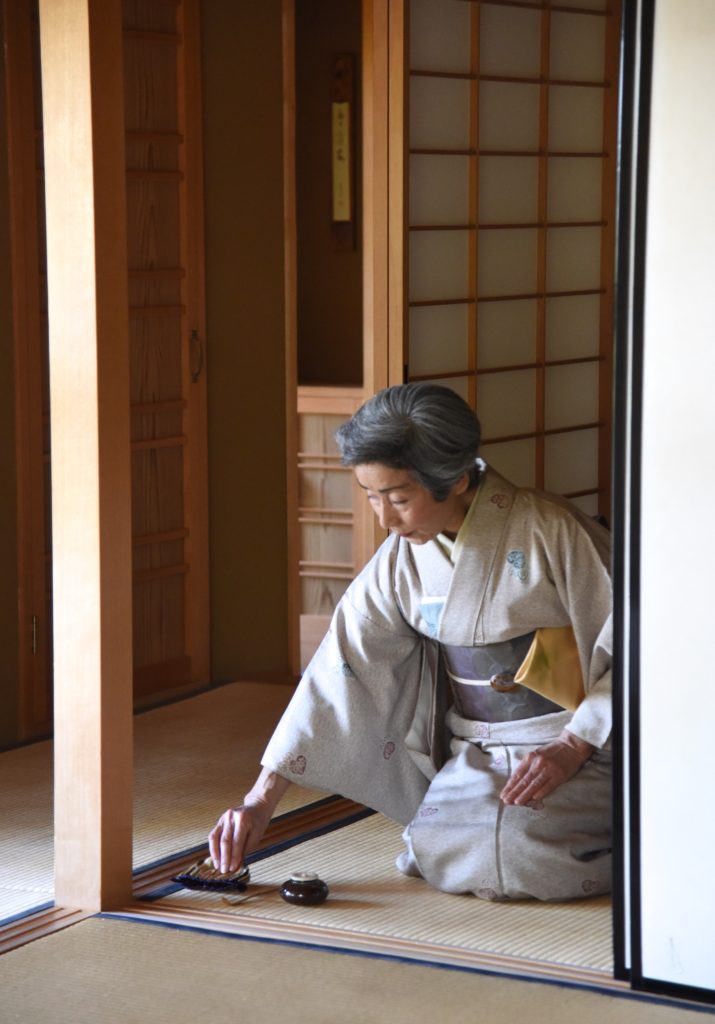
<div id="attachment_32328" style="width: 570px" class="wp-caption aligncenter"><img loading="lazy" decoding="async" aria-describedby="caption-attachment-32328" class="size-large wp-image-32328" src="https://www.oh-i-see.com/blog/wp-content/uploads/2018/10/MMM_7623-Version-2-715x1024.jpg" alt="Japanese woman at door of tea room preparing for a Japanese tea ceremony, showing the cultural traditions of Japan. (Image © Meredith Mullins.)" width="560" height="802" /><p id="caption-attachment-32328" class="wp-caption-text">The host enters the tea room through a sliding door.<br />© Meredith Mullins</p></div>
<p><strong>Ichi-go Ichi-e </strong></p>
<p>Every tea gathering is a special experience. Each occasion calls for unique preparations, depending on the season, the time of day, the guests, and the theme of the ceremony.</p>
<p>The flowers and the hanging scroll in the alcove of the tea house <em>(tokonoma)</em> represent the season and the theme. The tea bowls are selected to match the character of the guests.</p>
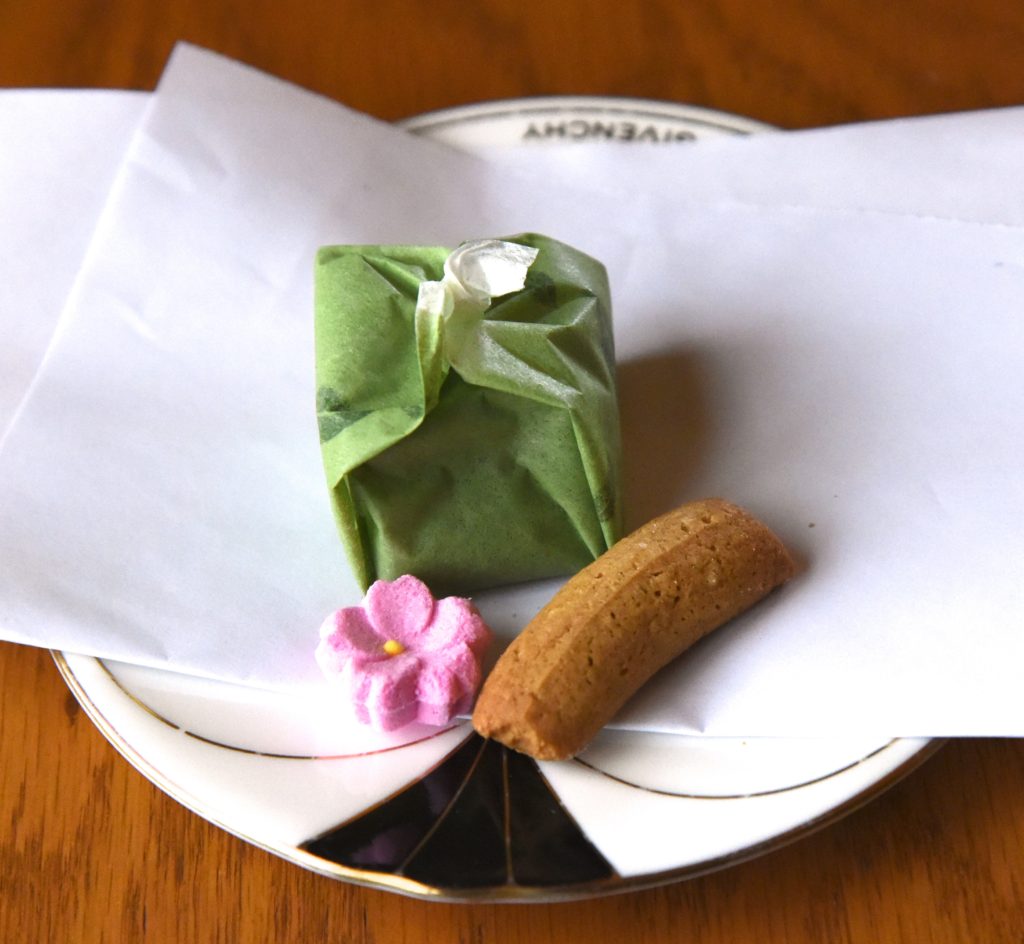
<p>The host decides whether to offer a meal or just the traditional sweets, which are served to complement the mild bitterness of the green matcha tea.</p>
<div id="attachment_32330" style="width: 570px" class="wp-caption aligncenter"><img loading="lazy" decoding="async" aria-describedby="caption-attachment-32330" class="size-large wp-image-32330" src="https://www.oh-i-see.com/blog/wp-content/uploads/2018/10/MMM_7572-Version-2-1024x944.jpg" alt="Japanese sweets for the Japanese tea ceremony, showing the cultural traditions of Japan. (Image © Meredith Mullins.)" width="560" height="516" /><p id="caption-attachment-32330" class="wp-caption-text">Traditional sweets are served to complement the slight bitterness of the matcha tea.<br />(Mrs. Matsui diplomatically reminded me to unwrap the one in paper, as the paper is not edible.)<br />© Meredith Mullins</p></div>
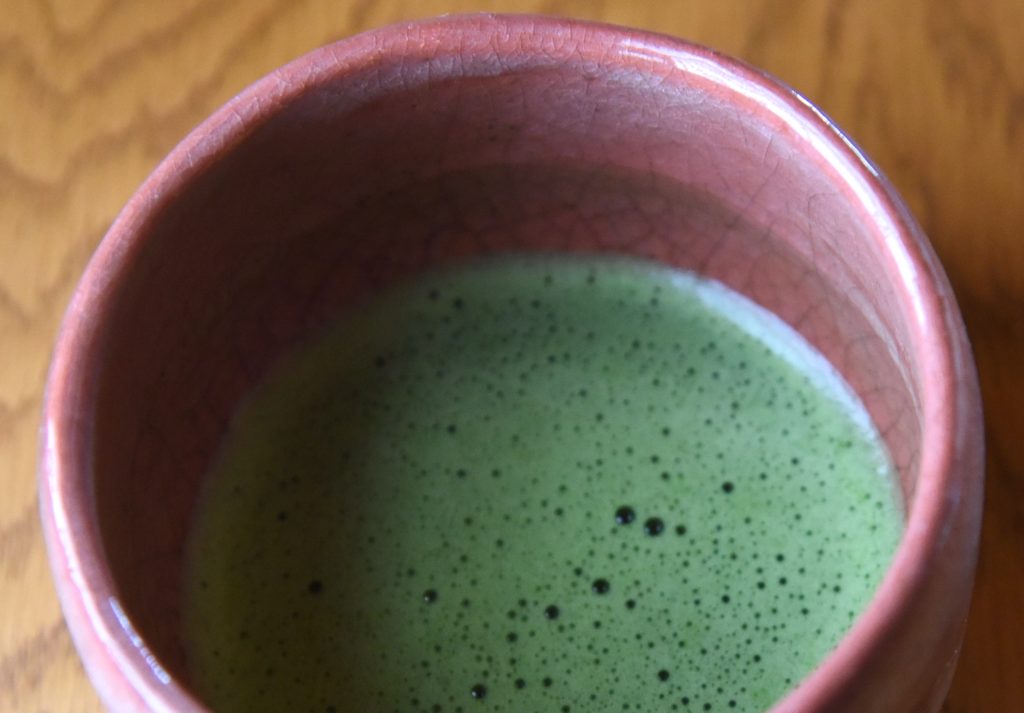
<p>The host also decides whether to serve thick tea (for more formal occasions, served in one bowl to be shared by all guests) or thin tea (for more informal occasions, with individual tea bowls, chosen for each guest). If the host wishes, both thin tea and thick tea can be served in the same ceremony.</p>
<div id="attachment_32333" style="width: 570px" class="wp-caption aligncenter"><img loading="lazy" decoding="async" aria-describedby="caption-attachment-32333" class="size-large wp-image-32333" src="https://www.oh-i-see.com/blog/wp-content/uploads/2018/10/MMM_7601-Version-2-1024x713.jpg" alt="Bowl of matcha tea in a Japanese tea ceremony, showing the cultural traditions of Japan. (Image © Meredith Mullins.)" width="560" height="390" /><p id="caption-attachment-32333" class="wp-caption-text">Thin matcha tea in a carefully selected bowl for the occasion, the guest, and the season<br />© Meredith Mullins</p></div>
<p>All of these preparations ensure that the experience will be completely unique. And that sharing a cup of tea in this moment can never be replicated and, thus, should be treasured.</p>
<p>The Japanese saying Ichi-go Ichi-e means “One time. One Meeting.” Savor the moment, as if it were a once-in-a-lifetime experience . . . because it is.</p>
<div id="attachment_32307" style="width: 570px" class="wp-caption aligncenter"><img loading="lazy" decoding="async" aria-describedby="caption-attachment-32307" class="size-full wp-image-32307" src="https://www.oh-i-see.com/blog/wp-content/uploads/2018/10/Screen-Shot-2018-10-13-at-10.29.28-AM-e1539502260690.jpg" alt="Japanese symbols for Wa Kei Sei Jaku, the foundation for the Japanese tea ceremony showing cultural traditions of Japan. (Image by Meredith Mullins.)" width="560" height="146" /><p id="caption-attachment-32307" class="wp-caption-text">Wa Kei Sei Jaku: Harmony, Respect, Purity, Tranquility</p></div>
<h4>Wa Kei Sei Jaku</h4>
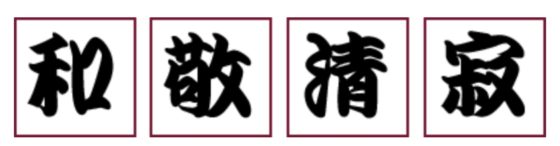
<p>Although each ceremony is different, the four principles of Wa Kei Sei Jaku are always the foundation.</p>
<p>Wa: harmony<br />
Kei: respect<br />
Sei: purity<br />
Jaku: tranquility</p>
<p>These principles ensure that the host and guests show respect for one another, that everyone leaves behind the thoughts and burdens of outside life, that the ceremony is performed from a pure heart, and that, hopefully, everyone finds some inner peace during the ceremony.</p>
<div id="attachment_32321" style="width: 570px" class="wp-caption aligncenter"><img loading="lazy" decoding="async" aria-describedby="caption-attachment-32321" class="size-large wp-image-32321" src="https://www.oh-i-see.com/blog/wp-content/uploads/2018/10/MMM_7570-Version-2-1024x984.jpg" alt="Japanese woman offers sweets in a Japanese tea ceremony, showing the cultural traditions of Japan. (Image © Meredith Mullins.)" width="560" height="538" /><p id="caption-attachment-32321" class="wp-caption-text">The sharing of a unique moment . . . from the heart.<br />© Meredith Mullins</p></div>
<h4>The Poetry of Silence</h4>
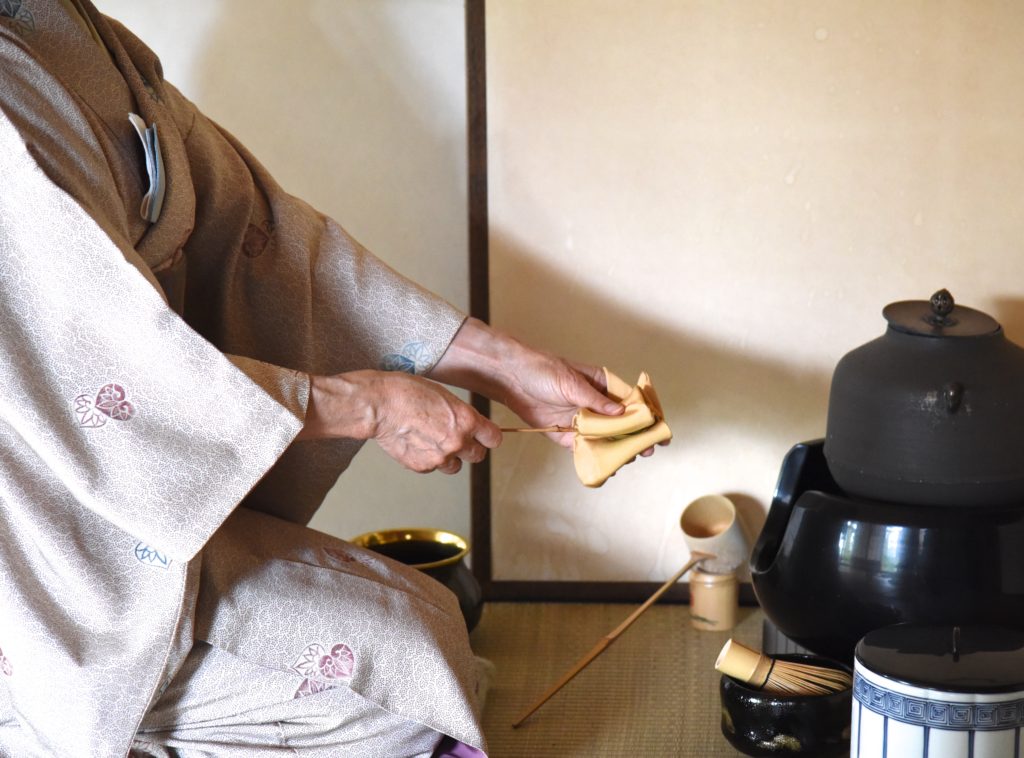
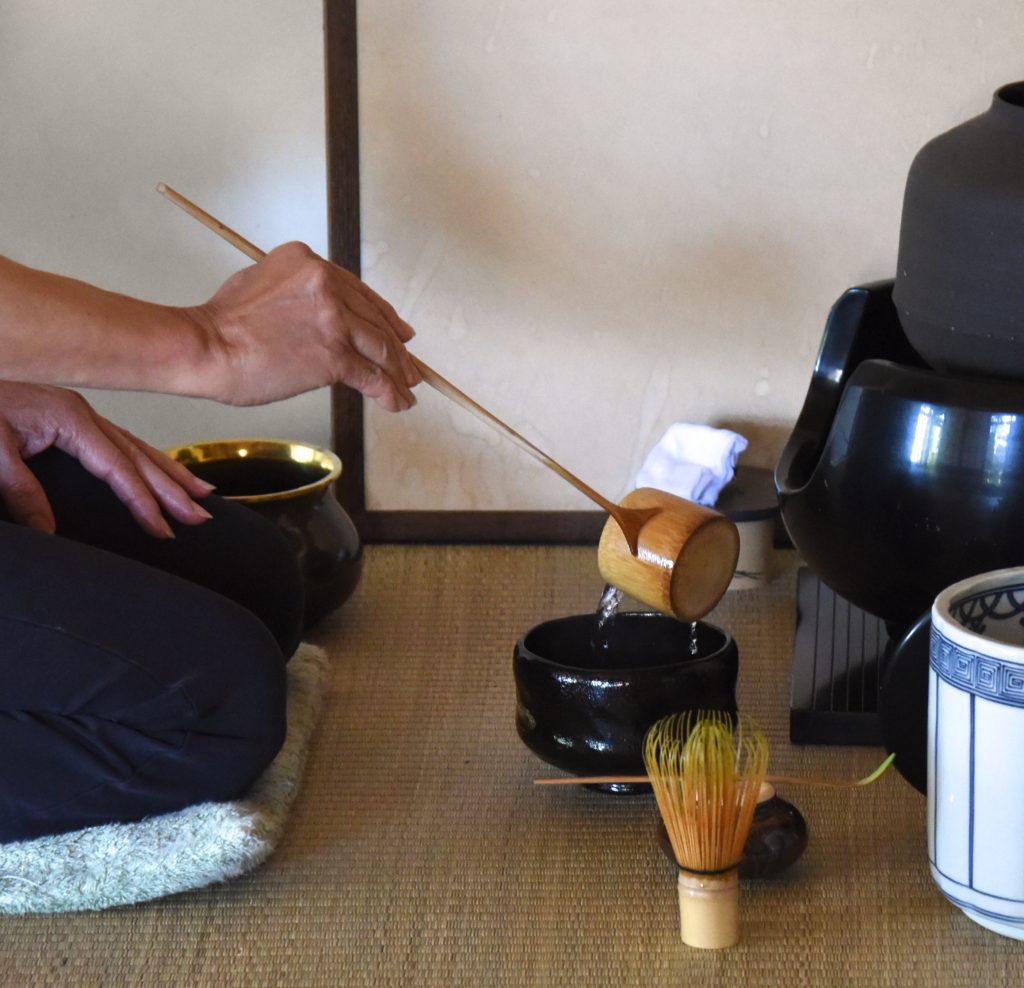
<p>The ceremony is filled with the sensory pleasures. Not only the graceful movements of the host, as the tools are carefully placed and cleaned and as the tea is prepared, but the heightened sounds, since most of the ceremony is performed in silence.</p>
<div id="attachment_32331" style="width: 570px" class="wp-caption aligncenter"><img loading="lazy" decoding="async" aria-describedby="caption-attachment-32331" class="size-large wp-image-32331" src="https://www.oh-i-see.com/blog/wp-content/uploads/2018/10/MMM_7580-1024x758.jpg" alt="Japanese woman cleaning tea scoop for a Japanese tea ceremony, showing the cultural traditions of Japan. (Image © Meredith Mullins.)" width="560" height="415" /><p id="caption-attachment-32331" class="wp-caption-text">The tea scoop, carved from a single piece of bamboo or ivory, is cleaned<br />with an intricately folded silk cloth.<br />© Meredith Mullins</p></div>
<p>The pouring of the tea water from the ladle brings to mind the sound of nature’s flowing water.</p>
<div id="attachment_32341" style="width: 570px" class="wp-caption aligncenter"><img loading="lazy" decoding="async" aria-describedby="caption-attachment-32341" class="size-large wp-image-32341" src="https://www.oh-i-see.com/blog/wp-content/uploads/2018/10/MMM_7655-Version-2-1024x988.jpg" alt="The ladling of water during a Japanese tea ceremony, showing the cultural traditions of Japan. (Image © Meredith Mullins.)" width="560" height="540" /><p id="caption-attachment-32341" class="wp-caption-text">During the silent preparation, sounds are a sensory pleasure.<br />© Meredith Mullins</p></div>
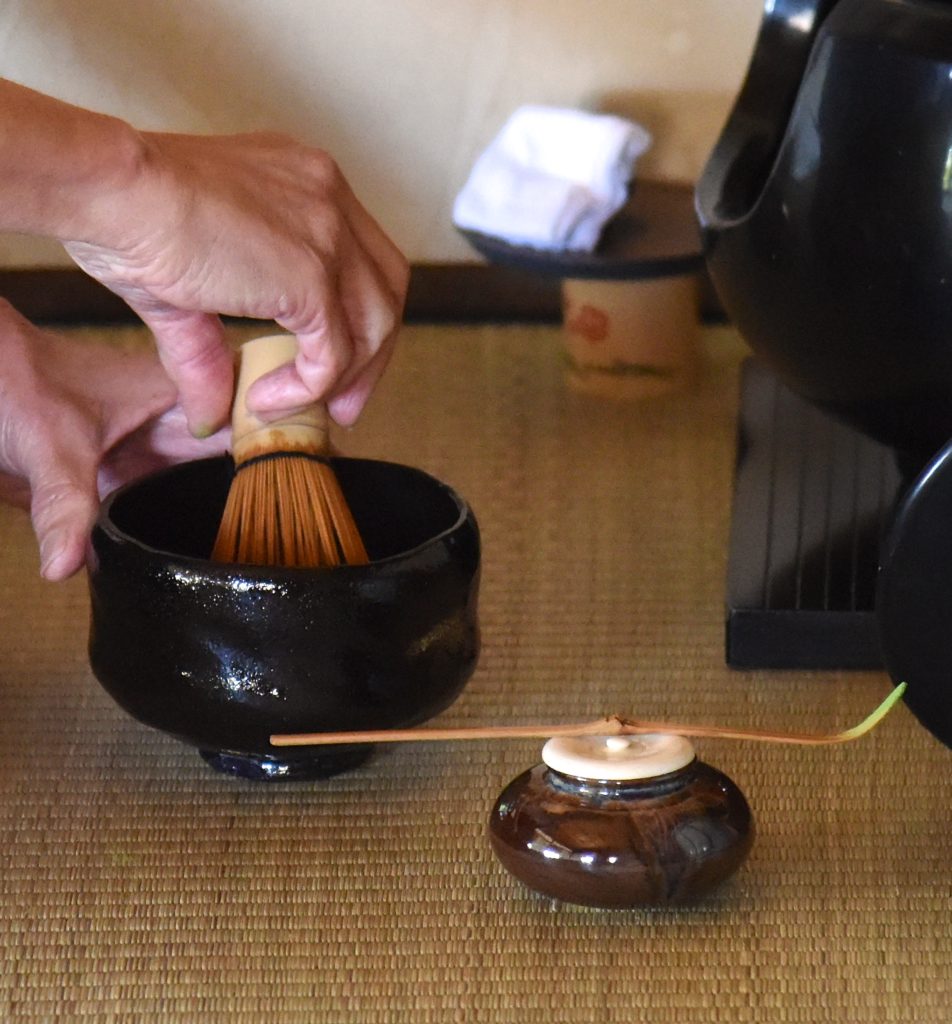
<p>The whisking of the powdered tea and hot water, even though the most frenetic part of the gentle ceremony, is so rhythmic it seems to soothe the soul.</p>
<div id="attachment_32339" style="width: 570px" class="wp-caption aligncenter"><img loading="lazy" decoding="async" aria-describedby="caption-attachment-32339" class="size-large wp-image-32339" src="https://www.oh-i-see.com/blog/wp-content/uploads/2018/10/MMM_7647-Version-2-952x1024.jpg" alt="Hands whisking matcha tea in a bowl during the Japanese tea ceremony, showing the cultural traditions of Japan. (Image © Meredith Mullins.)" width="560" height="602" /><p id="caption-attachment-32339" class="wp-caption-text">The powdered matcha tea is rapidly whisked together with the hot water.<br />© Meredith Mullins</p></div>
<p>The rustling silk of kimonos is a reminder of the depth of tradition.</p>
<p>This is not a chatty social gathering. The conversation is limited to guests asking about the provenance of the utensils, remarking on their beauty, and, perhaps, discussing the theme of the ceremony.</p>
<div id="attachment_32327" style="width: 570px" class="wp-caption aligncenter"><img loading="lazy" decoding="async" aria-describedby="caption-attachment-32327" class="size-large wp-image-32327" src="https://www.oh-i-see.com/blog/wp-content/uploads/2018/10/MMM_7619adj-1024x683.jpg" alt="Japanese woman displays the utensils of the Japanese tea ceremony, showing the cultural traditions of Japan. (Image © Meredith Mullins.)" width="560" height="374" /><p id="caption-attachment-32327" class="wp-caption-text">The host often displays the utensils for the guests to examine more closely.<br />© Meredith Mullins</p></div>
<h4>&#8220;Oh, I See&#8221; Moments from &#8220;The Way of Tea&#8221;</h4>
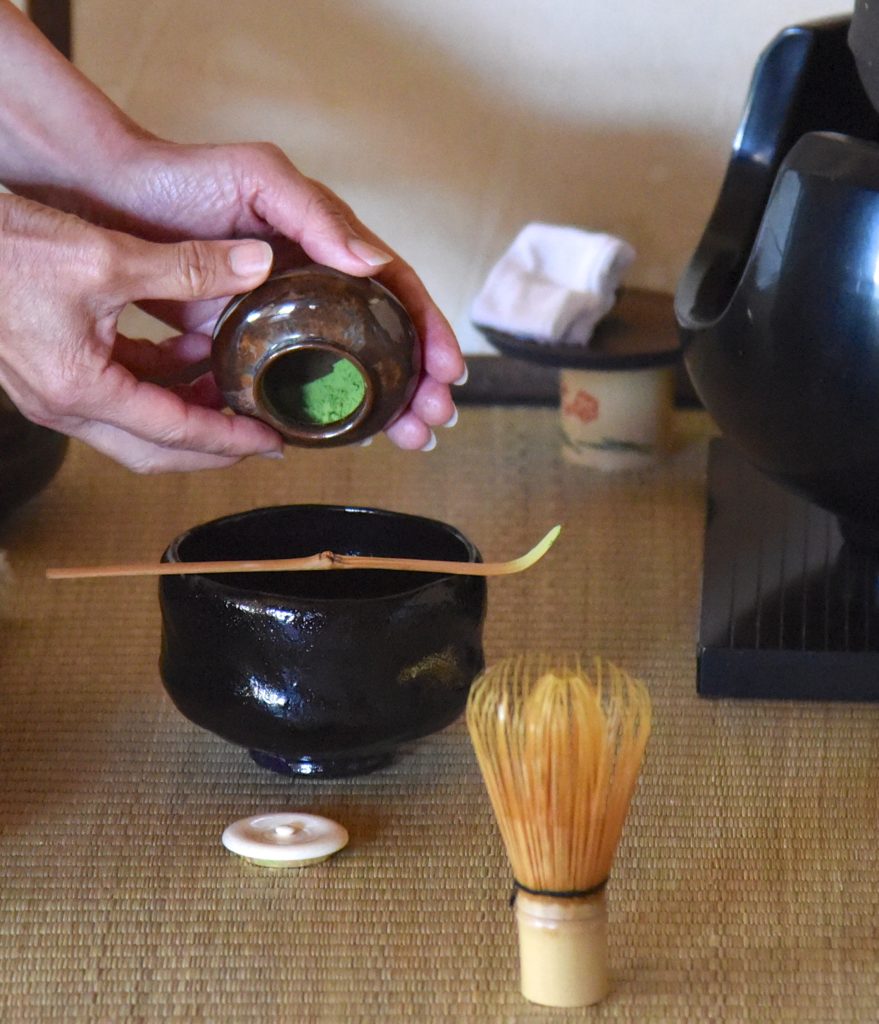
<p>I was mesmerized by the tea ceremony—hypnotic and elegant. It reaches into the depths of Japanese heritage and cultural traditions.</p>
<p>It reminded me of the beauty you can see when you take the time to appreciate the small details of the world and when you spend moments of quiet time being in the present.</p>
<div id="attachment_32329" style="width: 570px" class="wp-caption aligncenter"><img loading="lazy" decoding="async" aria-describedby="caption-attachment-32329" class="size-large wp-image-32329" src="https://www.oh-i-see.com/blog/wp-content/uploads/2018/10/MMM_7642-Version-3-879x1024.jpg" alt="Close up of the tools of the Japanese tea ceremony as the host pours the matcha powder, showing the cultural traditions of Japan. (Image © Meredith Mullins.)" width="560" height="652" /><p id="caption-attachment-32329" class="wp-caption-text">Every element adds to the harmony and beauty and the experience.<br />© Meredith Mullins</p></div>
<p>What impressed me the most are lessons that could be applied outside of the tea ceremony.</p>
<ul>
<li>Being present in the moment to appreciate the beauty of simplicity and tradition.</li>
<li>Thinking only of others—your guests—and doing everything for their benefit.</li>
<li>Showing ultimate respect for one another.</li>
<li>Sharing something from the heart to strengthen bonds of friendship.</li>
</ul>
<p>There are many profound elements to the Japanese tea ceremony. For me, the philosophies that could be applied to the rest of life will be the lasting treasures.</p>
<p><em>*Sen no Rikyu was the Japanese Tea Master who raised the tea ceremony to the level of art in the 16<sup>th</sup>century.</em></p>
<p><em>Thank you to Mrs. Matsui and Kozue Knowles for their guidance in understanding the depth of the tea ceremony and to <a href="http://www.chaya4tea.com" target="_blank" rel="noopener">Cha-Ya</a> tea shop.</em></p>
<p><i><a title="Creative Inspiration Flows In Underwater Photographs" href="#comments">Comment</a></i><em> on this post below, or inspire insight with your own OIC Moment </em><em><a href="https://www.oh-i-see.com/blog/your-oic-moments/">here</a>.</em></p>
{"id":32309,"date":"2018-10-15T03:00:15","date_gmt":"2018-10-15T10:00:15","guid":{"rendered":"https:\/\/www.oh-i-see.com\/blog\/?p=32309"},"modified":"2021-07-20T08:04:37","modified_gmt":"2021-07-20T15:04:37","slug":"cultural-traditions-of-the-japanese-tea-ceremony","status":"publish","type":"post","link":"https:\/\/www.oh-i-see.com\/blog\/cultural-traditions-of-the-japanese-tea-ceremony\/","title":{"rendered":"Cultural Traditions of the Japanese Tea Ceremony"},"content":{"rendered":"<div id=\"attachment_32334\" style=\"width: 570px\" class=\"wp-caption aligncenter\"><img loading=\"lazy\" decoding=\"async\" aria-describedby=\"caption-attachment-32334\" class=\"size-large wp-image-32334\" src=\"https:\/\/www.oh-i-see.com\/blog\/wp-content\/uploads\/2018\/10\/MMM_7610-1024x985.jpg\" alt=\"Japanese woman presents a tea caddy for the Japanese tea ceremony, showing the cultural traditions of Japan. (Image \u00a9 Meredith Mullins.)\" width=\"560\" height=\"539\" \/><p id=\"caption-attachment-32334\" class=\"wp-caption-text\">The Way of Tea<br \/>\u00a9 Meredith Mullins<\/p><\/div>\n<h2>Ichi-go Ichi-e: Life Lessons<\/h2>\n<p style=\"padding-left: 60px;\"><em>Let the tea be simple and your hospitality heartfelt.\u2014<\/em>Sen no Rikyu*<\/p>\n<p>When I entered the tea house, I suddenly felt reverential\u2014a guest of some greater spirit.<\/p>\n<p>The simple wooden walls, tatami floor, and perfect Ikebana arrangement created a sanctuary so serene that the only sounds were that of the birds in the garden and the simmering water for the tea.<\/p>\n<p>I met Kozue, a student who was dressed in a silk kimono of muted tones of lilac and plum that had been passed through generations of her family. I asked her how long she has been studying the Japanese tea ceremony.<\/p>\n<p>She bowed her head slightly and said, \u201cOnly 27 years.\u201d<\/p>\n<div id=\"attachment_32348\" style=\"width: 570px\" class=\"wp-caption aligncenter\"><img loading=\"lazy\" decoding=\"async\" aria-describedby=\"caption-attachment-32348\" class=\"size-large wp-image-32348\" src=\"https:\/\/www.oh-i-see.com\/blog\/wp-content\/uploads\/2018\/10\/MMM_7617-Version-2adj-815x1024.jpg\" alt=\"Japanese woman bows in front of utensils for the Japanese tea ceremony, showing the cultural traditions of Japan. (Image \u00a9 Meredith Mullins.)\" width=\"560\" height=\"704\" \/><p id=\"caption-attachment-32348\" class=\"wp-caption-text\">A lifetime of study<br \/>\u00a9 Meredith Mullins<\/p><\/div>\n<p>I knew then that there was a more profound layer to the seeming simplicity of the tea ceremony.<\/p>\n<p>Some art forms take a lifetime to master. The tea ceremony is one of those arts\u2014part of a rich heritage of Japanese cultural traditions.<\/p>\n<div id=\"attachment_32320\" style=\"width: 570px\" class=\"wp-caption aligncenter\"><img loading=\"lazy\" decoding=\"async\" aria-describedby=\"caption-attachment-32320\" class=\"size-large wp-image-32320\" src=\"https:\/\/www.oh-i-see.com\/blog\/wp-content\/uploads\/2018\/10\/MMM_7563-1024x840.jpg\" alt=\"An alcove in a Japanese tea house, the setting for the Japanese tea ceremony that shows the cultural traditions of Japan. (Image \u00a9 Meredith Mullins.)\" width=\"560\" height=\"459\" \/><p id=\"caption-attachment-32320\" class=\"wp-caption-text\">The simple elegance of the Japanese tea house<br \/>\u00a9 Meredith Mullins<\/p><\/div>\n<h4>From Mozart to <em>Chad\u014d<\/em><\/h4>\n<p>In the interest of full disclosure, I must admit to my tea inspiration. I was reminded of the elegance of the Japanese tea ceremony recently in an episode of \u201cMozart in the Jungle\u201d (Season 4\/Episode 8) directed by Roman Coppola. (Yes, television\u00a0<em>can\u00a0<\/em>be enlightening.) After watching this mesmerizing segment, I went in search of more knowledge.<\/p>\n<p>I was fortunate to find a local class in the art of Japanese tea taught by Mrs. Matsui, who has been studying the tea ceremony for most of her life.<\/p>\n<p>She has built a tea house in the Japanese garden behind her modern California home and teaches those who wish to learn more about the graceful and meticulously choreographed steps in <em>chad\u014d<\/em>, or the \u201cWay of Tea.\u201d<\/p>\n<div id=\"attachment_32322\" style=\"width: 570px\" class=\"wp-caption aligncenter\"><img loading=\"lazy\" decoding=\"async\" aria-describedby=\"caption-attachment-32322\" class=\"size-large wp-image-32322\" src=\"https:\/\/www.oh-i-see.com\/blog\/wp-content\/uploads\/2018\/10\/MMM_7576adj-1024x684.jpg\" alt=\"Japanese teacher Mrs. Matsui oversees a student in the art of the Japanese tea ceremony, showing the cultural traditions of Japan. (Image \u00a9 Meredith Mullins.)\" width=\"560\" height=\"374\" \/><p id=\"caption-attachment-32322\" class=\"wp-caption-text\">Mrs. Matsui guides her student in the graceful choreography of the ceremony.<br \/>\u00a9 Meredith Mullins<\/p><\/div>\n<h4>The Heart of the Ceremony<\/h4>\n<p>In Japanese, the tea ceremony is called <em>chanoyu, <\/em><em>sad\u014d, <\/em>or\u00a0<em>chad\u014d, <\/em>and is noted as one of the classical Japanese arts.<\/p>\n<p>The ceremony is not just about serving tea. It is a study of philosophy, art, aesthetics, calligraphy, and literature.<\/p>\n<p>More importantly, the ceremony is a traditional way of strengthening the bonds of those participating. It also inspires a commitment of time to the contemplation of beauty.<\/p>\n<div id=\"attachment_32328\" style=\"width: 570px\" class=\"wp-caption aligncenter\"><img loading=\"lazy\" decoding=\"async\" aria-describedby=\"caption-attachment-32328\" class=\"size-large wp-image-32328\" src=\"https:\/\/www.oh-i-see.com\/blog\/wp-content\/uploads\/2018\/10\/MMM_7623-Version-2-715x1024.jpg\" alt=\"Japanese woman at door of tea room preparing for a Japanese tea ceremony, showing the cultural traditions of Japan. (Image \u00a9 Meredith Mullins.)\" width=\"560\" height=\"802\" \/><p id=\"caption-attachment-32328\" class=\"wp-caption-text\">The host enters the tea room through a sliding door.<br \/>\u00a9 Meredith Mullins<\/p><\/div>\n<p><strong>Ichi-go Ichi-e <\/strong><\/p>\n<p>Every tea gathering is a special experience. Each occasion calls for unique preparations, depending on the season, the time of day, the guests, and the theme of the ceremony.<\/p>\n<p>The flowers and the hanging scroll in the alcove of the tea house <em>(tokonoma)<\/em> represent the season and the theme. The tea bowls are selected to match the character of the guests.<\/p>\n<p>The host decides whether to offer a meal or just the traditional sweets, which are served to complement the mild bitterness of the green matcha tea.<\/p>\n<div id=\"attachment_32330\" style=\"width: 570px\" class=\"wp-caption aligncenter\"><img loading=\"lazy\" decoding=\"async\" aria-describedby=\"caption-attachment-32330\" class=\"size-large wp-image-32330\" src=\"https:\/\/www.oh-i-see.com\/blog\/wp-content\/uploads\/2018\/10\/MMM_7572-Version-2-1024x944.jpg\" alt=\"Japanese sweets for the Japanese tea ceremony, showing the cultural traditions of Japan. (Image \u00a9 Meredith Mullins.)\" width=\"560\" height=\"516\" \/><p id=\"caption-attachment-32330\" class=\"wp-caption-text\">Traditional sweets are served to complement the slight bitterness of the matcha tea.<br \/>(Mrs. Matsui diplomatically reminded me to unwrap the one in paper, as the paper is not edible.)<br \/>\u00a9 Meredith Mullins<\/p><\/div>\n<p>The host also decides whether to serve thick tea (for more formal occasions, served in one bowl to be shared by all guests) or thin tea (for more informal occasions, with individual tea bowls, chosen for each guest). If the host wishes, both thin tea and thick tea can be served in the same ceremony.<\/p>\n<div id=\"attachment_32333\" style=\"width: 570px\" class=\"wp-caption aligncenter\"><img loading=\"lazy\" decoding=\"async\" aria-describedby=\"caption-attachment-32333\" class=\"size-large wp-image-32333\" src=\"https:\/\/www.oh-i-see.com\/blog\/wp-content\/uploads\/2018\/10\/MMM_7601-Version-2-1024x713.jpg\" alt=\"Bowl of matcha tea in a Japanese tea ceremony, showing the cultural traditions of Japan. (Image \u00a9 Meredith Mullins.)\" width=\"560\" height=\"390\" \/><p id=\"caption-attachment-32333\" class=\"wp-caption-text\">Thin matcha tea in a carefully selected bowl for the occasion, the guest, and the season<br \/>\u00a9 Meredith Mullins<\/p><\/div>\n<p>All of these preparations ensure that the experience will be completely unique. And that sharing a cup of tea in this moment can never be replicated and, thus, should be treasured.<\/p>\n<p>The Japanese saying Ichi-go Ichi-e means \u201cOne time. One Meeting.\u201d Savor the moment, as if it were a once-in-a-lifetime experience . . . because it is.<\/p>\n<div id=\"attachment_32307\" style=\"width: 570px\" class=\"wp-caption aligncenter\"><img loading=\"lazy\" decoding=\"async\" aria-describedby=\"caption-attachment-32307\" class=\"size-full wp-image-32307\" src=\"https:\/\/www.oh-i-see.com\/blog\/wp-content\/uploads\/2018\/10\/Screen-Shot-2018-10-13-at-10.29.28-AM-e1539502260690.jpg\" alt=\"Japanese symbols for Wa Kei Sei Jaku, the foundation for the Japanese tea ceremony showing cultural traditions of Japan. (Image by Meredith Mullins.)\" width=\"560\" height=\"146\" \/><p id=\"caption-attachment-32307\" class=\"wp-caption-text\">Wa Kei Sei Jaku: Harmony, Respect, Purity, Tranquility<\/p><\/div>\n<h4>Wa Kei Sei Jaku<\/h4>\n<p>Although each ceremony is different, the four principles of Wa Kei Sei Jaku are always the foundation.<\/p>\n<p>Wa: harmony<br \/>\nKei: respect<br \/>\nSei: purity<br \/>\nJaku: tranquility<\/p>\n<p>These principles ensure that the host and guests show respect for one another, that everyone leaves behind the thoughts and burdens of outside life, that the ceremony is performed from a pure heart, and that, hopefully, everyone finds some inner peace during the ceremony.<\/p>\n<div id=\"attachment_32321\" style=\"width: 570px\" class=\"wp-caption aligncenter\"><img loading=\"lazy\" decoding=\"async\" aria-describedby=\"caption-attachment-32321\" class=\"size-large wp-image-32321\" src=\"https:\/\/www.oh-i-see.com\/blog\/wp-content\/uploads\/2018\/10\/MMM_7570-Version-2-1024x984.jpg\" alt=\"Japanese woman offers sweets in a Japanese tea ceremony, showing the cultural traditions of Japan. (Image \u00a9 Meredith Mullins.)\" width=\"560\" height=\"538\" \/><p id=\"caption-attachment-32321\" class=\"wp-caption-text\">The sharing of a unique moment . . . from the heart.<br \/>\u00a9 Meredith Mullins<\/p><\/div>\n<h4>The Poetry of Silence<\/h4>\n<p>The ceremony is filled with the sensory pleasures. Not only the graceful movements of the host, as the tools are carefully placed and cleaned and as the tea is prepared, but the heightened sounds, since most of the ceremony is performed in silence.<\/p>\n<div id=\"attachment_32331\" style=\"width: 570px\" class=\"wp-caption aligncenter\"><img loading=\"lazy\" decoding=\"async\" aria-describedby=\"caption-attachment-32331\" class=\"size-large wp-image-32331\" src=\"https:\/\/www.oh-i-see.com\/blog\/wp-content\/uploads\/2018\/10\/MMM_7580-1024x758.jpg\" alt=\"Japanese woman cleaning tea scoop for a Japanese tea ceremony, showing the cultural traditions of Japan. (Image \u00a9 Meredith Mullins.)\" width=\"560\" height=\"415\" \/><p id=\"caption-attachment-32331\" class=\"wp-caption-text\">The tea scoop, carved from a single piece of bamboo or ivory, is cleaned<br \/>with an intricately folded silk cloth.<br \/>\u00a9 Meredith Mullins<\/p><\/div>\n<p>The pouring of the tea water from the ladle brings to mind the sound of nature\u2019s flowing water.<\/p>\n<div id=\"attachment_32341\" style=\"width: 570px\" class=\"wp-caption aligncenter\"><img loading=\"lazy\" decoding=\"async\" aria-describedby=\"caption-attachment-32341\" class=\"size-large wp-image-32341\" src=\"https:\/\/www.oh-i-see.com\/blog\/wp-content\/uploads\/2018\/10\/MMM_7655-Version-2-1024x988.jpg\" alt=\"The ladling of water during a Japanese tea ceremony, showing the cultural traditions of Japan. (Image \u00a9 Meredith Mullins.)\" width=\"560\" height=\"540\" \/><p id=\"caption-attachment-32341\" class=\"wp-caption-text\">During the silent preparation, sounds are a sensory pleasure.<br \/>\u00a9 Meredith Mullins<\/p><\/div>\n<p>The whisking of the powdered tea and hot water, even though the most frenetic part of the gentle ceremony, is so rhythmic it seems to soothe the soul.<\/p>\n<div id=\"attachment_32339\" style=\"width: 570px\" class=\"wp-caption aligncenter\"><img loading=\"lazy\" decoding=\"async\" aria-describedby=\"caption-attachment-32339\" class=\"size-large wp-image-32339\" src=\"https:\/\/www.oh-i-see.com\/blog\/wp-content\/uploads\/2018\/10\/MMM_7647-Version-2-952x1024.jpg\" alt=\"Hands whisking matcha tea in a bowl during the Japanese tea ceremony, showing the cultural traditions of Japan. (Image \u00a9 Meredith Mullins.)\" width=\"560\" height=\"602\" \/><p id=\"caption-attachment-32339\" class=\"wp-caption-text\">The powdered matcha tea is rapidly whisked together with the hot water.<br \/>\u00a9 Meredith Mullins<\/p><\/div>\n<p>The rustling silk of kimonos is a reminder of the depth of tradition.<\/p>\n<p>This is not a chatty social gathering. The conversation is limited to guests asking about the provenance of the utensils, remarking on their beauty, and, perhaps, discussing the theme of the ceremony.<\/p>\n<div id=\"attachment_32327\" style=\"width: 570px\" class=\"wp-caption aligncenter\"><img loading=\"lazy\" decoding=\"async\" aria-describedby=\"caption-attachment-32327\" class=\"size-large wp-image-32327\" src=\"https:\/\/www.oh-i-see.com\/blog\/wp-content\/uploads\/2018\/10\/MMM_7619adj-1024x683.jpg\" alt=\"Japanese woman displays the utensils of the Japanese tea ceremony, showing the cultural traditions of Japan. (Image \u00a9 Meredith Mullins.)\" width=\"560\" height=\"374\" \/><p id=\"caption-attachment-32327\" class=\"wp-caption-text\">The host often displays the utensils for the guests to examine more closely.<br \/>\u00a9 Meredith Mullins<\/p><\/div>\n<h4>&#8220;Oh, I See&#8221; Moments from &#8220;The Way of Tea&#8221;<\/h4>\n<p>I was mesmerized by the tea ceremony\u2014hypnotic and elegant. It reaches into the depths of Japanese heritage and cultural traditions.<\/p>\n<p>It reminded me of the beauty you can see when you take the time to appreciate the small details of the world and when you spend moments of quiet time being in the present.<\/p>\n<div id=\"attachment_32329\" style=\"width: 570px\" class=\"wp-caption aligncenter\"><img loading=\"lazy\" decoding=\"async\" aria-describedby=\"caption-attachment-32329\" class=\"size-large wp-image-32329\" src=\"https:\/\/www.oh-i-see.com\/blog\/wp-content\/uploads\/2018\/10\/MMM_7642-Version-3-879x1024.jpg\" alt=\"Close up of the tools of the Japanese tea ceremony as the host pours the matcha powder, showing the cultural traditions of Japan. (Image \u00a9 Meredith Mullins.)\" width=\"560\" height=\"652\" \/><p id=\"caption-attachment-32329\" class=\"wp-caption-text\">Every element adds to the harmony and beauty and the experience.<br \/>\u00a9 Meredith Mullins<\/p><\/div>\n<p>What impressed me the most are lessons that could be applied outside of the tea ceremony.<\/p>\n<ul>\n<li>Being present in the moment to appreciate the beauty of simplicity and tradition.<\/li>\n<li>Thinking only of others\u2014your guests\u2014and doing everything for their benefit.<\/li>\n<li>Showing ultimate respect for one another.<\/li>\n<li>Sharing something from the heart to strengthen bonds of friendship.<\/li>\n<\/ul>\n<p>There are many profound elements to the Japanese tea ceremony. For me, the philosophies that could be applied to the rest of life will be the lasting treasures.<\/p>\n<p><em>*Sen no Rikyu was the Japanese Tea Master who raised the tea ceremony to the level of art in the 16<sup>th<\/sup>century.<\/em><\/p>\n<p><em>Thank you to Mrs. Matsui and Kozue Knowles for their guidance in understanding the depth of the tea ceremony and to <a href=\"http:\/\/www.chaya4tea.com\" target=\"_blank\" rel=\"noopener\">Cha-Ya<\/a> tea shop.<\/em><\/p>\n<p><i><a title=\"Creative Inspiration Flows In Underwater Photographs\" href=\"#comments\">Comment<\/a><\/i><em>\u00a0on this post below, or inspire insight with your own\u00a0OIC Moment\u00a0<\/em><em><a href=\"https:\/\/www.oh-i-see.com\/blog\/your-oic-moments\/\">here<\/a>.<\/em><\/p>\n","protected":false},"excerpt":{"rendered":null,"protected":false},"author":5,"featured_media":32334,"comment_status":"closed","ping_status":"open","sticky":false,"template":"","format":"standard","meta":{"footnotes":""},"categories":[99,217,202],"tags":[],"class_list":["post-32309","post","type-post","status-publish","format-standard","has-post-thumbnail","hentry","category-heritage-culture","category-japan-mappoints","category-lessons-life"],"aioseo_notices":[],"_links":{"self":[{"href":"https:\/\/www.oh-i-see.com\/blog\/wp-json\/wp\/v2\/posts\/32309","targetHints":{"allow":["GET"]}}],"collection":[{"href":"https:\/\/www.oh-i-see.com\/blog\/wp-json\/wp\/v2\/posts"}],"about":[{"href":"https:\/\/www.oh-i-see.com\/blog\/wp-json\/wp\/v2\/types\/post"}],"author":[{"embeddable":true,"href":"https:\/\/www.oh-i-see.com\/blog\/wp-json\/wp\/v2\/users\/5"}],"replies":[{"embeddable":true,"href":"https:\/\/www.oh-i-see.com\/blog\/wp-json\/wp\/v2\/comments?post=32309"}],"version-history":[{"count":41,"href":"https:\/\/www.oh-i-see.com\/blog\/wp-json\/wp\/v2\/posts\/32309\/revisions"}],"predecessor-version":[{"id":32388,"href":"https:\/\/www.oh-i-see.com\/blog\/wp-json\/wp\/v2\/posts\/32309\/revisions\/32388"}],"wp:featuredmedia":[{"embeddable":true,"href":"https:\/\/www.oh-i-see.com\/blog\/wp-json\/wp\/v2\/media\/32334"}],"wp:attachment":[{"href":"https:\/\/www.oh-i-see.com\/blog\/wp-json\/wp\/v2\/media?parent=32309"}],"wp:term":[{"taxonomy":"category","embeddable":true,"href":"https:\/\/www.oh-i-see.com\/blog\/wp-json\/wp\/v2\/categories?post=32309"},{"taxonomy":"post_tag","embeddable":true,"href":"https:\/\/www.oh-i-see.com\/blog\/wp-json\/wp\/v2\/tags?post=32309"}],"curies":[{"name":"wp","href":"https:\/\/api.w.org\/{rel}","templated":true}]}}