<p>[nopinit]<br />
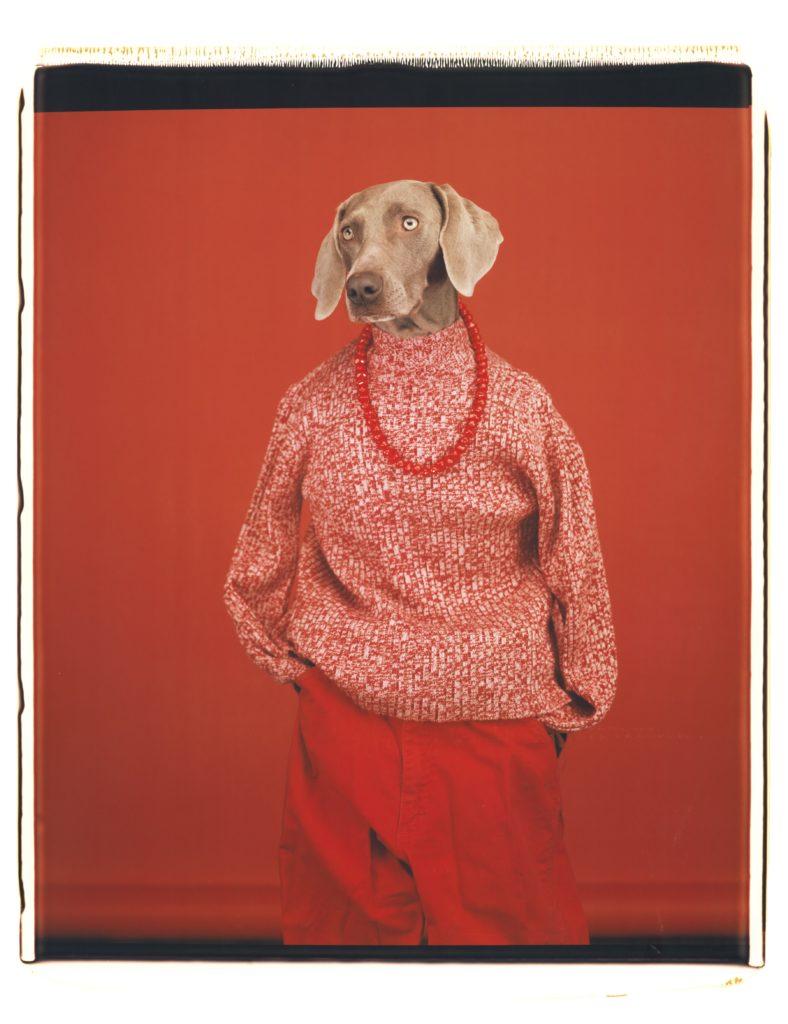
<div id="attachment_31469" style="width: 570px" class="wp-caption aligncenter"><img loading="lazy" decoding="async" aria-describedby="caption-attachment-31469" class="size-large wp-image-31469" src="https://www.oh-i-see.com/blog/wp-content/uploads/2018/07/2018-WEGM-press03-788x1024.jpg" alt="Casual, a photo by William Wegman in 2002, shown at the Rencontres d'Arles (Arles Photo Festival). (Image © William Wegman.)" width="560" height="728" /><p id="caption-attachment-31469" class="wp-caption-text">Candy stars in Casual (2002)<br />© William Wegman (Courtesy of the artist)</p></div></p>
<h2>William Wegman Makes Us Smile</h2>
<p>What’s the best way to experience William Wegman’s “Being Human” exhibit at the 2018 Rencontres d’Arles (Arles Photo Festival)?</p>
<p>Spend time with Wegman’s original 20 x 24 Polaroid prints—but also take note of the faces of the visitors.</p>
<p>Everyone is smiling.</p>
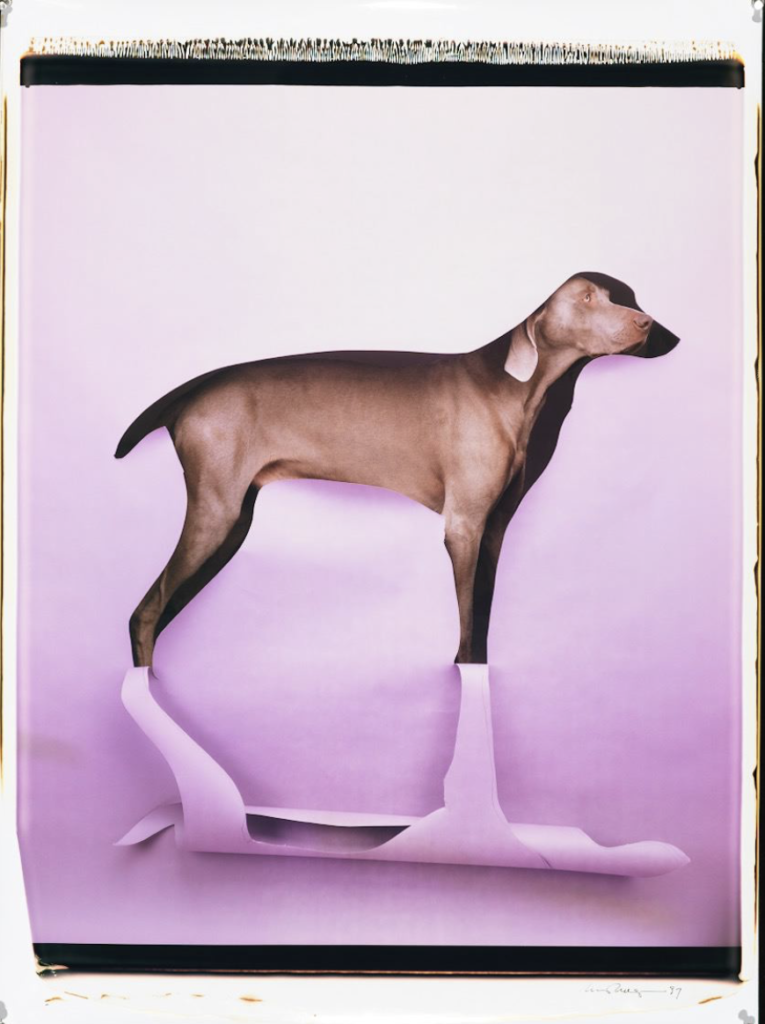
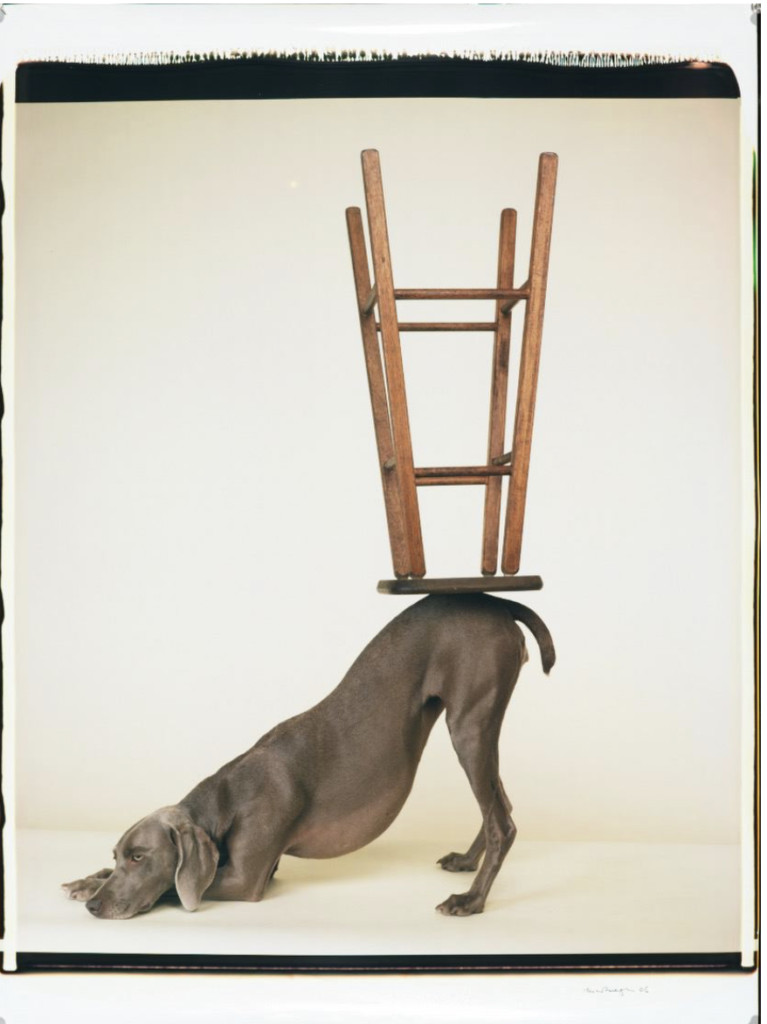
<p>We’re smiling at dogs sporting festive wigs, or arching majestically on shapes of color, or agilely balancing things on their nose or head, or morphing into other animals like a giraffelant, or going about the daily tasks of living (with a surreptitious set of human hands).</p>
<p>We’re smiling at each of the 100 photographs displayed in this show, but we’re really smiling at ourselves as we make a connection to the fascinating world of being human.</p>
<p>We’re also amazed at just how creative Wegman has been in the nearly 50 years he has been photographing his beloved weimaraners.</p>
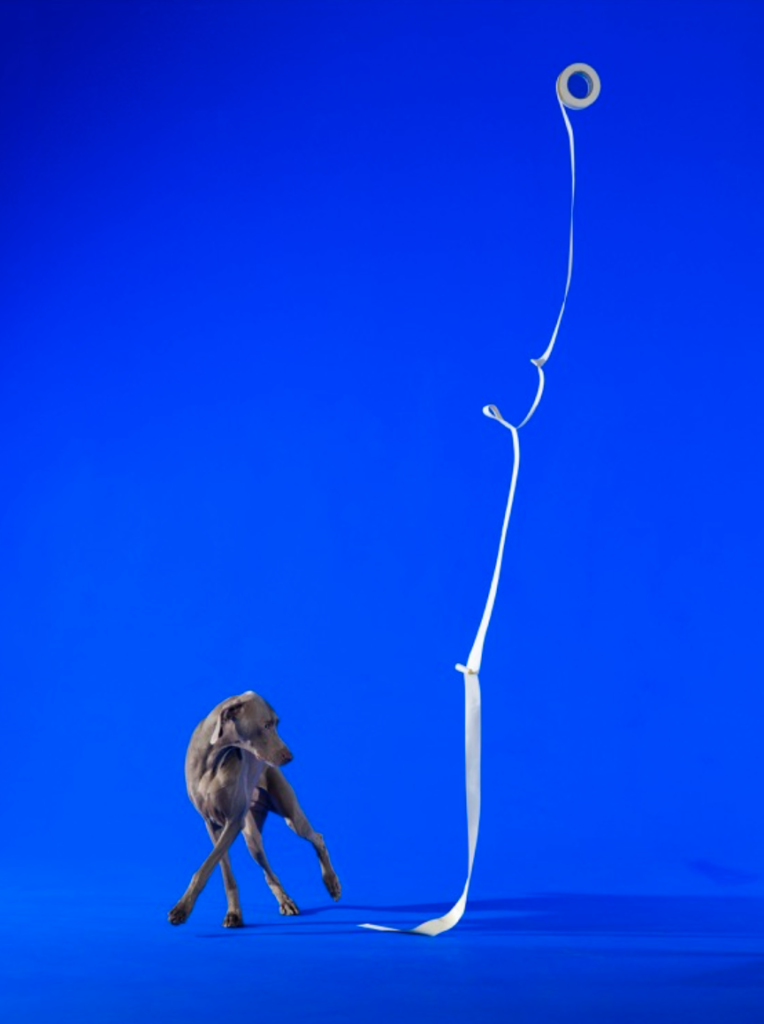
<div id="attachment_31462" style="width: 570px" class="wp-caption aligncenter"><img loading="lazy" decoding="async" aria-describedby="caption-attachment-31462" class="wp-image-31462 size-large" src="https://www.oh-i-see.com/blog/wp-content/uploads/2018/07/Screen-Shot-2018-07-10-at-7.40.50-PM-765x1024.png" alt="Cut to Reveal, a photo by William Wegman at the Rencontres d'Arles (Arles Photo Festival). (Image © William Wegman.)" width="560" height="750" /><p id="caption-attachment-31462" class="wp-caption-text">Batty stars in Cut to Reveal (1997)<br />© William Wegman (Courtesy of the artist)</p></div>
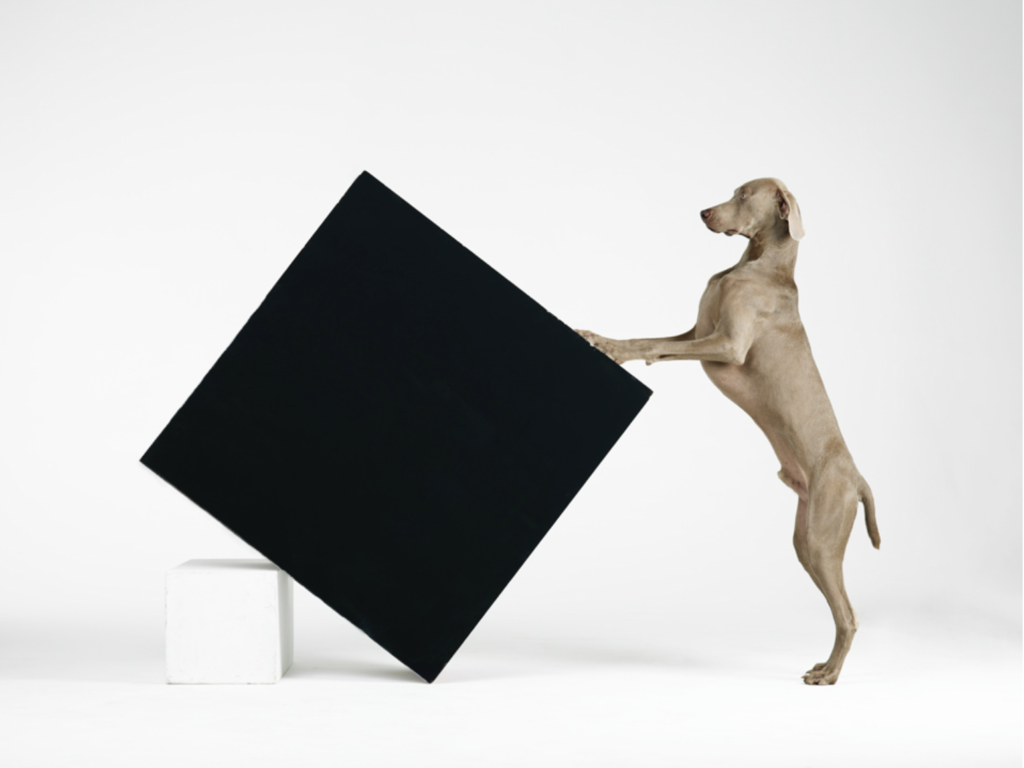
<p>With a retrospective such as “Being Human,” it becomes clear that Wegman continues to evolve and challenge himself (and his dogs)—with a unique blend of conceptual art and surrealism; a range of elements from cubism, color fields, masquerades, high fashion, theatrical costumes, eclectic furniture, and figure studies; and above all . . . humor.</p>
<p>In a world where the harsh realities of the planet are often a subtle (or not so subtle) presence in photographic images, these images give our spirit a chance to laugh.</p>
<div id="attachment_31466" style="width: 570px" class="wp-caption aligncenter"><img loading="lazy" decoding="async" aria-describedby="caption-attachment-31466" class="wp-image-31466 size-large" src="https://www.oh-i-see.com/blog/wp-content/uploads/2018/07/Screen-Shot-2018-07-10-at-7.37.01-PM-767x1024.png" alt="Upside Downward, a photo by William Wegman at the Rencontres d'Arles (Arles Photo Festival). (Image © William Wegman.)" width="560" height="748" /><p id="caption-attachment-31466" class="wp-caption-text">Penny stars in Upside Downward (2006)<br />© William Wegman (Courtesy of the artist)</p></div>
<h4>No Underdogs Here</h4>
<p>As the exhibit curator William Ewing notes in the book <em>Being Human, </em>Wegman explores many genres—photojournalism, astronomy, gastronomy, landscapes, seascapes, haute couture, theatre, opera, art trends, and metaphysical and difficult existential questions—all through the noble character and soulsearching pale eyes of his dogs.</p>
<p>“I’ve always thought of working with the dogs as parallel play. The dogs play their game and I play mine,” says Wegman in conversation with Ewing.</p>
<p>The canine cast of characters all like to play . . . and to work. The dogs <u>want</u> to be chosen to be photographed. In fact, they feel left out if they are not the center of attention on the set.</p>
<p>Sometimes Wegman has to pretend that everyone has a part, even when one dog is the focus. There’s no underdog here.</p>
<p>In the Wegman studio, every dog is a star. And every dog has his or her own talent and personality. Wegman is an expert at casting the right dog with the right creative vision. We get to know the character of Man Ray, Fay Ray, Chundo, Bettina (Batty), Crooky, Mazzy, Chip, Bobbin, Candy, Penny, Flo, and Topper.</p>
<div id="attachment_31467" style="width: 570px" class="wp-caption aligncenter"><img loading="lazy" decoding="async" aria-describedby="caption-attachment-31467" class="wp-image-31467 size-large" src="https://www.oh-i-see.com/blog/wp-content/uploads/2018/07/Screen-Shot-2018-07-10-at-7.42.54-PM-1024x768.png" alt="Constructivism, a photo by William Wegman at the Rencontres d'Arles (Arles Photo Festival). (Image © William Wegman.)" width="560" height="420" /><p id="caption-attachment-31467" class="wp-caption-text">Topper stars in Constructivism (2014)<br />© William Wegman (Courtesy of the artist)</p></div>
<h4>In The Beginning There Was Man Ray</h4>
<p>How did it all begin? The puppy Man Ray came into the picture (pun intended) while Wegman was teaching in California in 1970. Wegman’s artistic media up until that time had been drawing, painting, and video.</p>
<p>Man Ray made it clear that he wanted to be a part of the action, so Wegman began featuring him in photographs. He marveled at how Man Ray was transformed by the act of photographing him. “He <em>became</em>,” in Wegman’s words.</p>
<p>Man Ray was regal, confident, a leader of the pack. He emerged as the star of Wegman’s photographs, as well as videos. He even learned to spell.</p>
<p><iframe loading="lazy" title="William Wegman &#039;The Spelling Quiz&#039;" width="560" height="315" src="https://www.youtube.com/embed/mlApzm6HhqE?feature=oembed" frameborder="0" allow="accelerometer; autoplay; clipboard-write; encrypted-media; gyroscope; picture-in-picture; web-share" referrerpolicy="strict-origin-when-cross-origin" allowfullscreen></iframe></p>
<p style="text-align: center;"><em>If video does not display, watch it <a href="https://www.youtube.com/watch?v=mlApzm6HhqE" target="_blank" rel="noopener">here.</a></em></p>
<h4>The Dog Photographer</h4>
<p>Although Wegman is sometimes called “the dog photographer” or is accused of being too anthropomorphic, his art moves well beyond any such categorization (although it’s hard to argue the anthropomorphism point when Man Ray was named “Man of the Year” by the <em>Village Voice </em>after he died).</p>
<p>The basic truth is that Wegman’s art is a tender collaboration between a human and humans’ best friends. The subject is not dogs. The subject is life.</p>
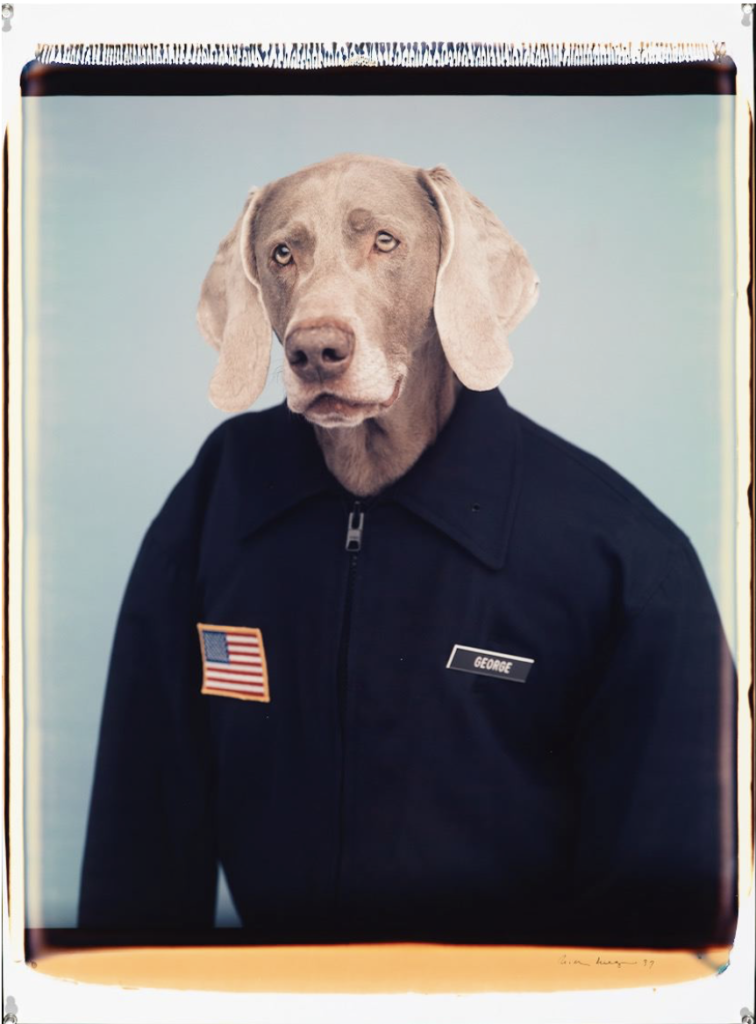
<div id="attachment_31464" style="width: 570px" class="wp-caption aligncenter"><img loading="lazy" decoding="async" aria-describedby="caption-attachment-31464" class="wp-image-31464 size-large" src="https://www.oh-i-see.com/blog/wp-content/uploads/2018/07/Screen-Shot-2018-07-10-at-7.37.32-PM-756x1024.png" alt="George, a photo by William Wegman at the Rencontres d'Arles (Arles Photo Festival). (Image © William Wegman.)" width="560" height="759" /><p id="caption-attachment-31464" class="wp-caption-text">Chundo stars in George (1997)<br />© William Wegman (Courtesy of the artist)</p></div>
<p>The portraiture is not unlike other humanists’ approach. The photographer works to show the deeper layers of the subject so that the viewer will be engaged in the story . . . in the discovery . . . in the exploration.</p>
<p>Wegman has the advantage that wiemaraners are hunting dogs and are inclined to stay still, as if pointing. However, he still must elicit the right emotions (although he admits that the wiemaraner expression is somewhat detached . . . similar to an elegant fashion model who is a bit above it all).</p>
<p>The Wegman techniques are slightly different from the average portrait photographer. How does he get his subjects to do what he wants?</p>
<p>“<em>Cat </em>was a big word with many of my dogs,&#8221; Wegman says. &#8220;<em>Ball </em>has been an important word until recently, and <em>Bone </em>continues to be promising. But if you keep saying <em>Bone </em>and don’t deliver, the word crashes and you have to find another word.”</p>
<div id="attachment_31463" style="width: 570px" class="wp-caption aligncenter"><img loading="lazy" decoding="async" aria-describedby="caption-attachment-31463" class="wp-image-31463 size-large" src="https://www.oh-i-see.com/blog/wp-content/uploads/2018/07/Screen-Shot-2018-07-10-at-7.38.10-PM-764x1024.png" alt="Cursive Display, a photo by William Wegman at the Rencontres d'Arles (Arles Photo Festival). (Image © William Wegman.)" width="560" height="751" /><p id="caption-attachment-31463" class="wp-caption-text">Flo stars in Cursive Display (2013)<br />© William Wegman (Courtesy of the artist)</p></div>
<h4>The Polaroid Era</h4>
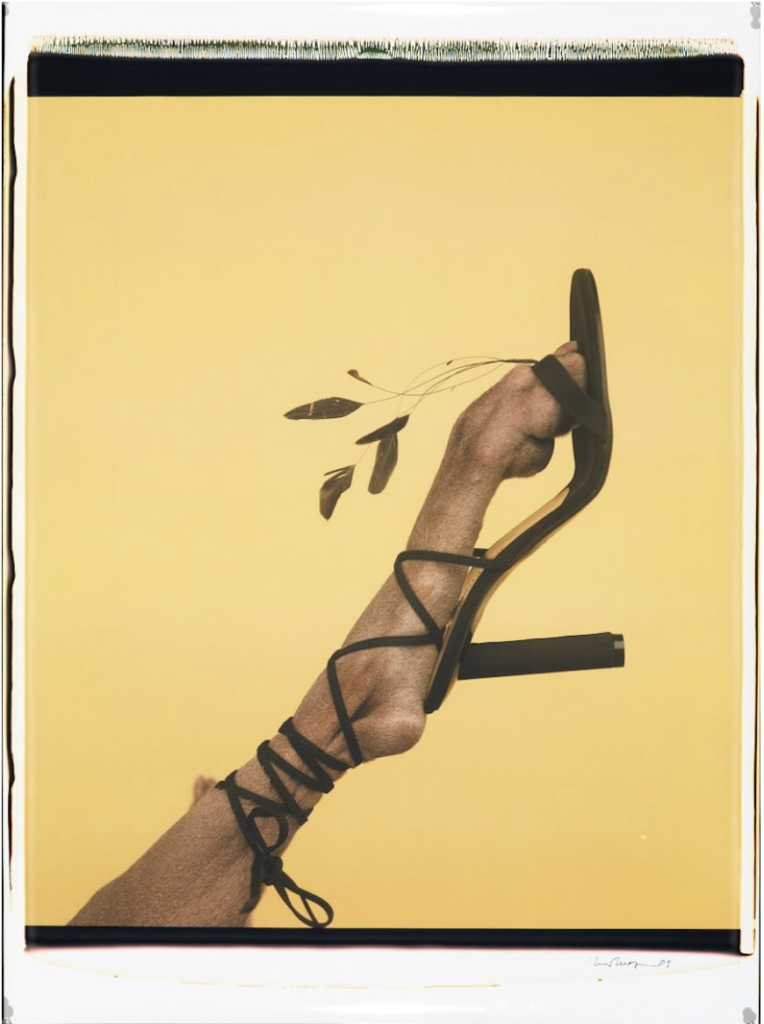
<p>Wegman’s style and vision changed in 1978 when Polaroid invited him to try out one of their few new 20 x 24 cameras.</p>
<p>The camera was the size of a refrigerator and weighed more than 400 pounds. Wegman had to go to the Polaroid studio (dogs, costumes, and props in hand) to create the photographs.</p>
<p>The camera dictated that he work in color, in a vertical format. He saw the images almost immediately after shooting, which enabled timely adjustments. And the images had all the quality advantages of a large-format camera.</p>
<p>Because of the size and immobility of the camera, he had to bring his subjects up to the level of the lens. There also was no post-shoot manipulation. The image was exactly as it was shot.</p>
<p>Later, he did go on location from time to time, hauling the camera in a truck (along with the Polaroid assistant).</p>
<p>Wegman worked with the Polaroid camera from 1979 to 2007, creating more than 15,000 images.</p>
<p>Knowing the challenges of this camera format makes seeing these Polaroid originals in the exhibit all the more thrilling. It becomes obvious how much work went into creating these complex stories and capturing the “decisive moment.”</p>
<p>As Wegman said in an interview, ““The lucky accident happens over and over again if you just spend time at it.”</p>
<p>After the end of the Polaroid era, Wegman moved to digital. Thus, he still has the benefit of seeing the image immediately so he can make adjustments.</p>
<p>However, because post-production is now a possibility, he must test the faith of his viewers to know he does not manipulate the images with Photoshop. He is still working in the Polaroid philosophy.</p>
<div id="attachment_31465" style="width: 570px" class="wp-caption aligncenter"><img loading="lazy" decoding="async" aria-describedby="caption-attachment-31465" class="size-large wp-image-31465" src="https://www.oh-i-see.com/blog/wp-content/uploads/2018/07/Screen-Shot-2018-07-10-at-7.37.18-PM-764x1024.png" alt="Feathered Footwear, a photo by William Wegman at the Rencontres d'Arles (Arles Photo Festival). (Image © William Wegman.)" width="560" height="751" /><p id="caption-attachment-31465" class="wp-caption-text">Feathered Footwear (1999)<br />© William Wegman (Courtesy of the artist)</p></div>
<h4>An &#8220;Oh I See&#8221; Pawsterity Moment</h4>
<p>The axiom that photographing something you love brings you closer to that subject is certainly true for William Wegman.</p>
<p>An aboriginal saying is also true: Dogs make us human.</p>
<p>We come out of the “Being Human” exhibit feeling better about ourselves and our fellow beings. And we come out smiling.</p>
<p>&nbsp;</p>
<p><em><a href="https://www.rencontres-arles.com/en" target="_blank" rel="noopener">Les Rencontres de la photographie d&#8217;Arles,</a> exhibitions run from July 2 until September 23 2018, 34 Rue du Dr Fanton, 13200 Arles</em></p>
<p><em>The exhibit “Being Human,” curated by William Ewing is produced by the <a href="https://www.fep-photo.org" target="_blank" rel="noopener">Foundation for the Exhibition of Photography,</a> Minneapolis, in collaboration with the Rencontres d&#8217;Arles. </em></p>
<p><em>William Wegman’s work can be found at the <a href="https://www.speronewestwater.com" target="_blank" rel="noopener">Sperone Westwater Gallery</a> in New York. His numerous books can be found on <a href="https://www.amazon.com/William-Wegman/e/B000AP9PC4" target="_blank" rel="noopener">Amazon.</a></em></p>
<p><em>The new book “Being Human” in collaboration with William Ewing includes more than 300 photos, many of which have never been shown, and can be found <a href="https://www.chroniclebooks.com/titles/william-wegman-being-human.html" target="_blank" rel="noopener">here.</a></em></p>
<p><i><a title="Creative Inspiration Flows In Underwater Photographs" href="#comments">Comment</a></i><em> on this post below, or inspire insight with your own OIC Moment </em><em><a href="https://www.oh-i-see.com/blog/your-oic-moments/">here</a>.</em></p>
<p>A bonus encore: Wegman&#8217;s famous Dog Duet.</p>
<p><iframe loading="lazy" title="William Wegman - Dog Duet (1975)" width="560" height="315" src="https://www.youtube.com/embed/hpa09i588_o?feature=oembed" frameborder="0" allow="accelerometer; autoplay; clipboard-write; encrypted-media; gyroscope; picture-in-picture; web-share" referrerpolicy="strict-origin-when-cross-origin" allowfullscreen></iframe></p>
<p style="text-align: center;"><em>If video does not display, watch it <a href="https://www.youtube.com/watch?v=hpa09i588_o" target="_blank" rel="noopener">here.</a></em></p>
{"id":31470,"date":"2018-07-23T03:00:48","date_gmt":"2018-07-23T10:00:48","guid":{"rendered":"https:\/\/www.oh-i-see.com\/blog\/?p=31470"},"modified":"2018-07-23T08:14:17","modified_gmt":"2018-07-23T15:14:17","slug":"everything-is-pawssible-at-the-arles-photo-festival","status":"publish","type":"post","link":"https:\/\/www.oh-i-see.com\/blog\/everything-is-pawssible-at-the-arles-photo-festival\/","title":{"rendered":"Everything is Pawssible at the Arles Photo Festival"},"content":{"rendered":"<p>[nopinit]<br \/>\n<div id=\"attachment_31469\" style=\"width: 570px\" class=\"wp-caption aligncenter\"><img loading=\"lazy\" decoding=\"async\" aria-describedby=\"caption-attachment-31469\" class=\"size-large wp-image-31469\" src=\"https:\/\/www.oh-i-see.com\/blog\/wp-content\/uploads\/2018\/07\/2018-WEGM-press03-788x1024.jpg\" alt=\"Casual, a photo by William Wegman in 2002, shown at the Rencontres d'Arles (Arles Photo Festival). (Image \u00a9 William Wegman.)\" width=\"560\" height=\"728\" \/><p id=\"caption-attachment-31469\" class=\"wp-caption-text\">Candy stars in Casual (2002)<br \/>\u00a9 William Wegman (Courtesy of the artist)<\/p><\/div><\/p>\n<h2>William Wegman Makes Us Smile<\/h2>\n<p>What\u2019s the best way to experience William Wegman\u2019s \u201cBeing Human\u201d exhibit at the 2018 Rencontres d\u2019Arles (Arles Photo Festival)?<\/p>\n<p>Spend time with Wegman\u2019s original 20 x 24 Polaroid prints\u2014but also take note of the faces of the visitors.<\/p>\n<p>Everyone is smiling.<\/p>\n<p>We\u2019re smiling at dogs sporting festive wigs, or arching majestically on shapes of color, or agilely balancing things on their nose or head, or morphing into other animals like a giraffelant, or going about the daily tasks of living (with a surreptitious set of human hands).<\/p>\n<p>We\u2019re smiling at each of the 100 photographs displayed in this show, but we\u2019re really smiling at ourselves as we make a connection to the fascinating world of being human.<\/p>\n<p>We\u2019re also amazed at just how creative Wegman has been in the nearly 50 years he has been photographing his beloved weimaraners.<\/p>\n<div id=\"attachment_31462\" style=\"width: 570px\" class=\"wp-caption aligncenter\"><img loading=\"lazy\" decoding=\"async\" aria-describedby=\"caption-attachment-31462\" class=\"wp-image-31462 size-large\" src=\"https:\/\/www.oh-i-see.com\/blog\/wp-content\/uploads\/2018\/07\/Screen-Shot-2018-07-10-at-7.40.50-PM-765x1024.png\" alt=\"Cut to Reveal, a photo by William Wegman at the Rencontres d'Arles (Arles Photo Festival). (Image \u00a9 William Wegman.)\" width=\"560\" height=\"750\" \/><p id=\"caption-attachment-31462\" class=\"wp-caption-text\">Batty stars in Cut to Reveal (1997)<br \/>\u00a9 William Wegman (Courtesy of the artist)<\/p><\/div>\n<p>With a retrospective such as \u201cBeing Human,\u201d it becomes clear that Wegman continues to evolve and challenge himself (and his dogs)\u2014with a unique blend of conceptual art and surrealism; a range of elements from cubism, color fields, masquerades, high fashion, theatrical costumes, eclectic furniture, and figure studies; and above all . . . humor.<\/p>\n<p>In a world where the harsh realities of the planet are often a subtle (or not so subtle) presence in photographic images, these images give our spirit a chance to laugh.<\/p>\n<div id=\"attachment_31466\" style=\"width: 570px\" class=\"wp-caption aligncenter\"><img loading=\"lazy\" decoding=\"async\" aria-describedby=\"caption-attachment-31466\" class=\"wp-image-31466 size-large\" src=\"https:\/\/www.oh-i-see.com\/blog\/wp-content\/uploads\/2018\/07\/Screen-Shot-2018-07-10-at-7.37.01-PM-767x1024.png\" alt=\"Upside Downward, a photo by William Wegman at the Rencontres d'Arles (Arles Photo Festival). (Image \u00a9 William Wegman.)\" width=\"560\" height=\"748\" \/><p id=\"caption-attachment-31466\" class=\"wp-caption-text\">Penny stars in Upside Downward (2006)<br \/>\u00a9 William Wegman (Courtesy of the artist)<\/p><\/div>\n<h4>No Underdogs Here<\/h4>\n<p>As the exhibit curator William Ewing notes in the book <em>Being Human,\u00a0<\/em>Wegman explores many genres\u2014photojournalism, astronomy, gastronomy, landscapes, seascapes, haute couture, theatre, opera, art trends, and metaphysical and difficult existential questions\u2014all through the noble character and soulsearching pale eyes of his dogs.<\/p>\n<p>\u201cI\u2019ve always thought of working with the dogs as parallel play. The dogs play their game and I play mine,\u201d says Wegman in conversation with Ewing.<\/p>\n<p>The canine cast of characters all like to play . . . and to work. The dogs <u>want<\/u>\u00a0to be chosen to be photographed. In fact, they feel left out if they are not the center of attention on the set.<\/p>\n<p>Sometimes Wegman has to pretend that everyone has a part, even when one dog is the focus. There\u2019s no underdog here.<\/p>\n<p>In the Wegman studio, every dog is a star. And every dog has his or her own talent and personality. Wegman is an expert at casting the right dog with the right creative vision. We get to know the character of Man Ray, Fay Ray, Chundo, Bettina (Batty), Crooky, Mazzy, Chip, Bobbin, Candy, Penny, Flo, and Topper.<\/p>\n<div id=\"attachment_31467\" style=\"width: 570px\" class=\"wp-caption aligncenter\"><img loading=\"lazy\" decoding=\"async\" aria-describedby=\"caption-attachment-31467\" class=\"wp-image-31467 size-large\" src=\"https:\/\/www.oh-i-see.com\/blog\/wp-content\/uploads\/2018\/07\/Screen-Shot-2018-07-10-at-7.42.54-PM-1024x768.png\" alt=\"Constructivism, a photo by William Wegman at the Rencontres d'Arles (Arles Photo Festival). (Image \u00a9 William Wegman.)\" width=\"560\" height=\"420\" \/><p id=\"caption-attachment-31467\" class=\"wp-caption-text\">Topper stars in Constructivism (2014)<br \/>\u00a9 William Wegman (Courtesy of the artist)<\/p><\/div>\n<h4>In The Beginning There Was Man Ray<\/h4>\n<p>How did it all begin? The puppy Man Ray came into the picture (pun intended) while Wegman was teaching in California in 1970. Wegman\u2019s artistic media up until that time had been drawing, painting, and video.<\/p>\n<p>Man Ray made it clear that he wanted to be a part of the action, so Wegman began featuring him in photographs. He marveled at how Man Ray was transformed by the act of photographing him. \u201cHe <em>became<\/em>,\u201d in Wegman\u2019s words.<\/p>\n<p>Man Ray was regal, confident, a leader of the pack. He emerged as the star of Wegman\u2019s photographs, as well as videos. He even learned to spell.<\/p>\n<p><iframe loading=\"lazy\" title=\"William Wegman &#039;The Spelling Quiz&#039;\" width=\"560\" height=\"315\" src=\"https:\/\/www.youtube.com\/embed\/mlApzm6HhqE?feature=oembed\" frameborder=\"0\" allow=\"accelerometer; autoplay; clipboard-write; encrypted-media; gyroscope; picture-in-picture; web-share\" referrerpolicy=\"strict-origin-when-cross-origin\" allowfullscreen><\/iframe><\/p>\n<p style=\"text-align: center;\"><em>If video does not display, watch it <a href=\"https:\/\/www.youtube.com\/watch?v=mlApzm6HhqE\" target=\"_blank\" rel=\"noopener\">here.<\/a><\/em><\/p>\n<h4>The Dog Photographer<\/h4>\n<p>Although Wegman is sometimes called \u201cthe dog photographer\u201d or is accused of being too anthropomorphic, his art moves well beyond any such categorization (although it\u2019s hard to argue the anthropomorphism point when Man Ray was named \u201cMan of the Year\u201d by the <em>Village Voice\u00a0<\/em>after he died).<\/p>\n<p>The basic truth is that Wegman\u2019s art is a tender collaboration between a human and humans\u2019 best friends. The subject is not dogs. The subject is life.<\/p>\n<div id=\"attachment_31464\" style=\"width: 570px\" class=\"wp-caption aligncenter\"><img loading=\"lazy\" decoding=\"async\" aria-describedby=\"caption-attachment-31464\" class=\"wp-image-31464 size-large\" src=\"https:\/\/www.oh-i-see.com\/blog\/wp-content\/uploads\/2018\/07\/Screen-Shot-2018-07-10-at-7.37.32-PM-756x1024.png\" alt=\"George, a photo by William Wegman at the Rencontres d'Arles (Arles Photo Festival). (Image \u00a9 William Wegman.)\" width=\"560\" height=\"759\" \/><p id=\"caption-attachment-31464\" class=\"wp-caption-text\">Chundo stars in George (1997)<br \/>\u00a9 William Wegman (Courtesy of the artist)<\/p><\/div>\n<p>The portraiture is not unlike other humanists\u2019 approach. The photographer works to show the deeper layers of the subject so that the viewer will be engaged in the story . . . in the discovery . . . in the exploration.<\/p>\n<p>Wegman has the advantage that wiemaraners are hunting dogs and are inclined to stay still, as if pointing. However, he still must elicit the right emotions (although he admits that the wiemaraner expression is somewhat detached . . . similar to an elegant fashion model who is a bit above it all).<\/p>\n<p>The Wegman techniques are slightly different from the average portrait photographer. How does he get his subjects to do what he wants?<\/p>\n<p>\u201c<em>Cat\u00a0<\/em>was a big word with many of my dogs,&#8221; Wegman says. &#8220;<em>Ball\u00a0<\/em>has been an important word until recently, and <em>Bone\u00a0<\/em>continues to be promising. But if you keep saying <em>Bone\u00a0<\/em>and don\u2019t deliver, the word crashes and you have to find another word.\u201d<\/p>\n<div id=\"attachment_31463\" style=\"width: 570px\" class=\"wp-caption aligncenter\"><img loading=\"lazy\" decoding=\"async\" aria-describedby=\"caption-attachment-31463\" class=\"wp-image-31463 size-large\" src=\"https:\/\/www.oh-i-see.com\/blog\/wp-content\/uploads\/2018\/07\/Screen-Shot-2018-07-10-at-7.38.10-PM-764x1024.png\" alt=\"Cursive Display, a photo by William Wegman at the Rencontres d'Arles (Arles Photo Festival). (Image \u00a9 William Wegman.)\" width=\"560\" height=\"751\" \/><p id=\"caption-attachment-31463\" class=\"wp-caption-text\">Flo stars in Cursive Display (2013)<br \/>\u00a9 William Wegman (Courtesy of the artist)<\/p><\/div>\n<h4>The Polaroid Era<\/h4>\n<p>Wegman\u2019s style and vision changed in 1978 when Polaroid invited him to try out one of their few new 20 x 24 cameras.<\/p>\n<p>The camera was the size of a refrigerator and weighed more than 400 pounds. Wegman had to go to the Polaroid studio (dogs, costumes, and props in hand) to create the photographs.<\/p>\n<p>The camera dictated that he work in color, in a vertical format. He saw the images almost immediately after shooting, which enabled timely adjustments. And the images had all the quality advantages of a large-format camera.<\/p>\n<p>Because of the size and immobility of the camera, he had to bring his subjects up to the level of the lens. There also was no post-shoot manipulation. The image was exactly as it was shot.<\/p>\n<p>Later, he did go on location from time to time, hauling the camera in a truck (along with the Polaroid assistant).<\/p>\n<p>Wegman worked with the Polaroid camera from 1979 to 2007, creating more than 15,000 images.<\/p>\n<p>Knowing the challenges of this camera format makes seeing these Polaroid originals in the exhibit all the more thrilling. It becomes obvious how much work went into creating these complex stories and capturing the \u201cdecisive moment.\u201d<\/p>\n<p>As Wegman said in an interview, \u201c\u201cThe lucky accident happens over and over again if you just spend time at it.\u201d<\/p>\n<p>After the end of the Polaroid era, Wegman moved to digital. Thus, he still has the benefit of seeing the image immediately so he can make adjustments.<\/p>\n<p>However, because post-production is now a possibility, he must test the faith of his viewers to know he does not manipulate the images with Photoshop. He is still working in the Polaroid philosophy.<\/p>\n<div id=\"attachment_31465\" style=\"width: 570px\" class=\"wp-caption aligncenter\"><img loading=\"lazy\" decoding=\"async\" aria-describedby=\"caption-attachment-31465\" class=\"size-large wp-image-31465\" src=\"https:\/\/www.oh-i-see.com\/blog\/wp-content\/uploads\/2018\/07\/Screen-Shot-2018-07-10-at-7.37.18-PM-764x1024.png\" alt=\"Feathered Footwear, a photo by William Wegman at the Rencontres d'Arles (Arles Photo Festival). (Image \u00a9 William Wegman.)\" width=\"560\" height=\"751\" \/><p id=\"caption-attachment-31465\" class=\"wp-caption-text\">Feathered Footwear (1999)<br \/>\u00a9 William Wegman (Courtesy of the artist)<\/p><\/div>\n<h4>An &#8220;Oh I See&#8221; Pawsterity Moment<\/h4>\n<p>The axiom that photographing something you love brings you closer to that subject is certainly true for William Wegman.<\/p>\n<p>An aboriginal saying is also true: Dogs make us human.<\/p>\n<p>We come out of the \u201cBeing Human\u201d exhibit feeling better about ourselves and our fellow beings. And we come out smiling.<\/p>\n<p>&nbsp;<\/p>\n<p><em><a href=\"https:\/\/www.rencontres-arles.com\/en\" target=\"_blank\" rel=\"noopener\">Les Rencontres de la photographie d&#8217;Arles,<\/a> exhibitions run from July 2 until September 23 2018,\u00a034 Rue du Dr Fanton, 13200 Arles<\/em><\/p>\n<p><em>The exhibit \u201cBeing Human,\u201d curated by William Ewing is produced by the <a href=\"https:\/\/www.fep-photo.org\" target=\"_blank\" rel=\"noopener\">Foundation for the Exhibition of Photography,<\/a> Minneapolis, in collaboration with the Rencontres d&#8217;Arles. <\/em><\/p>\n<p><em>William Wegman\u2019s work can be found at the <a href=\"https:\/\/www.speronewestwater.com\" target=\"_blank\" rel=\"noopener\">Sperone Westwater Gallery<\/a> in New York. His numerous books can be found on <a href=\"https:\/\/www.amazon.com\/William-Wegman\/e\/B000AP9PC4\" target=\"_blank\" rel=\"noopener\">Amazon.<\/a><\/em><\/p>\n<p><em>The new book \u201cBeing Human\u201d in collaboration with William Ewing includes more than 300 photos, many of which have never been shown, and can be found <a href=\"https:\/\/www.chroniclebooks.com\/titles\/william-wegman-being-human.html\" target=\"_blank\" rel=\"noopener\">here.<\/a><\/em><\/p>\n<p><i><a title=\"Creative Inspiration Flows In Underwater Photographs\" href=\"#comments\">Comment<\/a><\/i><em>\u00a0on this post below, or inspire insight with your own\u00a0OIC Moment\u00a0<\/em><em><a href=\"https:\/\/www.oh-i-see.com\/blog\/your-oic-moments\/\">here<\/a>.<\/em><\/p>\n<p>A bonus encore: Wegman&#8217;s famous Dog Duet.<\/p>\n<p><iframe loading=\"lazy\" title=\"William Wegman - Dog Duet (1975)\" width=\"560\" height=\"315\" src=\"https:\/\/www.youtube.com\/embed\/hpa09i588_o?feature=oembed\" frameborder=\"0\" allow=\"accelerometer; autoplay; clipboard-write; encrypted-media; gyroscope; picture-in-picture; web-share\" referrerpolicy=\"strict-origin-when-cross-origin\" allowfullscreen><\/iframe><\/p>\n<p style=\"text-align: center;\"><em>If video does not display, watch it <a href=\"https:\/\/www.youtube.com\/watch?v=hpa09i588_o\" target=\"_blank\" rel=\"noopener\">here.<\/a><\/em><\/p>\n","protected":false},"excerpt":{"rendered":null,"protected":false},"author":5,"featured_media":31469,"comment_status":"open","ping_status":"open","sticky":false,"template":"","format":"standard","meta":{"footnotes":""},"categories":[200,171,199],"tags":[],"class_list":["post-31470","post","type-post","status-publish","format-standard","has-post-thumbnail","hentry","category-france-mappoints","category-photography-creative","category-usa-mappoints"],"aioseo_notices":[],"_links":{"self":[{"href":"https:\/\/www.oh-i-see.com\/blog\/wp-json\/wp\/v2\/posts\/31470","targetHints":{"allow":["GET"]}}],"collection":[{"href":"https:\/\/www.oh-i-see.com\/blog\/wp-json\/wp\/v2\/posts"}],"about":[{"href":"https:\/\/www.oh-i-see.com\/blog\/wp-json\/wp\/v2\/types\/post"}],"author":[{"embeddable":true,"href":"https:\/\/www.oh-i-see.com\/blog\/wp-json\/wp\/v2\/users\/5"}],"replies":[{"embeddable":true,"href":"https:\/\/www.oh-i-see.com\/blog\/wp-json\/wp\/v2\/comments?post=31470"}],"version-history":[{"count":39,"href":"https:\/\/www.oh-i-see.com\/blog\/wp-json\/wp\/v2\/posts\/31470\/revisions"}],"predecessor-version":[{"id":31540,"href":"https:\/\/www.oh-i-see.com\/blog\/wp-json\/wp\/v2\/posts\/31470\/revisions\/31540"}],"wp:featuredmedia":[{"embeddable":true,"href":"https:\/\/www.oh-i-see.com\/blog\/wp-json\/wp\/v2\/media\/31469"}],"wp:attachment":[{"href":"https:\/\/www.oh-i-see.com\/blog\/wp-json\/wp\/v2\/media?parent=31470"}],"wp:term":[{"taxonomy":"category","embeddable":true,"href":"https:\/\/www.oh-i-see.com\/blog\/wp-json\/wp\/v2\/categories?post=31470"},{"taxonomy":"post_tag","embeddable":true,"href":"https:\/\/www.oh-i-see.com\/blog\/wp-json\/wp\/v2\/tags?post=31470"}],"curies":[{"name":"wp","href":"https:\/\/api.w.org\/{rel}","templated":true}]}}