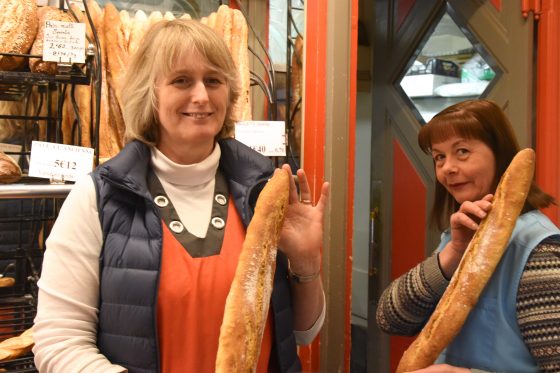
<div id="attachment_29769" style="width: 570px" class="wp-caption aligncenter"><img loading="lazy" decoding="async" aria-describedby="caption-attachment-29769" class="wp-image-29769 size-full" src="https://www.oh-i-see.com/blog/wp-content/uploads/2017/11/MER_5010-Version-2-e1511100998160.jpg" alt="A French bakery (boulangerie) with two women selling baguettes, illustrating baguettiquette, a form of French wordplay about the etiquette of eating baguettes. (Image © Meredith Mullins.)" width="560" height="373" /><p id="caption-attachment-29769" class="wp-caption-text">Proper baguettiquette begins with the selection of the right baguette.<br />© Meredith Mullins</p></div>
<h2>French Language Puns Offer Stories about the Culture</h2>
<p>You can often step into French life through its language. Sometimes you can even invent new words to expand the boundaries of French language and culture. All it takes are some bilingual puns and a fun sense of French wordplay.</p>
<p>What word inventions come to your mind?</p>
<h4>Observing Baguettiquette</h4>
<p>What are the rules and traditions surrounding that oh-so-French symbol, the <em>baguette</em>?</p>
<p>Hardly a day goes by in France where a <em>baguette</em> doesn’t show its crusty face—tucked under someone’s arm in the street, paired with cheeses and a good bottle of wine at a riverside picnic, or at home eaten fresh from the oven of your local <em>boulangerie</em>.</p>
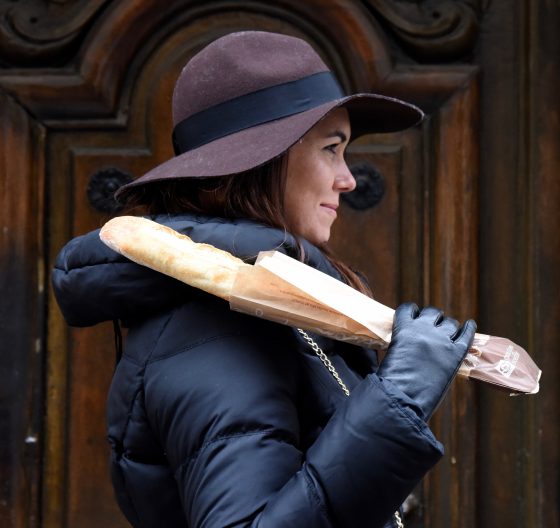
<div id="attachment_29809" style="width: 570px" class="wp-caption aligncenter"><img loading="lazy" decoding="async" aria-describedby="caption-attachment-29809" class="wp-image-29809 size-full" src="https://www.oh-i-see.com/blog/wp-content/uploads/2017/11/MER_5050-e1511171963228.jpg" alt="Young woman carrying baguette on her shoulder, proper baguettetiquette, an invented word in French language as part of wordplay. (Image © Meredith Mullins.)" width="560" height="528" /><p id="caption-attachment-29809" class="wp-caption-text">Just sling the baguette over your shoulder and keep walking.<br />© Meredith Mullins</p></div>
<p>More than one famous French street photographer captured a decisive <em>baguette</em> moment. They are a significant part of everyday life.</p>
<p>Here are some of the unwritten rules of <em>baguettiquette</em>:</p>
<ul>
<li>You’re allowed (and encouraged) to spread butter and jam on your <em>baguette</em> at breakfast and dunk it in your coffee or tea.</li>
<li>When in France, you learn quickly to put your bread on the table beside your plate. In fact, if you put bread on your plate, you’re committing a serious <em>dough pas.</em></li>
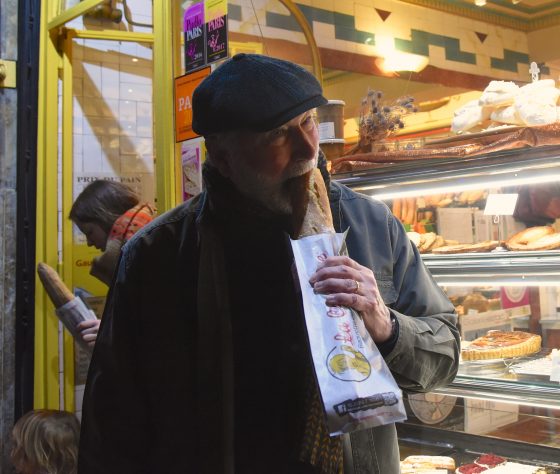
<li>You will be among the locals if you can’t resist biting off the end of the <em>baguette</em> as you carry it home, especially if it’s warm from the oven.</li>
<li>To that end (no pun intended), it is best to time your visit to the <em>boulangerie</em> to coincide with the morning or evening baking.</li>
<li>You can feel free to clean your plate with your bread to savor the last bits and drops of a delicious meal. This technique also expedites dishwashing.</li>
</ul>
<h4></h4>
<div id="attachment_29770" style="width: 570px" class="wp-caption aligncenter"><img loading="lazy" decoding="async" aria-describedby="caption-attachment-29770" class="wp-image-29770 size-full" src="https://www.oh-i-see.com/blog/wp-content/uploads/2017/11/MER_5029-Version-2-e1511101206379.jpg" alt="Man eating end of a baguette in Paris, France, illustrating rules of baguettiquette, a word invented via wordplay with the French language. (Image © Meredith Mullins.)" width="560" height="474" /><p id="caption-attachment-29770" class="wp-caption-text">Can anyone resist biting off the crunchy end of a <em>baguette</em> <br />on the way home from the <em>boulangerie</em>?<br />© Meredith Mullins</p></div>
<h4>Experiencing Déjà Rue</h4>
<p>The magnetism and magic of Paris is to be able to walk down an endless number of streets, always discovering some treasure—whether it’s layers of history, local characters, or new cafés and tiny shops.</p>
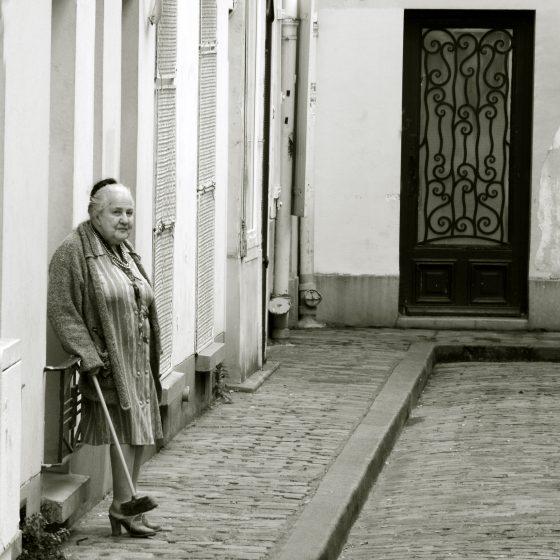
<div id="attachment_29777" style="width: 570px" class="wp-caption aligncenter"><img loading="lazy" decoding="async" aria-describedby="caption-attachment-29777" class="wp-image-29777 size-full" src="https://www.oh-i-see.com/blog/wp-content/uploads/2017/11/MA1_8769-e1511101678564.jpg" alt="Woman in a Montmartre alleyway, illustrating wordplay in the French language (deja rue). (Image © Meredith Mullins.)" width="560" height="560" /><p id="caption-attachment-29777" class="wp-caption-text">An interesting character at every turn when you&#8217;re <em>flaneuring</em><br />© Meredith Mullins</p></div>
<p>From medieval alleyways to broad avenues, people have cultivated the art of <em>flaneuring </em>for many years—wandering without destination or purpose.</p>
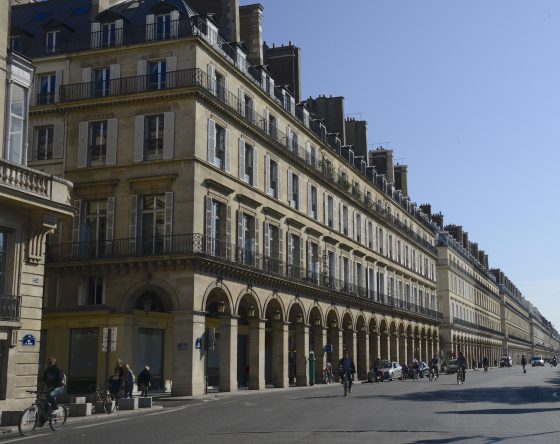
<p>There are some streets where, even if you’ve never been before, something feels familiar. You’ve been there in another time, another life. You’ve been there in a Victor Hugo novel or a Baudelaire poem. You’ve been there in a symphony or in a saxophone solo under a streetlamp. That&#8217;s <em>déjà rue.</em></p>
<p>You know you belong there.</p>
<div id="attachment_29773" style="width: 570px" class="wp-caption aligncenter"><img loading="lazy" decoding="async" aria-describedby="caption-attachment-29773" class="wp-image-29773 size-full" src="https://www.oh-i-see.com/blog/wp-content/uploads/2017/11/M108177-Version-2-e1511101475681.jpg" alt="Rue de Rivoli in Paris France, illustrating some wordplay (deja rue) in the French language. (Image © Meredith Mullins.)" width="560" height="444" /><p id="caption-attachment-29773" class="wp-caption-text">The famous Rue de Rivoli, but seen in a different way—without traffic!<br />© Meredith Mullins</p></div>
<h4>Finding Véliberation</h4>
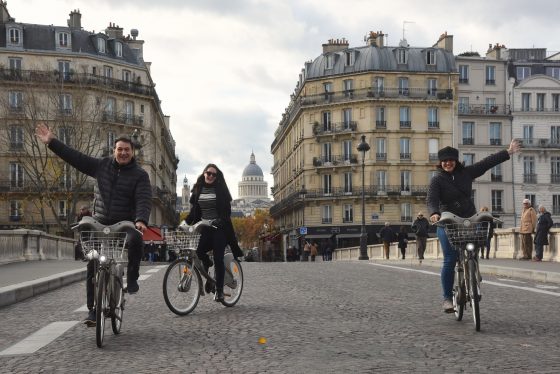
<p>The speedier version of <em>flaneuring</em> is <em>velibing</em>—flying freely through Paris on one of the bikes available from the city’s bike-sharing system.</p>
<p>It is indeed a liberating experience, especially when the traffic is minimal. (“When is that?” you might ask. Early Sunday mornings, or perhaps between 3 and 5 am . . . or in August when most of the locals are on vacation.)</p>
<div id="attachment_29771" style="width: 570px" class="wp-caption aligncenter"><img loading="lazy" decoding="async" aria-describedby="caption-attachment-29771" class="wp-image-29771 size-full" src="https://www.oh-i-see.com/blog/wp-content/uploads/2017/11/MER_5048adj-e1511101879924.jpg" alt="Three velib riders in Paris France, illustrating the wordplay in the French language of veliberation. (Image © Meredith Mullins.)" width="560" height="374" /><p id="caption-attachment-29771" class="wp-caption-text">Véliberation!<br />© Meredith Mullins</p></div>
<p>The Vélib system is now more than ten years old in Paris and is undergoing some important changes under Mayor Hidalgo, who wants Paris to be the most bike-friendly capital in the world.</p>
<p>The number of bikes and bike lanes is expected to double. Electric bikes will be added to the fleet. And signs will be added to the streets allowing cyclists to go through red lights and turn right on red.</p>
<p>A new system for parking the bikes will be installed to allow two bikes in one parking space. Arriving at your destination and not finding a parking space has been a recurring problem.</p>
<p>Despite challenges over the past 10 years (including a high rate of theft and destruction of the bikes), the system has been deemed a success. It is an environmentally-friendly way to move around the city, with the added bonus of that elusive feeling of <em>véliberation</em>.</p>
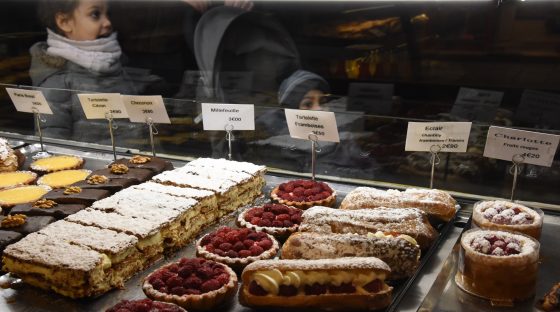
<div id="attachment_29768" style="width: 570px" class="wp-caption aligncenter"><img loading="lazy" decoding="async" aria-describedby="caption-attachment-29768" class="wp-image-29768 size-full" src="https://www.oh-i-see.com/blog/wp-content/uploads/2017/11/MER_5007-Version-2-e1511102025982.jpg" alt="Bakery (boulangerie) window in Paris France, illustrating the concept of eclairity, wordplay in the French language. (Image © Meredith Mullins.)" width="560" height="312" /><p id="caption-attachment-29768" class="wp-caption-text">So many choices. We must seek clarity.<br />© Meredith Mullins</p></div>
<h4>Seeking Éclairity</h4>
<p>Gazing in the window of a <em>boulangerie</em> or <em>patisserie</em> is a tough job, but someone has to do it. The array is artistic, colorful, mesmerizing, and tempting or taunting (depending on your health regime).</p>
<p>Some mornings are destined for <em>croissants</em>. Some evenings cry out for <em>tartelettes</em>. Often, there are a thousand small voices singing the song of the <em>millefeuille</em>.</p>
<p>But it is those days of <em>éclairity</em>, when the choice is clear. The <em>éclair</em>.</p>
<p><em>Éclairs</em> are now omnipresent around the world, but they did, in fact, originate in France. They are believed to have been created by 19<sup>th</sup> century royalty chef Marie-Antonin Carême.</p>
<p>He liked to create structures, such as the Charlotte and the Napoleon. The <em>éclair</em> was a masterpiece of exterior and interior magic.</p>
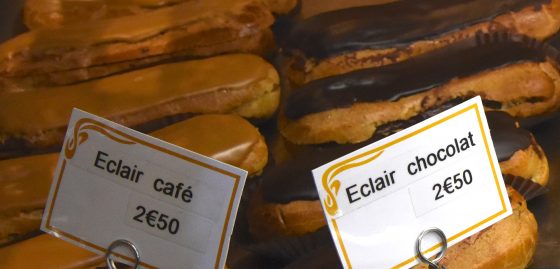
<div id="attachment_29792" style="width: 570px" class="wp-caption aligncenter"><img loading="lazy" decoding="async" aria-describedby="caption-attachment-29792" class="wp-image-29792 size-full" src="https://www.oh-i-see.com/blog/wp-content/uploads/2017/11/MER_5003-Version-2-1-e1511103296237.jpg" alt="Chocolate and coffee eclairs in a bakery (boulangerie) window, illustrating wordplay in the French language. (Image © Meredith Mullins.)" width="560" height="269" /><p id="caption-attachment-29792" class="wp-caption-text">Traditional éclairs in chocolate and coffee.<br />© Meredith Mullins</p></div>
<p><em>Éclair</em> means &#8220;flash of lightening&#8221; in French. It is believed that the pastry was so named because the confectioner’s glaze glistened or perhaps because it was quickly gobbled up . . . by both royalty and common folk. Either way, it caused a stir in the world of French pastry.</p>
<p>Now, the flavors of chocolate, vanilla, and coffee are the foundation of tradition, but also the precursor for more creative approaches—for example, truffle, lemongrass, matcha tea, and pistachio.</p>
<p><em>Éclairity</em>. Is it a flash of lightening or a way of life? Only you know the answer.</p>
<h4>Offering a Sincere &#8220;Bone Appétit&#8221;</h4>
<p>The French enjoy the pleasure of food and good company. Before you begin a meal, your host, friends, or waiter may offer a <em>“Bon appétit,”</em> a sincere wish to enjoy the meal that will follow.</p>
<p>It literally means “have a good appetite,” but more likely than not, that’s a given when you sit down to a delicious French meal.</p>
<div id="attachment_29766" style="width: 310px" class="wp-caption aligncenter"><img loading="lazy" decoding="async" aria-describedby="caption-attachment-29766" class="wp-image-29766 size-shareaholic-thumbnail" src="https://www.oh-i-see.com/blog/wp-content/uploads/2017/11/95218621sized-300x450.jpg" alt="Dog with a bone, illustrating wordplay in the French language. (Image © Igor Terekhov/Hemera.)" width="300" height="450" /><p id="caption-attachment-29766" class="wp-caption-text"><em>Bone appétit!</em><br />© Igor Terekhov/Hemera</p></div>
<p><em>Bone appétit</em>? Well, it speaks for itself. The French love their animals, especially their dogs. You’ll see dogs strutting by the Seine, eating in Michelin-starred restaurants, and wearing the best of canine <em>haute couture</em>. (See the <a href="https://www.oh-i-see.com/blog/2017/08/28/travel-tales-tailsmaking-dog-travel-great-again/" target="_blank" rel="noopener">Travel Tails</a> story in OIC Moments.)</p>
<p>They deserve the best, so <em>Bone appétit</em>.</p>
<h4>The &#8220;Oh, I See&#8221; Moments</h4>
<p>We can learn a lot about French culture by looking at the French language, even when using imagination to invent a new lexicon. And so today, have a laugh on <em>les bons mots </em>of this French language wordplay and look beyond to gain appreciation for the simple pleasures of French culture: <em>Baguette</em> etiquette. <em>Flaneuring</em>. Free-flying bike riding. <em>Éclairs</em> . . . and more.</p>
<p><em>Thank you to the Boulangerie Martin on the Ile St Louis. For more information on éclairs, follow the trends with <a href="https://www.davidlebovitz.com/eclairs-in-paris/" target="_blank" rel="noopener">David Lebovitz.</a> </em></p>
<p><em><a href="#comments">Comment</a> on this post below. </em></p>
{"id":29763,"date":"2017-11-20T03:00:16","date_gmt":"2017-11-20T11:00:16","guid":{"rendered":"http:\/\/ohisee.genweb.site\/blog\/?p=29763"},"modified":"2021-07-20T08:02:25","modified_gmt":"2021-07-20T15:02:25","slug":"a-game-of-french-wordplay-les-bons-mots","status":"publish","type":"post","link":"https:\/\/www.oh-i-see.com\/blog\/a-game-of-french-wordplay-les-bons-mots\/","title":{"rendered":"A Game of French Wordplay: Les Bons Mots"},"content":{"rendered":"<div id=\"attachment_29769\" style=\"width: 570px\" class=\"wp-caption aligncenter\"><img loading=\"lazy\" decoding=\"async\" aria-describedby=\"caption-attachment-29769\" class=\"wp-image-29769 size-full\" src=\"https:\/\/www.oh-i-see.com\/blog\/wp-content\/uploads\/2017\/11\/MER_5010-Version-2-e1511100998160.jpg\" alt=\"A French bakery (boulangerie) with two women selling baguettes, illustrating baguettiquette, a form of French wordplay about the etiquette of eating baguettes. (Image \u00a9 Meredith Mullins.)\" width=\"560\" height=\"373\" \/><p id=\"caption-attachment-29769\" class=\"wp-caption-text\">Proper baguettiquette begins with the selection of the right baguette.<br \/>\u00a9 Meredith Mullins<\/p><\/div>\n<h2>French Language Puns Offer Stories about the Culture<\/h2>\n<p>You can often step into French life through its language. Sometimes you can even invent new words to expand the boundaries of French language and culture. All it takes are some bilingual puns and a fun sense of French wordplay.<\/p>\n<p>What word inventions come to your mind?<\/p>\n<h4>Observing Baguettiquette<\/h4>\n<p>What are the rules and traditions surrounding that oh-so-French symbol, the <em>baguette<\/em>?<\/p>\n<p>Hardly a day goes by in France where a <em>baguette<\/em> doesn\u2019t show its crusty face\u2014tucked under someone\u2019s arm in the street, paired with cheeses and a good bottle of wine at a riverside picnic, or at home eaten fresh from the oven of your local <em>boulangerie<\/em>.<\/p>\n<div id=\"attachment_29809\" style=\"width: 570px\" class=\"wp-caption aligncenter\"><img loading=\"lazy\" decoding=\"async\" aria-describedby=\"caption-attachment-29809\" class=\"wp-image-29809 size-full\" src=\"https:\/\/www.oh-i-see.com\/blog\/wp-content\/uploads\/2017\/11\/MER_5050-e1511171963228.jpg\" alt=\"Young woman carrying baguette on her shoulder, proper baguettetiquette, an invented word in French language as part of wordplay. (Image \u00a9 Meredith Mullins.)\" width=\"560\" height=\"528\" \/><p id=\"caption-attachment-29809\" class=\"wp-caption-text\">Just sling the baguette over your shoulder and keep walking.<br \/>\u00a9 Meredith Mullins<\/p><\/div>\n<p>More than one famous French street photographer captured a decisive <em>baguette<\/em> moment. They are a significant part of everyday life.<\/p>\n<p>Here are some of the unwritten rules of <em>baguettiquette<\/em>:<\/p>\n<ul>\n<li>You\u2019re allowed (and encouraged) to spread butter and jam on your <em>baguette<\/em> at breakfast and dunk it in your coffee or tea.<\/li>\n<li>When in France, you learn quickly to put your bread on the table beside your plate. In fact, if you put bread on your plate, you\u2019re committing a serious <em>dough pas.<\/em><\/li>\n<li>You will be among the locals if you can\u2019t resist biting off the end of the <em>baguette<\/em> as you carry it home, especially if it\u2019s warm from the oven.<\/li>\n<li>To that end (no pun intended), it is best to time your visit to the <em>boulangerie<\/em> to coincide with the morning or evening baking.<\/li>\n<li>You can feel free to clean your plate with your bread to savor the last bits and drops of a delicious meal. This technique also expedites dishwashing.<\/li>\n<\/ul>\n<h4><\/h4>\n<div id=\"attachment_29770\" style=\"width: 570px\" class=\"wp-caption aligncenter\"><img loading=\"lazy\" decoding=\"async\" aria-describedby=\"caption-attachment-29770\" class=\"wp-image-29770 size-full\" src=\"https:\/\/www.oh-i-see.com\/blog\/wp-content\/uploads\/2017\/11\/MER_5029-Version-2-e1511101206379.jpg\" alt=\"Man eating end of a baguette in Paris, France, illustrating rules of baguettiquette, a word invented via wordplay with the French language. (Image \u00a9 Meredith Mullins.)\" width=\"560\" height=\"474\" \/><p id=\"caption-attachment-29770\" class=\"wp-caption-text\">Can anyone resist biting off the crunchy end of a <em>baguette<\/em> <br \/>on the way home from the <em>boulangerie<\/em>?<br \/>\u00a9 Meredith Mullins<\/p><\/div>\n<h4>Experiencing D\u00e9j\u00e0 Rue<\/h4>\n<p>The magnetism and magic of Paris is to be able to walk down an endless number of streets, always discovering some treasure\u2014whether it\u2019s layers of history, local characters, or new caf\u00e9s and tiny shops.<\/p>\n<div id=\"attachment_29777\" style=\"width: 570px\" class=\"wp-caption aligncenter\"><img loading=\"lazy\" decoding=\"async\" aria-describedby=\"caption-attachment-29777\" class=\"wp-image-29777 size-full\" src=\"https:\/\/www.oh-i-see.com\/blog\/wp-content\/uploads\/2017\/11\/MA1_8769-e1511101678564.jpg\" alt=\"Woman in a Montmartre alleyway, illustrating wordplay in the French language (deja rue). (Image \u00a9 Meredith Mullins.)\" width=\"560\" height=\"560\" \/><p id=\"caption-attachment-29777\" class=\"wp-caption-text\">An interesting character at every turn when you&#8217;re <em>flaneuring<\/em><br \/>\u00a9 Meredith Mullins<\/p><\/div>\n<p>From medieval alleyways to broad avenues, people have cultivated the art of <em>flaneuring <\/em>for many years\u2014wandering without destination or purpose.<\/p>\n<p>There are some streets where, even if you\u2019ve never been before, something feels familiar. You\u2019ve been there in another time, another life. You\u2019ve been there in a Victor Hugo novel or a Baudelaire poem. You\u2019ve been there in a symphony or in a saxophone solo under a streetlamp. That&#8217;s\u00a0<em>d\u00e9j\u00e0 rue.<\/em><\/p>\n<p>You know you belong there.<\/p>\n<div id=\"attachment_29773\" style=\"width: 570px\" class=\"wp-caption aligncenter\"><img loading=\"lazy\" decoding=\"async\" aria-describedby=\"caption-attachment-29773\" class=\"wp-image-29773 size-full\" src=\"https:\/\/www.oh-i-see.com\/blog\/wp-content\/uploads\/2017\/11\/M108177-Version-2-e1511101475681.jpg\" alt=\"Rue de Rivoli in Paris France, illustrating some wordplay (deja rue) in the French language. (Image \u00a9 Meredith Mullins.)\" width=\"560\" height=\"444\" \/><p id=\"caption-attachment-29773\" class=\"wp-caption-text\">The famous Rue de Rivoli, but seen in a different way\u2014without traffic!<br \/>\u00a9 Meredith Mullins<\/p><\/div>\n<h4>Finding V\u00e9liberation<\/h4>\n<p>The speedier version of <em>flaneuring<\/em> is <em>velibing<\/em>\u2014flying freely through Paris on one of the bikes available from the city\u2019s bike-sharing system.<\/p>\n<p>It is indeed a liberating experience, especially when the traffic is minimal. (\u201cWhen is that?\u201d you might ask. Early Sunday mornings, or perhaps between 3 and 5 am . . . or in August when most of the locals are on vacation.)<\/p>\n<div id=\"attachment_29771\" style=\"width: 570px\" class=\"wp-caption aligncenter\"><img loading=\"lazy\" decoding=\"async\" aria-describedby=\"caption-attachment-29771\" class=\"wp-image-29771 size-full\" src=\"https:\/\/www.oh-i-see.com\/blog\/wp-content\/uploads\/2017\/11\/MER_5048adj-e1511101879924.jpg\" alt=\"Three velib riders in Paris France, illustrating the wordplay in the French language of veliberation. (Image \u00a9 Meredith Mullins.)\" width=\"560\" height=\"374\" \/><p id=\"caption-attachment-29771\" class=\"wp-caption-text\">V\u00e9liberation!<br \/>\u00a9 Meredith Mullins<\/p><\/div>\n<p>The V\u00e9lib system is now more than ten years old in Paris and is undergoing some important changes under Mayor Hidalgo, who wants Paris to be the most bike-friendly capital in the world.<\/p>\n<p>The number of bikes and bike lanes is expected to double. Electric bikes will be added to the fleet. And signs will be added to the streets allowing cyclists to go through red lights and turn right on red.<\/p>\n<p>A new system for parking the bikes will be installed to allow two bikes in one parking space. Arriving at your destination and not finding a parking space has been a recurring problem.<\/p>\n<p>Despite challenges over the past 10 years (including a high rate of theft and destruction of the bikes), the system has been deemed a success. It is an environmentally-friendly way to move around the city, with the added bonus of that elusive feeling of <em>v\u00e9liberation<\/em>.<\/p>\n<div id=\"attachment_29768\" style=\"width: 570px\" class=\"wp-caption aligncenter\"><img loading=\"lazy\" decoding=\"async\" aria-describedby=\"caption-attachment-29768\" class=\"wp-image-29768 size-full\" src=\"https:\/\/www.oh-i-see.com\/blog\/wp-content\/uploads\/2017\/11\/MER_5007-Version-2-e1511102025982.jpg\" alt=\"Bakery (boulangerie) window in Paris France, illustrating the concept of eclairity, wordplay in the French language. (Image \u00a9 Meredith Mullins.)\" width=\"560\" height=\"312\" \/><p id=\"caption-attachment-29768\" class=\"wp-caption-text\">So many choices. We must seek clarity.<br \/>\u00a9 Meredith Mullins<\/p><\/div>\n<h4>Seeking \u00c9clairity<\/h4>\n<p>Gazing in the window of a <em>boulangerie<\/em> or <em>patisserie<\/em> is a tough job, but someone has to do it. The array is artistic, colorful, mesmerizing, and tempting or taunting (depending on your health regime).<\/p>\n<p>Some mornings are destined for <em>croissants<\/em>. Some evenings cry out for <em>tartelettes<\/em>. Often, there are a thousand small voices singing the song of the <em>millefeuille<\/em>.<\/p>\n<p>But it is those days of <em>\u00e9clairity<\/em>, when the choice is clear. The <em>\u00e9clair<\/em>.<\/p>\n<p><em>\u00c9clairs<\/em> are now omnipresent around the world, but they did, in fact, originate in France. They are believed to have been created by 19<sup>th<\/sup> century royalty chef Marie-Antonin Car\u00eame.<\/p>\n<p>He liked to create structures, such as the Charlotte and the Napoleon. The <em>\u00e9clair<\/em> was a masterpiece of exterior and interior magic.<\/p>\n<div id=\"attachment_29792\" style=\"width: 570px\" class=\"wp-caption aligncenter\"><img loading=\"lazy\" decoding=\"async\" aria-describedby=\"caption-attachment-29792\" class=\"wp-image-29792 size-full\" src=\"https:\/\/www.oh-i-see.com\/blog\/wp-content\/uploads\/2017\/11\/MER_5003-Version-2-1-e1511103296237.jpg\" alt=\"Chocolate and coffee eclairs in a bakery (boulangerie) window, illustrating wordplay in the French language. (Image \u00a9 Meredith Mullins.)\" width=\"560\" height=\"269\" \/><p id=\"caption-attachment-29792\" class=\"wp-caption-text\">Traditional \u00e9clairs in chocolate and coffee.<br \/>\u00a9 Meredith Mullins<\/p><\/div>\n<p><em>\u00c9clair<\/em> means &#8220;flash of lightening&#8221; in French. It is believed that the pastry was so named because the confectioner\u2019s glaze glistened or perhaps because it was quickly gobbled up . . . by both royalty and common folk. Either way, it caused a stir in the world of French pastry.<\/p>\n<p>Now, the flavors of chocolate, vanilla, and coffee are the foundation of tradition, but also the precursor for more creative approaches\u2014for example, truffle, lemongrass, matcha tea, and pistachio.<\/p>\n<p><em>\u00c9clairity<\/em>. Is it a flash of lightening or a way of life? Only you know the answer.<\/p>\n<h4>Offering a Sincere &#8220;Bone App\u00e9tit&#8221;<\/h4>\n<p>The French enjoy the pleasure of food and good company. Before you begin a meal, your host, friends, or waiter may offer a <em>\u201cBon app\u00e9tit,\u201d<\/em> a sincere wish to enjoy the meal that will follow.<\/p>\n<p>It literally means \u201chave a good appetite,\u201d but more likely than not, that\u2019s a given when you sit down to a delicious French meal.<\/p>\n<div id=\"attachment_29766\" style=\"width: 310px\" class=\"wp-caption aligncenter\"><img loading=\"lazy\" decoding=\"async\" aria-describedby=\"caption-attachment-29766\" class=\"wp-image-29766 size-shareaholic-thumbnail\" src=\"https:\/\/www.oh-i-see.com\/blog\/wp-content\/uploads\/2017\/11\/95218621sized-300x450.jpg\" alt=\"Dog with a bone, illustrating wordplay in the French language. (Image \u00a9 Igor Terekhov\/Hemera.)\" width=\"300\" height=\"450\" \/><p id=\"caption-attachment-29766\" class=\"wp-caption-text\"><em>Bone app\u00e9tit!<\/em><br \/>\u00a9 Igor Terekhov\/Hemera<\/p><\/div>\n<p><em>Bone app\u00e9tit<\/em>?\u00a0Well, it speaks for itself. The French love their animals, especially their dogs. You\u2019ll see dogs strutting by the Seine, eating in Michelin-starred restaurants, and wearing the best of canine <em>haute couture<\/em>. (See the <a href=\"https:\/\/www.oh-i-see.com\/blog\/2017\/08\/28\/travel-tales-tailsmaking-dog-travel-great-again\/\" target=\"_blank\" rel=\"noopener\">Travel Tails<\/a> story in OIC Moments.)<\/p>\n<p>They deserve the best, so <em>Bone app\u00e9tit<\/em>.<\/p>\n<h4>The &#8220;Oh, I See&#8221; Moments<\/h4>\n<p>We can learn a lot about French culture by looking at the French language, even when using imagination to invent a new lexicon. And so today, have a laugh on <em>les bons mots\u00a0<\/em>of this\u00a0French language wordplay and look beyond to gain appreciation for the simple pleasures of French culture:\u00a0<em>Baguette<\/em> etiquette. <em>Flaneuring<\/em>. Free-flying bike riding. <em>\u00c9clairs<\/em> . . . and more.<\/p>\n<p><em>Thank you to the\u00a0Boulangerie Martin on the Ile St Louis. For more information on \u00e9clairs, follow the trends\u00a0with <a href=\"https:\/\/www.davidlebovitz.com\/eclairs-in-paris\/\" target=\"_blank\" rel=\"noopener\">David Lebovitz.<\/a>\u00a0<\/em><\/p>\n<p><em><a href=\"#comments\">Comment<\/a>\u00a0on this post below.\u00a0<\/em><\/p>\n","protected":false},"excerpt":{"rendered":null,"protected":false},"author":5,"featured_media":29769,"comment_status":"closed","ping_status":"open","sticky":false,"template":"","format":"standard","meta":{"footnotes":""},"categories":[200,102,95],"tags":[],"class_list":["post-29763","post","type-post","status-publish","format-standard","has-post-thumbnail","hentry","category-france-mappoints","category-culture-language","category-wordplay-language"],"aioseo_notices":[],"_links":{"self":[{"href":"https:\/\/www.oh-i-see.com\/blog\/wp-json\/wp\/v2\/posts\/29763","targetHints":{"allow":["GET"]}}],"collection":[{"href":"https:\/\/www.oh-i-see.com\/blog\/wp-json\/wp\/v2\/posts"}],"about":[{"href":"https:\/\/www.oh-i-see.com\/blog\/wp-json\/wp\/v2\/types\/post"}],"author":[{"embeddable":true,"href":"https:\/\/www.oh-i-see.com\/blog\/wp-json\/wp\/v2\/users\/5"}],"replies":[{"embeddable":true,"href":"https:\/\/www.oh-i-see.com\/blog\/wp-json\/wp\/v2\/comments?post=29763"}],"version-history":[{"count":30,"href":"https:\/\/www.oh-i-see.com\/blog\/wp-json\/wp\/v2\/posts\/29763\/revisions"}],"predecessor-version":[{"id":40404,"href":"https:\/\/www.oh-i-see.com\/blog\/wp-json\/wp\/v2\/posts\/29763\/revisions\/40404"}],"wp:featuredmedia":[{"embeddable":true,"href":"https:\/\/www.oh-i-see.com\/blog\/wp-json\/wp\/v2\/media\/29769"}],"wp:attachment":[{"href":"https:\/\/www.oh-i-see.com\/blog\/wp-json\/wp\/v2\/media?parent=29763"}],"wp:term":[{"taxonomy":"category","embeddable":true,"href":"https:\/\/www.oh-i-see.com\/blog\/wp-json\/wp\/v2\/categories?post=29763"},{"taxonomy":"post_tag","embeddable":true,"href":"https:\/\/www.oh-i-see.com\/blog\/wp-json\/wp\/v2\/tags?post=29763"}],"curies":[{"name":"wp","href":"https:\/\/api.w.org\/{rel}","templated":true}]}}