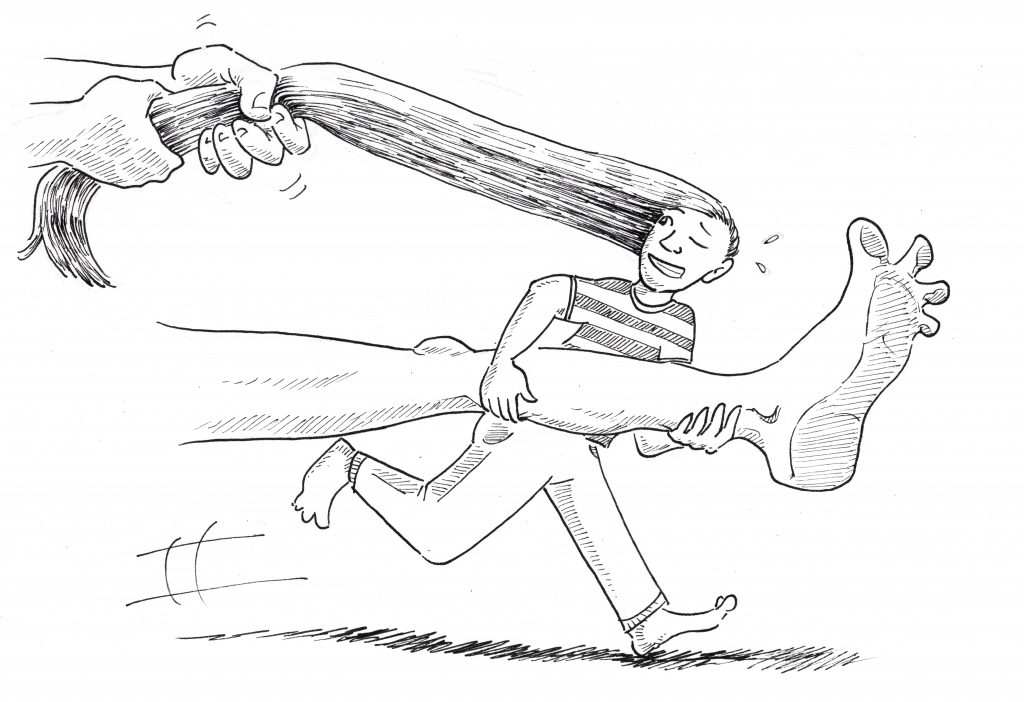
<div id="attachment_29376" style="width: 570px" class="wp-caption aligncenter"><img loading="lazy" decoding="async" aria-describedby="caption-attachment-29376" class="wp-image-29376" src="https://www.oh-i-see.com/blog/wp-content/uploads/2017/09/20170917-love-of-ocean-8-1024x702.jpg" alt="A cartoon of a woman pulling a leg and hands grabbing her hair, showing how visual wordplay with Spanish and English proverbs tickles the bilingual brain. (image © Eva Boynton)." width="560" height="384" srcset="https://www.oh-i-see.com/blog/wp-content/uploads/2017/09/20170917-love-of-ocean-8-1024x702.jpg 1024w, https://www.oh-i-see.com/blog/wp-content/uploads/2017/09/20170917-love-of-ocean-8-300x206.jpg 300w, https://www.oh-i-see.com/blog/wp-content/uploads/2017/09/20170917-love-of-ocean-8-768x526.jpg 768w, https://www.oh-i-see.com/blog/wp-content/uploads/2017/09/20170917-love-of-ocean-8-207x142.jpg 207w" sizes="auto, (max-width: 560px) 100vw, 560px" /><p id="caption-attachment-29376" class="wp-caption-text">&#8220;Ouch! You&#8217;re pulling my leg!&#8221;<br /><em>&#8220;¡Ay!</em> <em>¡Me</em> <em>estás tomando el pelo!&#8221;</em> (&#8220;Ouch! You&#8217;re grabbing my hair!&#8221;)<br />© drawing by Eva Boynton</p></div>
<h2>Spanish and English Proverbs in Pictures</h2>
<p>While living in Mexico, I heard phrases whose literal translations created odd visual images for me and confused my developing bilingual brain. For example: <em>&#8220;Me estás tomando el pelo!&#8221; </em>(You are grabbing my hair!&#8221;). My initial bewildered response? I checked to see if my hands were minding their business at my side.</p>
<p>With further explanation, I soon understood that such strange phrases were <em>proverbios y refranes</em> (proverbs and sayings), wise and colorful ways to make a point. In this case: &#8220;You are pulling my leg.&#8221;</p>
<p>As I started collecting Spanish proverbs, something else began to appear.  <strong>Oh, I saw</strong> that the essence of a proverb often translates from language to language even when the metaphors and imagery vary.</p>
<p>For me, someone who thinks visually, these proverbs were waiting to be translated into cartoonish illustrations that bring their wordplay to life.</p>
<h4>1. Together is Always Better</h4>
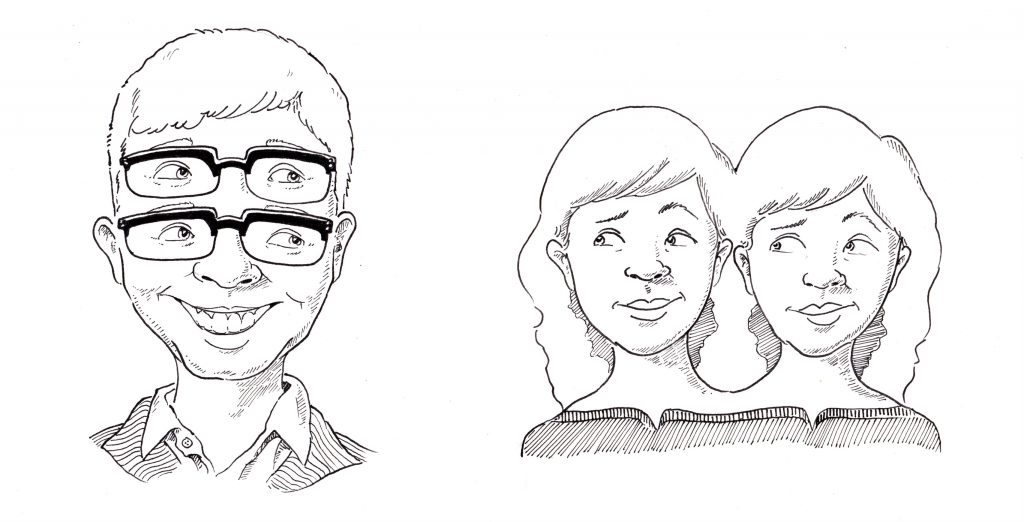
<p>Proverbs and sayings state a general truth and often offer advice metaphorically. Has anyone ever told you, &#8220;Two heads are better than one&#8221;?</p>
<div id="attachment_29336" style="width: 570px" class="wp-caption aligncenter"><img loading="lazy" decoding="async" aria-describedby="caption-attachment-29336" class="wp-image-29336 size-large" src="https://www.oh-i-see.com/blog/wp-content/uploads/2017/09/dos-ojos-1024x522.jpg" alt="A cartoon of a man with four eyes and a woman with two heads, illustrating how visual wordplay with Spanish and English proverbs tickles the bilingual brain. (image © Eva Boynton)." width="560" height="285" srcset="https://www.oh-i-see.com/blog/wp-content/uploads/2017/09/dos-ojos-1024x522.jpg 1024w, https://www.oh-i-see.com/blog/wp-content/uploads/2017/09/dos-ojos-300x153.jpg 300w, https://www.oh-i-see.com/blog/wp-content/uploads/2017/09/dos-ojos-768x392.jpg 768w, https://www.oh-i-see.com/blog/wp-content/uploads/2017/09/dos-ojos-207x106.jpg 207w" sizes="auto, (max-width: 560px) 100vw, 560px" /><p id="caption-attachment-29336" class="wp-caption-text">There&#8217;s something different about this guy . . .<br />© drawing by Eva Boynton</p></div>
<p>How about the Spanish equivalent: <em>&#8220;</em><em>Cuatro ojos ven mas que dos&#8221; </em>(&#8220;Four eyes see more than two&#8221;)? Whether there&#8217;s an extra head or more than two eyes, collaborating with others always helps to solve problems.</p>
<h4>2. You Can&#8217;t Hide What&#8217;s Inside</h4>
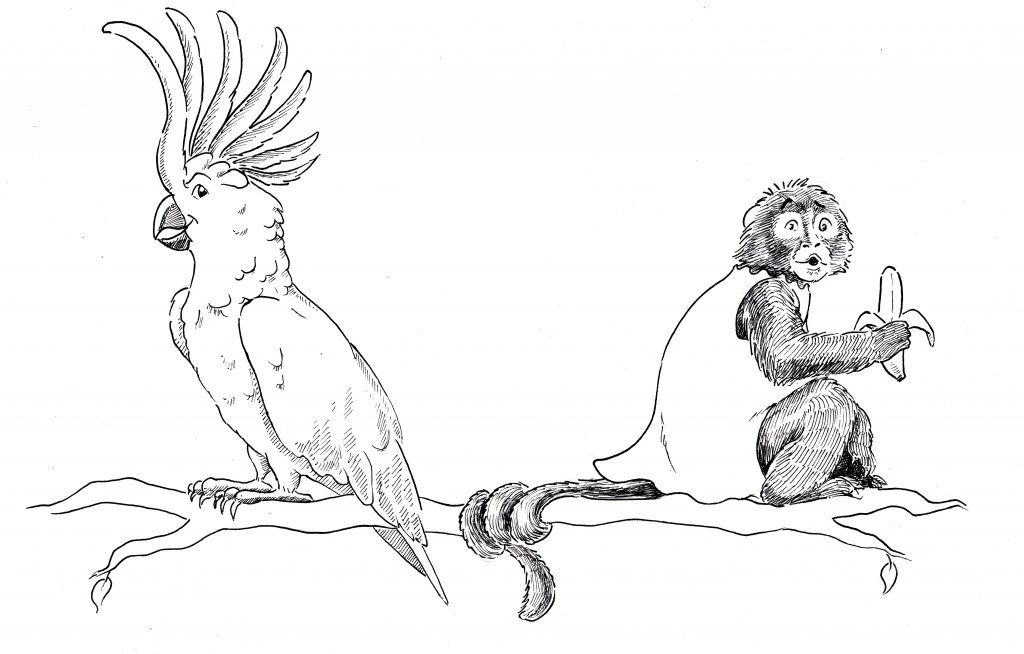
<p>Whether in Spanish or English, proverbs represent values people hold. They reflect shared experience and the wisdom that arises from it. For example, &#8220;Fine feathers don&#8217;t make fine birds&#8221; communicate that it&#8217;s not the elegant coat and shiny earrings that define a person, but rather what is underneath.</p>
<div id="attachment_29404" style="width: 570px" class="wp-caption aligncenter"><img loading="lazy" decoding="async" aria-describedby="caption-attachment-29404" class="wp-image-29404 size-large" src="https://www.oh-i-see.com/blog/wp-content/uploads/2017/09/Fine-feathers-1024x654.jpg" alt="A cartoon of a cockatoo and a monkey with a silk dress sitting on a branch, illustrating how visual wordplay with Spanish and English proverbs tickles the bilingual brain. (image © Eva Boynton)." width="560" height="358" srcset="https://www.oh-i-see.com/blog/wp-content/uploads/2017/09/Fine-feathers-1024x654.jpg 1024w, https://www.oh-i-see.com/blog/wp-content/uploads/2017/09/Fine-feathers-300x192.jpg 300w, https://www.oh-i-see.com/blog/wp-content/uploads/2017/09/Fine-feathers-768x490.jpg 768w, https://www.oh-i-see.com/blog/wp-content/uploads/2017/09/Fine-feathers-207x132.jpg 207w" sizes="auto, (max-width: 560px) 100vw, 560px" /><p id="caption-attachment-29404" class="wp-caption-text">What banana?<br />© drawing by Eva Boynton</p></div>
<p>In Spanish, the feathers metaphor takes on a different form:<em> Aunque la mona se vista de seda, mona se queda </em>(&#8220;Although the monkey is dressed in silk, she remains a monkey&#8221;). The true nature and that fuzzy monkey tail cannot be hidden by silken decoration.</p>
<h4>3. Pay Attention or Learn Your Lesson</h4>
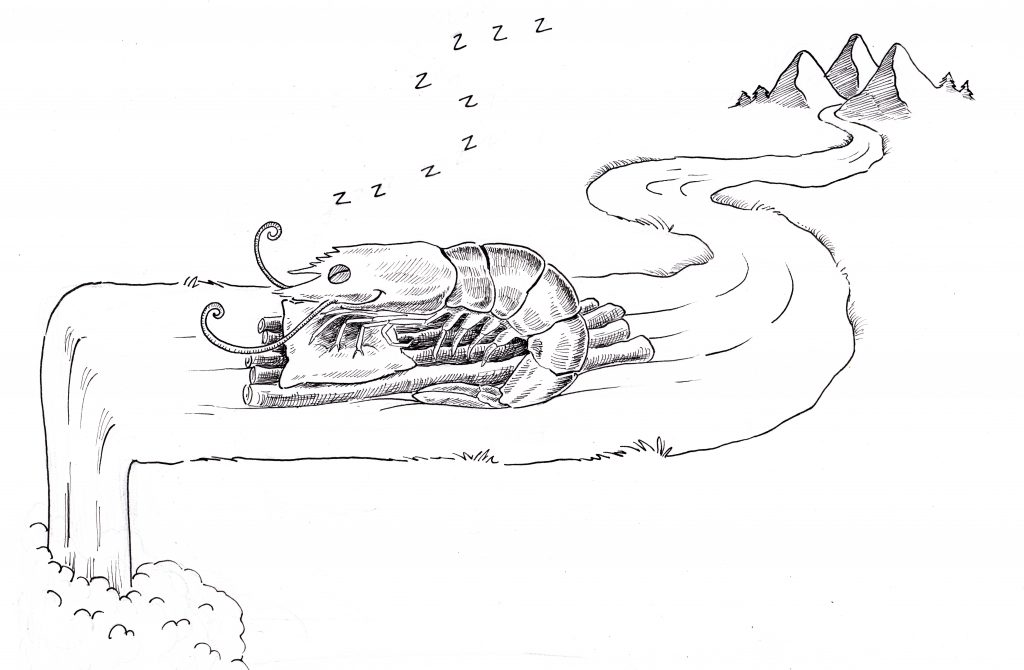
<p>Proverbs and sayings touch every aspect of life. &#8220;You snooze you lose,&#8221; said a man who quickly slipped into <em>my</em> parking spot. That jolted me into the present after being distracted by a pretty view. The proverb had it right with its warning not to hesitate and miss an opportunity.</p>
<div id="attachment_29340" style="width: 570px" class="wp-caption aligncenter"><img loading="lazy" decoding="async" aria-describedby="caption-attachment-29340" class="wp-image-29340 size-large" src="https://www.oh-i-see.com/blog/wp-content/uploads/2017/09/20170917-love-of-ocean-3-1024x670.jpg" alt="A cartoon of a shrimp sleeping on a raft going down a stream, illustrating how visual wordplay with Spanish and English proverbs tickles the bilingual brain. (image © Eva Boynton)." width="560" height="366" srcset="https://www.oh-i-see.com/blog/wp-content/uploads/2017/09/20170917-love-of-ocean-3-1024x670.jpg 1024w, https://www.oh-i-see.com/blog/wp-content/uploads/2017/09/20170917-love-of-ocean-3-300x196.jpg 300w, https://www.oh-i-see.com/blog/wp-content/uploads/2017/09/20170917-love-of-ocean-3-768x503.jpg 768w, https://www.oh-i-see.com/blog/wp-content/uploads/2017/09/20170917-love-of-ocean-3-207x135.jpg 207w" sizes="auto, (max-width: 560px) 100vw, 560px" /><p id="caption-attachment-29340" class="wp-caption-text">Zzzz..nothing to worry about&#8230;zzzz<br />© drawing by Eva Boynton</p></div>
<p>Maybe the raft is incredibly comfortable, but this shrimp is about to learn the same lesson&#8212;in Spanish: <em>&#8220;</em><em>Camarón que se duerme se lo lleva la corriente&#8221;</em> (&#8220;A sleeping shrimp gets carried away by the current&#8221;)<em>. </em></p>
<h4>4. Beware of Musical Chairs</h4>
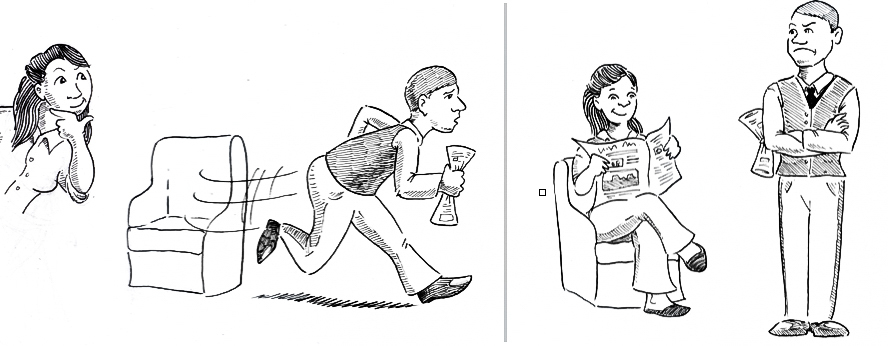
<p>There are many English and Spanish proverbs with warnings about losing something you already have. In Spanish, <em>&#8220;</em><em>El que se fue a Sevilla, perdió su silla&#8221;</em> (&#8220;He who left for the town of Sevilla, lost his seat.&#8221;) is a good reminder to pay attention.</p>
<div id="attachment_29421" style="width: 570px" class="wp-caption aligncenter"><img loading="lazy" decoding="async" aria-describedby="caption-attachment-29421" class="wp-image-29421" src="https://www.oh-i-see.com/blog/wp-content/uploads/2017/09/20170919-20170919-Screen-Shot-2017-09-19-at-6.14.31-PM.jpg" alt="A cartoon strip of a woman taking the chair of a man who left his seat, showing how visual wordplay with Spanish and English proverbs tickles the bilingual brain. (image © Eva Boynton)." width="560" height="218" srcset="https://www.oh-i-see.com/blog/wp-content/uploads/2017/09/20170919-20170919-Screen-Shot-2017-09-19-at-6.14.31-PM.jpg 888w, https://www.oh-i-see.com/blog/wp-content/uploads/2017/09/20170919-20170919-Screen-Shot-2017-09-19-at-6.14.31-PM-300x117.jpg 300w, https://www.oh-i-see.com/blog/wp-content/uploads/2017/09/20170919-20170919-Screen-Shot-2017-09-19-at-6.14.31-PM-768x299.jpg 768w, https://www.oh-i-see.com/blog/wp-content/uploads/2017/09/20170919-20170919-Screen-Shot-2017-09-19-at-6.14.31-PM-207x81.jpg 207w" sizes="auto, (max-width: 560px) 100vw, 560px" /><p id="caption-attachment-29421" class="wp-caption-text">I was only gone ONE minute!<br />© drawing by Eva Boynton</p></div>
<p>Not all proverbs are a beautiful slice of wisdom. Sometimes they can be sarcastic, to the point, and biting. If someone took my seat and chanted,  &#8220;Finders keepers, losers weepers,&#8221; I would most likely furrow my brow, cross my arms, and . . .</p>
<h4>5. What Looks Nice Sometimes Bites</h4>
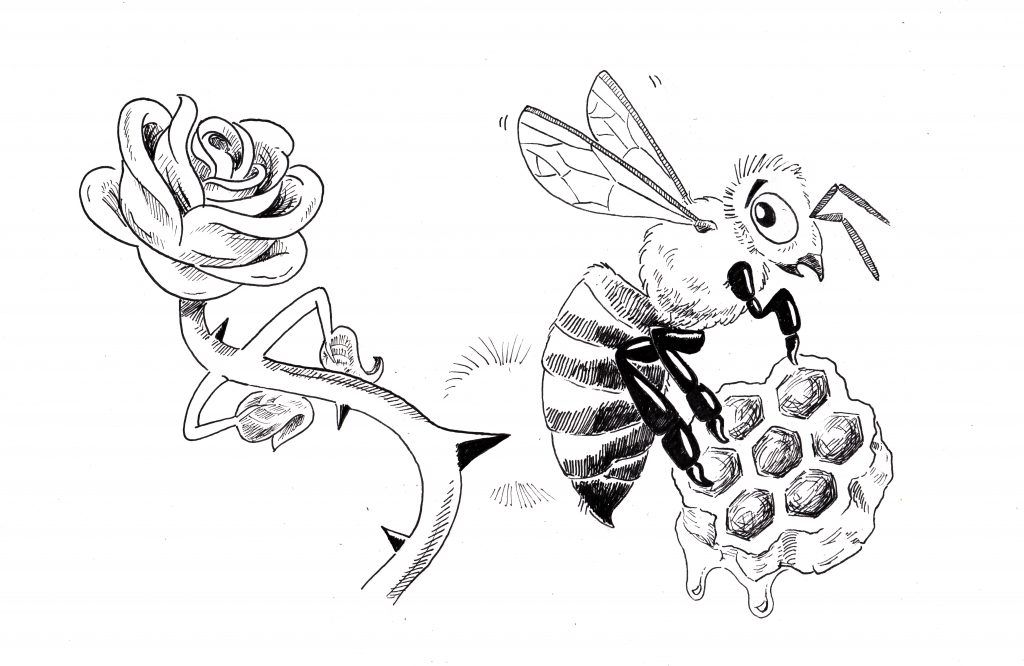
<p>&#8220;Every rose has its thorn . . . every cowboy sings his sad, sad, song&#8221; is more than a couple of lines from an eighties song by the band Poison. &#8220;Every rose has its thorn&#8221; is also a famous proverb with advice on the nature of things&#8212;something that appears beautiful and perfect can have its sharp side.</p>
<div id="attachment_29406" style="width: 570px" class="wp-caption aligncenter"><img loading="lazy" decoding="async" aria-describedby="caption-attachment-29406" class="wp-image-29406 size-large" src="https://www.oh-i-see.com/blog/wp-content/uploads/2017/09/Rose-thornsJPG-1024x666.jpg" alt="A cartoon of a rose poking its thorn at a bee holding honey, showing how visual wordplay with Spanish and English proverbs tickles the bilingual brain. (image © Eva Boynton)." width="560" height="364" srcset="https://www.oh-i-see.com/blog/wp-content/uploads/2017/09/Rose-thornsJPG-1024x666.jpg 1024w, https://www.oh-i-see.com/blog/wp-content/uploads/2017/09/Rose-thornsJPG-300x195.jpg 300w, https://www.oh-i-see.com/blog/wp-content/uploads/2017/09/Rose-thornsJPG-768x500.jpg 768w, https://www.oh-i-see.com/blog/wp-content/uploads/2017/09/Rose-thornsJPG-207x135.jpg 207w" sizes="auto, (max-width: 560px) 100vw, 560px" /><p id="caption-attachment-29406" class="wp-caption-text">And I thought you smelled nice!<br />© drawing by Eva Boynton</p></div>
<p>When I asked my husband for an example of the proverb in Spanish,<em> </em>he came up with,<em> &#8220;Hasta las abejas que tienen miel, tienen aguijón&#8221;</em> (&#8220;Even bees with honey have stingers&#8221;). He smiled and elaborated in Spanglish, &#8220;You are sweet and cute, <em>pero cuando te enojas, tienes aguijón&#8221;</em> (but when you are angry, you have a stinger). Perfect, I wrote that one down.</p>
<p>As my pen marked the page, I wondered about the significance of a rose versus a bee. What might the choice say about the culture or the language?</p>
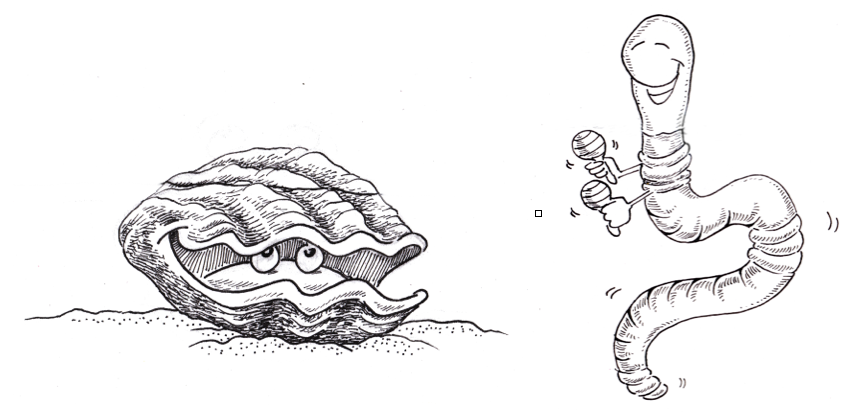
<p>If you have a bilingual brain, try out some <em>bi-visual </em>wordplay of your own. You may find yourself <em>feliz como una lombriz</em> (happy as a worm) when you think in Spanish and &#8220;happy as a clam&#8221; when your clever brain turns to English<em>. </em>And please share the bilingual proverbs you come up with in the Comments.</p>
<div id="attachment_29418" style="width: 423px" class="wp-caption aligncenter"><img loading="lazy" decoding="async" aria-describedby="caption-attachment-29418" class="wp-image-29418" src="https://www.oh-i-see.com/blog/wp-content/uploads/2017/09/Screen-Shot-2017-09-20-at-7.05.29-PM.png" alt="A cartoon of a smiling clam and a dancing worm with maracas, showing how visual wordplay with Spanish and English proverbs tickles the bilingual brain. (image © Eva Boynton)." width="413" height="204" srcset="https://www.oh-i-see.com/blog/wp-content/uploads/2017/09/Screen-Shot-2017-09-20-at-7.05.29-PM.png 841w, https://www.oh-i-see.com/blog/wp-content/uploads/2017/09/Screen-Shot-2017-09-20-at-7.05.29-PM-300x148.png 300w, https://www.oh-i-see.com/blog/wp-content/uploads/2017/09/Screen-Shot-2017-09-20-at-7.05.29-PM-768x380.png 768w, https://www.oh-i-see.com/blog/wp-content/uploads/2017/09/Screen-Shot-2017-09-20-at-7.05.29-PM-207x102.png 207w" sizes="auto, (max-width: 413px) 100vw, 413px" /><p id="caption-attachment-29418" class="wp-caption-text">Nice maracas!<br />© drawing by Eva Boynton</p></div>
<p><i><a title="Creative Inspiration Flows In Underwater Photographs" href="#comments">Comment</a></i><em> on this post below, or inspire insight with your own OIC Moment </em><em><a href="https://www.oh-i-see.com/blog/your-oic-moments/">here</a>.</em></p>
{"id":29322,"date":"2017-11-14T03:00:37","date_gmt":"2017-11-14T11:00:37","guid":{"rendered":"http:\/\/ohisee.genweb.site\/blog\/?p=29322"},"modified":"2021-07-20T08:02:26","modified_gmt":"2021-07-20T15:02:26","slug":"visual-wordplay-for-the-bilingual-brain","status":"publish","type":"post","link":"https:\/\/www.oh-i-see.com\/blog\/visual-wordplay-for-the-bilingual-brain\/","title":{"rendered":"Visual Wordplay for the Bilingual Brain"},"content":{"rendered":"<div id=\"attachment_29376\" style=\"width: 570px\" class=\"wp-caption aligncenter\"><img loading=\"lazy\" decoding=\"async\" aria-describedby=\"caption-attachment-29376\" class=\"wp-image-29376\" src=\"https:\/\/www.oh-i-see.com\/blog\/wp-content\/uploads\/2017\/09\/20170917-love-of-ocean-8-1024x702.jpg\" alt=\"A cartoon of a woman pulling a leg and hands grabbing her hair, showing how visual wordplay with Spanish and English proverbs tickles the bilingual brain. (image \u00a9 Eva Boynton).\" width=\"560\" height=\"384\" srcset=\"https:\/\/www.oh-i-see.com\/blog\/wp-content\/uploads\/2017\/09\/20170917-love-of-ocean-8-1024x702.jpg 1024w, https:\/\/www.oh-i-see.com\/blog\/wp-content\/uploads\/2017\/09\/20170917-love-of-ocean-8-300x206.jpg 300w, https:\/\/www.oh-i-see.com\/blog\/wp-content\/uploads\/2017\/09\/20170917-love-of-ocean-8-768x526.jpg 768w, https:\/\/www.oh-i-see.com\/blog\/wp-content\/uploads\/2017\/09\/20170917-love-of-ocean-8-207x142.jpg 207w\" sizes=\"auto, (max-width: 560px) 100vw, 560px\" \/><p id=\"caption-attachment-29376\" class=\"wp-caption-text\">&#8220;Ouch! You&#8217;re pulling my leg!&#8221;<br \/><em>&#8220;\u00a1Ay!<\/em>\u00a0<em>\u00a1Me<\/em> <em>est\u00e1s tomando el pelo!&#8221;<\/em> (&#8220;Ouch! You&#8217;re grabbing my hair!&#8221;)<br \/>\u00a9 drawing by Eva Boynton<\/p><\/div>\n<h2>Spanish and English Proverbs in Pictures<\/h2>\n<p>While living in Mexico, I heard phrases whose literal translations created odd visual images for me and confused my developing bilingual brain. For example: <em>&#8220;Me est\u00e1s tomando el pelo!&#8221;\u00a0<\/em>(You are grabbing my hair!&#8221;). My initial bewildered response? I checked to see if my hands were minding their business at my side.<\/p>\n<p>With further explanation, I soon understood that such strange phrases were\u00a0<em>proverbios y\u00a0refranes<\/em> (proverbs and sayings), wise and colorful ways to make a point. In this case: &#8220;You are pulling my leg.&#8221;<\/p>\n<p>As I started collecting Spanish proverbs, something else began to appear. \u00a0<strong>Oh, I saw<\/strong>\u00a0that the essence of a proverb often translates from language to language even when the metaphors and imagery vary.<\/p>\n<p>For me, someone who thinks visually, these proverbs were waiting to be translated into cartoonish illustrations that bring their wordplay to life.<\/p>\n<h4>1. Together is Always Better<\/h4>\n<p>Proverbs and sayings state a general truth and often offer advice metaphorically. Has anyone ever told you, &#8220;Two heads are better than one&#8221;?<\/p>\n<div id=\"attachment_29336\" style=\"width: 570px\" class=\"wp-caption aligncenter\"><img loading=\"lazy\" decoding=\"async\" aria-describedby=\"caption-attachment-29336\" class=\"wp-image-29336 size-large\" src=\"https:\/\/www.oh-i-see.com\/blog\/wp-content\/uploads\/2017\/09\/dos-ojos-1024x522.jpg\" alt=\"A cartoon of a man with four eyes and a woman with two heads, illustrating how visual wordplay with Spanish and English proverbs tickles the bilingual brain. (image \u00a9 Eva Boynton).\" width=\"560\" height=\"285\" srcset=\"https:\/\/www.oh-i-see.com\/blog\/wp-content\/uploads\/2017\/09\/dos-ojos-1024x522.jpg 1024w, https:\/\/www.oh-i-see.com\/blog\/wp-content\/uploads\/2017\/09\/dos-ojos-300x153.jpg 300w, https:\/\/www.oh-i-see.com\/blog\/wp-content\/uploads\/2017\/09\/dos-ojos-768x392.jpg 768w, https:\/\/www.oh-i-see.com\/blog\/wp-content\/uploads\/2017\/09\/dos-ojos-207x106.jpg 207w\" sizes=\"auto, (max-width: 560px) 100vw, 560px\" \/><p id=\"caption-attachment-29336\" class=\"wp-caption-text\">There&#8217;s something different about this guy . . .<br \/>\u00a9 drawing by Eva Boynton<\/p><\/div>\n<p>How about the Spanish equivalent:\u00a0<em>&#8220;<\/em><em>Cuatro\u00a0ojos ven mas que dos&#8221;\u00a0<\/em>(&#8220;Four eyes see more than two&#8221;)? Whether there&#8217;s an extra head or more than two eyes, collaborating with others always helps to solve problems.<\/p>\n<h4>2. You Can&#8217;t Hide What&#8217;s Inside<\/h4>\n<p>Whether in Spanish or English, proverbs represent values people hold. They reflect shared experience and the wisdom that arises from it. For example, &#8220;Fine feathers don&#8217;t make fine birds&#8221; communicate that\u00a0it&#8217;s not the elegant coat and shiny earrings that define a person, but rather what is underneath.<\/p>\n<div id=\"attachment_29404\" style=\"width: 570px\" class=\"wp-caption aligncenter\"><img loading=\"lazy\" decoding=\"async\" aria-describedby=\"caption-attachment-29404\" class=\"wp-image-29404 size-large\" src=\"https:\/\/www.oh-i-see.com\/blog\/wp-content\/uploads\/2017\/09\/Fine-feathers-1024x654.jpg\" alt=\"A cartoon of a cockatoo and a monkey with a silk dress sitting on a branch, illustrating how visual wordplay with Spanish and English proverbs tickles the bilingual brain. (image \u00a9 Eva Boynton).\" width=\"560\" height=\"358\" srcset=\"https:\/\/www.oh-i-see.com\/blog\/wp-content\/uploads\/2017\/09\/Fine-feathers-1024x654.jpg 1024w, https:\/\/www.oh-i-see.com\/blog\/wp-content\/uploads\/2017\/09\/Fine-feathers-300x192.jpg 300w, https:\/\/www.oh-i-see.com\/blog\/wp-content\/uploads\/2017\/09\/Fine-feathers-768x490.jpg 768w, https:\/\/www.oh-i-see.com\/blog\/wp-content\/uploads\/2017\/09\/Fine-feathers-207x132.jpg 207w\" sizes=\"auto, (max-width: 560px) 100vw, 560px\" \/><p id=\"caption-attachment-29404\" class=\"wp-caption-text\">What banana?<br \/>\u00a9 drawing by Eva Boynton<\/p><\/div>\n<p>In Spanish, the feathers metaphor takes on a different form:<em>\u00a0Aunque\u00a0la mona se vista de seda, mona se queda\u00a0<\/em>(&#8220;Although the monkey is dressed in silk, she remains a monkey&#8221;). The true nature and that fuzzy monkey tail cannot be hidden by silken decoration.<\/p>\n<h4>3. Pay Attention or Learn Your Lesson<\/h4>\n<p>Proverbs and sayings touch every aspect of life. &#8220;You snooze you lose,&#8221; said a man who quickly slipped into\u00a0<em>my<\/em> parking spot. That jolted me into the present after being distracted by a pretty view. The proverb had it right with its warning not to hesitate and miss an opportunity.<\/p>\n<div id=\"attachment_29340\" style=\"width: 570px\" class=\"wp-caption aligncenter\"><img loading=\"lazy\" decoding=\"async\" aria-describedby=\"caption-attachment-29340\" class=\"wp-image-29340 size-large\" src=\"https:\/\/www.oh-i-see.com\/blog\/wp-content\/uploads\/2017\/09\/20170917-love-of-ocean-3-1024x670.jpg\" alt=\"A cartoon of a shrimp sleeping on a raft going down a stream, illustrating how visual wordplay with Spanish and English proverbs tickles the bilingual brain. (image \u00a9 Eva Boynton).\" width=\"560\" height=\"366\" srcset=\"https:\/\/www.oh-i-see.com\/blog\/wp-content\/uploads\/2017\/09\/20170917-love-of-ocean-3-1024x670.jpg 1024w, https:\/\/www.oh-i-see.com\/blog\/wp-content\/uploads\/2017\/09\/20170917-love-of-ocean-3-300x196.jpg 300w, https:\/\/www.oh-i-see.com\/blog\/wp-content\/uploads\/2017\/09\/20170917-love-of-ocean-3-768x503.jpg 768w, https:\/\/www.oh-i-see.com\/blog\/wp-content\/uploads\/2017\/09\/20170917-love-of-ocean-3-207x135.jpg 207w\" sizes=\"auto, (max-width: 560px) 100vw, 560px\" \/><p id=\"caption-attachment-29340\" class=\"wp-caption-text\">Zzzz..nothing to worry about&#8230;zzzz<br \/>\u00a9 drawing by Eva Boynton<\/p><\/div>\n<p>Maybe the raft is incredibly comfortable, but this shrimp is about to learn the same lesson&#8212;in Spanish: <em>&#8220;<\/em><em>Camar\u00f3n que se duerme\u00a0se lo lleva\u00a0la corriente&#8221;<\/em>\u00a0(&#8220;A sleeping shrimp gets carried away by the current&#8221;)<em>.\u00a0<\/em><\/p>\n<h4>4. Beware of Musical Chairs<\/h4>\n<p>There are many English and Spanish proverbs with warnings about losing something you already have. In Spanish, <em>&#8220;<\/em><em>El que se fue a Sevilla, perdi\u00f3 su silla&#8221;<\/em>\u00a0(&#8220;He who left for the town of Sevilla, lost his seat.&#8221;) is a good reminder to pay attention.<\/p>\n<div id=\"attachment_29421\" style=\"width: 570px\" class=\"wp-caption aligncenter\"><img loading=\"lazy\" decoding=\"async\" aria-describedby=\"caption-attachment-29421\" class=\"wp-image-29421\" src=\"https:\/\/www.oh-i-see.com\/blog\/wp-content\/uploads\/2017\/09\/20170919-20170919-Screen-Shot-2017-09-19-at-6.14.31-PM.jpg\" alt=\"A cartoon strip of a woman taking the chair of a man who left his seat, showing how visual wordplay with Spanish and English proverbs tickles the bilingual brain. (image \u00a9 Eva Boynton).\" width=\"560\" height=\"218\" srcset=\"https:\/\/www.oh-i-see.com\/blog\/wp-content\/uploads\/2017\/09\/20170919-20170919-Screen-Shot-2017-09-19-at-6.14.31-PM.jpg 888w, https:\/\/www.oh-i-see.com\/blog\/wp-content\/uploads\/2017\/09\/20170919-20170919-Screen-Shot-2017-09-19-at-6.14.31-PM-300x117.jpg 300w, https:\/\/www.oh-i-see.com\/blog\/wp-content\/uploads\/2017\/09\/20170919-20170919-Screen-Shot-2017-09-19-at-6.14.31-PM-768x299.jpg 768w, https:\/\/www.oh-i-see.com\/blog\/wp-content\/uploads\/2017\/09\/20170919-20170919-Screen-Shot-2017-09-19-at-6.14.31-PM-207x81.jpg 207w\" sizes=\"auto, (max-width: 560px) 100vw, 560px\" \/><p id=\"caption-attachment-29421\" class=\"wp-caption-text\">I was only gone ONE minute!<br \/>\u00a9 drawing by Eva Boynton<\/p><\/div>\n<p>Not all proverbs are a beautiful slice of wisdom. Sometimes they can be sarcastic, to the point, and biting. If someone took my seat and chanted, \u00a0&#8220;Finders keepers, losers weepers,&#8221; I would most likely furrow my brow, cross my arms, and . . .<\/p>\n<h4>5. What Looks Nice Sometimes Bites<\/h4>\n<p>&#8220;Every rose has its thorn . . . every cowboy sings his sad, sad, song&#8221;\u00a0is more than a couple of lines from an eighties song by the band Poison. &#8220;Every rose has its thorn&#8221; is also a famous proverb with advice on the nature of things&#8212;something that appears beautiful and perfect can have its sharp side.<\/p>\n<div id=\"attachment_29406\" style=\"width: 570px\" class=\"wp-caption aligncenter\"><img loading=\"lazy\" decoding=\"async\" aria-describedby=\"caption-attachment-29406\" class=\"wp-image-29406 size-large\" src=\"https:\/\/www.oh-i-see.com\/blog\/wp-content\/uploads\/2017\/09\/Rose-thornsJPG-1024x666.jpg\" alt=\"A cartoon of a rose poking its thorn at a bee holding honey, showing how visual wordplay with Spanish and English proverbs tickles the bilingual brain. (image \u00a9 Eva Boynton).\" width=\"560\" height=\"364\" srcset=\"https:\/\/www.oh-i-see.com\/blog\/wp-content\/uploads\/2017\/09\/Rose-thornsJPG-1024x666.jpg 1024w, https:\/\/www.oh-i-see.com\/blog\/wp-content\/uploads\/2017\/09\/Rose-thornsJPG-300x195.jpg 300w, https:\/\/www.oh-i-see.com\/blog\/wp-content\/uploads\/2017\/09\/Rose-thornsJPG-768x500.jpg 768w, https:\/\/www.oh-i-see.com\/blog\/wp-content\/uploads\/2017\/09\/Rose-thornsJPG-207x135.jpg 207w\" sizes=\"auto, (max-width: 560px) 100vw, 560px\" \/><p id=\"caption-attachment-29406\" class=\"wp-caption-text\">And I thought you smelled nice!<br \/>\u00a9 drawing by Eva Boynton<\/p><\/div>\n<p>When I asked my husband for an example of the proverb in Spanish,<em>\u00a0<\/em>he came up with,<em> &#8220;Hasta las abejas que tienen miel, tienen\u00a0aguij\u00f3n&#8221;<\/em> (&#8220;Even bees with honey have stingers&#8221;). He smiled and elaborated in Spanglish, &#8220;You are sweet and cute,\u00a0<em>pero cuando\u00a0te\u00a0enojas, tienes aguij\u00f3n&#8221;<\/em> (but when you are angry, you have a stinger). Perfect, I wrote that one down.<\/p>\n<p>As my pen marked the page, I wondered about the significance of a rose versus a bee. What might the choice say about the culture or the language?<\/p>\n<p>If you have a bilingual brain, try out some <em>bi-visual <\/em>wordplay of your own.\u00a0You may find yourself <em>feliz como una\u00a0lombriz<\/em>\u00a0(happy as a worm) when you think in Spanish and &#8220;happy as a clam&#8221; when your clever brain turns to English<em>. <\/em>And please share the bilingual proverbs you come up with in the Comments.<\/p>\n<div id=\"attachment_29418\" style=\"width: 423px\" class=\"wp-caption aligncenter\"><img loading=\"lazy\" decoding=\"async\" aria-describedby=\"caption-attachment-29418\" class=\"wp-image-29418\" src=\"https:\/\/www.oh-i-see.com\/blog\/wp-content\/uploads\/2017\/09\/Screen-Shot-2017-09-20-at-7.05.29-PM.png\" alt=\"A cartoon of a smiling clam and a dancing worm with maracas, showing how visual wordplay with Spanish and English proverbs tickles the bilingual brain. (image \u00a9 Eva Boynton).\" width=\"413\" height=\"204\" srcset=\"https:\/\/www.oh-i-see.com\/blog\/wp-content\/uploads\/2017\/09\/Screen-Shot-2017-09-20-at-7.05.29-PM.png 841w, https:\/\/www.oh-i-see.com\/blog\/wp-content\/uploads\/2017\/09\/Screen-Shot-2017-09-20-at-7.05.29-PM-300x148.png 300w, https:\/\/www.oh-i-see.com\/blog\/wp-content\/uploads\/2017\/09\/Screen-Shot-2017-09-20-at-7.05.29-PM-768x380.png 768w, https:\/\/www.oh-i-see.com\/blog\/wp-content\/uploads\/2017\/09\/Screen-Shot-2017-09-20-at-7.05.29-PM-207x102.png 207w\" sizes=\"auto, (max-width: 413px) 100vw, 413px\" \/><p id=\"caption-attachment-29418\" class=\"wp-caption-text\">Nice maracas!<br \/>\u00a9 drawing by Eva Boynton<\/p><\/div>\n<p><i><a title=\"Creative Inspiration Flows In Underwater Photographs\" href=\"#comments\">Comment<\/a><\/i><em>\u00a0on this post below, or inspire insight with your own\u00a0OIC Moment\u00a0<\/em><em><a href=\"https:\/\/www.oh-i-see.com\/blog\/your-oic-moments\/\">here<\/a>.<\/em><\/p>\n","protected":false},"excerpt":{"rendered":null,"protected":false},"author":10,"featured_media":29406,"comment_status":"closed","ping_status":"open","sticky":false,"template":"","format":"standard","meta":{"footnotes":""},"categories":[189,102,235,95],"tags":[],"class_list":["post-29322","post","type-post","status-publish","format-standard","has-post-thumbnail","hentry","category-bilingual-language","category-culture-language","category-proverbs-language","category-wordplay-language"],"aioseo_notices":[],"_links":{"self":[{"href":"https:\/\/www.oh-i-see.com\/blog\/wp-json\/wp\/v2\/posts\/29322","targetHints":{"allow":["GET"]}}],"collection":[{"href":"https:\/\/www.oh-i-see.com\/blog\/wp-json\/wp\/v2\/posts"}],"about":[{"href":"https:\/\/www.oh-i-see.com\/blog\/wp-json\/wp\/v2\/types\/post"}],"author":[{"embeddable":true,"href":"https:\/\/www.oh-i-see.com\/blog\/wp-json\/wp\/v2\/users\/10"}],"replies":[{"embeddable":true,"href":"https:\/\/www.oh-i-see.com\/blog\/wp-json\/wp\/v2\/comments?post=29322"}],"version-history":[{"count":88,"href":"https:\/\/www.oh-i-see.com\/blog\/wp-json\/wp\/v2\/posts\/29322\/revisions"}],"predecessor-version":[{"id":31756,"href":"https:\/\/www.oh-i-see.com\/blog\/wp-json\/wp\/v2\/posts\/29322\/revisions\/31756"}],"wp:featuredmedia":[{"embeddable":true,"href":"https:\/\/www.oh-i-see.com\/blog\/wp-json\/wp\/v2\/media\/29406"}],"wp:attachment":[{"href":"https:\/\/www.oh-i-see.com\/blog\/wp-json\/wp\/v2\/media?parent=29322"}],"wp:term":[{"taxonomy":"category","embeddable":true,"href":"https:\/\/www.oh-i-see.com\/blog\/wp-json\/wp\/v2\/categories?post=29322"},{"taxonomy":"post_tag","embeddable":true,"href":"https:\/\/www.oh-i-see.com\/blog\/wp-json\/wp\/v2\/tags?post=29322"}],"curies":[{"name":"wp","href":"https:\/\/api.w.org\/{rel}","templated":true}]}}