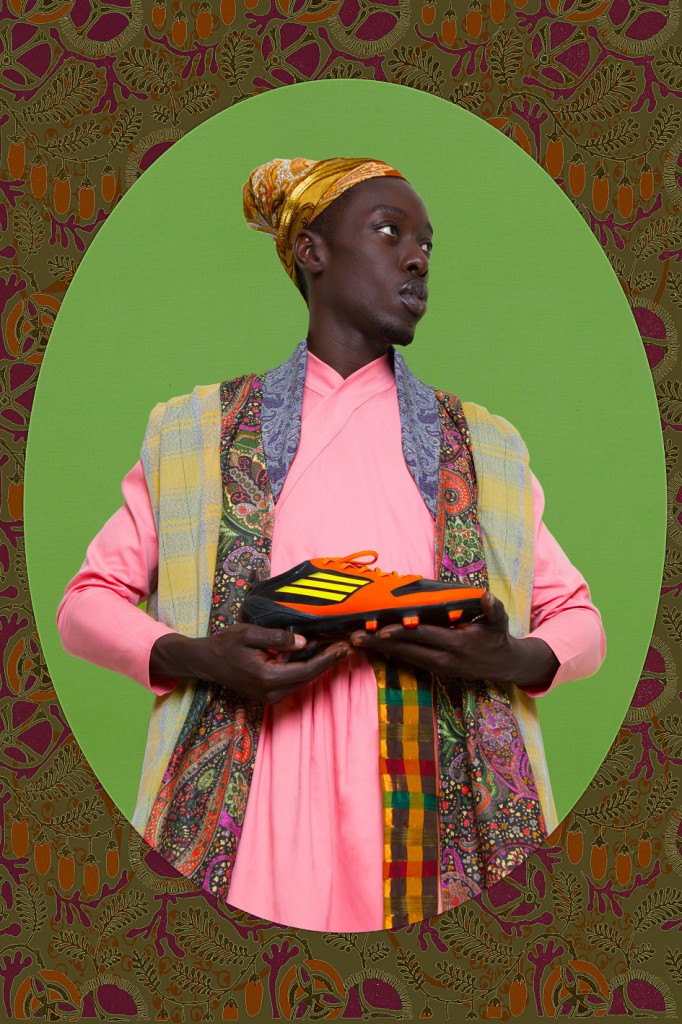
Ikhlas Khan, from the Diaspora series, 2015
© Omar Victor Diop. Courtesy Galerie MAGNIN-A, Paris
Ikhlas Khan, from the Diaspora series, 2015
© Omar Victor Diop. Courtesy Galerie MAGNIN-A, Paris
The room is alive with cultural history. The photographs exhibited in the Grande Halle of the Rencontres d’Arles are rich in texture and color. The historic African figures are presented formally, elegantly, powerfully. Their pride shines through.
As the photographer Omar Victor Diop explains, “They seem to say, ‘Look at me. I was here. I did this.’”
The portrait photography in Diop’s exhibit “Diaspora,” which recently opened at the Arles festival of photography, transports us to another time. The images are not just a sensory journey into the cultural history of Africa, but are also a making of history of the artistic kind. The 34-year-old artist has something compelling to say.
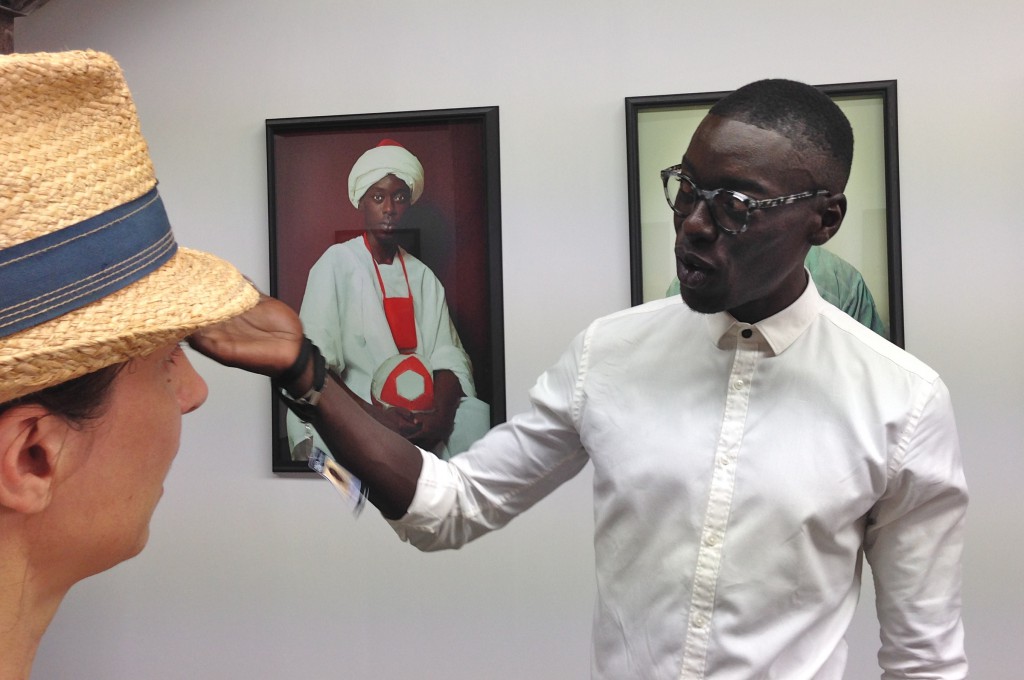
Omar Victor Diop at the opening of Diaspora at the Rencontres d’Arles in France
© Meredith Mullins
What do the subjects of Diaspora—Jean-Baptiste Belley, Ikhlas Khan, Frederick Douglass, Dom Nicolau, and August Sabac El Cher—have in common?
“Most of them were born into or sold into slavery,” Diop points out. “They all managed to be very influential—in areas that were not ready for them, with people who did not recognize them even as human beings. These men transformed the negative into something positive that lasted throughout the century.”
These historic figures are not particularly well known. Diop had not even heard of them before he began his research, although some were born not far from his home in Senegal.
He dove into history to find these “exotic others” and then embarked on an art history journey to find the original artworks that immortalized them (created from the 15th to 19th centuries).
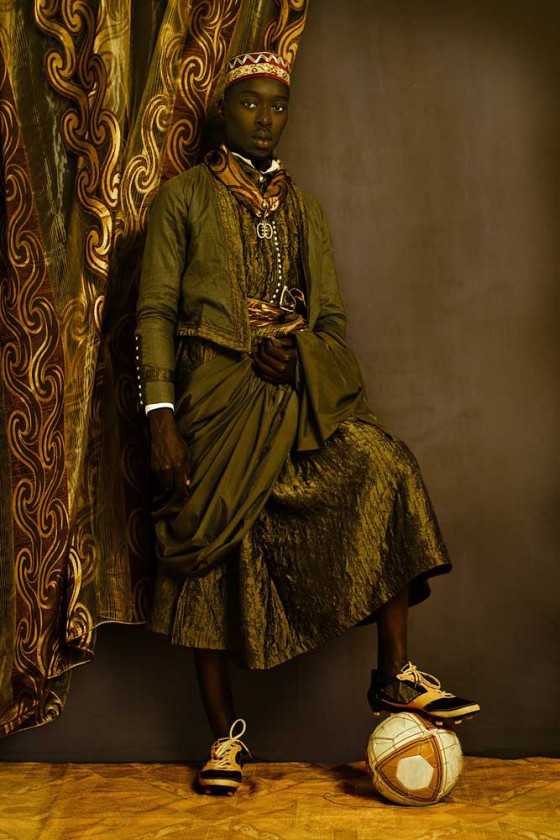
Dom Nicolau, 2014/Série Diaspora
© Omar Victor Diop. Courtesy Galerie MAGNIN-A, Paris
The subjects range from Dom Nicolau, Prince of Kongo (known for his public protest of colonialism) to Juan de Pareja, a slave in the household and workshop of the painter Velázquez (painted by Velázquez around the time de Pareja was granted his freedom).
And from Ayuba Suleiman Diallo (author of one of the earliest slave narratives), to Frederick Douglass (a leader of the abolitionist movement in America and the first African American to be nominated for Vice President of the Unites States).
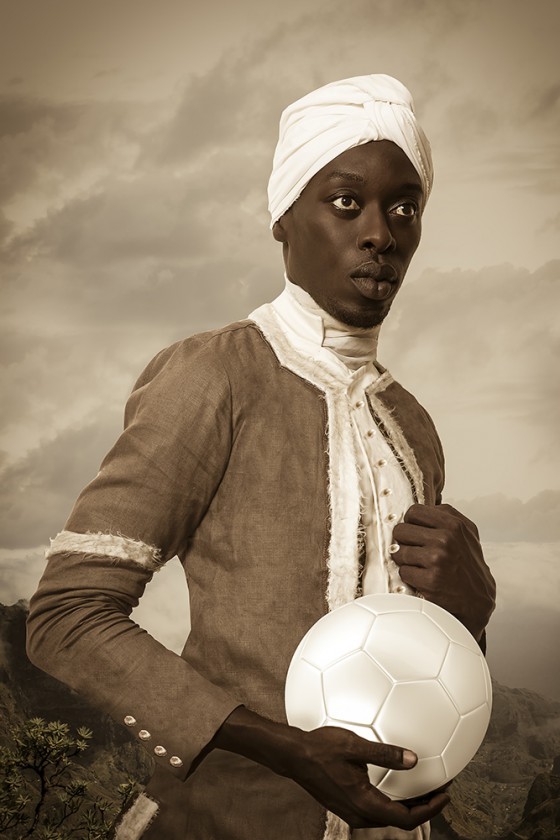
Angelo Soliman, 2014/Série Diaspora
© Omar Victor Diop. Courtesy Galerie MAGNIN-A, Paris
When we look closely, we find that the photographs have even more in common. The subjects all have the same face. Diop has transformed himself into these historic figures, while he mirrors the original artwork in costume and style.
As he worked alone in the studio to make these images, he admits to feeling as if he were having a conversation with each subject.
“I felt very emotional at times, as if the historic figure was there with me. Each session felt like a prayer. These stories were beautiful enough that they had to be told and shown.”
Of all his Diaspora subjects, Diop feels closest to Jean-Baptiste Belley. Belley was born on the island of Gorée, only two kilometers away from Diop’s birthplace.
Belley was sent to the French West Indies as a slave, but managed to buy his freedom and moved to France.
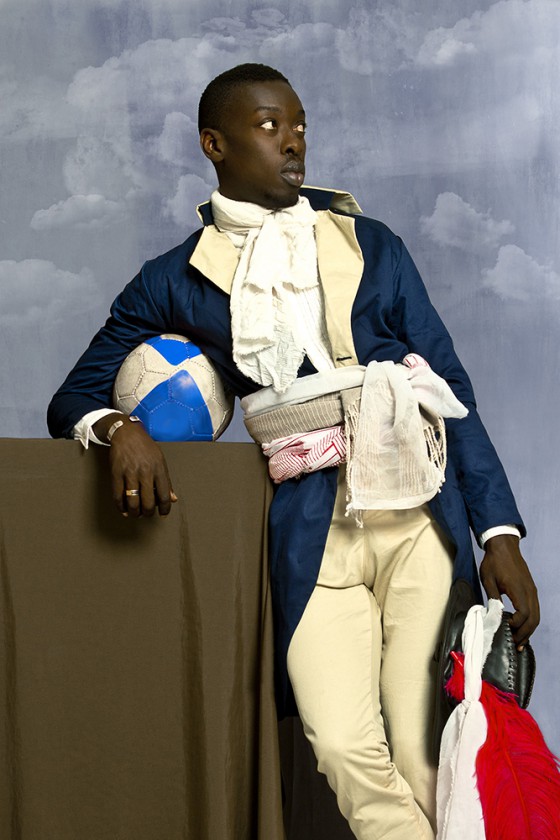
Jean-Baptiste Belley, 2014/Série Diaspora
© Omar Victor Diop. Courtesy Galerie MAGNIN-A, Paris
Diop adds to the story, “In France, he was a member of the National Convention and a part of the revolution Dream Team who gave birth to the French Republic. Very few people know about Belley. Not in France. Not in Senegal.”
“He wanted a better world and fought for it,” Diop continues, with reverence and respect. “He was enslaved by the same people for whom he later fought. The story deserves to be told . . . as often as possible.”
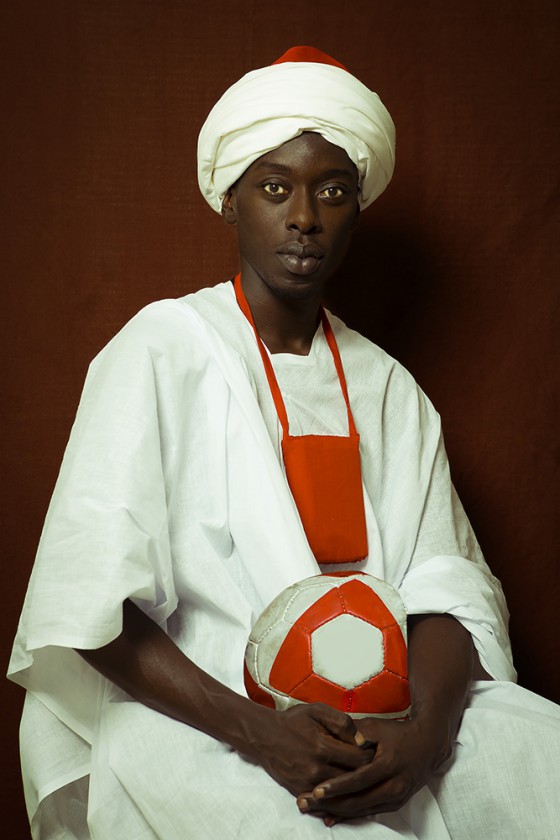
Ayuba Suleiman Diallo, 2014/Série Diaspora
© Omar Victor Diop. Courtesy Galerie MAGNIN-A, Paris
When we take one more close look, we see that each photograph also has a subtle connection to soccer (football)—a ball, a shoe, a referee’s whistle, a glove.
Diop uses these elements to provide a common contemporary thread to unify the original artwork, which crossed several centuries.
More important, he sees a similarity between these historic heroes and the African soccer players.
Just as the heroes of the past achieved glory and recognition, so do the soccer players of today. And, just as these historic figures suffered from racism, so too do the players of today.
“With soccer players, there is a very interesting blend of glory, hero-worship and exclusion,” Diop explains. “Every so often, you get racist chants or banana skins thrown on the pitch and the whole illusion of integration is shattered in the most brutal way.”
We are reminded of the past and the present.
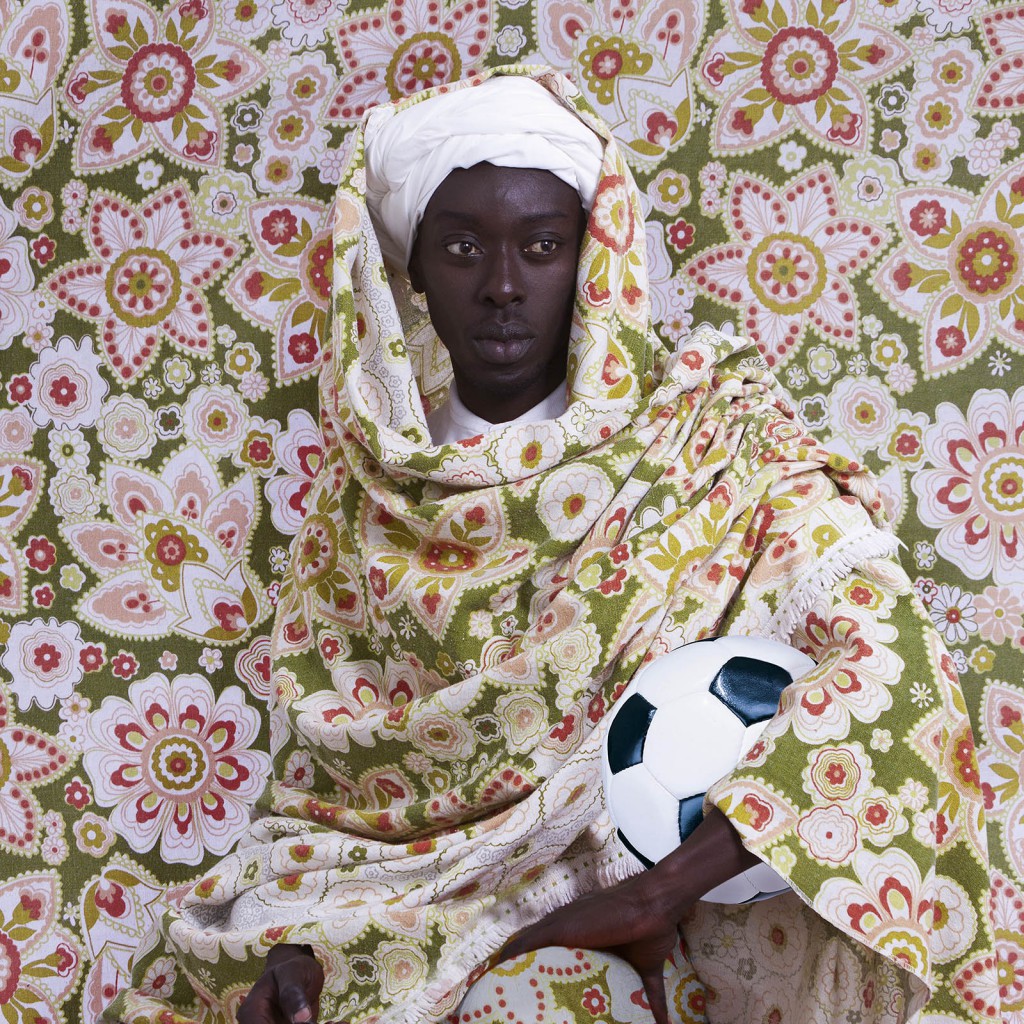
El Moro, 2014/Série Diaspora
© Omar Victor Diop. Courtesy Galerie MAGNIN-A, Paris
What is in the future for this thoughtful young artist? What projects come next after his memorable portrait photography exploring the cultural history of Africa?
“My goal is to leave a body of work that has the ability to speak to everyone,” Diop says and adds that he doesn’t mean to sound pretentious. “Of course I’m African. I’m a proud African. But I’m curious about the rest of the world. I want to be influenced by different societies and contexts.”
He sums it up simply and powerfully: “It’s all about celebrating humanity. It’s about what binds us together.”
As an artist (and a humanist), Diop has wisdom way beyond his years.
Omar Victor Diop‘s exhibit at the Rencontres d’Arles is open through September 20. His work can also be seen at the Galerie MAGNIN-A in Paris and at PhotoQuai, sponsored by the Musée Quai Branly (beginning 22 September).
Comment on this post below, or inspire insight with your own OIC Moment here.
{"id":23305,"date":"2015-07-20T03:00:35","date_gmt":"2015-07-20T10:00:35","guid":{"rendered":"http:\/\/ohisee.genweb.site\/blog\/?p=23305"},"modified":"2021-07-20T07:58:12","modified_gmt":"2021-07-20T14:58:12","slug":"opening-eyes-to-the-cultural-history-of-africa","status":"publish","type":"post","link":"https:\/\/www.oh-i-see.com\/blog\/opening-eyes-to-the-cultural-history-of-africa\/","title":{"rendered":"Opening Eyes to the Cultural History of Africa"},"content":{"rendered":"
Ikhlas Khan, from the Diaspora series, 2015
\u00a9 Omar Victor Diop. Courtesy Galerie MAGNIN-A, Paris<\/p><\/div>\n
The room is alive with cultural history. The photographs exhibited in the Grande Halle of the Rencontres d\u2019Arles are rich in texture and color. The historic African figures are presented formally, elegantly, powerfully. Their pride shines through.<\/p>\n
As the photographer Omar Victor Diop explains, \u201cThey seem to say, ‘Look at me. I was here. I did this.’\u201d<\/p>\n
The portrait photography in Diop\u2019s exhibit \u201cDiaspora,\u201d which recently opened at the Arles festival of photography, transports us to another time. The images are not just a sensory journey into the cultural history of Africa, but are also a making of history of the artistic kind. The 34-year-old artist has something compelling to say.<\/p>\n

Omar Victor Diop at the opening of Diaspora at the Rencontres d’Arles in France
\u00a9 Meredith Mullins<\/p><\/div>\n
What do the subjects of Diaspora\u2014Jean-Baptiste Belley, Ikhlas Khan, Frederick Douglass, Dom Nicolau, and August Sabac El Cher\u2014have in common?<\/p>\n
\u201cMost of them were born into or sold into slavery,\u201d Diop points out. \u201cThey all managed to be very influential\u2014in areas that were not ready for them, with people who did not recognize them even as human beings. These men transformed the negative into something positive that lasted throughout the century.\u201d<\/p>\n
These historic figures are not particularly well known. Diop had not even heard of them before he began his research, although some were born not far from his home in Senegal.<\/p>\n
He dove into history to find these \u201cexotic others\u201d and then embarked on an art history journey to find the original artworks that immortalized them (created from the 15th<\/sup> to 19th<\/sup> centuries).<\/p>\n Dom Nicolau, 2014\/S\u00e9rie Diaspora The subjects range from Dom Nicolau, Prince of Kongo (known for his public protest of colonialism) to Juan de Pareja, a slave in the household and workshop of the painter Vel\u00e1zquez (painted by Vel\u00e1zquez around the time de Pareja was granted his freedom).<\/p>\n And from Ayuba Suleiman Diallo (author of one of the earliest slave narratives), to Frederick Douglass (a leader of the abolitionist movement in America and the first African American to be nominated for Vice President of the Unites States).<\/p>\n Angelo Soliman, 2014\/S\u00e9rie Diaspora When we look closely, we find that the photographs have even more in common. The subjects all have the same face. Diop has transformed himself into these historic figures, while\u00a0he mirrors the original artwork in costume and style.<\/p>\n As he worked alone in the studio to make these images, he admits to feeling as if he were having a conversation with each subject.<\/p>\n \u201cI felt very emotional at times, as if the historic figure was there with me. Each session felt like a prayer. These stories were beautiful enough that they had to be told and shown.\u201d<\/p>\n Of all his Diaspora subjects, Diop feels closest to Jean-Baptiste Belley. Belley was born on the island of Gor\u00e9e, only two kilometers away from Diop\u2019s birthplace.<\/p>\n Belley was sent to the French West Indies as a slave, but managed to buy his freedom and moved to France.<\/p>\n Jean-Baptiste Belley, 2014\/S\u00e9rie Diaspora Diop adds to the story, \u201cIn France, he was a member of the National Convention and a part of the revolution Dream Team who gave birth to the French Republic. Very few people know about Belley. Not in France. Not in Senegal.\u201d<\/p>\n \u201cHe wanted a better world and fought for it,\u201d Diop continues, with reverence and respect. \u201cHe was enslaved by the same people for whom he later fought. The story deserves to be told . . . as often as possible.\u201d<\/p>\n Ayuba Suleiman Diallo, 2014\/S\u00e9rie Diaspora When we take one more close look, we see that each photograph also has a subtle connection to soccer (football)\u2014a ball, a shoe, a referee\u2019s whistle, a glove.<\/p>\n Diop uses these elements to provide a common contemporary thread to unify the original artwork, which crossed several centuries.<\/p>\n More important, he sees a similarity between these historic heroes and the African soccer players.<\/p>\n Just as the heroes of the past achieved glory and recognition, so do the soccer players of today. And, just as these historic figures suffered from racism, so too do the players of today.<\/p>\n \u201cWith soccer players, there is a very interesting blend of glory, hero-worship and exclusion,\u201d Diop explains. \u201cEvery so often, you get racist chants or banana skins thrown on the pitch and the whole illusion of integration is shattered in the most brutal way.\u201d<\/p>\n We are reminded of the past and the present.<\/p>\n El Moro, 2014\/S\u00e9rie Diaspora What is in the future for this thoughtful young artist? What projects come next after his memorable portrait photography exploring\u00a0the cultural history of Africa?<\/p>\n \u201cMy goal is to leave a body of work that has the ability to speak to everyone,\u201d Diop says and adds that he doesn\u2019t mean to sound pretentious. \u201cOf course I\u2019m African. I\u2019m a proud African. But I\u2019m curious about the rest of the world. I want to be influenced by different societies and contexts.\u201d<\/p>\n He sums it up simply and powerfully: \u201cIt\u2019s all about celebrating humanity. It\u2019s about what binds us together.\u201d<\/p>\n As an artist (and a humanist), Diop has wisdom way beyond his years.<\/p>\n Omar Victor Diop<\/a>‘s exhibit at the Rencontres d’Arles<\/a> is open through September 20. His work can also be seen at the Galerie MAGNIN-A<\/a> in Paris and at PhotoQuai, sponsored by the Mus\u00e9e Quai Branly (beginning 22 September).<\/em><\/p>\n Comment<\/a><\/i>\u00a0on this post below, or inspire insight with your own\u00a0OIC Moment\u00a0<\/em>here<\/em><\/a>.<\/em><\/p>\n","protected":false},"excerpt":{"rendered":null,"protected":false},"author":5,"featured_media":23304,"comment_status":"closed","ping_status":"open","sticky":false,"template":"","format":"standard","meta":{"footnotes":""},"categories":[507,99,171],"tags":[],"class_list":["post-23305","post","type-post","status-publish","format-standard","has-post-thumbnail","hentry","category-africa-mappoints","category-heritage-culture","category-photography-creative"],"aioseo_notices":[],"_links":{"self":[{"href":"https:\/\/www.oh-i-see.com\/blog\/wp-json\/wp\/v2\/posts\/23305","targetHints":{"allow":["GET"]}}],"collection":[{"href":"https:\/\/www.oh-i-see.com\/blog\/wp-json\/wp\/v2\/posts"}],"about":[{"href":"https:\/\/www.oh-i-see.com\/blog\/wp-json\/wp\/v2\/types\/post"}],"author":[{"embeddable":true,"href":"https:\/\/www.oh-i-see.com\/blog\/wp-json\/wp\/v2\/users\/5"}],"replies":[{"embeddable":true,"href":"https:\/\/www.oh-i-see.com\/blog\/wp-json\/wp\/v2\/comments?post=23305"}],"version-history":[{"count":19,"href":"https:\/\/www.oh-i-see.com\/blog\/wp-json\/wp\/v2\/posts\/23305\/revisions"}],"predecessor-version":[{"id":40757,"href":"https:\/\/www.oh-i-see.com\/blog\/wp-json\/wp\/v2\/posts\/23305\/revisions\/40757"}],"wp:featuredmedia":[{"embeddable":true,"href":"https:\/\/www.oh-i-see.com\/blog\/wp-json\/wp\/v2\/media\/23304"}],"wp:attachment":[{"href":"https:\/\/www.oh-i-see.com\/blog\/wp-json\/wp\/v2\/media?parent=23305"}],"wp:term":[{"taxonomy":"category","embeddable":true,"href":"https:\/\/www.oh-i-see.com\/blog\/wp-json\/wp\/v2\/categories?post=23305"},{"taxonomy":"post_tag","embeddable":true,"href":"https:\/\/www.oh-i-see.com\/blog\/wp-json\/wp\/v2\/tags?post=23305"}],"curies":[{"name":"wp","href":"https:\/\/api.w.org\/{rel}","templated":true}]}}
\u00a9 Omar Victor Diop. Courtesy Galerie MAGNIN-A, Paris<\/p><\/div>\n
\u00a9 Omar Victor Diop. Courtesy Galerie MAGNIN-A, Paris<\/p><\/div>\nA Closer Look: Oh, I See a Common Spirit<\/strong><\/h4>\n
A Kindred\u00a0Soul<\/strong><\/h4>\n

\u00a9 Omar Victor Diop. Courtesy Galerie MAGNIN-A, Paris<\/p><\/div>\n
\u00a9 Omar Victor Diop. Courtesy Galerie MAGNIN-A, Paris<\/p><\/div>\nThe Soccer Connection<\/strong><\/h4>\n

\u00a9 Omar Victor Diop. Courtesy Galerie MAGNIN-A, Paris<\/p><\/div>\nThe Future<\/strong><\/h4>\n