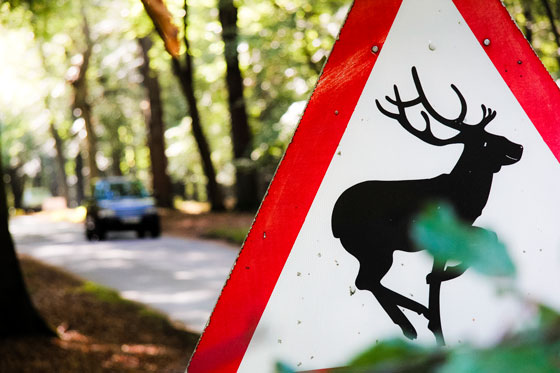
<div id="attachment_22128" style="width: 570px" class="wp-caption aligncenter"><img loading="lazy" decoding="async" aria-describedby="caption-attachment-22128" class="wp-image-22128 size-full" src="https://www.oh-i-see.com/blog/wp-content/uploads/2015/03/154079448sized.jpg" alt="Deer crossing sign in Hertfordshire, England, shows a running deer with a huge set of antlers, illustrating how different cultures interpret the same animal on road signs. (Image © Simon Gurney)" width="560" height="373" srcset="https://www.oh-i-see.com/blog/wp-content/uploads/2015/03/154079448sized.jpg 560w, https://www.oh-i-see.com/blog/wp-content/uploads/2015/03/154079448sized-300x200.jpg 300w, https://www.oh-i-see.com/blog/wp-content/uploads/2015/03/154079448sized-207x138.jpg 207w" sizes="auto, (max-width: 560px) 100vw, 560px" /><p id="caption-attachment-22128" class="wp-caption-text">In Hertfordshire, England, the deer on road signs have a certain regal look <br />with antlers fit for a bejeweled crown.<br />© Simon Gurney</p></div>
<h2>Crossing the Road and Cultures, Too</h2>
<p>Why does a chicken cross the road? Ponder that all you wish, but know for sure that a chicken and a host of other beasts are gonna cross the road.</p>
<p>Humans devised the idea of warning signs to help you avoid a bump in the road. Governments and international commissions created copious specs (862 pages in the US Manual alone) to make sure the humans got it right.</p>
<p>With all the international constraints and the small size of the &#8220;canvas,&#8221; you might think road signs would be boring, routine, standard. But&#8212;surprise!&#8212;they show more about different cultures and geographies than you might think!</p>
<h4>Deer Designs</h4>
<p>Deer are native to every continent except Australia and Antarctica. That results in many different deer species across geographies and climates, providing a challenge to anyone who might want to standardize the deer sign.</p>
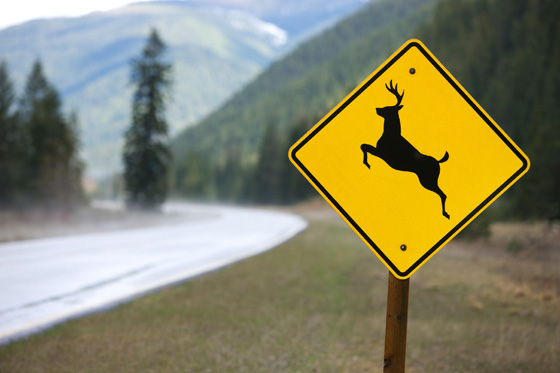
<p>The iconic deer on the US sign is a silhouette with a nice leap and a cute turned-up tail. But why are the antlers backward?</p>
<div id="attachment_22097" style="width: 570px" class="wp-caption aligncenter"><img loading="lazy" decoding="async" aria-describedby="caption-attachment-22097" class="wp-image-22097 size-full" src="https://www.oh-i-see.com/blog/wp-content/uploads/2015/03/12019720sized.jpg" alt="Deer crossing sign on an Idaho roadway, illustrating how the design of road signs varies in different cultures. (Image © jimkruger)" width="560" height="373" srcset="https://www.oh-i-see.com/blog/wp-content/uploads/2015/03/12019720sized.jpg 560w, https://www.oh-i-see.com/blog/wp-content/uploads/2015/03/12019720sized-300x200.jpg 300w, https://www.oh-i-see.com/blog/wp-content/uploads/2015/03/12019720sized-207x138.jpg 207w" sizes="auto, (max-width: 560px) 100vw, 560px" /><p id="caption-attachment-22097" class="wp-caption-text">If a deer on this Idaho roadway jumps at your car, don&#8217;t take time to compare <br />its horns to the sign. Just get outta the way! <br />© jimkruger</p></div>
<p>The style, the balance, the angle of the leap of this American deer may seem like pure perfection, but it lacks the &#8220;moves&#8221; of the deer on the English country road.</p>
<p>And it&#8217;s also missing some personalized charm. The beguiling smile of the British deer wasn&#8217;t there when the sign went up, but the 3/4 perspective used by the designer invited some playfulness. Well done, mate!</p>
<p>For designers, the horns are always the dilemma, especially when more than one species of deer cross the same road. Maybe they see the horns like hair styles&#8212;this year, bigger and bouffant; next year, curly and compact. Perhaps the horns balance the angle of the leap. Or, do the antlers just reflect the deer in the &#8216;hood?</p>
<div id="attachment_22131" style="width: 570px" class="wp-caption aligncenter"><img loading="lazy" decoding="async" aria-describedby="caption-attachment-22131" class="wp-image-22131 size-full" src="https://www.oh-i-see.com/blog/wp-content/uploads/2015/03/3DeerCombo.jpg" alt="Three deer crossing signs: white, triangular sign with red border and deer from France; yellow diamond-shaped sign with black border and deer from Canada; yellow triangular sign with red border and deer from Sweden, illustrating how road signs can vary in different cultures. [Image © alblec (Canada) / © 221A (Sweden)]" width="560" height="270" srcset="https://www.oh-i-see.com/blog/wp-content/uploads/2015/03/3DeerCombo.jpg 560w, https://www.oh-i-see.com/blog/wp-content/uploads/2015/03/3DeerCombo-300x145.jpg 300w, https://www.oh-i-see.com/blog/wp-content/uploads/2015/03/3DeerCombo-207x100.jpg 207w" sizes="auto, (max-width: 560px) 100vw, 560px" /><p id="caption-attachment-22131" class="wp-caption-text">Deer crossing signs (l to r) from France&#8212;an elegant deer, of course, on its way to Paris&#8212;<br />and from Canada (© alblec), and Sweden (© 221A)</p></div>
<p>Despite many attempts, the shapes of warning signs defy international standardization&#8212;diamond-shaped in the US and Canada, triangular in most of the EU. Background colors and border styles vary, too. Like beauty, the efficacy of warnings is clearly in the eye of the beholder.</p>
<h4>The Happiness Index</h4>
<p>The UN looks at happiness across countries by polling citizens and collecting information on several happiness indexes. It has set every March 20 as the <a href="http://www.dayofhappiness.net/about/" target="_blank" rel="noopener">International Day of Happiness</a>.</p>
<p>Published each year since 2012, the <a href="https://worldhappiness.report/blog/its-a-three-peat-finland-keeps-top-spot-as-happiest-country-in-world/" target="_blank" rel="noopener">World Happiness Report</a> ranks countries based on the Gallup World Poll. In 2020, Finland came in first and several other Scandinavian countries&#8212;Norway, Sweden, and Denmark&#8212;ranked in the top ten. A half-world away, tiny Costa Rica, the land of <em><a href="https://www.oh-i-see.com/blog/2013/10/06/culture-smart-hows-life-in-costa-rica/" target="_blank" rel="noopener">pura vida</a>, </em>ranked #15; the US, #18; and Spain, #28.</p>
<p>Though there&#8217;s no way to know if the happiness indexes pertain to the bovine population, it is curious that the wag of the tail on cattle crossing signs in Spain and Costa Rica are oh-so-different!</p>
<div id="attachment_22102" style="width: 410px" class="wp-caption aligncenter"><img loading="lazy" decoding="async" aria-describedby="caption-attachment-22102" class="wp-image-22102" src="https://www.oh-i-see.com/blog/wp-content/uploads/2015/03/CowComboImage.jpg" alt="Two road signs warning of cattle crossings, the top by a road in Spain and the bottom by a road in Costa Rica, illustrating how different cultures depict the same animal on road signs. [Image © percds (top) and © Sheron Long (bottom)]" width="400" height="514" srcset="https://www.oh-i-see.com/blog/wp-content/uploads/2015/03/CowComboImage.jpg 560w, https://www.oh-i-see.com/blog/wp-content/uploads/2015/03/CowComboImage-233x300.jpg 233w, https://www.oh-i-see.com/blog/wp-content/uploads/2015/03/CowComboImage-161x207.jpg 161w, https://www.oh-i-see.com/blog/wp-content/uploads/2015/03/CowComboImage-300x386.jpg 300w" sizes="auto, (max-width: 400px) 100vw, 400px" /><p id="caption-attachment-22102" class="wp-caption-text">Wag more. Moo less! <br />Cattle crossing signs in Spain (top) and in Costa Rica (bottom).<br />© percds / © Sheron Long</p></div>
<h4>Fact and Feeling</h4>
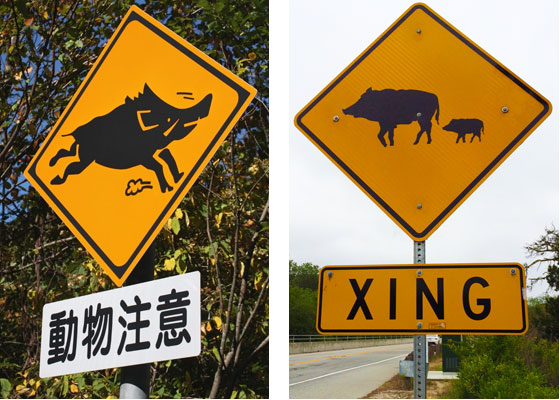
<p>Happiness is not the only emotion that springs from the metal of a road sign. The mellow California sign below would have you thinking, &#8220;C&#8217;mon, wild boars are mothers, too.&#8221; But it&#8217;s the Japanese sign that gets it right.</p>
<div id="attachment_22105" style="width: 510px" class="wp-caption aligncenter"><img loading="lazy" decoding="async" aria-describedby="caption-attachment-22105" class="wp-image-22105" src="https://www.oh-i-see.com/blog/wp-content/uploads/2015/03/BoarCombo.jpg" alt="Two road signs warning of a wild boar crossing, the one on the left from Japan and the one on the right from Carmel, CA, illustrating the same animal depicted on road signs in different cultures. (Image © Spontaneous Pictures (L) and © Sheron Long (R)" width="500" height="357" srcset="https://www.oh-i-see.com/blog/wp-content/uploads/2015/03/BoarCombo.jpg 560w, https://www.oh-i-see.com/blog/wp-content/uploads/2015/03/BoarCombo-300x214.jpg 300w, https://www.oh-i-see.com/blog/wp-content/uploads/2015/03/BoarCombo-207x148.jpg 207w" sizes="auto, (max-width: 500px) 100vw, 500px" /><p id="caption-attachment-22105" class="wp-caption-text">The personality of a wild boar does not change because it migrates to California!<br />© Spontaneous Pictures (l) / © Sheron Long (r)</p></div>
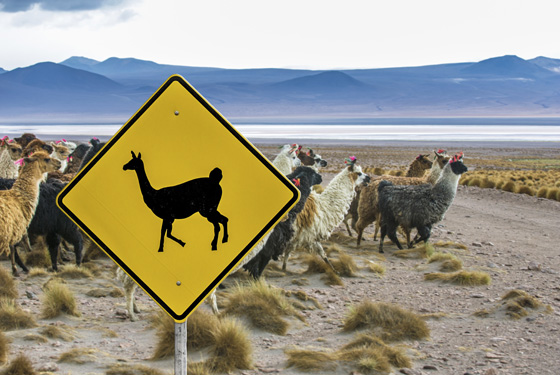
<p>In some parts of the world, the road signs are factually correct, delivering on their promise.</p>
<div id="attachment_22099" style="width: 570px" class="wp-caption aligncenter"><img loading="lazy" decoding="async" aria-describedby="caption-attachment-22099" class="wp-image-22099 size-full" src="https://www.oh-i-see.com/blog/wp-content/uploads/2015/03/186094550sized.jpg" alt="Llama and Vicuña crossing sign in the highlands of Bolivia with the corresponding animals crossing behind it, illustrating how road signs vary in different cultures. (Image © javarman3)" width="560" height="375" srcset="https://www.oh-i-see.com/blog/wp-content/uploads/2015/03/186094550sized.jpg 560w, https://www.oh-i-see.com/blog/wp-content/uploads/2015/03/186094550sized-300x201.jpg 300w, https://www.oh-i-see.com/blog/wp-content/uploads/2015/03/186094550sized-207x139.jpg 207w" sizes="auto, (max-width: 560px) 100vw, 560px" /><p id="caption-attachment-22099" class="wp-caption-text">Llama and vicuña crossing in the Bolivian highlands&#8211;a wooly meet-up!<br />© javarman3</p></div>
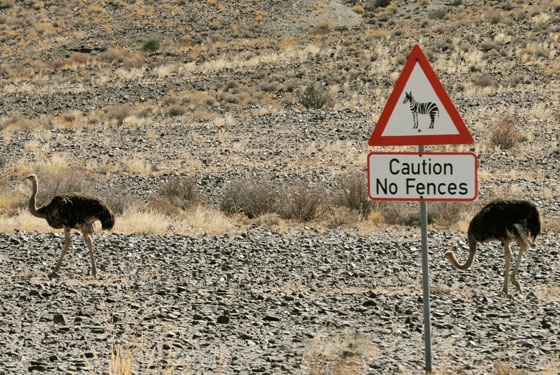
<p>In others, not so much. This road sign throws you a curve&#8212;it promises straight-line black-and-white stripes and delivers two rounds of fluffy brown feathers.</p>
<div id="attachment_22098" style="width: 570px" class="wp-caption aligncenter"><img loading="lazy" decoding="async" aria-describedby="caption-attachment-22098" class="wp-image-22098 size-full" src="https://www.oh-i-see.com/blog/wp-content/uploads/2015/03/10973452sizedcrop.jpg" alt="Zebra crossing sign with &quot;No Fences&quot; warning in Namibia with ostriches behind it, illustrating that road signs vary in different cultures. (Image © Bryta)" width="560" height="375" srcset="https://www.oh-i-see.com/blog/wp-content/uploads/2015/03/10973452sizedcrop.jpg 560w, https://www.oh-i-see.com/blog/wp-content/uploads/2015/03/10973452sizedcrop-300x201.jpg 300w, https://www.oh-i-see.com/blog/wp-content/uploads/2015/03/10973452sizedcrop-207x139.jpg 207w" sizes="auto, (max-width: 560px) 100vw, 560px" /><p id="caption-attachment-22098" class="wp-caption-text">&#8220;No fences&#8221; in Namibia means ostriches and other beasts can crash the party.<br />© Bryta</p></div>
<h4><strong>Confusion and Contradiction </strong></h4>
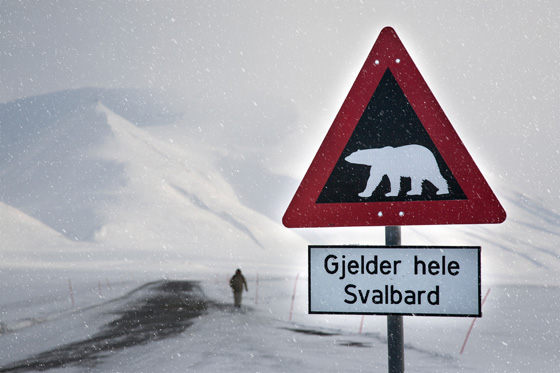
<p>Svalbard, a cluster of islands about midway between Norway and the North Pole, has a small permanent population and polar bears. It needs warning signs, of course, and this one says, &#8220;Applies throughout Svalbard.&#8221; But still you have to wonder why it&#8217;s there&#8212;if you&#8217;re walking in an Arctic snowstorm and encounter a polar bear, will you see it?</p>
<div id="attachment_22100" style="width: 570px" class="wp-caption aligncenter"><img loading="lazy" decoding="async" aria-describedby="caption-attachment-22100" class="size-full wp-image-22100" src="https://www.oh-i-see.com/blog/wp-content/uploads/2015/03/22410139sized.jpg" alt="Polar bear crossing sign on a snow-covered road in Norway, illustrating how animals vary on road signs in different countries. (Image © Avatar_023)" width="560" height="373" srcset="https://www.oh-i-see.com/blog/wp-content/uploads/2015/03/22410139sized.jpg 560w, https://www.oh-i-see.com/blog/wp-content/uploads/2015/03/22410139sized-300x200.jpg 300w, https://www.oh-i-see.com/blog/wp-content/uploads/2015/03/22410139sized-207x138.jpg 207w" sizes="auto, (max-width: 560px) 100vw, 560px" /><p id="caption-attachment-22100" class="wp-caption-text">White on white polar bear crossing in Norway<br />© Avatar_023</p></div>
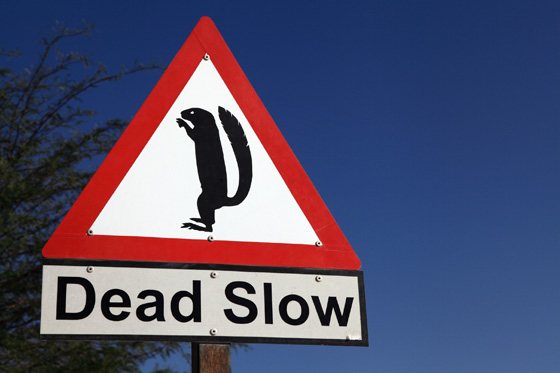
<p>If you&#8217;re driving through the warmer climate of Namibia, it&#8217;s good to be on the lookout for ground squirrels. They live in bands, sometimes in groups of 20, all of which might be milling around the same crossing.</p>
<p>But what&#8217;s the message on the crossing sign? Are the ground squirrels already road kill, or are they slow? Or, are they road kill because they&#8217;re slow? Or, do YOU go slow so you don&#8217;t end up as road kill?</p>
<div id="attachment_22101" style="width: 570px" class="wp-caption aligncenter"><img loading="lazy" decoding="async" aria-describedby="caption-attachment-22101" class="size-full wp-image-22101" src="https://www.oh-i-see.com/blog/wp-content/uploads/2015/03/27390468sized.jpg" alt="Ground squirrel crossing sign with a &quot;Dead Slow&quot; notice in Namibia, illustrating the variety of animals on road signs in different cultures. (Image © namibelephant)" width="560" height="373" srcset="https://www.oh-i-see.com/blog/wp-content/uploads/2015/03/27390468sized.jpg 560w, https://www.oh-i-see.com/blog/wp-content/uploads/2015/03/27390468sized-300x200.jpg 300w, https://www.oh-i-see.com/blog/wp-content/uploads/2015/03/27390468sized-207x138.jpg 207w" sizes="auto, (max-width: 560px) 100vw, 560px" /><p id="caption-attachment-22101" class="wp-caption-text">Ground squirrel crossing in Namibia<br />© namibelephant</p></div>
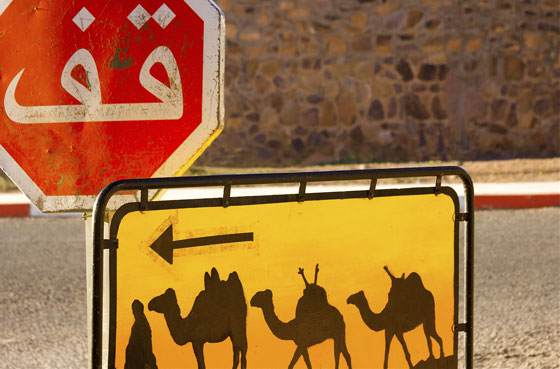
<p>Confusion can turn to contradiction. The red sign says STOP in Arabic, but apparently camels are exempt.</p>
<div id="attachment_22093" style="width: 570px" class="wp-caption aligncenter"><img loading="lazy" decoding="async" aria-describedby="caption-attachment-22093" class="wp-image-22093 size-full" src="https://www.oh-i-see.com/blog/wp-content/uploads/2015/03/40864130sized.jpg" alt="Stop sign and camel crossing directional sign toward the Sahara desert in Morocco, illustrating the variety of animals on road signs in different cultures. (Image © Jann Huizenga)" width="560" height="369" srcset="https://www.oh-i-see.com/blog/wp-content/uploads/2015/03/40864130sized.jpg 560w, https://www.oh-i-see.com/blog/wp-content/uploads/2015/03/40864130sized-300x198.jpg 300w, https://www.oh-i-see.com/blog/wp-content/uploads/2015/03/40864130sized-207x136.jpg 207w" sizes="auto, (max-width: 560px) 100vw, 560px" /><p id="caption-attachment-22093" class="wp-caption-text">In Morocco, red stop sign and camel directional sign toward the Sahara desert. Stop or go? <br />© Jann Huizenga</p></div>
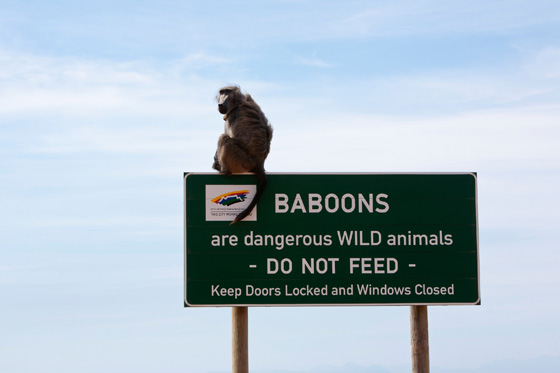
<p>Clarity is the gold standard for warning signs, and some rise to the challenge. Take this one in South Africa&#8212;it&#8217;s clear, it&#8217;s realer than real, and if you do what it says, you&#8217;ll never feel as silly as a baboon.</p>
<div id="attachment_22096" style="width: 570px" class="wp-caption aligncenter"><img loading="lazy" decoding="async" aria-describedby="caption-attachment-22096" class="size-full wp-image-22096" src="https://www.oh-i-see.com/blog/wp-content/uploads/2015/03/16296846sized.jpg" alt="Baboon warning sign in Cape Town, South Africa, illustrating the variety of animals on road signs in different cultures. (Image © Micky Wiswedel)" width="560" height="373" srcset="https://www.oh-i-see.com/blog/wp-content/uploads/2015/03/16296846sized.jpg 560w, https://www.oh-i-see.com/blog/wp-content/uploads/2015/03/16296846sized-300x200.jpg 300w, https://www.oh-i-see.com/blog/wp-content/uploads/2015/03/16296846sized-207x138.jpg 207w" sizes="auto, (max-width: 560px) 100vw, 560px" /><p id="caption-attachment-22096" class="wp-caption-text">Special precautions prevail at this baboon crossing in Cape Town, South Africa.<br />© Micky Wiswedel</p></div>
<h4>Where in the World Are You?</h4>
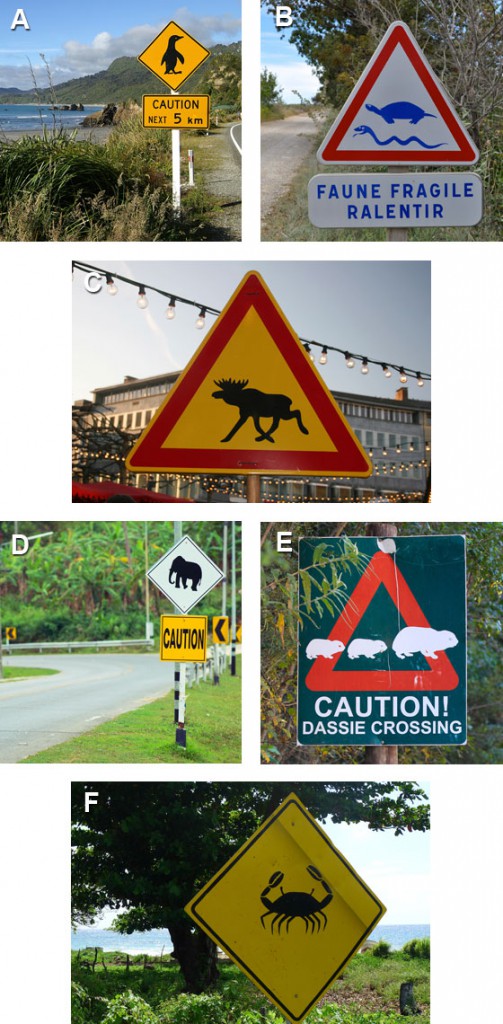
<p>Get ready to say, &#8220;<strong>Oh, I see!</strong>&#8221; It&#8217;s your turn to cross the road into different cultures and match the road signs to these <strong>map points: </strong></p>
<p><strong>1.</strong> Germany  <strong>2.</strong> Nicaragua  <strong>3.</strong> New Zealand  <strong>4.</strong> Thailand  <strong>5.</strong> South Africa  <strong>6.</strong> France</p>
<div id="attachment_22095" style="width: 513px" class="wp-caption aligncenter"><img loading="lazy" decoding="async" aria-describedby="caption-attachment-22095" class="wp-image-22095 size-large" src="https://www.oh-i-see.com/blog/wp-content/uploads/2015/03/SignActivityImage-503x1024.jpg" alt="Warning signs for animal crossings---penguins, turtles and snakes, moose, elephants, daisies, and crabs, all illustrating how different cultures represent animals on road signs. (Images---A: © Oralleff / B: © Sheron Long / C: © Andreas Weber / D: © Tim Arbaev / E: © David Callan / F: © Steve B Photography" width="503" height="1024" srcset="https://www.oh-i-see.com/blog/wp-content/uploads/2015/03/SignActivityImage-503x1024.jpg 503w, https://www.oh-i-see.com/blog/wp-content/uploads/2015/03/SignActivityImage-147x300.jpg 147w, https://www.oh-i-see.com/blog/wp-content/uploads/2015/03/SignActivityImage-102x207.jpg 102w, https://www.oh-i-see.com/blog/wp-content/uploads/2015/03/SignActivityImage-300x611.jpg 300w, https://www.oh-i-see.com/blog/wp-content/uploads/2015/03/SignActivityImage.jpg 560w" sizes="auto, (max-width: 503px) 100vw, 503px" /><p id="caption-attachment-22095" class="wp-caption-text">Oh, I see! Do U?<br />Credits (A-F): © Oralleff / © Sheron Long / © Andreas Weber <br />© Tim Arbaev / © David Callan / © Steve B Photography</p></div>
<p>Different wildlife, different cultures, different languages. They all hold the clues. Good luck, and <strong>STOP </strong>to check your road sign answers below.</p>
<p><a title="Creative Inspiration Flows In Underwater Photographs" href="#comments"><i>Comment</i></a><em> on this post below.</em></p>
<p><em>For more on how cultures show their differences on school signs, see &#8220;<a href="https://www.oh-i-see.com/blog/2021/03/09/in-the-school-zone-of-different-cultures/" target="_blank" rel="noopener">In the (School) Zone of Different Cultures</a>.&#8221;</em></p>
<h5><em>With appreciation to Thinkstock and iStock for images except those copyrighted by Sheron Long.</em></h5>
<h6><strong>Answers:</strong> <strong>1.</strong> Germany is C, a moose crossing at the Christmas market in the Königsplatz in Kassel, Germany. <strong>2.</strong> Nicaragua is F, a crab crossing by Long Bay on Corn Island. <strong>3.</strong> New Zealand is A, a penguin crossing on the South Island. <strong>4.</strong> Thailand is D, an elephant crossing in Phuket. <strong>5.</strong> South Africa is E, a dassie crossing at KwaZulu-Natal. <strong>6.</strong> France is B, a snake and turtle crossing in the swampy lands of the Camargue.</h6>
{"id":22063,"date":"2015-03-31T03:00:20","date_gmt":"2015-03-31T10:00:20","guid":{"rendered":"http:\/\/ohisee.genweb.site\/blog\/?p=22063"},"modified":"2021-07-20T07:56:57","modified_gmt":"2021-07-20T14:56:57","slug":"oh-deer-road-signs-in-different-cultures","status":"publish","type":"post","link":"https:\/\/www.oh-i-see.com\/blog\/oh-deer-road-signs-in-different-cultures\/","title":{"rendered":"Oh, Deer! Road Signs in Different Cultures"},"content":{"rendered":"<div id=\"attachment_22128\" style=\"width: 570px\" class=\"wp-caption aligncenter\"><img loading=\"lazy\" decoding=\"async\" aria-describedby=\"caption-attachment-22128\" class=\"wp-image-22128 size-full\" src=\"https:\/\/www.oh-i-see.com\/blog\/wp-content\/uploads\/2015\/03\/154079448sized.jpg\" alt=\"Deer crossing sign in Hertfordshire, England, shows a running deer with a huge set of antlers, illustrating how different cultures interpret the same animal on road signs. (Image \u00a9 Simon Gurney)\" width=\"560\" height=\"373\" srcset=\"https:\/\/www.oh-i-see.com\/blog\/wp-content\/uploads\/2015\/03\/154079448sized.jpg 560w, https:\/\/www.oh-i-see.com\/blog\/wp-content\/uploads\/2015\/03\/154079448sized-300x200.jpg 300w, https:\/\/www.oh-i-see.com\/blog\/wp-content\/uploads\/2015\/03\/154079448sized-207x138.jpg 207w\" sizes=\"auto, (max-width: 560px) 100vw, 560px\" \/><p id=\"caption-attachment-22128\" class=\"wp-caption-text\">In Hertfordshire, England, the deer on road signs have a certain regal look <br \/>with antlers fit for a bejeweled crown.<br \/>\u00a9 Simon Gurney<\/p><\/div>\n<h2>Crossing the Road and Cultures, Too<\/h2>\n<p>Why does a\u00a0chicken cross the road? Ponder that all you wish, but know for sure that a chicken and a host of other beasts are gonna\u00a0cross the road.<\/p>\n<p>Humans devised the idea of warning signs to help you\u00a0avoid a bump in the road. Governments and international commissions created copious specs (862 pages in the US Manual alone) to make sure the humans got it right.<\/p>\n<p>With all the international constraints and the\u00a0small size of the &#8220;canvas,&#8221; you might\u00a0think road signs would be boring, routine,\u00a0standard. But&#8212;surprise!&#8212;they show more about different cultures and geographies than you might think!<\/p>\n<h4>Deer Designs<\/h4>\n<p>Deer\u00a0are native to every continent except Australia and Antarctica.\u00a0That\u00a0results in\u00a0many\u00a0different deer\u00a0species across\u00a0geographies and climates, providing a challenge to anyone who might want to standardize the deer sign.<\/p>\n<p>The iconic deer on the US sign is a\u00a0silhouette with a nice leap and a cute turned-up tail.\u00a0But why are the antlers backward?<\/p>\n<div id=\"attachment_22097\" style=\"width: 570px\" class=\"wp-caption aligncenter\"><img loading=\"lazy\" decoding=\"async\" aria-describedby=\"caption-attachment-22097\" class=\"wp-image-22097 size-full\" src=\"https:\/\/www.oh-i-see.com\/blog\/wp-content\/uploads\/2015\/03\/12019720sized.jpg\" alt=\"Deer crossing sign on an Idaho roadway, illustrating how the design of road signs varies in different cultures. (Image \u00a9 jimkruger)\" width=\"560\" height=\"373\" srcset=\"https:\/\/www.oh-i-see.com\/blog\/wp-content\/uploads\/2015\/03\/12019720sized.jpg 560w, https:\/\/www.oh-i-see.com\/blog\/wp-content\/uploads\/2015\/03\/12019720sized-300x200.jpg 300w, https:\/\/www.oh-i-see.com\/blog\/wp-content\/uploads\/2015\/03\/12019720sized-207x138.jpg 207w\" sizes=\"auto, (max-width: 560px) 100vw, 560px\" \/><p id=\"caption-attachment-22097\" class=\"wp-caption-text\">If a deer on this Idaho roadway jumps at your car, don&#8217;t take time to compare <br \/>its horns to the sign. Just get outta the way! <br \/>\u00a9 jimkruger<\/p><\/div>\n<p>The style, the balance, the angle of the leap of this American deer\u00a0may seem like pure perfection, but it lacks the &#8220;moves&#8221; of the deer on the English country road.<\/p>\n<p>And it&#8217;s also missing some personalized charm. The beguiling smile of the British deer wasn&#8217;t there when the sign went up, but the 3\/4 perspective used by the designer invited some\u00a0playfulness. Well done, mate!<\/p>\n<p>For designers,\u00a0the horns\u00a0are always the dilemma, especially when more than one species of deer cross the same road.\u00a0Maybe they\u00a0see the horns like hair styles&#8212;this year, bigger and bouffant; next year, curly and compact. Perhaps\u00a0the horns balance the angle of the leap.\u00a0Or, do the antlers just reflect the deer in the &#8216;hood?<\/p>\n<div id=\"attachment_22131\" style=\"width: 570px\" class=\"wp-caption aligncenter\"><img loading=\"lazy\" decoding=\"async\" aria-describedby=\"caption-attachment-22131\" class=\"wp-image-22131 size-full\" src=\"https:\/\/www.oh-i-see.com\/blog\/wp-content\/uploads\/2015\/03\/3DeerCombo.jpg\" alt=\"Three deer crossing signs: white, triangular sign with red border and deer from France; yellow diamond-shaped sign with black border and deer from Canada; yellow triangular sign with red border and deer from Sweden, illustrating how road signs can vary in different cultures. [Image \u00a9 alblec (Canada) \/ \u00a9 221A (Sweden)]\" width=\"560\" height=\"270\" srcset=\"https:\/\/www.oh-i-see.com\/blog\/wp-content\/uploads\/2015\/03\/3DeerCombo.jpg 560w, https:\/\/www.oh-i-see.com\/blog\/wp-content\/uploads\/2015\/03\/3DeerCombo-300x145.jpg 300w, https:\/\/www.oh-i-see.com\/blog\/wp-content\/uploads\/2015\/03\/3DeerCombo-207x100.jpg 207w\" sizes=\"auto, (max-width: 560px) 100vw, 560px\" \/><p id=\"caption-attachment-22131\" class=\"wp-caption-text\">Deer crossing signs (l to r) from France&#8212;an elegant deer, of course, on its way to Paris&#8212;<br \/>and from Canada (\u00a9 alblec), and Sweden (\u00a9 221A)<\/p><\/div>\n<p>Despite many attempts, the shapes of warning signs defy international standardization&#8212;diamond-shaped in the US and Canada, triangular in most of the EU. Background colors and border styles vary, too. Like beauty, the efficacy of warnings is clearly in the eye of the beholder.<\/p>\n<h4>The Happiness Index<\/h4>\n<p>The UN looks at happiness across countries by polling citizens and collecting information on several happiness indexes. It has set every March 20 as the <a href=\"http:\/\/www.dayofhappiness.net\/about\/\" target=\"_blank\" rel=\"noopener\">International Day of Happiness<\/a>.<\/p>\n<p>Published each year since 2012, the\u00a0<a href=\"https:\/\/worldhappiness.report\/blog\/its-a-three-peat-finland-keeps-top-spot-as-happiest-country-in-world\/\" target=\"_blank\" rel=\"noopener\">World Happiness Report<\/a>\u00a0ranks countries based on the Gallup World Poll. In 2020, Finland came in first and several other Scandinavian countries&#8212;Norway, Sweden, and Denmark&#8212;ranked in the top ten. A half-world away, tiny Costa Rica, the land of\u00a0<em><a href=\"https:\/\/www.oh-i-see.com\/blog\/2013\/10\/06\/culture-smart-hows-life-in-costa-rica\/\" target=\"_blank\" rel=\"noopener\">pura vida<\/a>,\u00a0<\/em>ranked #15; the US, #18; and Spain, #28.<\/p>\n<p>Though there&#8217;s no way to know if the happiness indexes pertain to the bovine population, it is curious that the wag of the tail on cattle crossing\u00a0signs in Spain and Costa Rica\u00a0are oh-so-different!<\/p>\n<div id=\"attachment_22102\" style=\"width: 410px\" class=\"wp-caption aligncenter\"><img loading=\"lazy\" decoding=\"async\" aria-describedby=\"caption-attachment-22102\" class=\"wp-image-22102\" src=\"https:\/\/www.oh-i-see.com\/blog\/wp-content\/uploads\/2015\/03\/CowComboImage.jpg\" alt=\"Two road signs warning of cattle crossings, the top by a road in Spain and the bottom by a road in Costa Rica, illustrating how different cultures depict the same animal on road signs. [Image \u00a9 percds (top) and \u00a9 Sheron Long (bottom)]\" width=\"400\" height=\"514\" srcset=\"https:\/\/www.oh-i-see.com\/blog\/wp-content\/uploads\/2015\/03\/CowComboImage.jpg 560w, https:\/\/www.oh-i-see.com\/blog\/wp-content\/uploads\/2015\/03\/CowComboImage-233x300.jpg 233w, https:\/\/www.oh-i-see.com\/blog\/wp-content\/uploads\/2015\/03\/CowComboImage-161x207.jpg 161w, https:\/\/www.oh-i-see.com\/blog\/wp-content\/uploads\/2015\/03\/CowComboImage-300x386.jpg 300w\" sizes=\"auto, (max-width: 400px) 100vw, 400px\" \/><p id=\"caption-attachment-22102\" class=\"wp-caption-text\">Wag more. Moo less! <br \/>Cattle crossing signs in Spain (top) and in Costa Rica (bottom).<br \/>\u00a9 percds \/ \u00a9 Sheron Long<\/p><\/div>\n<h4>Fact and Feeling<\/h4>\n<p>Happiness is not the only emotion that\u00a0springs from\u00a0the metal of a road sign. The mellow California sign below would have you thinking, &#8220;C&#8217;mon, wild boars are mothers, too.&#8221; But it&#8217;s\u00a0the Japanese sign that gets it right.<\/p>\n<div id=\"attachment_22105\" style=\"width: 510px\" class=\"wp-caption aligncenter\"><img loading=\"lazy\" decoding=\"async\" aria-describedby=\"caption-attachment-22105\" class=\"wp-image-22105\" src=\"https:\/\/www.oh-i-see.com\/blog\/wp-content\/uploads\/2015\/03\/BoarCombo.jpg\" alt=\"Two road signs warning of a wild boar crossing, the one on the left from Japan and the one on the right from Carmel, CA, illustrating the same animal depicted on road signs in different cultures. (Image \u00a9 Spontaneous Pictures (L) and \u00a9 Sheron Long (R)\" width=\"500\" height=\"357\" srcset=\"https:\/\/www.oh-i-see.com\/blog\/wp-content\/uploads\/2015\/03\/BoarCombo.jpg 560w, https:\/\/www.oh-i-see.com\/blog\/wp-content\/uploads\/2015\/03\/BoarCombo-300x214.jpg 300w, https:\/\/www.oh-i-see.com\/blog\/wp-content\/uploads\/2015\/03\/BoarCombo-207x148.jpg 207w\" sizes=\"auto, (max-width: 500px) 100vw, 500px\" \/><p id=\"caption-attachment-22105\" class=\"wp-caption-text\">The personality of a wild boar does not change because it migrates to California!<br \/>\u00a9 Spontaneous Pictures (l) \/ \u00a9 Sheron Long (r)<\/p><\/div>\n<p>In some parts of the world, the road\u00a0signs are factually correct, delivering on their promise.<\/p>\n<div id=\"attachment_22099\" style=\"width: 570px\" class=\"wp-caption aligncenter\"><img loading=\"lazy\" decoding=\"async\" aria-describedby=\"caption-attachment-22099\" class=\"wp-image-22099 size-full\" src=\"https:\/\/www.oh-i-see.com\/blog\/wp-content\/uploads\/2015\/03\/186094550sized.jpg\" alt=\"Llama and Vicu\u00f1a crossing sign in the highlands of Bolivia with the corresponding animals crossing behind it, illustrating how road signs vary in different cultures. (Image \u00a9 javarman3)\" width=\"560\" height=\"375\" srcset=\"https:\/\/www.oh-i-see.com\/blog\/wp-content\/uploads\/2015\/03\/186094550sized.jpg 560w, https:\/\/www.oh-i-see.com\/blog\/wp-content\/uploads\/2015\/03\/186094550sized-300x201.jpg 300w, https:\/\/www.oh-i-see.com\/blog\/wp-content\/uploads\/2015\/03\/186094550sized-207x139.jpg 207w\" sizes=\"auto, (max-width: 560px) 100vw, 560px\" \/><p id=\"caption-attachment-22099\" class=\"wp-caption-text\">Llama and vicu\u00f1a crossing in the Bolivian highlands&#8211;a wooly meet-up!<br \/>\u00a9 javarman3<\/p><\/div>\n<p>In others, not\u00a0so much.\u00a0This road sign throws you a curve&#8212;it promises straight-line black-and-white stripes and delivers two rounds of fluffy brown feathers.<\/p>\n<div id=\"attachment_22098\" style=\"width: 570px\" class=\"wp-caption aligncenter\"><img loading=\"lazy\" decoding=\"async\" aria-describedby=\"caption-attachment-22098\" class=\"wp-image-22098 size-full\" src=\"https:\/\/www.oh-i-see.com\/blog\/wp-content\/uploads\/2015\/03\/10973452sizedcrop.jpg\" alt=\"Zebra crossing sign with &quot;No Fences&quot; warning in Namibia with ostriches behind it, illustrating that road signs vary in different cultures. (Image \u00a9 Bryta)\" width=\"560\" height=\"375\" srcset=\"https:\/\/www.oh-i-see.com\/blog\/wp-content\/uploads\/2015\/03\/10973452sizedcrop.jpg 560w, https:\/\/www.oh-i-see.com\/blog\/wp-content\/uploads\/2015\/03\/10973452sizedcrop-300x201.jpg 300w, https:\/\/www.oh-i-see.com\/blog\/wp-content\/uploads\/2015\/03\/10973452sizedcrop-207x139.jpg 207w\" sizes=\"auto, (max-width: 560px) 100vw, 560px\" \/><p id=\"caption-attachment-22098\" class=\"wp-caption-text\">&#8220;No fences&#8221; in Namibia means ostriches and other beasts can crash the party.<br \/>\u00a9 Bryta<\/p><\/div>\n<h4><strong>Confusion and Contradiction\u00a0<\/strong><\/h4>\n<p>Svalbard, a cluster of islands about midway between Norway and the North Pole, has a small permanent population and polar bears. It needs warning signs, of course, and this one says, &#8220;Applies throughout Svalbard.&#8221; But still you have to wonder why it&#8217;s\u00a0there&#8212;if you&#8217;re\u00a0walking in an\u00a0Arctic snowstorm and encounter a polar bear, will you\u00a0see it?<\/p>\n<div id=\"attachment_22100\" style=\"width: 570px\" class=\"wp-caption aligncenter\"><img loading=\"lazy\" decoding=\"async\" aria-describedby=\"caption-attachment-22100\" class=\"size-full wp-image-22100\" src=\"https:\/\/www.oh-i-see.com\/blog\/wp-content\/uploads\/2015\/03\/22410139sized.jpg\" alt=\"Polar bear crossing sign on a snow-covered road in Norway, illustrating how animals vary on road signs in different countries. (Image \u00a9 Avatar_023)\" width=\"560\" height=\"373\" srcset=\"https:\/\/www.oh-i-see.com\/blog\/wp-content\/uploads\/2015\/03\/22410139sized.jpg 560w, https:\/\/www.oh-i-see.com\/blog\/wp-content\/uploads\/2015\/03\/22410139sized-300x200.jpg 300w, https:\/\/www.oh-i-see.com\/blog\/wp-content\/uploads\/2015\/03\/22410139sized-207x138.jpg 207w\" sizes=\"auto, (max-width: 560px) 100vw, 560px\" \/><p id=\"caption-attachment-22100\" class=\"wp-caption-text\">White on white polar bear crossing in Norway<br \/>\u00a9 Avatar_023<\/p><\/div>\n<p>If you&#8217;re driving through\u00a0the warmer climate of Namibia, it&#8217;s good to be on the lookout for\u00a0ground squirrels. They live in bands, sometimes in groups of\u00a020, all of which\u00a0might be milling around the same crossing.<\/p>\n<p>But what&#8217;s the message on the crossing\u00a0sign? Are the ground squirrels already road kill, or are they slow? Or, are they road kill because they&#8217;re slow? Or, do YOU\u00a0go slow so you don&#8217;t end up as road kill?<\/p>\n<div id=\"attachment_22101\" style=\"width: 570px\" class=\"wp-caption aligncenter\"><img loading=\"lazy\" decoding=\"async\" aria-describedby=\"caption-attachment-22101\" class=\"size-full wp-image-22101\" src=\"https:\/\/www.oh-i-see.com\/blog\/wp-content\/uploads\/2015\/03\/27390468sized.jpg\" alt=\"Ground squirrel crossing sign with a &quot;Dead Slow&quot; notice in Namibia, illustrating the variety of animals on road signs in different cultures. (Image \u00a9 namibelephant)\" width=\"560\" height=\"373\" srcset=\"https:\/\/www.oh-i-see.com\/blog\/wp-content\/uploads\/2015\/03\/27390468sized.jpg 560w, https:\/\/www.oh-i-see.com\/blog\/wp-content\/uploads\/2015\/03\/27390468sized-300x200.jpg 300w, https:\/\/www.oh-i-see.com\/blog\/wp-content\/uploads\/2015\/03\/27390468sized-207x138.jpg 207w\" sizes=\"auto, (max-width: 560px) 100vw, 560px\" \/><p id=\"caption-attachment-22101\" class=\"wp-caption-text\">Ground squirrel crossing in Namibia<br \/>\u00a9 namibelephant<\/p><\/div>\n<p>Confusion can turn to contradiction. The red sign says STOP in Arabic, but apparently camels are exempt.<\/p>\n<div id=\"attachment_22093\" style=\"width: 570px\" class=\"wp-caption aligncenter\"><img loading=\"lazy\" decoding=\"async\" aria-describedby=\"caption-attachment-22093\" class=\"wp-image-22093 size-full\" src=\"https:\/\/www.oh-i-see.com\/blog\/wp-content\/uploads\/2015\/03\/40864130sized.jpg\" alt=\"Stop sign and camel crossing directional sign toward the Sahara desert in Morocco, illustrating the variety of animals on road signs in different cultures. (Image \u00a9 Jann Huizenga)\" width=\"560\" height=\"369\" srcset=\"https:\/\/www.oh-i-see.com\/blog\/wp-content\/uploads\/2015\/03\/40864130sized.jpg 560w, https:\/\/www.oh-i-see.com\/blog\/wp-content\/uploads\/2015\/03\/40864130sized-300x198.jpg 300w, https:\/\/www.oh-i-see.com\/blog\/wp-content\/uploads\/2015\/03\/40864130sized-207x136.jpg 207w\" sizes=\"auto, (max-width: 560px) 100vw, 560px\" \/><p id=\"caption-attachment-22093\" class=\"wp-caption-text\">In Morocco, red stop sign and camel directional sign toward the Sahara desert. Stop or go? <br \/>\u00a9 Jann Huizenga<\/p><\/div>\n<p>Clarity is the gold standard for warning signs, and some\u00a0rise to the challenge. Take this one in South Africa&#8212;it&#8217;s clear, it&#8217;s realer than real, and if you do what it says, you&#8217;ll\u00a0never feel as silly as a baboon.<\/p>\n<div id=\"attachment_22096\" style=\"width: 570px\" class=\"wp-caption aligncenter\"><img loading=\"lazy\" decoding=\"async\" aria-describedby=\"caption-attachment-22096\" class=\"size-full wp-image-22096\" src=\"https:\/\/www.oh-i-see.com\/blog\/wp-content\/uploads\/2015\/03\/16296846sized.jpg\" alt=\"Baboon warning sign in Cape Town, South Africa, illustrating the variety of animals on road signs in different cultures. (Image \u00a9 Micky Wiswedel)\" width=\"560\" height=\"373\" srcset=\"https:\/\/www.oh-i-see.com\/blog\/wp-content\/uploads\/2015\/03\/16296846sized.jpg 560w, https:\/\/www.oh-i-see.com\/blog\/wp-content\/uploads\/2015\/03\/16296846sized-300x200.jpg 300w, https:\/\/www.oh-i-see.com\/blog\/wp-content\/uploads\/2015\/03\/16296846sized-207x138.jpg 207w\" sizes=\"auto, (max-width: 560px) 100vw, 560px\" \/><p id=\"caption-attachment-22096\" class=\"wp-caption-text\">Special precautions prevail at this baboon crossing in Cape Town, South Africa.<br \/>\u00a9 Micky Wiswedel<\/p><\/div>\n<h4>Where in the World Are You?<\/h4>\n<p>Get ready to say, &#8220;<strong>Oh, I see!<\/strong>&#8221; It&#8217;s your turn to cross the road into\u00a0different cultures and\u00a0match the road signs to these <strong>map points:\u00a0<\/strong><\/p>\n<p><strong>1.<\/strong> Germany \u00a0<strong>2.<\/strong> Nicaragua \u00a0<strong>3.<\/strong> New Zealand \u00a0<strong>4.<\/strong> Thailand \u00a0<strong>5.<\/strong> South Africa \u00a0<strong>6.<\/strong> France<\/p>\n<div id=\"attachment_22095\" style=\"width: 513px\" class=\"wp-caption aligncenter\"><img loading=\"lazy\" decoding=\"async\" aria-describedby=\"caption-attachment-22095\" class=\"wp-image-22095 size-large\" src=\"https:\/\/www.oh-i-see.com\/blog\/wp-content\/uploads\/2015\/03\/SignActivityImage-503x1024.jpg\" alt=\"Warning signs for animal crossings---penguins, turtles and snakes, moose, elephants, daisies, and crabs, all illustrating how different cultures represent animals on road signs. (Images---A: \u00a9 Oralleff \/ B: \u00a9 Sheron Long \/ C: \u00a9 Andreas Weber \/ D: \u00a9 Tim Arbaev \/ E: \u00a9 David Callan \/ F: \u00a9 Steve B Photography\" width=\"503\" height=\"1024\" srcset=\"https:\/\/www.oh-i-see.com\/blog\/wp-content\/uploads\/2015\/03\/SignActivityImage-503x1024.jpg 503w, https:\/\/www.oh-i-see.com\/blog\/wp-content\/uploads\/2015\/03\/SignActivityImage-147x300.jpg 147w, https:\/\/www.oh-i-see.com\/blog\/wp-content\/uploads\/2015\/03\/SignActivityImage-102x207.jpg 102w, https:\/\/www.oh-i-see.com\/blog\/wp-content\/uploads\/2015\/03\/SignActivityImage-300x611.jpg 300w, https:\/\/www.oh-i-see.com\/blog\/wp-content\/uploads\/2015\/03\/SignActivityImage.jpg 560w\" sizes=\"auto, (max-width: 503px) 100vw, 503px\" \/><p id=\"caption-attachment-22095\" class=\"wp-caption-text\">Oh, I see! Do U?<br \/>Credits (A-F): \u00a9 Oralleff \/ \u00a9 Sheron Long \/ \u00a9 Andreas Weber <br \/>\u00a9 Tim Arbaev \/ \u00a9 David Callan \/ \u00a9 Steve B Photography<\/p><\/div>\n<p>Different wildlife, different cultures, different languages. They all hold the clues.\u00a0Good luck, and <strong>STOP\u00a0<\/strong>to check your road sign answers below.<\/p>\n<p><a title=\"Creative Inspiration Flows In Underwater Photographs\" href=\"#comments\"><i>Comment<\/i><\/a><em>\u00a0on this post below.<\/em><\/p>\n<p><em>For more on how cultures show their differences on school signs, see &#8220;<a href=\"https:\/\/www.oh-i-see.com\/blog\/2021\/03\/09\/in-the-school-zone-of-different-cultures\/\" target=\"_blank\" rel=\"noopener\">In the (School) Zone of Different Cultures<\/a>.&#8221;<\/em><\/p>\n<h5><em>With appreciation\u00a0to Thinkstock and iStock for images except those copyrighted by Sheron Long.<\/em><\/h5>\n<h6><strong>Answers:<\/strong>\u00a0<strong>1.<\/strong> Germany is C, a moose crossing\u00a0at the Christmas market in the K\u00f6nigsplatz in Kassel, Germany. <strong>2.<\/strong> Nicaragua is F, a crab crossing by Long Bay on Corn Island. <strong>3.<\/strong> New Zealand is A, a penguin crossing on the South Island. <strong>4.<\/strong> Thailand is D, an elephant crossing in\u00a0Phuket. <strong>5.<\/strong> South Africa is E, a dassie crossing at KwaZulu-Natal. <strong>6.<\/strong> France is B, a snake and turtle\u00a0crossing in the swampy lands of the Camargue.<\/h6>\n","protected":false},"excerpt":{"rendered":null,"protected":false},"author":4,"featured_media":22128,"comment_status":"closed","ping_status":"open","sticky":false,"template":"","format":"standard","meta":{"footnotes":""},"categories":[97,227],"tags":[],"class_list":["post-22063","post","type-post","status-publish","format-standard","has-post-thumbnail","hentry","category-diversity-culture","category-worldwide-mappoints"],"aioseo_notices":[],"_links":{"self":[{"href":"https:\/\/www.oh-i-see.com\/blog\/wp-json\/wp\/v2\/posts\/22063","targetHints":{"allow":["GET"]}}],"collection":[{"href":"https:\/\/www.oh-i-see.com\/blog\/wp-json\/wp\/v2\/posts"}],"about":[{"href":"https:\/\/www.oh-i-see.com\/blog\/wp-json\/wp\/v2\/types\/post"}],"author":[{"embeddable":true,"href":"https:\/\/www.oh-i-see.com\/blog\/wp-json\/wp\/v2\/users\/4"}],"replies":[{"embeddable":true,"href":"https:\/\/www.oh-i-see.com\/blog\/wp-json\/wp\/v2\/comments?post=22063"}],"version-history":[{"count":3,"href":"https:\/\/www.oh-i-see.com\/blog\/wp-json\/wp\/v2\/posts\/22063\/revisions"}],"predecessor-version":[{"id":40328,"href":"https:\/\/www.oh-i-see.com\/blog\/wp-json\/wp\/v2\/posts\/22063\/revisions\/40328"}],"wp:featuredmedia":[{"embeddable":true,"href":"https:\/\/www.oh-i-see.com\/blog\/wp-json\/wp\/v2\/media\/22128"}],"wp:attachment":[{"href":"https:\/\/www.oh-i-see.com\/blog\/wp-json\/wp\/v2\/media?parent=22063"}],"wp:term":[{"taxonomy":"category","embeddable":true,"href":"https:\/\/www.oh-i-see.com\/blog\/wp-json\/wp\/v2\/categories?post=22063"},{"taxonomy":"post_tag","embeddable":true,"href":"https:\/\/www.oh-i-see.com\/blog\/wp-json\/wp\/v2\/tags?post=22063"}],"curies":[{"name":"wp","href":"https:\/\/api.w.org\/{rel}","templated":true}]}}