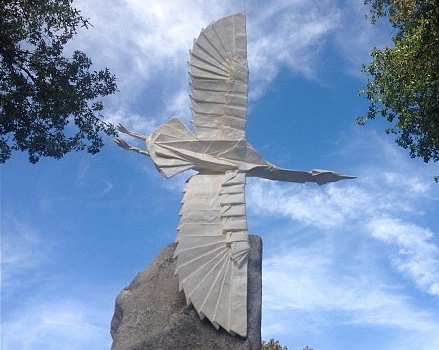
<div id="attachment_17815" style="width: 570px" class="wp-caption aligncenter"><img loading="lazy" decoding="async" aria-describedby="caption-attachment-17815" class=" wp-image-17815   " alt="Peace Flight origami sculpture, showing the creative process of Robert Lang (Image © Robert Lang)" src="https://www.oh-i-see.com/blog/wp-content/uploads/2014/03/Peace-Flight.jpg" width="560" height="446" srcset="https://www.oh-i-see.com/blog/wp-content/uploads/2014/03/Peace-Flight.jpg 439w, https://www.oh-i-see.com/blog/wp-content/uploads/2014/03/Peace-Flight-300x239.jpg 300w, https://www.oh-i-see.com/blog/wp-content/uploads/2014/03/Peace-Flight-207x165.jpg 207w" sizes="auto, (max-width: 560px) 100vw, 560px" /><p id="caption-attachment-17815" class="wp-caption-text"><span style="text-decoration: underline; color: #3366ff;"><a href="http://www.langorigami.com/art/gallery/gallery.php?tag=metal-sculpture&amp;name=peace_flight_metal_sculpture" target="_blank" rel="noopener"><span style="color: #3366ff; text-decoration: underline;">Peace Flight</span></a></span><br />Robert J. Lang and Kevin Box<br />Folded 2013; Composed 2013<br />cast stainless steel on stone; approx. 3&#8242; x 2&#8242; x 4&#8242; on stone<br />© Robert Lang</p></div>
<h2>A Creative Process Governed by Math</h2>
<p><a href="http://www.langorigami.com/" target="_blank" rel="noopener">Dr. Robert Lang</a> can make paper cranes. But his origami cranes not only have feathered wings and three toes on each foot, they soar with life.</p>
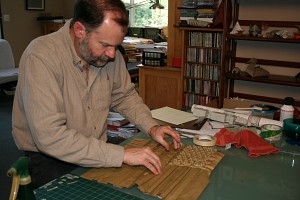
<div id="attachment_17809" style="width: 310px" class="wp-caption alignright"><img loading="lazy" decoding="async" aria-describedby="caption-attachment-17809" class="size-full wp-image-17809 " alt="Origami artist Robert Lang engaged in his creative process. (Image © Robert Lang)" src="https://www.oh-i-see.com/blog/wp-content/uploads/2014/03/Robert-Lang.jpg" width="300" height="200" srcset="https://www.oh-i-see.com/blog/wp-content/uploads/2014/03/Robert-Lang.jpg 300w, https://www.oh-i-see.com/blog/wp-content/uploads/2014/03/Robert-Lang-207x138.jpg 207w" sizes="auto, (max-width: 300px) 100vw, 300px" /><p id="caption-attachment-17809" class="wp-caption-text">Origami artist Robert Lang<br />© Robert Lang</p></div>
<p>In 2001, this physicist/engineer left his successful science career to write a book about how to make your own designs for origami, the traditional Japanese art of folding paper.</p>
<p>Why the career change?</p>
<p>This obviously brilliant man, who has 50 patents awarded and pending on semiconductor lasers, optics, and integrated optoelectronics, had an <strong>&#8220;Oh, I see&#8221; moment</strong>:</p>
<p style="padding-left: 30px;"><em>There were plenty of other really good engineers and managers that could do whatever I could do as an engineer, but I felt like there were few people who could write this book. </em></p>
<p><span style="line-height: 1.5em;">So he took a risk, left his job, and decided to see where it would take him.</span></p>
<p>Millions of folds later, he has found that origami continues to take him beyond what he could have imagined.</p>
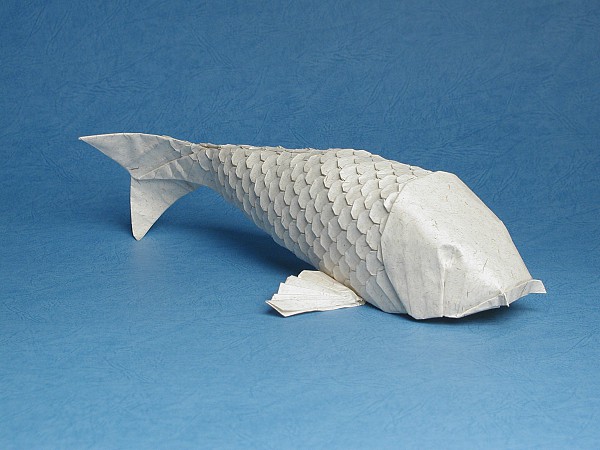
<div id="attachment_17812" style="width: 570px" class="wp-caption aligncenter"><img loading="lazy" decoding="async" aria-describedby="caption-attachment-17812" class=" wp-image-17812  " alt="Koi, opus 425, origami sculpture, showing the creative process of Robert Lang (© Robert Lang)" src="https://www.oh-i-see.com/blog/wp-content/uploads/2014/03/Koi-opus-425.jpg" width="560" height="420" srcset="https://www.oh-i-see.com/blog/wp-content/uploads/2014/03/Koi-opus-425.jpg 600w, https://www.oh-i-see.com/blog/wp-content/uploads/2014/03/Koi-opus-425-300x225.jpg 300w, https://www.oh-i-see.com/blog/wp-content/uploads/2014/03/Koi-opus-425-207x155.jpg 207w" sizes="auto, (max-width: 560px) 100vw, 560px" /><p id="caption-attachment-17812" class="wp-caption-text"><span style="text-decoration: underline; color: #3366ff;"><a href="http://www.langorigami.com/art/gallery/gallery.php?tag=sea-life&amp;name=scaled_koi" target="_blank" rel="noopener"><span style="color: #3366ff; text-decoration: underline;">Koi, opus 425</span></a></span><br />Folded: 2002; Composed: 2002<br />One uncut square; 15&#8243;<br />© Robert Lang</p></div>
<p>Lang&#8217;s work has appeared worldwide in both ads and art shows.</p>
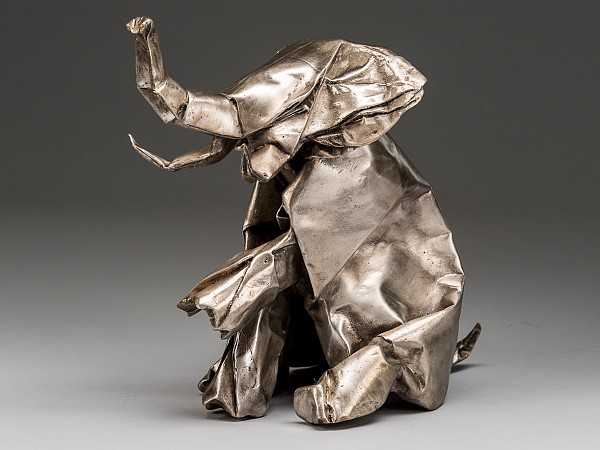
<p>He works in the more traditional smaller origami size as well as life-size. He even works in currency. While much of his work is made from some sort of paper, he has collaborated with sculptor Kevin Box to render a number of his pieces in metal.</p>
<div id="attachment_17811" style="width: 570px" class="wp-caption aligncenter"><img loading="lazy" decoding="async" aria-describedby="caption-attachment-17811" class=" wp-image-17811  " alt="Dollar Camera, origami sculpture showing the creative process of Robert Lang. (Image © Robert Lang)" src="https://www.oh-i-see.com/blog/wp-content/uploads/2014/03/Dollar-Camera.jpg" width="560" height="420" srcset="https://www.oh-i-see.com/blog/wp-content/uploads/2014/03/Dollar-Camera.jpg 600w, https://www.oh-i-see.com/blog/wp-content/uploads/2014/03/Dollar-Camera-300x225.jpg 300w, https://www.oh-i-see.com/blog/wp-content/uploads/2014/03/Dollar-Camera-207x155.jpg 207w" sizes="auto, (max-width: 560px) 100vw, 560px" /><p id="caption-attachment-17811" class="wp-caption-text"><span style="text-decoration: underline; color: #3366ff;"><a href="http://www.langorigami.com/art/gallery/gallery.php?tag=currency&amp;name=dollar_camera" target="_blank" rel="noopener"><span style="color: #3366ff; text-decoration: underline;">Dollar Camera</span></a></span><br />Folded: 2009; Composed: 2009<br />Two uncut one-dollar bills; 3&#8243;<br />© Robert Lang</p></div>
<h4>The Math</h4>
<p>When he switched careers, Lang admits at first he was worried that giving up engineering would mean giving up the mathematical work he loved so much. But, he says:</p>
<p style="padding-left: 30px;"><em>The math of origami is as interesting as engineering ever had been. The itch [to work with math] gets scratched as much by origami as it ever did by physics.</em></p>
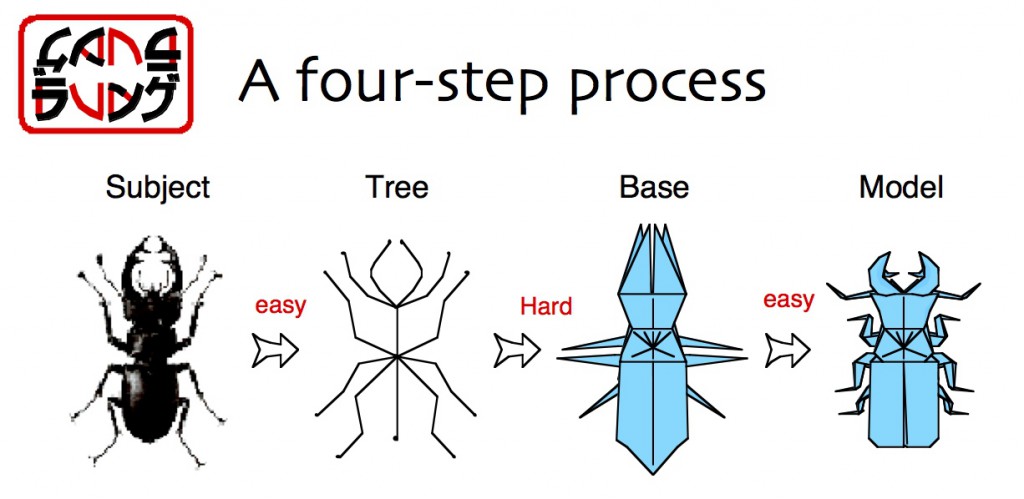
<p>To make an origami figure, Lang goes through four steps:</p>
<ul>
<li>He starts with the subject.</li>
<li>Then, he draws a tree figure (like a stick figure) of the basic shape.</li>
<li>Next, he creates a folded-paper base with flaps for the appendages.</li>
<li>Finally, he forms the specific shape into the model.</li>
</ul>
<div id="attachment_17818" style="width: 560px" class="wp-caption aligncenter"><img loading="lazy" decoding="async" aria-describedby="caption-attachment-17818" class=" wp-image-17818   " style="border: 1px solid black;" alt="Diagram of the four-step creative process of origami design. (Image © Robert Lang)" src="https://www.oh-i-see.com/blog/wp-content/uploads/2014/03/four-step-process-1024x499.jpg" width="550" height="267" srcset="https://www.oh-i-see.com/blog/wp-content/uploads/2014/03/four-step-process-1024x499.jpg 1024w, https://www.oh-i-see.com/blog/wp-content/uploads/2014/03/four-step-process-300x146.jpg 300w, https://www.oh-i-see.com/blog/wp-content/uploads/2014/03/four-step-process-207x100.jpg 207w, https://www.oh-i-see.com/blog/wp-content/uploads/2014/03/four-step-process-900x438.jpg 900w, https://www.oh-i-see.com/blog/wp-content/uploads/2014/03/four-step-process.jpg 1226w" sizes="auto, (max-width: 550px) 100vw, 550px" /><p id="caption-attachment-17818" class="wp-caption-text">Four-step process for origami design<br />© Robert Lang</p></div>
<p>The tree figure and the final shape are the easy parts. Creating the base is the hard part. That&#8217;s where math comes in.</p>
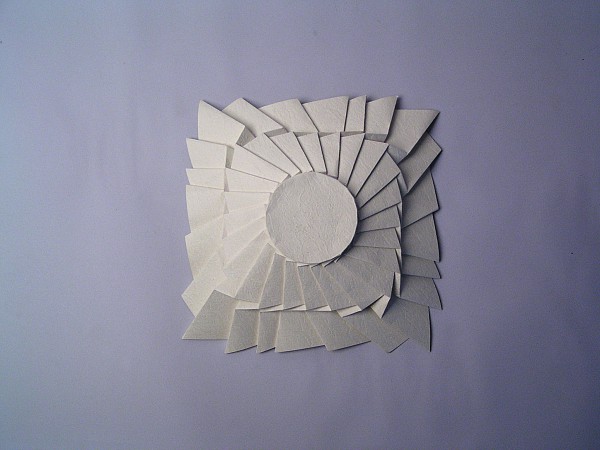
<p>The <a href="http://www.langorigami.com/science/sciencelinks.php" target="_blank" rel="noopener">math of origami</a> is about shapes and relationships and forms, not necessarily arithmetic. The folding pattern to create a flap (or leg or antennae) is based on a circle pattern. The smaller the flap, the smaller the circle (a quarter circle is the smallest amount of paper you need to make a flap).</p>
<p>If you know how to &#8220;pack&#8221; these circles, which represent the body parts, and fill the remaining paper with a mathematical crease pattern, you have an origami pattern&#8212;and have solved another math challenge.</p>
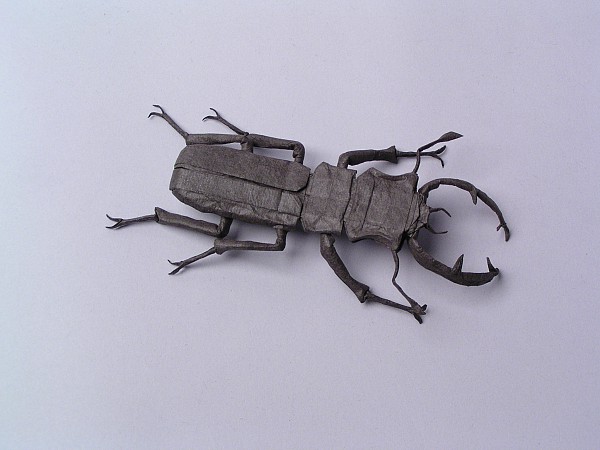
<div id="attachment_17813" style="width: 570px" class="wp-caption aligncenter"><img loading="lazy" decoding="async" aria-describedby="caption-attachment-17813" class=" wp-image-17813   " alt="Stag Beetle BP, opus 477, origami showing the creative process of Robert Lang. (Image © Robert Lang)" src="https://www.oh-i-see.com/blog/wp-content/uploads/2014/03/Stag-Beetle-BP-opus-477.jpg" width="560" height="420" srcset="https://www.oh-i-see.com/blog/wp-content/uploads/2014/03/Stag-Beetle-BP-opus-477.jpg 600w, https://www.oh-i-see.com/blog/wp-content/uploads/2014/03/Stag-Beetle-BP-opus-477-300x225.jpg 300w, https://www.oh-i-see.com/blog/wp-content/uploads/2014/03/Stag-Beetle-BP-opus-477-207x155.jpg 207w" sizes="auto, (max-width: 560px) 100vw, 560px" /><p id="caption-attachment-17813" class="wp-caption-text"><span style="text-decoration: underline; color: #3366ff;"><a href="http://www.langorigami.com/art/gallery/gallery.php?tag=insects&amp;name=stag_beetle_bp" target="_blank" rel="noopener"><span style="color: #3366ff; text-decoration: underline;">Stag Beetle BP, opus 477</span></a></span><br />Folded: 2005; Composed: 2005<br />One uncut square of Origamido paper; 5&#8243;<br />© Robert Lang</p></div>
<h4>Solving Puzzles</h4>
<p>A passionate scientist, Lang sees every origami design as a puzzle to be solved, especially the ones he does for artistic purposes.</p>
<p>His deep plunge into understanding the math behind his work has helped him create figures one could never imagine would evolve from a single flat piece of paper. Lang explains:</p>
<p style="padding-left: 30px;"><em>What is possible in origami is defined by the mathematical properties of a folded sheet of paper; if you understand the math, you can use it to create a lot of forms that you probably wouldn&#8217;t have discovered just by intuition.</em></p>
<p>Sure, there are some challenging projects Lang has begun that are not done yet. And that&#8217;s how he sees it&#8212;they aren’t failures; they are just not done yet. He feels that nothing is impossible since he is always learning new techniques and approaches.</p>
<div id="attachment_17814" style="width: 570px" class="wp-caption aligncenter"><img loading="lazy" decoding="async" aria-describedby="caption-attachment-17814" class=" wp-image-17814 " alt="Siam origami sculpture, showing the creative process of Robert Lang (Image © Robert Lang)" src="https://www.oh-i-see.com/blog/wp-content/uploads/2014/03/Siam.jpg" width="560" height="420" srcset="https://www.oh-i-see.com/blog/wp-content/uploads/2014/03/Siam.jpg 600w, https://www.oh-i-see.com/blog/wp-content/uploads/2014/03/Siam-300x225.jpg 300w, https://www.oh-i-see.com/blog/wp-content/uploads/2014/03/Siam-207x155.jpg 207w" sizes="auto, (max-width: 560px) 100vw, 560px" /><p id="caption-attachment-17814" class="wp-caption-text"><span style="text-decoration: underline; color: #3366ff;"><a href="http://www.langorigami.com/art/gallery/gallery.php?tag=metal-sculpture&amp;name=siam_silver_metal_sculpture" target="_blank" rel="noopener"><span style="color: #3366ff; text-decoration: underline;">Siam</span></a></span><br />by Robert J. Lang and Kevin Box<br />Folded: 2012; Composed: 2002<br />cast bronze, silver nitrate patina; 10&#8243; x 8&#8243; x 6&#8243;<br />Selby Fleetwood Gallery<br />© Robert Lang</p></div>
<h4>What&#8217;s the Point?</h4>
<p>Origami is wondrous, but it&#8217;s also useful. Lang explains:</p>
<p style="padding-left: 30px;"><em>Problems that you solve to create something beautiful turn out to have an application in the real world.</em></p>
<p>Scientists needed to get a football-field-sized lens into space, but it had to be carried on a spacecraft. What inspired their design? Origami.</p>
<p>Doctors had the idea of placing a stent in a human artery, but it had to be tiny to get to its destination. What inspired their design? Origami.</p>
<div id="attachment_17849" style="width: 570px" class="wp-caption aligncenter"><a href="https://www.oh-i-see.com/blog/wp-content/uploads/2014/03/Squaring-the-Circle.jpg"><img loading="lazy" decoding="async" aria-describedby="caption-attachment-17849" class=" wp-image-17849 " alt="Squaring the Circle origami by Robert Lang, showing creative expression. (Image © Robert Lang)" src="https://www.oh-i-see.com/blog/wp-content/uploads/2014/03/Squaring-the-Circle.jpg" width="560" height="420" srcset="https://www.oh-i-see.com/blog/wp-content/uploads/2014/03/Squaring-the-Circle.jpg 600w, https://www.oh-i-see.com/blog/wp-content/uploads/2014/03/Squaring-the-Circle-300x225.jpg 300w, https://www.oh-i-see.com/blog/wp-content/uploads/2014/03/Squaring-the-Circle-207x155.jpg 207w" sizes="auto, (max-width: 560px) 100vw, 560px" /></a><p id="caption-attachment-17849" class="wp-caption-text"><span style="color: #3366ff;"><span style="text-decoration: underline;"><a href="http://www.langorigami.com/art/gallery/gallery.php?tag=tessellations&amp;name=squaring_the_circle" target="_blank" rel="noopener"><span style="color: #3366ff; text-decoration: underline;">S</span></a></span><span style="text-decoration: underline;"><a href="http://www.langorigami.com/art/gallery/gallery.php?tag=tessellations&amp;name=squaring_the_circle" target="_blank" rel="noopener"><span style="color: #3366ff; text-decoration: underline;">quaring the Circle, opus 596</span></a></span></span><br />Folded: 2009; Composed: 2006<br />One uncut irregular sheet of Japanese paper; 12&#8243;<br />© Robert Lang</p></div>
<p>Engineers wanted to put inflatable, expanding air bags in cars for emergencies. What inspired their design? You get the idea. . .</p>
<h4>Sharing the Lessons</h4>
<p>Lang seems to be as passionate about teaching origami technique as he is about creating the designs. A natural teacher, Lang makes the math behind folding circle patterns to create flaps simple and logical, as illustrated in this <a href="http://www.youtube.com/watch?v=NYKcOFQCeno" target="_blank" rel="noopener">TEDtalk</a>.</p>
<p>Why the interest in teaching? His response is a perfect reflection of his precise art: there is a satisfaction in delivering a well-crafted presentation.</p>
<p>But he also reflects,</p>
<p style="padding-left: 30px;"><em>Maybe it’s because when I discover something, the ah-ha moment is really fun&#8212;that moment when you’ve discovered something new is a rush. When I see it in someone else’s face, I am vicariously experiencing it by seeing it in them.</em></p>
<p><strong>Oh, I see</strong>, Dr. Lang. And we at OIC couldn&#8217;t agree more!</p>
<p><em>Robert Lang provides folding patterns for a number of his pieces on his <a href="http://www.langorigami.com/art/compositions/compositions.php" target="_blank" rel="noopener">site</a>. </em><em>Get additional guidance from <a href="http://www.origami-instructions.com/" target="_blank" rel="noopener">Origami Instructions</a> and find free <a href="https://origamiusa.org/diagrams" target="_blank" rel="noopener">download patterns</a> from Origami USA.</em></p>
<p><em style="line-height: 1.5em;"><a title="Creative Inspiration Flows In Underwater Photographs" href="#comments">Comment</a> on this post below, or inspire insight with your own OIC Moment <a href="https://www.oh-i-see.com/blog/your-oic-moments/">here</a>.</em></p>
{"id":17766,"date":"2014-03-17T03:00:13","date_gmt":"2014-03-17T10:00:13","guid":{"rendered":"http:\/\/ohisee.genweb.site\/blog\/?p=17766"},"modified":"2021-07-20T07:54:44","modified_gmt":"2021-07-20T14:54:44","slug":"brought-into-the-fold-of-robert-langs-origami","status":"publish","type":"post","link":"https:\/\/www.oh-i-see.com\/blog\/brought-into-the-fold-of-robert-langs-origami\/","title":{"rendered":"Brought Into the Fold of Robert Lang&#8217;s Origami"},"content":{"rendered":"<div id=\"attachment_17815\" style=\"width: 570px\" class=\"wp-caption aligncenter\"><img loading=\"lazy\" decoding=\"async\" aria-describedby=\"caption-attachment-17815\" class=\" wp-image-17815   \" alt=\"Peace Flight origami sculpture, showing the creative process of Robert Lang (Image \u00a9 Robert Lang)\" src=\"https:\/\/www.oh-i-see.com\/blog\/wp-content\/uploads\/2014\/03\/Peace-Flight.jpg\" width=\"560\" height=\"446\" srcset=\"https:\/\/www.oh-i-see.com\/blog\/wp-content\/uploads\/2014\/03\/Peace-Flight.jpg 439w, https:\/\/www.oh-i-see.com\/blog\/wp-content\/uploads\/2014\/03\/Peace-Flight-300x239.jpg 300w, https:\/\/www.oh-i-see.com\/blog\/wp-content\/uploads\/2014\/03\/Peace-Flight-207x165.jpg 207w\" sizes=\"auto, (max-width: 560px) 100vw, 560px\" \/><p id=\"caption-attachment-17815\" class=\"wp-caption-text\"><span style=\"text-decoration: underline; color: #3366ff;\"><a href=\"http:\/\/www.langorigami.com\/art\/gallery\/gallery.php?tag=metal-sculpture&amp;name=peace_flight_metal_sculpture\" target=\"_blank\" rel=\"noopener\"><span style=\"color: #3366ff; text-decoration: underline;\">Peace Flight<\/span><\/a><\/span><br \/>Robert J. Lang and Kevin Box<br \/>Folded 2013; Composed 2013<br \/>cast stainless steel on stone; approx. 3&#8242; x 2&#8242; x 4&#8242; on stone<br \/>\u00a9 Robert Lang<\/p><\/div>\n<h2>A Creative Process Governed by Math<\/h2>\n<p><a href=\"http:\/\/www.langorigami.com\/\" target=\"_blank\" rel=\"noopener\">Dr. Robert Lang<\/a> can make paper cranes. But his origami cranes not only have feathered wings and three toes on each foot, they soar with life.<\/p>\n<div id=\"attachment_17809\" style=\"width: 310px\" class=\"wp-caption alignright\"><img loading=\"lazy\" decoding=\"async\" aria-describedby=\"caption-attachment-17809\" class=\"size-full wp-image-17809 \" alt=\"Origami artist Robert Lang engaged in his creative process. (Image \u00a9 Robert Lang)\" src=\"https:\/\/www.oh-i-see.com\/blog\/wp-content\/uploads\/2014\/03\/Robert-Lang.jpg\" width=\"300\" height=\"200\" srcset=\"https:\/\/www.oh-i-see.com\/blog\/wp-content\/uploads\/2014\/03\/Robert-Lang.jpg 300w, https:\/\/www.oh-i-see.com\/blog\/wp-content\/uploads\/2014\/03\/Robert-Lang-207x138.jpg 207w\" sizes=\"auto, (max-width: 300px) 100vw, 300px\" \/><p id=\"caption-attachment-17809\" class=\"wp-caption-text\">Origami artist Robert Lang<br \/>\u00a9 Robert Lang<\/p><\/div>\n<p>In 2001, this physicist\/engineer left his successful science career to write a book about how to make your own designs for origami, the traditional Japanese art of folding paper.<\/p>\n<p>Why the career change?<\/p>\n<p>This obviously brilliant man, who has\u00a050 patents awarded and pending on semiconductor lasers, optics, and integrated optoelectronics, had an <strong>&#8220;Oh, I see&#8221; moment<\/strong>:<\/p>\n<p style=\"padding-left: 30px;\"><em>There were plenty of other really good engineers and managers that could do whatever I could do as an engineer, but I felt like there were few people who could write this book.\u00a0<\/em><\/p>\n<p><span style=\"line-height: 1.5em;\">So he took a risk, left his job, and decided to see where it would take him.<\/span><\/p>\n<p>Millions of folds later, he has found that origami continues to take him beyond what he could have imagined.<\/p>\n<div id=\"attachment_17812\" style=\"width: 570px\" class=\"wp-caption aligncenter\"><img loading=\"lazy\" decoding=\"async\" aria-describedby=\"caption-attachment-17812\" class=\" wp-image-17812  \" alt=\"Koi, opus 425, origami sculpture, showing the creative process of Robert Lang (\u00a9 Robert Lang)\" src=\"https:\/\/www.oh-i-see.com\/blog\/wp-content\/uploads\/2014\/03\/Koi-opus-425.jpg\" width=\"560\" height=\"420\" srcset=\"https:\/\/www.oh-i-see.com\/blog\/wp-content\/uploads\/2014\/03\/Koi-opus-425.jpg 600w, https:\/\/www.oh-i-see.com\/blog\/wp-content\/uploads\/2014\/03\/Koi-opus-425-300x225.jpg 300w, https:\/\/www.oh-i-see.com\/blog\/wp-content\/uploads\/2014\/03\/Koi-opus-425-207x155.jpg 207w\" sizes=\"auto, (max-width: 560px) 100vw, 560px\" \/><p id=\"caption-attachment-17812\" class=\"wp-caption-text\"><span style=\"text-decoration: underline; color: #3366ff;\"><a href=\"http:\/\/www.langorigami.com\/art\/gallery\/gallery.php?tag=sea-life&amp;name=scaled_koi\" target=\"_blank\" rel=\"noopener\"><span style=\"color: #3366ff; text-decoration: underline;\">Koi, opus 425<\/span><\/a><\/span><br \/>Folded: 2002; Composed: 2002<br \/>One uncut square; 15&#8243;<br \/>\u00a9 Robert Lang<\/p><\/div>\n<p>Lang&#8217;s work has appeared worldwide in both ads and art shows.<\/p>\n<p>He works in the more traditional smaller origami size as well as life-size. He even works in currency. While much of his work is made from some sort of paper, he has collaborated with sculptor Kevin Box to render a number of his pieces in metal.<\/p>\n<div id=\"attachment_17811\" style=\"width: 570px\" class=\"wp-caption aligncenter\"><img loading=\"lazy\" decoding=\"async\" aria-describedby=\"caption-attachment-17811\" class=\" wp-image-17811  \" alt=\"Dollar Camera, origami sculpture showing the creative process of Robert Lang. (Image \u00a9 Robert Lang)\" src=\"https:\/\/www.oh-i-see.com\/blog\/wp-content\/uploads\/2014\/03\/Dollar-Camera.jpg\" width=\"560\" height=\"420\" srcset=\"https:\/\/www.oh-i-see.com\/blog\/wp-content\/uploads\/2014\/03\/Dollar-Camera.jpg 600w, https:\/\/www.oh-i-see.com\/blog\/wp-content\/uploads\/2014\/03\/Dollar-Camera-300x225.jpg 300w, https:\/\/www.oh-i-see.com\/blog\/wp-content\/uploads\/2014\/03\/Dollar-Camera-207x155.jpg 207w\" sizes=\"auto, (max-width: 560px) 100vw, 560px\" \/><p id=\"caption-attachment-17811\" class=\"wp-caption-text\"><span style=\"text-decoration: underline; color: #3366ff;\"><a href=\"http:\/\/www.langorigami.com\/art\/gallery\/gallery.php?tag=currency&amp;name=dollar_camera\" target=\"_blank\" rel=\"noopener\"><span style=\"color: #3366ff; text-decoration: underline;\">Dollar Camera<\/span><\/a><\/span><br \/>Folded: 2009; Composed: 2009<br \/>Two uncut one-dollar bills; 3&#8243;<br \/>\u00a9 Robert Lang<\/p><\/div>\n<h4>The Math<\/h4>\n<p>When he switched careers, Lang admits at first he was worried that giving up engineering would mean giving up the mathematical work he loved so much. But, he says:<\/p>\n<p style=\"padding-left: 30px;\"><em>The math of origami is as interesting as engineering ever had been. The itch [to work with math] gets scratched as much by origami as it ever did by physics.<\/em><\/p>\n<p>To make an origami figure, Lang goes through four steps:<\/p>\n<ul>\n<li>He starts with the subject.<\/li>\n<li>Then, he draws a tree figure (like a stick figure) of the basic shape.<\/li>\n<li>Next, he creates a folded-paper base with flaps for the appendages.<\/li>\n<li>Finally, he forms the specific shape into the model.<\/li>\n<\/ul>\n<div id=\"attachment_17818\" style=\"width: 560px\" class=\"wp-caption aligncenter\"><img loading=\"lazy\" decoding=\"async\" aria-describedby=\"caption-attachment-17818\" class=\" wp-image-17818   \" style=\"border: 1px solid black;\" alt=\"Diagram of the four-step creative process of origami design. (Image \u00a9 Robert Lang)\" src=\"https:\/\/www.oh-i-see.com\/blog\/wp-content\/uploads\/2014\/03\/four-step-process-1024x499.jpg\" width=\"550\" height=\"267\" srcset=\"https:\/\/www.oh-i-see.com\/blog\/wp-content\/uploads\/2014\/03\/four-step-process-1024x499.jpg 1024w, https:\/\/www.oh-i-see.com\/blog\/wp-content\/uploads\/2014\/03\/four-step-process-300x146.jpg 300w, https:\/\/www.oh-i-see.com\/blog\/wp-content\/uploads\/2014\/03\/four-step-process-207x100.jpg 207w, https:\/\/www.oh-i-see.com\/blog\/wp-content\/uploads\/2014\/03\/four-step-process-900x438.jpg 900w, https:\/\/www.oh-i-see.com\/blog\/wp-content\/uploads\/2014\/03\/four-step-process.jpg 1226w\" sizes=\"auto, (max-width: 550px) 100vw, 550px\" \/><p id=\"caption-attachment-17818\" class=\"wp-caption-text\">Four-step process for origami design<br \/>\u00a9 Robert Lang<\/p><\/div>\n<p>The tree figure and the final shape are the easy parts. Creating the base is the hard part. That&#8217;s where math comes in.<\/p>\n<p>The <a href=\"http:\/\/www.langorigami.com\/science\/sciencelinks.php\" target=\"_blank\" rel=\"noopener\">math of origami<\/a> is about shapes and relationships and forms, not necessarily arithmetic. The folding pattern to create a flap (or leg or antennae) is based on a circle pattern. The smaller the flap, the smaller the circle (a quarter circle is the smallest amount of paper you need to make a flap).<\/p>\n<p>If you know how to &#8220;pack&#8221; these circles, which represent the body parts, and fill the remaining paper with a mathematical crease pattern, you have an origami pattern&#8212;and have solved another math challenge.<\/p>\n<div id=\"attachment_17813\" style=\"width: 570px\" class=\"wp-caption aligncenter\"><img loading=\"lazy\" decoding=\"async\" aria-describedby=\"caption-attachment-17813\" class=\" wp-image-17813   \" alt=\"Stag Beetle BP, opus 477, origami showing the creative process of Robert Lang. (Image \u00a9 Robert Lang)\" src=\"https:\/\/www.oh-i-see.com\/blog\/wp-content\/uploads\/2014\/03\/Stag-Beetle-BP-opus-477.jpg\" width=\"560\" height=\"420\" srcset=\"https:\/\/www.oh-i-see.com\/blog\/wp-content\/uploads\/2014\/03\/Stag-Beetle-BP-opus-477.jpg 600w, https:\/\/www.oh-i-see.com\/blog\/wp-content\/uploads\/2014\/03\/Stag-Beetle-BP-opus-477-300x225.jpg 300w, https:\/\/www.oh-i-see.com\/blog\/wp-content\/uploads\/2014\/03\/Stag-Beetle-BP-opus-477-207x155.jpg 207w\" sizes=\"auto, (max-width: 560px) 100vw, 560px\" \/><p id=\"caption-attachment-17813\" class=\"wp-caption-text\"><span style=\"text-decoration: underline; color: #3366ff;\"><a href=\"http:\/\/www.langorigami.com\/art\/gallery\/gallery.php?tag=insects&amp;name=stag_beetle_bp\" target=\"_blank\" rel=\"noopener\"><span style=\"color: #3366ff; text-decoration: underline;\">Stag Beetle BP, opus 477<\/span><\/a><\/span><br \/>Folded: 2005; Composed: 2005<br \/>One uncut square of Origamido paper; 5&#8243;<br \/>\u00a9 Robert Lang<\/p><\/div>\n<h4>Solving Puzzles<\/h4>\n<p>A passionate scientist, Lang sees every origami design as a puzzle to be solved, especially the ones he does for artistic purposes.<\/p>\n<p>His deep plunge into understanding the math behind his work has helped him create figures one could never imagine would evolve from a single flat piece of paper. Lang explains:<\/p>\n<p style=\"padding-left: 30px;\"><em>What is possible in origami is defined by the mathematical properties of a folded sheet of paper; if you understand the math, you can use it to create a lot of forms that you probably wouldn&#8217;t have discovered just by intuition.<\/em><\/p>\n<p>Sure, there are some challenging projects Lang has begun that are not done yet. And that&#8217;s how he sees it&#8212;they aren\u2019t failures; they are just not done yet. He feels that nothing is impossible since he is always learning new techniques and approaches.<\/p>\n<div id=\"attachment_17814\" style=\"width: 570px\" class=\"wp-caption aligncenter\"><img loading=\"lazy\" decoding=\"async\" aria-describedby=\"caption-attachment-17814\" class=\" wp-image-17814 \" alt=\"Siam origami sculpture, showing the creative process of Robert Lang (Image \u00a9 Robert Lang)\" src=\"https:\/\/www.oh-i-see.com\/blog\/wp-content\/uploads\/2014\/03\/Siam.jpg\" width=\"560\" height=\"420\" srcset=\"https:\/\/www.oh-i-see.com\/blog\/wp-content\/uploads\/2014\/03\/Siam.jpg 600w, https:\/\/www.oh-i-see.com\/blog\/wp-content\/uploads\/2014\/03\/Siam-300x225.jpg 300w, https:\/\/www.oh-i-see.com\/blog\/wp-content\/uploads\/2014\/03\/Siam-207x155.jpg 207w\" sizes=\"auto, (max-width: 560px) 100vw, 560px\" \/><p id=\"caption-attachment-17814\" class=\"wp-caption-text\"><span style=\"text-decoration: underline; color: #3366ff;\"><a href=\"http:\/\/www.langorigami.com\/art\/gallery\/gallery.php?tag=metal-sculpture&amp;name=siam_silver_metal_sculpture\" target=\"_blank\" rel=\"noopener\"><span style=\"color: #3366ff; text-decoration: underline;\">Siam<\/span><\/a><\/span><br \/>by Robert J. Lang and Kevin Box<br \/>Folded: 2012; Composed: 2002<br \/>cast bronze, silver nitrate patina; 10&#8243; x 8&#8243; x 6&#8243;<br \/>Selby Fleetwood Gallery<br \/>\u00a9 Robert Lang<\/p><\/div>\n<h4>What&#8217;s the Point?<\/h4>\n<p>Origami is wondrous, but it&#8217;s also useful. Lang explains:<\/p>\n<p style=\"padding-left: 30px;\"><em>Problems that you solve to create something beautiful turn out to have an application in the real world.<\/em><\/p>\n<p>Scientists needed to get a football-field-sized lens into space, but it had to be carried on a spacecraft. What inspired their design? Origami.<\/p>\n<p>Doctors had the idea of placing a stent in a human artery, but it had to be tiny to get to its destination. What inspired their design? Origami.<\/p>\n<div id=\"attachment_17849\" style=\"width: 570px\" class=\"wp-caption aligncenter\"><a href=\"https:\/\/www.oh-i-see.com\/blog\/wp-content\/uploads\/2014\/03\/Squaring-the-Circle.jpg\"><img loading=\"lazy\" decoding=\"async\" aria-describedby=\"caption-attachment-17849\" class=\" wp-image-17849 \" alt=\"Squaring the Circle origami by Robert Lang, showing creative expression. (Image \u00a9 Robert Lang)\" src=\"https:\/\/www.oh-i-see.com\/blog\/wp-content\/uploads\/2014\/03\/Squaring-the-Circle.jpg\" width=\"560\" height=\"420\" srcset=\"https:\/\/www.oh-i-see.com\/blog\/wp-content\/uploads\/2014\/03\/Squaring-the-Circle.jpg 600w, https:\/\/www.oh-i-see.com\/blog\/wp-content\/uploads\/2014\/03\/Squaring-the-Circle-300x225.jpg 300w, https:\/\/www.oh-i-see.com\/blog\/wp-content\/uploads\/2014\/03\/Squaring-the-Circle-207x155.jpg 207w\" sizes=\"auto, (max-width: 560px) 100vw, 560px\" \/><\/a><p id=\"caption-attachment-17849\" class=\"wp-caption-text\"><span style=\"color: #3366ff;\"><span style=\"text-decoration: underline;\"><a href=\"http:\/\/www.langorigami.com\/art\/gallery\/gallery.php?tag=tessellations&amp;name=squaring_the_circle\" target=\"_blank\" rel=\"noopener\"><span style=\"color: #3366ff; text-decoration: underline;\">S<\/span><\/a><\/span><span style=\"text-decoration: underline;\"><a href=\"http:\/\/www.langorigami.com\/art\/gallery\/gallery.php?tag=tessellations&amp;name=squaring_the_circle\" target=\"_blank\" rel=\"noopener\"><span style=\"color: #3366ff; text-decoration: underline;\">quaring the Circle, opus 596<\/span><\/a><\/span><\/span><br \/>Folded: 2009; Composed: 2006<br \/>One uncut irregular sheet of Japanese paper; 12&#8243;<br \/>\u00a9 Robert Lang<\/p><\/div>\n<p>Engineers wanted to put inflatable, expanding air bags in cars for emergencies. What inspired their design? You get the idea. . .<\/p>\n<h4>Sharing the Lessons<\/h4>\n<p>Lang seems to be as passionate about teaching origami technique as he is about creating the designs. A natural teacher, Lang makes the math behind folding circle patterns to create flaps simple and logical, as illustrated in this <a href=\"http:\/\/www.youtube.com\/watch?v=NYKcOFQCeno\" target=\"_blank\" rel=\"noopener\">TEDtalk<\/a>.<\/p>\n<p>Why the interest in teaching? His response is a perfect reflection of his precise art: there is a satisfaction in delivering a well-crafted presentation.<\/p>\n<p>But he also reflects,<\/p>\n<p style=\"padding-left: 30px;\"><em>Maybe it\u2019s because when I discover something, the ah-ha moment is really fun&#8212;that moment when you\u2019ve discovered something new is a rush. When I see it in someone else\u2019s face, I am vicariously experiencing it by seeing it in them.<\/em><\/p>\n<p><strong>Oh, I see<\/strong>, Dr. Lang. And we at OIC couldn&#8217;t agree more!<\/p>\n<p><em>Robert Lang provides folding patterns for a number of his pieces on his <a href=\"http:\/\/www.langorigami.com\/art\/compositions\/compositions.php\" target=\"_blank\" rel=\"noopener\">site<\/a>.\u00a0<\/em><em>Get additional guidance from\u00a0<a href=\"http:\/\/www.origami-instructions.com\/\" target=\"_blank\" rel=\"noopener\">Origami Instructions<\/a> and find free <a href=\"https:\/\/origamiusa.org\/diagrams\" target=\"_blank\" rel=\"noopener\">download patterns<\/a>\u00a0from Origami USA.<\/em><\/p>\n<p><em style=\"line-height: 1.5em;\"><a title=\"Creative Inspiration Flows In Underwater Photographs\" href=\"#comments\">Comment<\/a>\u00a0on this post below, or inspire insight with your own\u00a0OIC Moment\u00a0<a href=\"https:\/\/www.oh-i-see.com\/blog\/your-oic-moments\/\">here<\/a>.<\/em><\/p>\n","protected":false},"excerpt":{"rendered":null,"protected":false},"author":6,"featured_media":17812,"comment_status":"closed","ping_status":"open","sticky":false,"template":"","format":"standard","meta":{"footnotes":""},"categories":[157,126],"tags":[],"class_list":["post-17766","post","type-post","status-publish","format-standard","has-post-thumbnail","hentry","category-innovations-creative","category-art-creative"],"aioseo_notices":[],"_links":{"self":[{"href":"https:\/\/www.oh-i-see.com\/blog\/wp-json\/wp\/v2\/posts\/17766","targetHints":{"allow":["GET"]}}],"collection":[{"href":"https:\/\/www.oh-i-see.com\/blog\/wp-json\/wp\/v2\/posts"}],"about":[{"href":"https:\/\/www.oh-i-see.com\/blog\/wp-json\/wp\/v2\/types\/post"}],"author":[{"embeddable":true,"href":"https:\/\/www.oh-i-see.com\/blog\/wp-json\/wp\/v2\/users\/6"}],"replies":[{"embeddable":true,"href":"https:\/\/www.oh-i-see.com\/blog\/wp-json\/wp\/v2\/comments?post=17766"}],"version-history":[{"count":1,"href":"https:\/\/www.oh-i-see.com\/blog\/wp-json\/wp\/v2\/posts\/17766\/revisions"}],"predecessor-version":[{"id":40719,"href":"https:\/\/www.oh-i-see.com\/blog\/wp-json\/wp\/v2\/posts\/17766\/revisions\/40719"}],"wp:featuredmedia":[{"embeddable":true,"href":"https:\/\/www.oh-i-see.com\/blog\/wp-json\/wp\/v2\/media\/17812"}],"wp:attachment":[{"href":"https:\/\/www.oh-i-see.com\/blog\/wp-json\/wp\/v2\/media?parent=17766"}],"wp:term":[{"taxonomy":"category","embeddable":true,"href":"https:\/\/www.oh-i-see.com\/blog\/wp-json\/wp\/v2\/categories?post=17766"},{"taxonomy":"post_tag","embeddable":true,"href":"https:\/\/www.oh-i-see.com\/blog\/wp-json\/wp\/v2\/tags?post=17766"}],"curies":[{"name":"wp","href":"https:\/\/api.w.org\/{rel}","templated":true}]}}