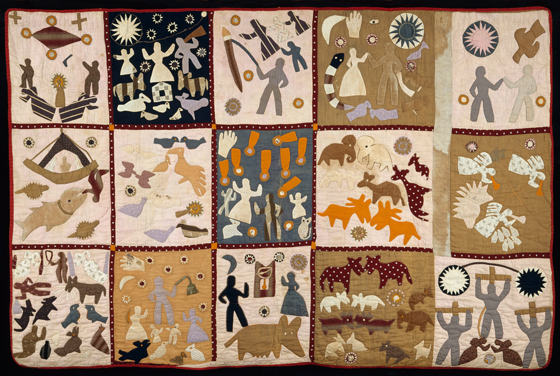
Story quilt created in 1898 by African American quilter Harriet Powers
Story quilt created in 1898 by African American quilter Harriet Powers
Harriet Powers (1837–1910) never learned to read or write, yet her story quilts left a significant record of life and events in the American south of the 19th Century.
{"id":12904,"date":"2013-11-10T03:00:40","date_gmt":"2013-11-10T11:00:40","guid":{"rendered":"http:\/\/ohisee.genweb.site\/blog\/?p=12904"},"modified":"2021-07-20T07:49:48","modified_gmt":"2021-07-20T14:49:48","slug":"culture-smart-sew-me-a-story","status":"publish","type":"post","link":"https:\/\/www.oh-i-see.com\/blog\/culture-smart-sew-me-a-story\/","title":{"rendered":"Culture Smart:
Story quilt created in 1898 by African American quilter Harriet Powers<\/p><\/div>\n
Harriet Powers (1837–1910) never learned to read or write, yet her story quilts left a significant record of life and events in the American south of the 19th Century.<\/p>\n
Powers was born into slavery and lived her entire life near Athens, Georgia. Though only two of her quilts survive today, she is widely praised for translating oral tradition into tangible art. She was inducted into\u00a0Georgia Women of Achievement<\/a> in 2009.<\/p>\n Powers’ quilts, stitched by hand and machine, are immediately recognizable for their bold use of appliqued designs. In the quilt above, each of the 15 panels tells a story from the Bible or documents a natural event. For example:<\/p>\n The technique of using strong lines to divide a textile into panels and the use of appliqu\u00e9s to tell stories are also prominent features of artistic traditions in West Africa. Powers’s creations reflect the influence of her African heritage.<\/p>\n At the same time, quilting as an activity and her European-style stitching, were obvious reflections of the time and place into which she was born.<\/p>\n Harriet Powers created her remarkable quilts in Georgia’s back country. The two that remain have now found their way to prestigious museums that honor her contributions to American art.<\/p>\n To read Powers’ descriptions of all 15 panels in the quilt pictured above, visit the Museum of Fine Arts, Boston<\/a> website. To view her other surviving quilt, visit the Smithsonian Institution’s National Museum of American History<\/a> website.<\/em><\/p>\n Learn more about the Georgia Women of Achievement<\/a>.<\/em><\/p>\n Comment<\/a>\u00a0on this post below, or inspire insight with your own\u00a0OIC Moment\u00a0<\/em>here<\/em><\/a>.<\/em><\/p>","protected":false},"excerpt":{"rendered":null,"protected":false},"author":4,"featured_media":12971,"comment_status":"closed","ping_status":"open","sticky":false,"template":"","format":"standard","meta":{"footnotes":""},"categories":[99,128,126,199],"tags":[],"class_list":["post-12904","post","type-post","status-publish","format-standard","has-post-thumbnail","hentry","category-heritage-culture","category-literature-creative","category-art-creative","category-usa-mappoints"],"aioseo_notices":[],"_links":{"self":[{"href":"https:\/\/www.oh-i-see.com\/blog\/wp-json\/wp\/v2\/posts\/12904","targetHints":{"allow":["GET"]}}],"collection":[{"href":"https:\/\/www.oh-i-see.com\/blog\/wp-json\/wp\/v2\/posts"}],"about":[{"href":"https:\/\/www.oh-i-see.com\/blog\/wp-json\/wp\/v2\/types\/post"}],"author":[{"embeddable":true,"href":"https:\/\/www.oh-i-see.com\/blog\/wp-json\/wp\/v2\/users\/4"}],"replies":[{"embeddable":true,"href":"https:\/\/www.oh-i-see.com\/blog\/wp-json\/wp\/v2\/comments?post=12904"}],"version-history":[{"count":1,"href":"https:\/\/www.oh-i-see.com\/blog\/wp-json\/wp\/v2\/posts\/12904\/revisions"}],"predecessor-version":[{"id":40653,"href":"https:\/\/www.oh-i-see.com\/blog\/wp-json\/wp\/v2\/posts\/12904\/revisions\/40653"}],"wp:featuredmedia":[{"embeddable":true,"href":"https:\/\/www.oh-i-see.com\/blog\/wp-json\/wp\/v2\/media\/12971"}],"wp:attachment":[{"href":"https:\/\/www.oh-i-see.com\/blog\/wp-json\/wp\/v2\/media?parent=12904"}],"wp:term":[{"taxonomy":"category","embeddable":true,"href":"https:\/\/www.oh-i-see.com\/blog\/wp-json\/wp\/v2\/categories?post=12904"},{"taxonomy":"post_tag","embeddable":true,"href":"https:\/\/www.oh-i-see.com\/blog\/wp-json\/wp\/v2\/tags?post=12904"}],"curies":[{"name":"wp","href":"https:\/\/api.w.org\/{rel}","templated":true}]}}\n
\n
\n
\n
\n